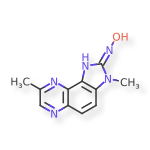
Details
| Stereochemistry | ACHIRAL |
| Molecular Formula | C11H11N5 |
| Molecular Weight | 213.2385 |
| Optical Activity | NONE |
| Defined Stereocenters | 0 / 0 |
| E/Z Centers | 0 |
| Charge | 0 |
SHOW SMILES / InChI
SMILES
CN1C(N)=NC2=C1C=CC3=C2N=C(C)C=N3
InChI
InChIKey=DVCCCQNKIYNAKB-UHFFFAOYSA-N
InChI=1S/C11H11N5/c1-6-5-13-7-3-4-8-10(9(7)14-6)15-11(12)16(8)2/h3-5H,1-2H3,(H2,12,15)
| Molecular Formula | C11H11N5 |
| Molecular Weight | 213.2385 |
| Charge | 0 |
| Count |
|
| Stereochemistry | ACHIRAL |
| Additional Stereochemistry | No |
| Defined Stereocenters | 0 / 0 |
| E/Z Centers | 0 |
| Optical Activity | NONE |
Approval Year
PubMed
| Title | Date | PubMed |
|---|---|---|
| Heterocyclic amines in griddled beef steak analysed using a single extract clean-up procedure. | 2007-04 |
|
| Enhancement of phase II enzyme activity by purpurin resulting in the suppression of MeIQx-DNA-adduct formation in mice. | 2007-01-10 |
|
| Effects of single nucleotide polymorphisms in human N-acetyltransferase 2 on metabolic activation (O-acetylation) of heterocyclic amine carcinogens. | 2006-09-01 |
|
| Differential effects of heterocyclic amines on poly(ADP-ribose) polymerase-1 and mono-ADP-ribosyltransferase A. | 2006-09 |
|
| Chemical synthesis of 2'-deoxyguanosine-C8 adducts with heterocyclic amines: an application to synthesis of oligonucleotides site-specifically adducted with 2-amino-1-methyl-6-phenylimidazo[4,5-b]pyridine. | 2006-06 |
|
| Meat mutagens and risk of distal colon adenoma in a cohort of U.S. men. | 2006-06 |
|
| Existence of a no effect level for MeIQx hepatocarcinogenicity on a background of thioacetamide-induced liver damage in rats. | 2006-06 |
|
| N-acetylcysteine and S-methylcysteine inhibit MeIQx rat hepatocarcinogenesis in the post-initiation stage. | 2006-05 |
|
| Influence of lignification and feruloylation of maize cell walls on the adsorption of heterocyclic aromatic amines. | 2006-03-08 |
|
| Lack of modification of 2-amino-3,8-dimethylimidazo[4,5-f]quinoxaline (MeIQx) rat hepatocarcinogenesis by caffeine, a CYP1A2 inducer, points to complex counteracting influences. | 2006-02-08 |
|
| Stability and reactivity of 2-nitrosoamino-3,8-dimethylimidazo[4,5-f]quinoxaline. | 2006-02 |
|
| Existence of no-observed effect levels for 2-amino-3,8-dimethylimidazo[4,5-f]quinoxaline on hepatic preneoplastic lesion development in BN rats. | 2006-01-18 |
|
| Existence of no hepatocarcinogenic effect levels of 2-amino-3,8-dimethylimidazo[4,5-f]quinoxaline with or without coadministration with ethanol. | 2006 |
|
| A prospective study of meat and meat mutagens and prostate cancer risk. | 2005-12-15 |
|
| Dose-dependence of promotion of 2-amino-3,8-dimethylimidazo[4,5-f]quinoxaline-induced rat hepatocarcinogenesis by ethanol: evidence for a threshold. | 2005-11 |
|
| Investigation of the separation of heterocyclic aromatic amines by reversed phase ion-pair liquid chromatography coupled with tandem mass spectrometry: the role of ion pair reagents on LC-MS/MS sensitivity. | 2005-10-25 |
|
| PhIP carcinogenicity in breast cancer: computational and experimental evidence for competitive interactions with human estrogen receptor. | 2005-10 |
|
| Meat, meat cooking methods and preservation, and risk for colorectal adenoma. | 2005-09-01 |
|
| Suppression of glutathione S-transferase placental form-positive foci development in rat hepatocarcinogenesis by Chlorella pyrenoidosa. | 2005-08 |
|
| Nitric oxide-mediated nitrosation of 2-amino-3,8-dimethylimidazo[4,5-f]quinoxaline potentiated by hemin and myeloperoxidase. | 2005-06 |
|
| Quantitation of carcinogenic heterocyclic aromatic amines and detection of novel heterocyclic aromatic amines in cooked meats and grill scrapings by HPLC/ESI-MS. | 2005-04-20 |
|
| Induction of colon tumors in C57BL/6J mice fed MeIQx, IQ, or PhIP followed by dextran sulfate sodium treatment. | 2005-04 |
|
| Formation of a mutagenic heterocyclic aromatic amine from creatinine in urine of meat eaters and vegetarians. | 2005-03 |
|
| Meat intake, cooking-related mutagens and risk of colorectal adenoma in a sigmoidoscopy-based case-control study. | 2005-03 |
|
| Inhibitory effects of heterocyclic amine-induced DNA adduct formation in mouse liver and lungs by beer. | 2005-02-09 |
|
| A comparison of genotoxicity between three common heterocyclic amines and acrylamide. | 2005-02-07 |
|
| Gene expression profiling of chemically induced rat mammary gland cancer. | 2005-02 |
|
| Colonic adenocarcinomas rapidly induced by the combined treatment with 2-amino-1-methyl-6-phenylimidazo[4,5-b]pyridine and dextran sodium sulfate in male ICR mice possess beta-catenin gene mutations and increases immunoreactivity for beta-catenin, cyclooxygenase-2 and inducible nitric oxide synthase. | 2005-01 |
|
| Global gene expression profiling of chemically induced rat mammary gland carcinomas and adenomas. | 2005 |
|
| Dietary exposure to heterocyclic amines in a Chinese population. | 2005 |
|
| Heterocyclic amines and genotype of N-acetyltransferases as risk factors for prostate cancer. | 2005 |
|
| Addition of various carbohydrates to beef burgers affects the formation of heterocyclic amines during frying. | 2004-12-15 |
|
| Lactoperoxidase-catalyzed activation of carcinogenic aromatic and heterocyclic amines. | 2004-12 |
|
| Induction of DNA-adducts and increase of 8-hydroxy-2-deoxyguanosine, but no development of preneoplastic lesions in offspring liver with transplacental and trans-breast milk exposure to 2-amino-3,8-dimethylimidazo [4,5-f ]quinoxaline (MeIQx) in rats. | 2004-12 |
|
| The cooked food derived carcinogen 2-amino-1-methyl-6-phenylimidazo[4,5-b] pyridine is a potent oestrogen: a mechanistic basis for its tissue-specific carcinogenicity. | 2004-12 |
|
| Effect of the South African traditional meat, biltong, on cancer-associated enzymes CYP2E1 and CYP1A2. | 2004-11 |
|
| No-observed effect levels for carcinogenicity and for in vivo mutagenicity of a genotoxic carcinogen. | 2004-10 |
|
| Embryonic turkey liver: activities of biotransformation enzymes and activation of DNA-reactive carcinogens. | 2004-10 |
|
| Heterocyclic amines in some Swedish cooked foods industrially prepared or from fast food outlets and restaurants. | 2004-09 |
|
| Rapid biomonitoring of heterocyclic aromatic amines in human urine by tandem solvent solid phase extraction liquid chromatography electrospray ionization mass spectrometry. | 2004-08 |
|
| Randomized controlled trial of dietary intervention: association between level of urinary phenolics and anti-mutagenicity. | 2004-07-11 |
|
| Modulation of cytochrome P450 1A1 by food-derived heterocyclic aromatic amines. | 2004-07-01 |
|
| Disruption of beta-catenin pathway or genomic instability define two distinct categories of liver cancer in transgenic mice. | 2004-05 |
|
| Inhibitory effects of beer on heterocyclic amine-induced mutagenesis and PhIP-induced aberrant crypt foci in rat colon. | 2004-04-11 |
|
| Phytoalexin resveratrol attenuates the mutagenicity of the heterocyclic amines 2-amino-1-methyl-6-phenylimidazo[4,5-b]pyridine and 2-amino-3,8-dimethylimidazo[4,5-f]quinoxaline. | 2004-03-25 |
|
| Determination of heterocyclic aromatic amines (HAs) content in samples of household-prepared meat dishes. | 2004-03-25 |
|
| Rapid analysis of gene expression changes caused by liver carcinogens and chemopreventive agents using a newly developed three-dimensional microarray system. | 2004-02 |
|
| Cytochrome P450 1A2 (CYP1A2) activity, mammographic density, and oxidative stress: a cross-sectional study. | 2004 |
|
| Post-initiation inhibition of MeIQx hepatocarcinogenesis in rats by cysteine. | 2003-06 |
|
| Inhibition of mutagenicity of food-derived heterocyclic amines by sulforaphane--a constituent of broccoli. | 2003-03 |
| Substance Class |
Chemical
Created
by
admin
on
Edited
Mon Mar 31 18:48:01 GMT 2025
by
admin
on
Mon Mar 31 18:48:01 GMT 2025
|
| Record UNII |
5GYH6416ZG
|
| Record Status |
Validated (UNII)
|
| Record Version |
|
-
Download
| Name | Type | Language | ||
|---|---|---|---|---|
|
Preferred Name | English | ||
|
Common Name | English | ||
|
Systematic Name | English | ||
|
Systematic Name | English | ||
|
Common Name | English | ||
|
Common Name | English |
| Code System | Code | Type | Description | ||
|---|---|---|---|---|---|
|
DTXSID1020801
Created by
admin on Mon Mar 31 18:48:01 GMT 2025 , Edited by admin on Mon Mar 31 18:48:01 GMT 2025
|
PRIMARY | |||
|
5GYH6416ZG
Created by
admin on Mon Mar 31 18:48:01 GMT 2025 , Edited by admin on Mon Mar 31 18:48:01 GMT 2025
|
PRIMARY | |||
|
62275
Created by
admin on Mon Mar 31 18:48:01 GMT 2025 , Edited by admin on Mon Mar 31 18:48:01 GMT 2025
|
PRIMARY | |||
|
77500-04-0
Created by
admin on Mon Mar 31 18:48:01 GMT 2025 , Edited by admin on Mon Mar 31 18:48:01 GMT 2025
|
PRIMARY | |||
|
C44308
Created by
admin on Mon Mar 31 18:48:01 GMT 2025 , Edited by admin on Mon Mar 31 18:48:01 GMT 2025
|
PRIMARY | |||
|
7767
Created by
admin on Mon Mar 31 18:48:01 GMT 2025 , Edited by admin on Mon Mar 31 18:48:01 GMT 2025
|
PRIMARY |
| Related Record | Type | Details | ||
|---|---|---|---|---|
|
DERIVATIVE -> PARENT | |||
|
PARENT -> CONSTITUENT ALWAYS PRESENT |
Heterocyclic amine skin content in cooked food sample. 860?44 pg/g sample.
Heterocyclic amine flesh content in cooked food sample. 152 pg/g sample.
|
||
|
PARENT -> CONSTITUENT ALWAYS PRESENT |
Heterocyclic amine skin content in cooked food sample. 588?70 pg/g sample.
|
||
|
PARENT -> CONSTITUENT ALWAYS PRESENT |
Heterocyclic amine in well cooked meat sample. 198?71 pg/g sample.
Heterocyclic amine in medium cooked meat sample. 138?67 pg/g sample.
|
||
|
CONSTITUENT ALWAYS PRESENT -> PARENT |
Heterocyclic amine skin content in cooked food sample. 593?59 pg/g sample.
Heterocyclic amine flesh content in cooked food sample. 99 pg/g sample.
|
||
|
PARENT -> CONSTITUENT ALWAYS PRESENT |
Heterocyclic amine in cooked meat sample. 77?10 pg/g sample.
|
||
|
PARENT -> CONSTITUENT ALWAYS PRESENT |
Heterocyclic amine in cooked meat sample. 202?12 pg/g sample.
|
||
|
PARENT -> CONSTITUENT ALWAYS PRESENT |
Semi-Dried(Aji-Hiraki) JAPANESE HORSE MACKEREL SKIN, COOKED
Heterocyclic amine skin content in cooked food sample. 420?29 pg/g sample.
|
||
|
PARENT -> CONSTITUENT ALWAYS PRESENT |
Heterocyclic amine content in cooked food sample. 492?87 pg/g sample.
|
||
|
PARENT -> CONSTITUENT ALWAYS PRESENT |
Heterocyclic amine skin content in cooked food sample. 385?34 pg/g sample.
Heterocyclic amine flesh content in cooked food sample. 25 pg/g sample.
|