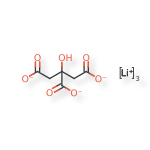
Details
| Stereochemistry | ACHIRAL |
| Molecular Formula | C6H5O7.3Li |
| Molecular Weight | 209.923 |
| Optical Activity | NONE |
| Defined Stereocenters | 0 / 0 |
| E/Z Centers | 0 |
| Charge | 0 |
SHOW SMILES / InChI
SMILES
[Li+].[Li+].[Li+].OC(CC([O-])=O)(CC([O-])=O)C([O-])=O
InChI
InChIKey=WJSIUCDMWSDDCE-UHFFFAOYSA-K
InChI=1S/C6H8O7.3Li/c7-3(8)1-6(13,5(11)12)2-4(9)10;;;/h13H,1-2H2,(H,7,8)(H,9,10)(H,11,12);;;/q;3*+1/p-3
DescriptionSources: https://www.ncbi.nlm.nih.gov/pubmed/12459525 | http://www.isaltis.com/en/module/99999689/28/lithium_gluconate | https://www.ncbi.nlm.nih.gov/pubmed/18330588https://www.accessdata.fda.gov/drugsatfda_docs/label/2011/017812s028,018421s027lbl.pdfCurator's Comment: Description was created based on several sources, including https://www.ncbi.nlm.nih.gov/pubmed/19538681 | https://www.ncbi.nlm.nih.gov/pubmed/23371914 | http://www.rsc.org/periodic-table/element/3/lithium
Sources: https://www.ncbi.nlm.nih.gov/pubmed/12459525 | http://www.isaltis.com/en/module/99999689/28/lithium_gluconate | https://www.ncbi.nlm.nih.gov/pubmed/18330588https://www.accessdata.fda.gov/drugsatfda_docs/label/2011/017812s028,018421s027lbl.pdf
Curator's Comment: Description was created based on several sources, including https://www.ncbi.nlm.nih.gov/pubmed/19538681 | https://www.ncbi.nlm.nih.gov/pubmed/23371914 | http://www.rsc.org/periodic-table/element/3/lithium
Lithium is an alkali metal widely used in industry. Lithium salts are indicated in the treatment of manic episodes of Bipolar Disorder. The use of lithium in psychiatry goes back to the mid-19th century. Early work, however, was soon forgotten, and John Cade is credited with reintroducing lithium to psychiatry for mania in 1949. Mogens Schou undertook a randomly controlled trial for mania in 1954, and in the course of that study became curious about lithium as a prophylactic for depressive illness. In 1970, the United States became the 50th country to admit lithium to the marketplace. The specific mechanisms by which lithium exerts its mood-stabilizing effects are not well understood. Lithium appears to preserve or increase the volume of brain structures involved in emotional regulation such as the prefrontal cortex, hippocampus and amygdala, possibly reflecting its neuroprotective effects. At a neuronal level, lithium reduces excitatory (dopamine and glutamate) but increases inhibitory (GABA) neurotransmission; however, these broad effects are underpinned by complex neurotransmitter systems that strive to achieve homeostasis by way of compensatory changes. For example, at an intracellular and molecular level, lithium targets second-messenger systems that further modulate neurotransmission. For instance, the effects of lithium on the adenyl cyclase and phospho-inositide pathways, as well as protein kinase C, may serve to dampen excessive excitatory neurotransmission. In addition to these many putative mechanisms, it has also been proposed that the neuroprotective effects of lithium are key to its therapeutic actions. In this regard, lithium has been shown to reduce the oxidative stress that occurs with multiple episodes of mania and depression. Further, it increases protective proteins such as brain-derived neurotrophic factor and B-cell lymphoma 2, and reduces apoptotic processes through inhibition of glycogen synthase kinase 3 and autophagy.
Originator
Curator's Comment: The first lithium mineral petalite, LiAlSi4O10, was discovered on the Swedish island of Utö by the Brazilian, Jozé Bonifácio de Andralda e Silva in the 1790s. It was observed to give an intense crimson flame when thrown onto a fire. In 1817, Johan August Arfvedson of Stockholm analysed it and deduced it contained a previously unknown metal, which he called lithium. He realised this was a new alkali metal and a lighter version of sodium. However, unlike sodium he was not able to separate it by electrolysis. In 1821 William Brande obtained a tiny amount this way but not enough on which to make measurements. It was not until 1855 that the German chemist Robert Bunsen and the British chemist Augustus Matthiessen obtained it in bulk by the electrolysis of molten lithium chloride.
Approval Year
Targets
| Primary Target | Pharmacology | Condition | Potency |
|---|---|---|---|
Target ID: CHEMBL262 |
6.53 µM [IC50] | ||
Target ID: CHEMBL262 |
2.0 mM [Ki] | ||
Target ID: O95861 Gene ID: 10380.0 Gene Symbol: BPNT1 Target Organism: Homo sapiens (Human) |
0.3 mM [IC50] | ||
Target ID: GO:0038179 |
Conditions
| Condition | Modality | Targets | Highest Phase | Product |
|---|---|---|---|---|
| Primary | LITHIUM CARBONATE Approved UseLithium is indicated in the treatment of manic episodes of Bipolar Disorder. Launch Date1965 |
PubMed
| Title | Date | PubMed |
|---|---|---|
| Hexavalent chromium affects sperm motility by influencing protein tyrosine phosphorylation in the midpiece of boar spermatozoa. | 2016-01 |
|
| Evaluation of aggregating brain cell cultures for the detection of acute organ-specific toxicity. | 2013-06 |
|
| Chemicals inducing acute irritant contact dermatitis mobilize intracellular calcium in human keratinocytes. | 2013-02 |
|
| High sensitivity of RBL-2H3 cells to cadmium and manganese: an implication of the role of ZIP8. | 2011-07 |
|
| Iatrogenic Flecainide toxicity. | 2010-12 |
|
| Hyper-alkalinization without hyper-hydration for the prevention of high-dose methotrexate acute nephrotoxicity in patients with osteosarcoma. | 2010-11 |
|
| Acute propafenone toxicity after two exposures at standard dosing. | 2010-06-16 |
|
| Randomized controlled trial: lisinopril reduces proteinuria, ammonia, and renal polypeptide tubular catabolism in patients with chronic allograft nephropathy. | 2010-01-15 |
|
| Mass casualties from acute inhalation of chlorine gas. | 2009-12 |
|
| Sodium bicarbonate versus normal saline for protection against contrast nephropathy. | 2009 |
|
| Contrast medium-induced nephropathy: strategies for prevention. | 2008-09 |
|
| G418-mediated ribosomal read-through of a nonsense mutation causing autosomal recessive proximal renal tubular acidosis. | 2008-09 |
|
| Comparison of usefulness of sodium bicarbonate versus sodium chloride to prevent contrast-induced nephropathy in patients undergoing an emergent coronary procedure. | 2007-09-01 |
|
| Acute renal failure due to phenazopyridine (Pyridium) overdose: case report and review of the literature. | 2006-11 |
|
| Deregulation of the p16-cyclin D1/cyclin-dependent kinase 4-retinoblastoma pathway involved in the rat bladder carcinogenesis induced by terephthalic acid-calculi. | 2006-10 |
|
| Early bicarbonate loading and dantroline for ziprasidone/haloperidol-induced neuroleptic malignant syndrome. | 2006-04 |
|
| Nalidixic acid overdose and metabolic acidosis. | 2006-03 |
|
| Alkaline induces metallothionein gene expression and potentiates cell proliferation in Chinese hamster ovary cells. | 2005-12 |
|
| Quinidine cardiotoxicity. | 2005-05 |
|
| Reversal of citalopram-induced junctional bradycardia with intravenous sodium bicarbonate. | 2005-01 |
|
| Fanconi syndrome caused by antiepileptic therapy with valproic Acid. | 2004-07 |
|
| Prevention of contrast-induced nephropathy with sodium bicarbonate: a randomized controlled trial. | 2004-05-19 |
|
| The prevention of pain from injection of rocuronium by magnesium sulphate, lignocaine, sodium bicarbonate and alfentanil. | 2003-06 |
|
| Physostigmine, sodium bicarbonate, or hypertonic saline to treat diphenhydramine toxicity. | 2002-02 |
|
| Ménière's disease in childhood. | 2001-12-01 |
|
| Aborted sudden death, transient Brugada pattern, and wide QRS dysrrhythmias after massive cocaine ingestion. | 2001-10 |
|
| Oral sodium bicarbonate reduces proximal renal tubular peptide catabolism, ammoniogenesis, and tubular damage in renal patients. | 1998-03 |
|
| Pathophysiology and treatment of cocaine toxicity: implications for the heart and cardiovascular system. | 1996-12 |
|
| Metabolic alkalosis and myoclonus from antacid ingestion. | 1996-06 |
|
| Effect of calcium chloride and 4-aminopyridine therapy on desipramine toxicity in rats. | 1996 |
|
| Reduction of desipramine cardiotoxicity and prolongation of survival in rats with the use of polyclonal drug-specific antibody Fab fragments. | 1995-09 |
|
| Reversal of flecainide-induced ventricular arrhythmia by hypertonic sodium bicarbonate in dogs. | 1995-05 |
|
| Neutralizing pH of lidocaine reduces pain during Norplant system insertion procedure. | 1995-05 |
|
| Effects of magnesium sulfate and lidocaine in the treatment of ventricular arrhythmias in experimental amitriptyline poisoning in the rat. | 1994-03 |
|
| Alkalinization of local anesthesia with sodium bicarbonate--preferred method of local anesthesia. | 1994-01 |
|
| Sodium bicarbonate alleviates penile pain induced by intracavernous injections for erectile dysfunction. | 1993-05 |
|
| Reversal of desipramine toxicity in rats using drug-specific antibody Fab' fragment: effects on hypotension and interaction with sodium bicarbonate. | 1992-03 |
|
| Summation effects of uracil and other promoters on epithelial lesion development in the F344 rat urinary bladder initiated by N-butyl-N-(4-hydroxybutyl)nitrosamine. | 1991-11 |
|
| The effect of pH buffering on reducing the pain associated with subcutaneous infiltration of bupivicaine. | 1991-03 |
|
| Incidence of hypotension associated with epidural anesthesia using alkalinized and nonalkalinized lidocaine for cesarean section. | 1987-11 |
|
| Experimental amitriptyline intoxication: treatment of cardiac toxicity with sodium bicarbonate. | 1986-09 |
|
| Urothelial injury to the rabbit bladder from various alkaline and acidic solutions used to dissolve kidney stones. | 1986-07 |
|
| Treatment of ventricular tachyarrhythmias resulting from amitriptyline toxicity in dogs. | 1984-11 |
|
| Experimental amitriptyline intoxication: electrophysiologic manifestations and management. | 1984-01-01 |
|
| Calcification of superficial scalp veins secondary to intravenous infusion of sodium bicarbonate and calcium chloride. | 1983-07 |
|
| Bupivacaine cardiotoxicity in a pregnant patient with mitral valve prolapse. | 1983-06 |
|
| [Effect of antacids on mineral metabolism]. | 1983-03 |
|
| Organophosphate poisoning: modifications in acid base equilibrium and use of sodium bicarbonate as an aid in the treatment of toxicity in dogs. | 1983-02 |
|
| Obsolete but dangerous antacid preparations. | 1978-01 |
|
| Sodium bicarbonate and systemic hemodynamics in volunteers anesthetized with halothane. | 1975-05 |
Patents
Sample Use Guides
Optimal patient response to Lithium Carbonate usually can be established and maintained with 600 mg t.i.d. Optimal patient response to Lithium Oral Solution usually can be established and maintained with 10 mL (2 full teaspoons) (16 mEq of lithium) t.i.d. Such doses will normally produce an effective serum lithium level ranging between 1.0 and 1.5 mEq/l. Dosage must be individualized according to serum levels and clinical response. Regular monitoring of the patient’s clinical state and of serum lithium levels is necessary. Serum levels should be determined twice per week during the acute phase, and until the serum level and clinical condition of the patient have been stabilized.
Route of Administration:
Oral
| Name | Type | Language | ||
|---|---|---|---|---|
|
Common Name | English | ||
|
Preferred Name | English | ||
|
Common Name | English | ||
|
Common Name | English |
| Code System | Code | Type | Description | ||
|---|---|---|---|---|---|
|
3655633623
Created by
admin on Mon Mar 31 20:56:58 GMT 2025 , Edited by admin on Mon Mar 31 20:56:58 GMT 2025
|
PRIMARY | |||
|
919-16-4
Created by
admin on Mon Mar 31 20:56:58 GMT 2025 , Edited by admin on Mon Mar 31 20:56:58 GMT 2025
|
PRIMARY | |||
|
DTXSID70883185
Created by
admin on Mon Mar 31 20:56:58 GMT 2025 , Edited by admin on Mon Mar 31 20:56:58 GMT 2025
|
PRIMARY | |||
|
213-045-8
Created by
admin on Mon Mar 31 20:56:58 GMT 2025 , Edited by admin on Mon Mar 31 20:56:58 GMT 2025
|
PRIMARY | |||
|
m6856
Created by
admin on Mon Mar 31 20:56:58 GMT 2025 , Edited by admin on Mon Mar 31 20:56:58 GMT 2025
|
PRIMARY | Merck Index | ||
|
Lithium citrate
Created by
admin on Mon Mar 31 20:56:58 GMT 2025 , Edited by admin on Mon Mar 31 20:56:58 GMT 2025
|
PRIMARY | |||
|
13520
Created by
admin on Mon Mar 31 20:56:58 GMT 2025 , Edited by admin on Mon Mar 31 20:56:58 GMT 2025
|
PRIMARY | |||
|
100000181637
Created by
admin on Mon Mar 31 20:56:58 GMT 2025 , Edited by admin on Mon Mar 31 20:56:58 GMT 2025
|
PRIMARY |
ACTIVE MOIETY
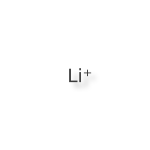
PARENT (SALT/SOLVATE)
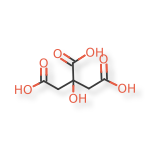
SUBSTANCE RECORD