


Details
| Stereochemistry | ACHIRAL |
| Molecular Formula | C7H7N4O2.C6H11O7.Ca |
| Molecular Weight | 414.381 |
| Optical Activity | UNSPECIFIED |
| Defined Stereocenters | 4 / 4 |
| E/Z Centers | 0 |
| Charge | 0 |
SHOW SMILES / InChI
SMILES
[Ca++].CN1C=NC2=C1C(=O)[N-]C(=O)N2C.OC[C@@H](O)[C@@H](O)[C@H](O)[C@@H](O)C([O-])=O
InChI
InChIKey=YUMGBTPDXDOEGH-PVBYDLIKSA-L
InChI=1S/C7H8N4O2.C6H12O7.Ca/c1-10-3-8-5-4(10)6(12)9-7(13)11(5)2;7-1-2(8)3(9)4(10)5(11)6(12)13;/h3H,1-2H3,(H,9,12,13);2-5,7-11H,1H2,(H,12,13);/q;;+2/p-2/t;2-,3-,4+,5-;/m.1./s1
| Molecular Formula | Ca |
| Molecular Weight | 40.078 |
| Charge | 2 |
| Count |
|
| Stereochemistry | ACHIRAL |
| Additional Stereochemistry | No |
| Defined Stereocenters | 0 / 0 |
| E/Z Centers | 0 |
| Optical Activity | NONE |
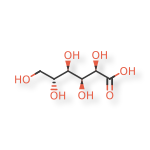
| Molecular Formula | C6H10O7 |
| Molecular Weight | 194.1394 |
| Charge | -2 |
| Count |
|
| Stereochemistry | ABSOLUTE |
| Additional Stereochemistry | No |
| Defined Stereocenters | 4 / 4 |
| E/Z Centers | 0 |
| Optical Activity | UNSPECIFIED |
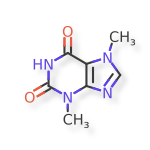
| Molecular Formula | C7H8N4O2 |
| Molecular Weight | 180.164 |
| Charge | 0 |
| Count |
|
| Stereochemistry | ACHIRAL |
| Additional Stereochemistry | No |
| Defined Stereocenters | 0 / 0 |
| E/Z Centers | 0 |
| Optical Activity | NONE |
Theobromine is the primary alkaloid present in the cocoa and chocolate. Theobromine is found in the shells and beans of the cacao plant and it is extracted from the husks of the bean and used for the synthesis of caffeine. Theobromine is an adenosine A1 and A2a receptor antagonist. Thesodate is used as a vasodilator, a diuretic, and heart stimulant. And similar to caffeine, it may be useful in management of fatigue and orthostatic hypotension. The symptomatic adverse reactions produced by theobromine are more or less tolerable and if they become severe, they can be treated symptomatically, these include anxiety, restlessness, tremors, sleeplessness, nausea and vomiting, loss of appetite. Theobromine is currently not in use as a medicinal drug.
CNS Activity
Originator
Approval Year
Targets
| Primary Target | Pharmacology | Condition | Potency |
|---|---|---|---|
Target ID: P30543 Gene ID: 25369.0 Gene Symbol: Adora2a Target Organism: Rattus norvegicus (Rat) |
250.0 µM [IC50] | ||
Target ID: CHEMBL318 |
120.0 µM [Ki] | ||
Target ID: P05177 Gene ID: 1544.0 Gene Symbol: CYP1A2 Target Organism: Homo sapiens (Human) |
|||
Target ID: P05181 Gene ID: 1571.0 Gene Symbol: CYP2E1 Target Organism: Homo sapiens (Human) |
Conditions
| Condition | Modality | Targets | Highest Phase | Product |
|---|---|---|---|---|
| Primary | Thesodate Approved UseTheobromine was used as a diuretic and in the treatment of angina pectoris and hypertension. |
|||
| Palliative | Unknown Approved UseUnknown |
|||
| Primary | Thesodate Approved UseTheobromine used as a diuretic and in the treatment of angina pectoris and hypertension |
Cmax
| Value | Dose | Co-administered | Analyte | Population |
|---|---|---|---|---|
8.38 μg/mL EXPERIMENT https://www.ncbi.nlm.nih.gov/pubmed/27662634 |
4 mg/kg bw single, intravenous dose: 4 mg/kg bw route of administration: Intravenous experiment type: SINGLE co-administered: |
THEOBROMINE plasma | Equus caballus population: HEALTHY age: ADULT sex: UNKNOWN food status: UNKNOWN |
AUC
| Value | Dose | Co-administered | Analyte | Population |
|---|---|---|---|---|
92 μg × h/mL EXPERIMENT https://www.ncbi.nlm.nih.gov/pubmed/27662634 |
4 mg/kg bw single, intravenous dose: 4 mg/kg bw route of administration: Intravenous experiment type: SINGLE co-administered: |
THEOBROMINE plasma | Equus caballus population: HEALTHY age: ADULT sex: UNKNOWN food status: UNKNOWN |
|
13351 mg × min/L EXPERIMENT https://www.ncbi.nlm.nih.gov/pubmed/6729831 |
50 mg/kg bw single, oral dose: 50 mg/kg bw route of administration: Oral experiment type: SINGLE co-administered: |
THEOBROMINE plasma | Rattus norvegicus population: HEALTHY age: ADULT sex: MALE food status: FASTED |
T1/2
| Value | Dose | Co-administered | Analyte | Population |
|---|---|---|---|---|
15.7 h EXPERIMENT https://www.ncbi.nlm.nih.gov/pubmed/27662634 |
4 mg/kg bw single, intravenous dose: 4 mg/kg bw route of administration: Intravenous experiment type: SINGLE co-administered: |
THEOBROMINE plasma | Equus caballus population: HEALTHY age: ADULT sex: UNKNOWN food status: UNKNOWN |
|
4.23 h EXPERIMENT https://www.ncbi.nlm.nih.gov/pubmed/6729831 |
50 mg/kg bw single, oral dose: 50 mg/kg bw route of administration: Oral experiment type: SINGLE co-administered: |
THEOBROMINE plasma | Rattus norvegicus population: HEALTHY age: ADULT sex: MALE food status: FASTED |
Funbound
| Value | Dose | Co-administered | Analyte | Population |
|---|---|---|---|---|
88% EXPERIMENT https://www.ncbi.nlm.nih.gov/pubmed/6729831 |
50 mg/kg bw single, oral dose: 50 mg/kg bw route of administration: Oral experiment type: SINGLE co-administered: |
THEOBROMINE plasma | Rattus norvegicus population: HEALTHY age: ADULT sex: MALE food status: FASTED |
PubMed
| Title | Date | PubMed |
|---|---|---|
| Adenosinergic protection of dopaminergic and GABAergic neurons against mitochondrial inhibition through receptors located in the substantia nigra and striatum, respectively. | 2003-11-26 |
|
| Inhibition of caffeine biosynthesis in tea (Camellia sinensis) and coffee (Coffea arabica) plants by ribavirin. | 2003-11-20 |
|
| Adenosine kinase inhibitors. 3. Synthesis, SAR, and antiinflammatory activity of a series of l-lyxofuranosyl nucleosides. | 2003-10-23 |
|
| Study on inclusion complex of cyclodextrin with methyl xanthine derivatives by fluorimetry. | 2003-10 |
|
| Purine alkaloids in Paullinia. | 2003-10 |
|
| Antioxidant and prooxidant properties of caffeine, theobromine and xanthine. | 2003-09 |
|
| Polydeoxyribonucleotide (PDRN) promotes human osteoblast proliferation: a new proposal for bone tissue repair. | 2003-08-29 |
|
| Producing decaffeinated coffee plants. | 2003-06-19 |
|
| Antinociceptive mechanisms of orally administered decursinol in the mouse. | 2003-06-13 |
|
| Intraspinal adenosine induces spinal cord norepinephrine release in spinal nerve-ligated rats but not in normal or sham controls. | 2003-06 |
|
| Molecular cloning and functional characterization of three distinct N-methyltransferases involved in the caffeine biosynthetic pathway in coffee plants. | 2003-05 |
|
| Study on the paper substrate room temperature phosphorescence of theobromine, caffeine and theophylline and analytical application. | 2003-05 |
|
| Adenosine A1 receptor activation reduces myocardial reperfusion effects on intrinsic cardiac nervous system. | 2003-05 |
|
| Effect of naturally occurring plant phenolics on the induction of drug metabolizing enzymes by o-toluidine. | 2003-04-15 |
|
| RNA binding efficacy of theophylline, theobromine and caffeine. | 2003-04 |
|
| De-intercalation of ethidium bromide and acridine orange by xanthine derivatives and their modulatory effect on anticancer agents: a study of DNA-directed toxicity enlightened by time correlated single photon counting. | 2003-04 |
|
| Endogenous adenosine prevents post-tetanic release facilitation mediated by alpha3beta2 nicotinic autoreceptors. | 2003-03-19 |
|
| Antagonism of adenosine receptors by caffeine and caffeine metabolites in equine forebrain tissues. | 2003-02 |
|
| Regional differences in the adenosine A(2) receptor-mediated modulation of contractions in rat vas deferens. | 2003-01-24 |
|
| Isolation of a new dual-functional caffeine synthase gene encoding an enzyme for the conversion of 7-methylxanthine to caffeine from coffee (Coffea arabica L.). | 2003-01-16 |
|
| Researching on new species of "Mate": Ilex brevicuspis: phytochemical and pharmacology study. | 2003-01 |
|
| Chocolate feeding of pregnant mice influences length of limbs of their progeny. | 2003 |
|
| Group I aptazymes as genetic regulatory switches. | 2002-12-04 |
|
| Value assignment of nutrient concentrations in standard reference material 2384 baking chocolate. | 2002-11-20 |
|
| Role of extracellular ATP metabolism in regulation of platelet reactivity. | 2002-09 |
|
| Glucose-induced islet blood flow increase in rats: interaction between nervous and metabolic mediators. | 2002-09 |
|
| High-performance capillary electrophoresis analysis of mate infusions prepared from stems and leaves of Ilex paraguariensis using automated micellar electrokinetic capillary chromatography. | 2002-08-20 |
|
| Extraction of methylxanthines from guaraná seeds, maté leaves, and cocoa beans using supercritical carbon dioxide and ethanol. | 2002-08-14 |
|
| Caffeine potentiates the discriminative-stimulus effects of nicotine in rats. | 2002-08 |
|
| Cacao usage by the earliest Maya civilization. | 2002-07-18 |
|
| Glucan stimulates human dermal fibroblast collagen biosynthesis through a nuclear factor-1 dependent mechanism. | 2002-07-09 |
|
| Electronic structure of some adenosine receptor antagonists. III. Quantitative investigation of the electronic absorption spectra of alkyl xanthines. | 2002-07 |
|
| Inhibition of vaccinia virus replication by adenosine in BSC-40 cells: involvement of A(2) receptor-mediated PKA activation. | 2002-07 |
|
| The involvement of nitric oxide on the adenosine A(2) receptor-induced cardiovascular inhibitory responses in the posterior hypothalamus of rats. | 2002-06-21 |
|
| Enhanced analysis of purine and pyrimidine bases by the use of double-strand polyaniline coatings in micellar electrokinetic capillary chromatography. | 2002-06 |
|
| Pharmacology of ephedra alkaloids and caffeine after single-dose dietary supplement use. | 2002-06 |
|
| Synergistic up-regulation of vascular endothelial growth factor expression in murine macrophages by adenosine A(2A) receptor agonists and endotoxin. | 2002-06 |
|
| Adenosine acts through an A3 receptor to prevent the induction of murine anti-CD3-activated killer T cells. | 2002-05-20 |
|
| Effects of phenothiazine neuroleptics on the rate of caffeine demethylation and hydroxylation in the rat liver. | 2002-05-03 |
|
| Adenosine inhibits calcium channel currents via A1 receptors on salamander retinal ganglion cells in a mini-slice preparation. | 2002-05 |
|
| Spinal noradrenergic activation mediates allodynia reduction from an allosteric adenosine modulator in a rat model of neuropathic pain. | 2002-05 |
|
| Theacrine (1,3,7,9-tetramethyluric acid) synthesis in leaves of a Chinese tea, kucha (Camellia assamica var. kucha). | 2002-05 |
|
| Salt effects on caffeine solubility, distribution, and self-association. | 2002-04 |
|
| Study of catechin and xanthine tea profiles as geographical tracers. | 2002-03-27 |
|
| Selective solid-phase extraction sorbent for caffeine made by molecular imprinting. | 2002-03-01 |
|
| Determination of theophylline by HPLC and GC-IDMS, the effect of chemically similar xanthine derivatives on the specificity of the method and the possibility of paracetamol as interfering substance. | 2002 |
|
| Continuous measurement of caffeine and two metabolites in blood and skeletal muscle of unrestrained adult horses by semi-automated in vivo microdialysis. | 2001-12 |
|
| [Simultaneous determination of various food additives by high performance liquid chromatography]. | 2001-03 |
|
| Biotransformation of caffeine, paraxanthine, theobromine and theophylline by cDNA-expressed human CYP1A2 and CYP2E1. | 1992-04 |
|
| Identification and quantification of drugs in human amniotic fluid. | 1975-11 |
Patents
Sample Use Guides
1 tablet (500 mg of theobromide sodium acetate) 3–4 times daily
Route of Administration:
Oral
| Substance Class |
Chemical
Created
by
admin
on
Edited
Mon Mar 31 17:46:52 GMT 2025
by
admin
on
Mon Mar 31 17:46:52 GMT 2025
|
| Record UNII |
C8T5Q6L2DE
|
| Record Status |
Validated (UNII)
|
| Record Version |
|
-
Download
| Name | Type | Language | ||
|---|---|---|---|---|
|
Preferred Name | English |
| Code System | Code | Type | Description | ||
|---|---|---|---|---|---|
|
10125-98-1
Created by
admin on Mon Mar 31 17:46:52 GMT 2025 , Edited by admin on Mon Mar 31 17:46:52 GMT 2025
|
NON-SPECIFIC STOICHIOMETRY | |||
|
91826809
Created by
admin on Mon Mar 31 17:46:52 GMT 2025 , Edited by admin on Mon Mar 31 17:46:52 GMT 2025
|
PRIMARY | |||
|
C8T5Q6L2DE
Created by
admin on Mon Mar 31 17:46:52 GMT 2025 , Edited by admin on Mon Mar 31 17:46:52 GMT 2025
|
PRIMARY |
| Related Record | Type | Details | ||
|---|---|---|---|---|
|
|
PARENT -> SALT/SOLVATE |
|
||
|
|
PARENT -> SALT/SOLVATE | |||
|
|
PARENT -> SALT/SOLVATE |
| Related Record | Type | Details | ||
|---|---|---|---|---|
|
|
ACTIVE MOIETY |