


Details
| Stereochemistry | ABSOLUTE |
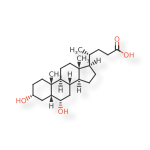
| Molecular Formula | C24H39O4.Na |
| Molecular Weight | 414.5538 |
| Optical Activity | UNSPECIFIED |
| Defined Stereocenters | 10 / 10 |
| E/Z Centers | 0 |
| Charge | 0 |
SHOW SMILES / InChI
SMILES
[Na+].C[C@H](CCC([O-])=O)[C@H]1CC[C@H]2[C@@H]3C[C@H](O)[C@@H]4C[C@H](O)CC[C@]4(C)[C@H]3CC[C@]12C
InChI
InChIKey=DUYSCILLIVEITB-ADQIWYCWSA-M
InChI=1S/C24H40O4.Na/c1-14(4-7-22(27)28)17-5-6-18-16-13-21(26)20-12-15(25)8-10-24(20,3)19(16)9-11-23(17,18)2;/h14-21,25-26H,4-13H2,1-3H3,(H,27,28);/q;+1/p-1/t14-,15-,16+,17-,18+,19+,20+,21+,23-,24-;/m1./s1
| Molecular Formula | Na |
| Molecular Weight | 22.98976928 |
| Charge | 1 |
| Count |
|
| Stereochemistry | ACHIRAL |
| Additional Stereochemistry | No |
| Defined Stereocenters | 0 / 0 |
| E/Z Centers | 0 |
| Optical Activity | NONE |
| Molecular Formula | C24H39O4 |
| Molecular Weight | 391.5641 |
| Charge | -1 |
| Count |
|
| Stereochemistry | ABSOLUTE |
| Additional Stereochemistry | No |
| Defined Stereocenters | 10 / 10 |
| E/Z Centers | 0 |
| Optical Activity | UNSPECIFIED |
DescriptionCurator's Comment: description was created based on several sources, including:
https://en.wikipedia.org/wiki/Hyodeoxycholic_acid | https://cdn2.hubspot.net/hub/150154/file-27656828-pdf/docs/atheronova-ahro-quarterly-update-04-05-2013.pdf | https://www.ncbi.nlm.nih.gov/pubmed/10936612
Curator's Comment: description was created based on several sources, including:
https://en.wikipedia.org/wiki/Hyodeoxycholic_acid | https://cdn2.hubspot.net/hub/150154/file-27656828-pdf/docs/atheronova-ahro-quarterly-update-04-05-2013.pdf | https://www.ncbi.nlm.nih.gov/pubmed/10936612
Hyodeoxycholic acid, also known as HDCA, is a secondary bile acid. Natural 6alpha-hydroxylated bile acids are receptor-specific activators of nuclear liver X receptor alpha (LXRalpha), a nuclear receptor regulating the expression of the cholesterol 7alpha-hydroxylase gene. AHRO-001 (Hyodeoxycholic acid) is in phase I clinical trials for the treatment of atherosclerosis. Through a complex signaling processes utilizing LXR receptors, the compound is designed to increase the efficiency of cholesterol efflux using the HDL cells, which act on all cholesterol in the arterial circulation as well as in the lipid core of plaque deposits in the artery walls. Use of AHRO-001 has shown no adverse effects on morbidity, mortality or toxicity and has been well tolerated at high doses.
Approval Year
AUC
| Value | Dose | Co-administered | Analyte | Population |
|---|---|---|---|---|
3344 mg × h/L EXPERIMENT https://pubmed.ncbi.nlm.nih.gov/16750434 |
3.44 mg/kg single, intraperitoneal dose: 3.44 mg/kg route of administration: Intraperitoneal experiment type: SINGLE co-administered: GENIPOSIDE|Isoniazid|Cholic acid |
HYODEOXYCHOLIC ACID plasma | Rattus norvegicus population: HEALTHY age: ADULT sex: MALE food status: UNKNOWN |
T1/2
| Value | Dose | Co-administered | Analyte | Population |
|---|---|---|---|---|
0.121 h EXPERIMENT https://pubmed.ncbi.nlm.nih.gov/16750434 |
3.44 mg/kg single, intraperitoneal dose: 3.44 mg/kg route of administration: Intraperitoneal experiment type: SINGLE co-administered: GENIPOSIDE|Isoniazid|Cholic acid |
HYODEOXYCHOLIC ACID plasma | Rattus norvegicus population: HEALTHY age: ADULT sex: MALE food status: UNKNOWN |
Overview
| CYP3A4 | CYP2C9 | CYP2D6 | hERG |
|---|---|---|---|
OverviewOther
| Other Inhibitor | Other Substrate | Other Inducer |
|---|---|---|
Drug as victim
| Target | Modality | Activity | Metabolite | Clinical evidence |
|---|---|---|---|---|
| likely | ||||
| likely | ||||
| likely | ||||
| no | ||||
| no | ||||
| no | ||||
| no | ||||
| no | ||||
| no | ||||
| no | ||||
| weak | ||||
| yes [Km 11.6 uM] | ||||
| yes [Km 12 uM] | ||||
| yes [Km 150.4 uM] | ||||
| yes [Km 178.5 uM] | ||||
| yes | ||||
| yes |
PubMed
| Title | Date | PubMed |
|---|---|---|
| Inhibition of human UGT2B7 gene expression in transgenic mice by the constitutive androstane receptor. | 2011-06 |
|
| Voluntary wheel running exercise and dietary lactose concomitantly reduce proportion of secondary bile acids in rat feces. | 2010-09 |
|
| Chemical genetic screen identifies lithocholic acid as an anti-aging compound that extends yeast chronological life span in a TOR-independent manner, by modulating housekeeping longevity assurance processes. | 2010-07 |
|
| Regulation of bile acid synthesis by fat-soluble vitamins A and D. | 2010-05-07 |
|
| Identification of human UGT2B7 as the major isoform involved in the O-glucuronidation of chloramphenicol. | 2010-03 |
|
| Liver X receptor agonist methyl-3β-hydroxy-5α,6α-epoxycholanate attenuates atherosclerosis in apolipoprotein E knockout mice without increasing plasma triglyceride. | 2010 |
|
| Challenges predicting ligand-receptor interactions of promiscuous proteins: the nuclear receptor PXR. | 2009-12 |
|
| Consumption of some polyphenols reduces fecal deoxycholic acid and lithocholic acid, the secondary bile acids of risk factors of colon cancer. | 2009-09-23 |
|
| 3-ketocholanoic acid is the major in vitro human hepatic microsomal metabolite of lithocholic acid. | 2009-09 |
|
| Serum bile acid profiling reflects enterohepatic detoxification state and intestinal barrier function in inflammatory bowel disease. | 2009-07-07 |
|
| Bear bile: dilemma of traditional medicinal use and animal protection. | 2009-01-12 |
|
| Improved analysis of bile acids in tissues and intestinal contents of rats using LC/ESI-MS. | 2009-01 |
|
| The inhibitory effects of cholalic acid and hyodeoxycholalic acid on the expression of TNFalpha and IL-1beta after cerebral ischemia in rats. | 2009-01 |
|
| Regulation of sulfotransferase and UDP-glucuronosyltransferase gene expression by the PPARs. | 2009 |
|
| Novel polymorphic human UDP-glucuronosyltransferase 2A3: cloning, functional characterization of enzyme variants, comparative tissue expression, and gene induction. | 2008-09 |
|
| Biotransformation of lithocholic acid by rat hepatic microsomes: metabolite analysis by liquid chromatography/mass spectrometry. | 2008-02 |
|
| Use of selected chemical markers in combination with a multiple regression model to assess the contribution of domesticated animal sources of fecal pollution in the environment. | 2007-11 |
|
| [Determination of chyodeoxycholic acid in Bile Arisaema by HPLC-ELSD]. | 2007-08 |
|
| Comparative study on major bioactive components in natural, artificial and in-vitro cultured Calculus Bovis. | 2007-01 |
|
| Isolation and determination of bile acids. | 2006-12-02 |
|
| Simultaneous determination of geniposide, baicalin, cholic acid and hyodeoxycholic acid in rat serum for the pharmacokinetic investigations by high performance liquid chromatography-tandem mass spectrometry. | 2006-09-14 |
|
| Resistance to ursodeoxycholic acid-induced growth arrest can also result in resistance to deoxycholic acid-induced apoptosis and increased tumorgenicity. | 2006-09-01 |
|
| 3alpha-6alpha-Dihydroxy-7alpha-fluoro-5beta-cholanoate (UPF-680), physicochemical and physiological properties of a new fluorinated bile acid that prevents 17alpha-ethynyl-estradiol-induced cholestasis in rats. | 2006-07-15 |
|
| Role for enhanced faecal excretion of bile acid in hydroxysteroid sulfotransferase-mediated protection against lithocholic acid-induced liver toxicity. | 2006-07 |
|
| Determination of three bile acids in artificial Calculus Bovis and its medicinal preparations by micellar electrokinetic capillary electrophoresis. | 2006-06-06 |
|
| Enzymatic production of bile Acid glucuronides used as analytical standards for liquid chromatography-mass spectrometry analyses. | 2006-06-06 |
|
| Mice lacking Mrp3 (Abcc3) have normal bile salt transport, but altered hepatic transport of endogenous glucuronides. | 2006-04 |
|
| Simultaneous determination of nine components in Qingkailing injection by HPLC/ELSD/DAD and its application to the quality control. | 2006-03-03 |
|
| Simultaneous determination of major bioactive components in Qingkailing injection by high-performance liquid chromatography with evaporative light scattering detection. | 2005-11 |
|
| [Simultaneous determination of five groups of components in qingkailing injection by high performance liquid chromatography with photo diode array detector and evaporative light scattering detector]. | 2005-09 |
|
| Interfacial properties of most monofluorinated bile acids deviate markedly from the natural congeners: studies with the Langmuir-Pockels surface balance. | 2005-03 |
|
| Effect of dried plums on colon cancer risk factors in rats. | 2005 |
|
| Identification of UGT2B9*2 and UGT2B33 isolated from female rhesus monkey liver. | 2004-06-01 |
|
| [Study on extraction technique of HDCA]. | 2004-05 |
|
| Effects of ileo-rectal anastomosis on cholesterol metabolism in pigs fed either casein or extruded soya beans. | 2004-05 |
|
| UDP-glucuronosyltransferase and sulfotransferase polymorphisms, sex hormone concentrations, and tumor receptor status in breast cancer patients. | 2004 |
|
| Steroids in the intestinal tract of rats are affected by dietary-fibre-rich barley-based diets. | 2003-11 |
|
| Substrate specificities of rat oatp1 and ntcp: implications for hepatic organic anion uptake. | 2003-11 |
|
| The cytotoxicity of hydrophobic bile acids is ameliorated by more hydrophilic bile acids in intestinal cell lines IEC-6 and Caco-2. | 2003-10-10 |
|
| Peroxisome proliferator-activated receptor alpha induces hepatic expression of the human bile acid glucuronidating UDP-glucuronosyltransferase 2B4 enzyme. | 2003-08-29 |
|
| Glucosidation of hyodeoxycholic acid by UDP-glucuronosyltransferase 2B7. | 2003-02-01 |
|
| Dietary bile acids inhibit potentially elemental diet-induced small intestinal atrophy in rats. | 2002-11 |
|
| [Study on effect of qingkailing injection and its active principle in inducing cell apoptosis in human acute promyelocytic leukemia]. | 2001-11 |
|
| Hyodeoxycholic acid efficiently suppresses atherosclerosis formation and plasma cholesterol levels in mice. | 2001-08 |
|
| Effect of bile salts on colonic mucus secretion in isolated vascularly perfused rat colon. | 2001-06 |
|
| Hydrophilic and hydrophobic bile acids exhibit different cytotoxicities through cytolysis, interleukin-8 synthesis and apoptosis in the intestinal epithelial cell lines. IEC-6 and Caco-2 cells. | 2001-05 |
|
| UGT2B23, a novel uridine diphosphate-glucuronosyltransferase enzyme expressed in steroid target tissues that conjugates androgen and estrogen metabolites. | 1999-12 |
|
| Reinduction of the hypnotic effects of thiopental with NSAIDs by decreasing thiopental plasma protein binding in humans. | 1993-04 |
|
| Complementary deoxyribonucleic acid cloning and expression of a human liver uridine diphosphate-glucuronosyltransferase glucuronidating carboxylic acid-containing drugs. | 1993-01 |
|
| Isolation and characterization of hyodeoxycholic-acid: UDP-glucuronosyltransferase from human liver. | 1991-09-01 |
Patents
Sample Use Guides
Cohort 1: 500 mg/dose, given as a single dose then as bid x7days and tid x 7days Cohort 2: 750 mg/dose, given as a single dose then as bid x7days and tid x 7days Cohort 3: 1000 mg/dose, given as a single dose then as bid x7days and tid x7days Cohort 4: 21 days dosing given at best tolerated dose determined by cohorts 1-3 Cohort 5: 12 wks dosing given at best tolerated dose determined by cohorts 1-4
Route of Administration:
Oral
| Substance Class |
Chemical
Created
by
admin
on
Edited
Mon Mar 31 17:56:22 GMT 2025
by
admin
on
Mon Mar 31 17:56:22 GMT 2025
|
| Record UNII |
HBY71R8HO2
|
| Record Status |
Validated (UNII)
|
| Record Version |
|
-
Download
| Name | Type | Language | ||
|---|---|---|---|---|
|
Common Name | English | ||
|
Preferred Name | English | ||
|
Systematic Name | English |
| Code System | Code | Type | Description | ||
|---|---|---|---|---|---|
|
DTXSID60908871
Created by
admin on Mon Mar 31 17:56:22 GMT 2025 , Edited by admin on Mon Mar 31 17:56:22 GMT 2025
|
PRIMARY | |||
|
23720132
Created by
admin on Mon Mar 31 17:56:22 GMT 2025 , Edited by admin on Mon Mar 31 17:56:22 GMT 2025
|
PRIMARY | |||
|
HBY71R8HO2
Created by
admin on Mon Mar 31 17:56:22 GMT 2025 , Edited by admin on Mon Mar 31 17:56:22 GMT 2025
|
PRIMARY | |||
|
DBSALT002661
Created by
admin on Mon Mar 31 17:56:22 GMT 2025 , Edited by admin on Mon Mar 31 17:56:22 GMT 2025
|
PRIMARY | |||
|
10421-49-5
Created by
admin on Mon Mar 31 17:56:22 GMT 2025 , Edited by admin on Mon Mar 31 17:56:22 GMT 2025
|
PRIMARY |
| Related Record | Type | Details | ||
|---|---|---|---|---|
|
|
PARENT -> SALT/SOLVATE |
| Related Record | Type | Details | ||
|---|---|---|---|---|
|
|
ACTIVE MOIETY |