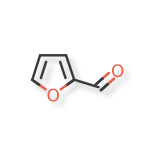
Details
| Stereochemistry | ACHIRAL |
| Molecular Formula | C5H4O2 |
| Molecular Weight | 96.0841 |
| Optical Activity | NONE |
| Defined Stereocenters | 0 / 0 |
| E/Z Centers | 0 |
| Charge | 0 |
SHOW SMILES / InChI
SMILES
O=CC1=CC=CO1
InChI
InChIKey=HYBBIBNJHNGZAN-UHFFFAOYSA-N
InChI=1S/C5H4O2/c6-4-5-2-1-3-7-5/h1-4H
| Molecular Formula | C5H4O2 |
| Molecular Weight | 96.0841 |
| Charge | 0 |
| Count |
|
| Stereochemistry | ACHIRAL |
| Additional Stereochemistry | No |
| Defined Stereocenters | 0 / 0 |
| E/Z Centers | 0 |
| Optical Activity | NONE |
Furfural (also called 2-formylfuran, furan-2-
aldehyde, 2-furancarboxaldehyde, 2-furyl-methanal, pyromucic
aldehyde, 2-furanaldehyde, 2-furancarbonal, carboxylic aldehyde,
furan-2-carbaldehyde, furancarbonal, 2-furaldehyde, or 2-furfural),
contains a heteroaromatic furan ring and an aldehyde functional
group. Furfural was first isolated in 1832 by J.W. Döbereiner, and
has been industrially produced since 1922. Today, furfural is used
for multiple purposes, for example as a selective extraction agent
(in the recovery of butadiene from oil steam cracking or in the refining of petroleum, diesel fuels, lubricants and vegetable oils), as a
solvent (for anthracene or resins), as an agent for vulcanization,
as a nematicide and fungicide, as a flavoring agent in a variety of
food products and alcoholic and non-alcoholic beverages, and as a
component of commercial herbicides, insecticides, pesticides,
antiseptics, disinfectors, and rust removers. Furfural is also involved
in the manufacture of pharmaceuticals, cosmetics, fragrances, flavors and resins (in this latter case, by condensation with phenol,
formaldehyde, acetone, or urea, to produce thermosetting resins
with extreme physical strength); as well as in other products such
as household cleaners and detergents. Furfural occurs naturally in some fruits and vegetables. It can be formed in other foods during cooking, and is present in wood smoke. Furfural is an ingredient contained in many fragrances and flavours. It may be found in fragrances used in decorative cosmetics, fine fragrances, shampoos, toilet soaps and other toiletries, in flavours of oral care products as well as in non-cosmetic products such as household cleaners and detergents. Furfural in the in the fragrance compound is reported to be 0.036% or less. The European Commission received a submission from the European Flavour & Fragrance Association with data supporting the safe use of Furfural as a fragrance ingredient. The predominant pathway of metabolism of Furfural in humans is oxidation of the aldehyde to yield furoic acid, which may either conjugate with amino acids or condense with acetyl coenzyme A to produce the furanacrylic acid. Furfural is a carcinogen classified in EU as a Category 3 carcinogen. Furfural was tested for carcinogenicity by oral administration in one study in mice and one study in rats. In mice, it increased the incidence of hepatocellular adenomas and carcinomas in males and of hepatocellular adenomas and forestomach papillomas in females. Male rats had a low incidence of cholangiocarcinomas, which occur rarely. In a two-stage assay on mouse skin, Furfural had weak initiating activity. On the basis of quantitative risk assessment it is concluded that Furfural at the maximum exposure stated by RIFM does not represent any significant cancer risk. However, the exposure should not be increased.
Approval Year
PubMed
| Title | Date | PubMed |
|---|---|---|
| Isolation of microorganisms for biological detoxification of lignocellulosic hydrolysates. | 2004-03 |
|
| Response to different environmental stress conditions of industrial and laboratory Saccharomyces cerevisiae strains. | 2004-02 |
|
| Antioxidative activities of volatile extracts from green tea, oolong tea, and black tea. | 2003-12-03 |
|
| Recovery of lignin and furfural from acetic acid-water-HCl pulping liquors. | 2003-12 |
|
| Analysis of aldehydes in beer using solid-phase microextraction with on-fiber derivatization and gas chromatography/mass spectrometry. | 2003-11-19 |
|
| Prazosin-related compounds. Effect of transforming the piperazinylquinazoline moiety into an aminomethyltetrahydroacridine system on the affinity for alpha1-adrenoreceptors. | 2003-11-06 |
|
| Quantitative analysis of 2-furfural and 5-methylfurfural in different Italian vinegars by headspace solid-phase microextraction coupled to gas chromatography-mass spectrometry using isotope dilution. | 2003-10-31 |
|
| Extracting material parameters from x-ray attenuation: a CT feasibility study using kilovoltage synchrotron x-rays incident upon low atomic number absorbers. | 2003-10-21 |
|
| Stereochemistry of intramolecular Diels-Alder furan (IMDAF) reactions of furyl-substituted chiral ethanolamides. | 2003-10-21 |
|
| Insecticidal compounds against Drosophila melanogaster from Cornus officinalis Sieb. et Zucc. | 2003-10 |
|
| Extraction and formation dynamic of oak-related volatile compounds from different volume barrels to wine and their behavior during bottle storage. | 2003-08-27 |
|
| Syntheses of 2, 5-dialkylfuran and tetrahydrofuran carbinols and their cytotoxic activity. | 2003-08 |
|
| Removal of mercury (II) from aqueous solution by activated carbon obtained from furfural. | 2003-08 |
|
| 3-Hydroxy-4,5-dimethyl-2(5H)-furanone: a key odorant of the typical aroma of oxidative aged Port wine. | 2003-07-16 |
|
| 2-Furoylmethyl amino acids and hydroxymethylfurfural as indicators of honey quality. | 2003-07-16 |
|
| Quantification of 5-HMF and dextrose in commercial aqueous dextrose solutions. | 2003-07-14 |
|
| Determination of furanic compounds in traditional balsamic vinegars by ion-exclusion liquid chromatography and diode-array detection. | 2003-07 |
|
| Generation of thiols by biotransformation of cysteine-aldehyde conjugates with baker's yeast. | 2003-06-04 |
|
| One-pot, two-step, practical catalytic synthesis of 2,5-diformylfuran from fructose. | 2003-05-29 |
|
| Thermal decomposition of specifically phosphorylated D-glucoses and their role in the control of the Maillard reaction. | 2003-05-21 |
|
| The potential role of advanced glycation end product and iNOS in chronic renal failure-related testicular dysfunction. An experimental study. | 2003-05-02 |
|
| Influence of seasonal variation on kinetics of time temperature integrators for thermally processed milk. | 2003-05 |
|
| Availability of corn stover as a sustainable feedstock for bioethanol production. | 2003-05 |
|
| Impurities in a morphine sulfate drug product identified as 5-(hydroxymethyl)-2-furfural, 10-hydroxymorphine and 10-oxomorphine. | 2003-03 |
|
| Insertion of carbon fragments into P(III)-N bonds in aminophosphines and aminobis(phosphines): synthesis, reactivity, and coordination chemistry of resulting phosphine oxide derivatives. Crystal and molecular structures of (Ph(2)P(O)CH(2))(2)NR (R = Me, (n)Pr, (n)Bu), Ph(2)P(O)CH(OH)(n)()Pr, and cis-[MoO(2)Cl(2)((Ph(2)P(O)CH(2))(2)NEt-kappaO,kappaO)]. | 2003-02-24 |
|
| "Action-at-a distance" of a new DNA oxidative damage product 6-furfuryl-adenine (kinetin) on template properties of modified DNA. | 2003-02-20 |
|
| An improved HPLC analysis of the metabolite furoic acid in the urine of workers occupationally exposed to furfural. | 2003-02-18 |
|
| Kinetics of hydroxymethylfurfural, lactulose and furosine formation in milk with different fat content. | 2003-02 |
|
| Furoyl and benzofuroyl pyrroloquinolones as potent and selective PDE5 inhibitors for treatment of erectile dysfunction. | 2003-01-30 |
|
| Chemical constituents from the Hydrangea chinensis. | 2003-01 |
|
| Modeling of the hydrolysis of sugar cane bagasse with hydrochloric acid. | 2003-01 |
|
| Affinity adsorption of glucose degradation products improves the biocompatibility of conventional peritoneal dialysis fluid. | 2003-01 |
|
| Limits for alkaline detoxification of dilute-acid lignocellulose hydrolysates. | 2003 |
|
| Evaluation of lipophilicity and antitumour activity of parallel carboxamide libraries. | 2002-11-25 |
|
| Evolution of phenolic compounds during an experimental aging in wood of Sherry vinegar. | 2002-11-20 |
|
| Identification and quantification of antioxidant components of honeys from various floral sources. | 2002-10-09 |
|
| Interactions between cyanidin 3-O-glucoside and furfural derivatives and their impact on food color changes. | 2002-09-25 |
|
| Role of aldehydic derivatives in the condensation of phenolic compounds with emphasis on the sensorial properties of fruit-derived foods. | 2002-09-25 |
|
| Supercritical fluid extraction of a lignocellulosic hydrolysate of spruce for detoxification and to facilitate analysis of inhibitors. | 2002-09-20 |
|
| Antioxidant effects of isorhamnetin 3,7-di-O-beta-D-glucopyranoside isolated from mustard leaf (Brassica juncea) in rats with streptozotocin-induced diabetes. | 2002-09-11 |
|
| Effect of different forms of alkali treatment on specific fermentation inhibitors and on the fermentability of lignocellulose hydrolysates for production of fuel ethanol. | 2002-09-11 |
|
| Reactivity of 5-nitro-2-furaldehyde in alkaline and acidic solutions. | 2002-08-29 |
|
| 4-Aryloxybutenolides as "chiral aldehyde" equivalents: an efficient enantioselective synthesis of (+)-brefeldin a. | 2002-08-14 |
|
| Four new compounds from the seeds of Cassia fistula. | 2002-08 |
|
| The influence of bark on the fermentation of Douglas-fir whitewood pre-hydrolysates. | 2002-08 |
|
| Thresholds of carcinogenicity of flavors. | 2002-08 |
|
| Identification of aroma compounds in Parmigiano-Reggiano cheese by gas chromatography/olfactometry. | 2002-06 |
|
| Impact of chronic renal failure and peritoneal dialysis fluids on advanced glycation end product and iNOS levels in penile tissue: an experimental study. | 2002-06 |
|
| Diastereoselective imino-aldol condensation of chiral 3-(p-Tolylsulfinyl)-2-furaldimine and ester enolates. | 2002-05 |
|
| Aerosol particle and organic vapor concentrations at industrial work sites in Malaysia. | 2001 |
Sample Use Guides
In Vivo Use Guide
Curator's Comment: In oral subchronic studies in rodents, dose levels of Furfural greater than 50 mg/kg bw/d are primarily associated with hepatic effects. 11 mg/kg may be considered a LOAEL in rats. https://ec.europa.eu/health/archive/ph_risk/committees/sccp/documents/out279_en.pdf
The estimated daily intake of furfural from its use as a flavoring agent, calculated using 'poundage' data provided by the flavoring industry, was 9 ug/kg body weight in Europe and 8 ug/kg body weight in the U.S.
Route of Administration:
Oral
Precision-cut human liver slices from four donors were cultured for 24 h in medium containing [3H]thymidine and 0-10 mM furfural. Small increases in the net grain count (i.e. nuclear grain count less mean cytoplasmic grain count) observed with 2-10 mM furfural were not due to any increase in the nuclear grain count.
| Substance Class |
Chemical
Created
by
admin
on
Edited
Mon Mar 31 18:40:07 GMT 2025
by
admin
on
Mon Mar 31 18:40:07 GMT 2025
|
| Record UNII |
DJ1HGI319P
|
| Record Status |
Validated (UNII)
|
| Record Version |
|
-
Download
| Name | Type | Language | ||
|---|---|---|---|---|
|
Preferred Name | English | ||
|
Official Name | English | ||
|
Common Name | English | ||
|
Common Name | English | ||
|
Common Name | English | ||
|
Common Name | English | ||
|
Common Name | English | ||
|
Systematic Name | English | ||
|
Systematic Name | English | ||
|
Common Name | English | ||
|
Systematic Name | English | ||
|
Common Name | English | ||
|
Common Name | English | ||
|
Common Name | English | ||
|
Common Name | English | ||
|
Code | English | ||
|
Common Name | English |
| Classification Tree | Code System | Code | ||
|---|---|---|---|---|
|
EPA PESTICIDE CODE |
43301
Created by
admin on Mon Mar 31 18:40:07 GMT 2025 , Edited by admin on Mon Mar 31 18:40:07 GMT 2025
|
||
|
JECFA EVALUATION |
FURFURAL
Created by
admin on Mon Mar 31 18:40:07 GMT 2025 , Edited by admin on Mon Mar 31 18:40:07 GMT 2025
|
| Code System | Code | Type | Description | ||
|---|---|---|---|---|---|
|
m5603
Created by
admin on Mon Mar 31 18:40:07 GMT 2025 , Edited by admin on Mon Mar 31 18:40:07 GMT 2025
|
PRIMARY | Merck Index | ||
|
SUB115712
Created by
admin on Mon Mar 31 18:40:07 GMT 2025 , Edited by admin on Mon Mar 31 18:40:07 GMT 2025
|
PRIMARY | |||
|
DJ1HGI319P
Created by
admin on Mon Mar 31 18:40:07 GMT 2025 , Edited by admin on Mon Mar 31 18:40:07 GMT 2025
|
PRIMARY | |||
|
202-627-7
Created by
admin on Mon Mar 31 18:40:07 GMT 2025 , Edited by admin on Mon Mar 31 18:40:07 GMT 2025
|
PRIMARY | |||
|
DTXSID1020647
Created by
admin on Mon Mar 31 18:40:07 GMT 2025 , Edited by admin on Mon Mar 31 18:40:07 GMT 2025
|
PRIMARY | |||
|
8841
Created by
admin on Mon Mar 31 18:40:07 GMT 2025 , Edited by admin on Mon Mar 31 18:40:07 GMT 2025
|
PRIMARY | |||
|
542
Created by
admin on Mon Mar 31 18:40:07 GMT 2025 , Edited by admin on Mon Mar 31 18:40:07 GMT 2025
|
PRIMARY | |||
|
169
Created by
admin on Mon Mar 31 18:40:07 GMT 2025 , Edited by admin on Mon Mar 31 18:40:07 GMT 2025
|
PRIMARY | |||
|
34768
Created by
admin on Mon Mar 31 18:40:07 GMT 2025 , Edited by admin on Mon Mar 31 18:40:07 GMT 2025
|
PRIMARY | |||
|
98-01-1
Created by
admin on Mon Mar 31 18:40:07 GMT 2025 , Edited by admin on Mon Mar 31 18:40:07 GMT 2025
|
PRIMARY | |||
|
furfural
Created by
admin on Mon Mar 31 18:40:07 GMT 2025 , Edited by admin on Mon Mar 31 18:40:07 GMT 2025
|
PRIMARY | |||
|
7362
Created by
admin on Mon Mar 31 18:40:07 GMT 2025 , Edited by admin on Mon Mar 31 18:40:07 GMT 2025
|
PRIMARY | |||
|
100000142139
Created by
admin on Mon Mar 31 18:40:07 GMT 2025 , Edited by admin on Mon Mar 31 18:40:07 GMT 2025
|
PRIMARY | |||
|
FURFURAL
Created by
admin on Mon Mar 31 18:40:07 GMT 2025 , Edited by admin on Mon Mar 31 18:40:07 GMT 2025
|
PRIMARY |
| Related Record | Type | Details | ||
|---|---|---|---|---|
|
PARENT -> CONSTITUENT ALWAYS PRESENT |
|
||
|
PARENT -> CONSTITUENT ALWAYS PRESENT |
|

| Related Record | Type | Details | ||
|---|---|---|---|---|
|
|
PARENT -> IMPURITY |
|
||
|
PARENT -> IMPURITY |
|
| Related Record | Type | Details | ||
|---|---|---|---|---|
|
|
ACTIVE MOIETY |
|