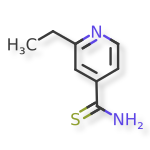
Details
| Stereochemistry | ACHIRAL |
| Molecular Formula | C8H10N2S.ClH |
| Molecular Weight | 202.704 |
| Optical Activity | NONE |
| Defined Stereocenters | 0 / 0 |
| E/Z Centers | 0 |
| Charge | 0 |
SHOW SMILES / InChI
SMILES
Cl.CCC1=NC=CC(=C1)C(N)=S
InChI
InChIKey=YNKSYHUKAKUZAR-UHFFFAOYSA-N
InChI=1S/C8H10N2S.ClH/c1-2-7-5-6(8(9)11)3-4-10-7;/h3-5H,2H2,1H3,(H2,9,11);1H
| Molecular Formula | C8H10N2S |
| Molecular Weight | 166.243 |
| Charge | 0 |
| Count |
|
| Stereochemistry | ACHIRAL |
| Additional Stereochemistry | No |
| Defined Stereocenters | 0 / 0 |
| E/Z Centers | 0 |
| Optical Activity | NONE |
| Molecular Formula | ClH |
| Molecular Weight | 36.461 |
| Charge | 0 |
| Count |
|
| Stereochemistry | ACHIRAL |
| Additional Stereochemistry | No |
| Defined Stereocenters | 0 / 0 |
| E/Z Centers | 0 |
| Optical Activity | NONE |
DescriptionCurator's Comment: Description was created using several sources including:
http://www.ncbi.nlm.nih.gov/pubmed/13741471;
https://www.ncbi.nlm.nih.gov/pubmed/17220416;
http://www.ncbi.nlm.nih.gov/pubmed/26435990
Curator's Comment: Description was created using several sources including:
http://www.ncbi.nlm.nih.gov/pubmed/13741471;
https://www.ncbi.nlm.nih.gov/pubmed/17220416;
http://www.ncbi.nlm.nih.gov/pubmed/26435990
Ethionamide is a second-line agent, structurally similar to isoniazid, used as a second-line therapy for the treatment of multidrug-resistant tuberculosis or active tuberculosis in case of patient intolerance to other drugs. Depending on its the concentration at the infected site and the susceptibility of the infecting organism it may be bacteriostatic or bactericidal. When used alone rapidly develops bacterial resistance. Ethionamide was approved by FDA in 1965 as TRECATOR manufactured by Wyeth Pharmaceuticals Inc. (purchased by Pfizer in 2009). Ethionamide is specific for Mycobacteria and is thought to exert a toxic effect on mycolic acid components of the bacterial cell wall when activated through intermediate S-oxidation by EtaA. Mycolic acid synthesis was shown to be inhibited by ethionamide in the EthA protein-overexpressing mycobacteria,
CNS Activity
Approval Year
Targets
| Primary Target | Pharmacology | Condition | Potency |
|---|---|---|---|
Target ID: P9WIE5|||Q50553 Gene ID: 885638.0 Gene Symbol: katG Target Organism: Mycobacterium tuberculosis (strain ATCC 25618 / H37Rv) Sources: http://www.drugbank.ca/drugs/DB00609 |
|||
Target ID: CHEMBL1849 |
Conditions
| Condition | Modality | Targets | Highest Phase | Product |
|---|---|---|---|---|
| Curative | TRECATOR Approved UseTrecator is primarily indicated for the treatment of active tuberculosis in patients with M. tuberculosis resistant to isoniazid or rifampin, or when there is intolerance on the part of the patient to other drugs. Its use alone in the treatment of tuberculosis results in the rapid development of resistance. It is essential, therefore, to give a suitable companion drug or drugs, the choice being based on the results of susceptibility tests. If the susceptibility tests indicate that the patient's organism is resistant to one of the first-line antituberculosis drugs (i.e., isoniazid or rifampin) yet susceptible to ethionamide, ethionamide should be accompanied by at least one drug to which the M. tuberculosis isolate is known to be susceptible.3 If the tuberculosis is resistant to both isoniazid and rifampin, yet susceptible to ethionamide, ethionamide should be accompanied by at least two other drugs to which the M. tuberculosis isolate is known to be susceptible.3 Patient nonadherence to prescribed treatment can result in treatment failure and in the development of drug-resistant tuberculosis, which can be life-threatening and lead to other serious health risks. It is, therefore, essential that patients adhere to the drug regimen for the full duration of treatment. Directly observed therapy is recommended for all patients receiving treatment for tuberculosis. Patients in whom drug-resistant M. tuberculosis organisms are isolated should be managed in consultation with an expert in the treatment of drug-resistant tuberculosis. Launch Date1965 |
Cmax
| Value | Dose | Co-administered | Analyte | Population |
|---|---|---|---|---|
2.16 μg/mL |
250 mg single, oral dose: 250 mg route of administration: Oral experiment type: SINGLE co-administered: |
ETHIONAMIDE plasma | Homo sapiens population: HEALTHY age: ADULT sex: UNKNOWN food status: FASTED |
AUC
| Value | Dose | Co-administered | Analyte | Population |
|---|---|---|---|---|
7.67 μg × h/mL |
250 mg single, oral dose: 250 mg route of administration: Oral experiment type: SINGLE co-administered: |
ETHIONAMIDE plasma | Homo sapiens population: HEALTHY age: ADULT sex: UNKNOWN food status: FASTED |
T1/2
| Value | Dose | Co-administered | Analyte | Population |
|---|---|---|---|---|
1.92 h |
250 mg single, oral dose: 250 mg route of administration: Oral experiment type: SINGLE co-administered: |
ETHIONAMIDE plasma | Homo sapiens population: HEALTHY age: ADULT sex: UNKNOWN food status: FASTED |
Funbound
| Value | Dose | Co-administered | Analyte | Population |
|---|---|---|---|---|
70% |
250 mg single, oral dose: 250 mg route of administration: Oral experiment type: SINGLE co-administered: |
ETHIONAMIDE plasma | Homo sapiens population: HEALTHY age: ADULT sex: UNKNOWN food status: FASTED |
Doses
| Dose | Population | Adverse events |
|---|---|---|
0.1 g 2 times / week multiple, oral MTD Dose: 0.1 g, 2 times / week Route: oral Route: multiple Dose: 0.1 g, 2 times / week Sources: |
unhealthy, >12 |
|
0.5 g 2 times / week multiple, oral MTD Dose: 0.5 g, 2 times / week Route: oral Route: multiple Dose: 0.5 g, 2 times / week Sources: |
unhealthy, >12 |
|
0.75 g 2 times / week multiple, oral MTD Dose: 0.75 g, 2 times / week Route: oral Route: multiple Dose: 0.75 g, 2 times / week Sources: |
unhealthy, >12 |
|
1.25 g 2 times / week multiple, oral MTD Dose: 1.25 g, 2 times / week Route: oral Route: multiple Dose: 1.25 g, 2 times / week Sources: |
unhealthy, >12 |
|
1.5 g 2 times / week multiple, oral MTD Dose: 1.5 g, 2 times / week Route: oral Route: multiple Dose: 1.5 g, 2 times / week Sources: |
unhealthy, >12 |
PubMed
| Title | Date | PubMed |
|---|---|---|
| Altered NADH/NAD+ ratio mediates coresistance to isoniazid and ethionamide in mycobacteria. | 2005-02 |
|
| Electron transfer kinetics and mechanistic study of the thionicotinamide coordinated to the pentacyanoferrate(III)/(II) complexes: a model system for the in vitro activation of thioamides anti-tuberculosis drugs. | 2005-02 |
|
| Analysis of Mycobacterium tuberculosis isolates from treatment failure patients living in East Timor. | 2005-01 |
|
| Drug susceptibility of Brazilian strains of Mycobacterium bovis using traditional and molecular techniques. | 2004-11 |
|
| Inhibitory effect of antituberculosis drugs on human cytochrome P450-mediated activities. | 2004-11 |
|
| Polymorphism and solvolysis of 2-cyano-3-[4-(N,N-diethylamino)phenyl]prop-2-enethioamide. | 2004-11 |
|
| Axially dissymmetric N-thioacylated (S)-(-)-1,1'-binaphthyl-2,2'-diamine ligands for copper-catalyzed asymmetric Michael addition of diethylzinc to alpha,beta-unsaturated ketone. | 2004-11 |
|
| Adjuvant interferon gamma in patients with drug - resistant pulmonary tuberculosis: a pilot study. | 2004-10-22 |
|
| Structure of EthR in a ligand bound conformation reveals therapeutic perspectives against tuberculosis. | 2004-10-22 |
|
| Mycobacterium triplex pulmonary disease in immunocompetent host. | 2004-10 |
|
| Multidrug resistant miliary tuberculosis and Pott's disease in an immunocompetent patient. | 2004-10 |
|
| Outcome of treatment of multidrug resistant tuberculosis. | 2004-09 |
|
| Effect of glutathione on the covalent binding of the 13C-labeled skin sensitizer 5-chloro-2-methylisothiazol-3-one to human serum albumin: identification of adducts by nuclear magnetic resonance, matrix-assisted laser desorption/ionization mass spectrometry, and nanoelectrospray tandem mass spectrometry. | 2004-09 |
|
| Pyridylthiocarbazide complexes of rhenium with potential radiopharmaceutical applications. | 2004-08-21 |
|
| Antituberculous activity of some aryl semicarbazone derivatives. | 2004-08-02 |
|
| Synthesis and antibacterial activity of arylpiperazinyl oxazolidinones with diversification of the N-substituents. | 2004-08-02 |
|
| Pharmacy data for tuberculosis surveillance and assessment of patient management. | 2004-08 |
|
| Crystal structure of the TetR/CamR family repressor Mycobacterium tuberculosis EthR implicated in ethionamide resistance. | 2004-07-23 |
|
| Treatment and follow-up of HIV-negative multidrug-resistant tuberculosis patients in an infectious diseases reference hospital, Buenos Aires, Argentina. | 2004-06 |
|
| Surveillance of Mycobacterium tuberculosis susceptibility to second-line drugs in Hong Kong, 1995-2002, after the implementation of DOTS-plus. | 2004-06 |
|
| Iatrogenic Mycobacterium simiae skin infection in an immunocompetent patient. | 2004-05 |
|
| Synthesis and antimycobacterial activity of 1,2,4-triazole 3-benzylsulfanyl derivatives. | 2004-04 |
|
| Use of MGIT 960 for rapid quantitative measurement of the susceptibility of Mycobacterium tuberculosis complex to ciprofloxacin and ethionamide. | 2004-04 |
|
| A case study in Hansen's disease acquired after heart transplant. | 2004-02-21 |
|
| A microplate indicator-based method for determining the susceptibility of multidrug-resistant Mycobacterium tuberculosis to antimicrobial agents. | 2004-02 |
|
| Computational study of conformational preferences of thioamide-containing azaglycine peptides. | 2004-01-30 |
|
| The prodrug activator EtaA from Mycobacterium tuberculosis is a Baeyer-Villiger monooxygenase. | 2004-01-30 |
|
| Covalent binding of the 13C-labeled skin sensitizers 5-chloro-2-methylisothiazol-3-one (MCI) and 2-methylisothiazol-3-one (MI) to a model peptide and glutathione. | 2004-01-19 |
|
| EthR, a repressor of the TetR/CamR family implicated in ethionamide resistance in mycobacteria, octamerizes cooperatively on its operator. | 2004-01 |
|
| New agents active against Mycobacterium avium complex selected by molecular topology: a virtual screening method. | 2004-01 |
|
| Pharmacokinetics and relative bioavailability of clofazimine in relation to food, orange juice and antacid. | 2004 |
|
| Kinetic spectrophotometric determination of some sulfur containing compounds in pharmaceutical preparations and human serum. | 2003-12 |
|
| Lepromatous leprosy in a heart transplant recipient. | 2003-12 |
|
| Invasive Mycobacterium marinum infections. | 2003-11 |
|
| Reaction and characterization of thioamide dianions derived from N-benzyl thioamides. | 2003-10-31 |
|
| Evaluation of indirect susceptibility testing of Mycobacterium tuberculosis to the first- and second-line, and alternative drugs by the newer MB/BacT system. | 2003-09 |
|
| Incorporation of antibiotics in liposomes designed for tuberculosis therapy by inhalation. | 2003-08-29 |
|
| Gatifloxacin and ethionamide as the foundation for therapy of tuberculosis. | 2003-08 |
|
| Chronic cases of tuberculosis in Casablanca, Morocco. | 2003-07 |
|
| Inhibition of InhA activity, but not KasA activity, induces formation of a KasA-containing complex in mycobacteria. | 2003-06-06 |
|
| Inactivation of mshB, a key gene in the mycothiol biosynthesis pathway in Mycobacterium smegmatis. | 2003-05 |
|
| Vibrational study of the secondary thioamide function, the intramolecular resonance assisted and intermolecular hydrogen bonding in NN'-hydroxyalkyl dithiooxamides. | 2003-04 |
|
| Preparation of thioamide building blocks via microwave-promoted three-component kindler reactions. | 2003-03-11 |
|
| Vibrational characterization of the tertiary amide and thioamide group. | 2003-03-01 |
|
| Mycobacterium celatum pulmonary infection in the immunocompetent: case report and review. | 2003-03 |
|
| Multidrug-resistant tuberculosis in pregnancy: case report and review of the literature. | 2003-03 |
|
| The 2,3-bis(2-methoxy-4-nitro-5-sulfophenyl)-2H-tetrazolium-5-carboxanilide (XTT) assay as rapid colorimetric method for determination of antibiotic susceptibility of clinical Mycobacterium tuberculosis isolates in liquid medium. | 2003 |
|
| Spectrum of drugs against atypical mycobacteria: how valid is the current practice of drug susceptibility testing and the choice of drugs? | 1992-12 |
|
| Mycolic acid synthesis: a target for ethionamide in mycobacteria? | 1992-06 |
|
| The antituberculous activity of thioamide in vitro and in the experimental animal (mouse and guinea pig). | 1960-05 |
Sample Use Guides
In Vivo Use Guide
Curator's Comment: If patient exhibits poor gastrointestinal tolerance, TRECATOR has to be administered in divided doses, with a maximum daily dosage of 1 gram
15 to 20 mg/kg/day, administered once daily
Route of Administration:
Oral
In Vitro Use Guide
Curator's Comment: Standardized in vitro susceptibility method for testing ethionamide against
M. tuberculosis organisms: after 2 to 3 weeks of incubation, MIC99 values are calculated.
Two standardized in vitro susceptibility methods are available for testing ethionamide against M. tuberculosis organisms. The modified proportion method (CDC or NCCLS M24-P) utilizes Middlebrook and Cohn 7H10 agar medium impregnated with ethionamide at a final concentration of 5.0 ug/mL. After 2 to 3 weeks of incubation, MIC99 values are calculated by comparing the quantity of organisms growing in the medium containing drug to the control
cultures. Mycobacterial growth in the presence of drug, of at least 1% of the growth in the control culture, indicates resistance.
| Substance Class |
Chemical
Created
by
admin
on
Edited
Mon Mar 31 21:51:51 GMT 2025
by
admin
on
Mon Mar 31 21:51:51 GMT 2025
|
| Record UNII |
6ZVV3G6C62
|
| Record Status |
Validated (UNII)
|
| Record Version |
|
-
Download
| Name | Type | Language | ||
|---|---|---|---|---|
|
Common Name | English | ||
|
Preferred Name | English | ||
|
Systematic Name | English | ||
|
Systematic Name | English | ||
|
Systematic Name | English | ||
|
Systematic Name | English | ||
|
Systematic Name | English |
| Code System | Code | Type | Description | ||
|---|---|---|---|---|---|
|
DTXSID70190301
Created by
admin on Mon Mar 31 21:51:51 GMT 2025 , Edited by admin on Mon Mar 31 21:51:51 GMT 2025
|
PRIMARY | |||
|
3036240
Created by
admin on Mon Mar 31 21:51:51 GMT 2025 , Edited by admin on Mon Mar 31 21:51:51 GMT 2025
|
PRIMARY | |||
|
300000053823
Created by
admin on Mon Mar 31 21:51:51 GMT 2025 , Edited by admin on Mon Mar 31 21:51:51 GMT 2025
|
PRIMARY | |||
|
6ZVV3G6C62
Created by
admin on Mon Mar 31 21:51:51 GMT 2025 , Edited by admin on Mon Mar 31 21:51:51 GMT 2025
|
PRIMARY | |||
|
222-972-7
Created by
admin on Mon Mar 31 21:51:51 GMT 2025 , Edited by admin on Mon Mar 31 21:51:51 GMT 2025
|
PRIMARY | |||
|
3684-73-9
Created by
admin on Mon Mar 31 21:51:51 GMT 2025 , Edited by admin on Mon Mar 31 21:51:51 GMT 2025
|
PRIMARY |
| Related Record | Type | Details | ||
|---|---|---|---|---|
|
|
PARENT -> SALT/SOLVATE |
|