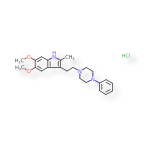
Details
| Stereochemistry | ACHIRAL |
| Molecular Formula | C23H29N3O2.ClH |
| Molecular Weight | 415.956 |
| Optical Activity | NONE |
| Defined Stereocenters | 0 / 0 |
| E/Z Centers | 0 |
| Charge | 0 |
SHOW SMILES / InChI
SMILES
Cl.COC1=C(OC)C=C2C(NC(C)=C2CCN3CCN(CC3)C4=CC=CC=C4)=C1
InChI
InChIKey=USAPVNXIZYFWLO-UHFFFAOYSA-N
InChI=1S/C23H29N3O2.ClH/c1-17-19(20-15-22(27-2)23(28-3)16-21(20)24-17)9-10-25-11-13-26(14-12-25)18-7-5-4-6-8-18;/h4-8,15-16,24H,9-14H2,1-3H3;1H
DescriptionCurator's Comment: Description was created based on several sources, including http://imr.sagepub.com/content/1/6/573.full.pdf
Curator's Comment: Description was created based on several sources, including http://imr.sagepub.com/content/1/6/573.full.pdf
Oxypertine (Equipertine, Forit, Integrin, Lanturil, Lotawin, Opertil) is a neuroleptic drug and was originally introduced as a treatment for schizophrenia in the 1960s. Oxypertine is an indole derivative with general properties similar to those of the phenothiazine, chlorpromazine. It has been given by mouth in the treatment of various psychoses including schizophrenia, mania, and disturbed behaviour, and of severe anxiety. Like reserpine and tetrabenazine, oxypertine depletes catecholamines, though not serotonin, possibly underlying its neuroleptic efficacy. The molecular structure is strongly similar to solypertine and milipertine.
Approval Year
Targets
| Primary Target | Pharmacology | Condition | Potency |
|---|---|---|---|
Target ID: CHEMBL1907610 |
54.0 nM [IC50] | ||
Target ID: CHEMBL2093868 |
210.0 nM [IC50] | ||
Target ID: CHEMBL2095179 |
|||
Target ID: Serotonin receptors |
25.0 nM [IC50] |
Conditions
| Condition | Modality | Targets | Highest Phase | Product |
|---|---|---|---|---|
| Primary | Unknown Approved UseUnknown |
|||
| Primary | FORIT Approved UseOxypertine is primarily indicated in conditions like Mania, Psychosis, Schizophrenia. |
|||
| Primary | FORIT Approved UseOxypertine is primarily indicated in conditions like Mania, Psychosis, Schizophrenia. |
AUC
| Value | Dose | Co-administered | Analyte | Population |
|---|---|---|---|---|
34 μg × min/mL EXPERIMENT https://pubmed.ncbi.nlm.nih.gov/6707118/ |
25 mg/kg single, oral dose: 25 mg/kg route of administration: Oral experiment type: SINGLE co-administered: |
1-PHENYLPIPERAZINE plasma | Rattus norvegicus population: HEALTHY age: UNKNOWN sex: MALE food status: UNKNOWN |
PubMed
| Title | Date | PubMed |
|---|---|---|
| Changes in clinical trials methodology over time: a systematic review of six decades of research in psychopharmacology. | 2010-03-03 |
|
| Atypical properties of several classes of antipsychotic drugs on the basis of differential induction of Fos-like immunoreactivity in the rat brain. | 2004-11-26 |
|
| Towards pick-and-place assembly of nanostructures. | 2004-03 |
|
| Toxicological detection of the new designer drug 1-(4-methoxyphenyl)piperazine and its metabolites in urine and differentiation from an intake of structurally related medicaments using gas chromatography-mass spectrometry. | 2003-12-25 |
|
| GAF film dosimetry of a tandem positioned beta-emitting intravascular brachytherapy source train. | 2003-06 |
|
| The "Haptic Finger"- a new device for monitoring skin condition. | 2003-05 |
|
| Enhanced separation of filamentous fungi by ultrasonic field: possible usage in repeated batch processes. | 2002-08-07 |
|
| Effects of sulpiride and oxypertine on the dopaminergic system in the rat striatum. | 1992 |
|
| Biochemical versus psychopathological action profile of neuroleptics: a comparative study of chlorpromazine and oxypertine in acute psychotic disorders. | 1975-05-01 |
Patents
| Name | Type | Language | ||
|---|---|---|---|---|
|
Preferred Name | English | ||
|
Common Name | English | ||
|
Code | English | ||
|
Systematic Name | English | ||
|
Common Name | English |
| Code System | Code | Type | Description | ||
|---|---|---|---|---|---|
|
17506-66-0
Created by
admin on Mon Mar 31 20:54:40 GMT 2025 , Edited by admin on Mon Mar 31 20:54:40 GMT 2025
|
PRIMARY | |||
|
SUB03592MIG
Created by
admin on Mon Mar 31 20:54:40 GMT 2025 , Edited by admin on Mon Mar 31 20:54:40 GMT 2025
|
PRIMARY | |||
|
169107
Created by
admin on Mon Mar 31 20:54:40 GMT 2025 , Edited by admin on Mon Mar 31 20:54:40 GMT 2025
|
PRIMARY | |||
|
DTXSID6048751
Created by
admin on Mon Mar 31 20:54:40 GMT 2025 , Edited by admin on Mon Mar 31 20:54:40 GMT 2025
|
PRIMARY | |||
|
9P131473P6
Created by
admin on Mon Mar 31 20:54:40 GMT 2025 , Edited by admin on Mon Mar 31 20:54:40 GMT 2025
|
PRIMARY | |||
|
100000085511
Created by
admin on Mon Mar 31 20:54:40 GMT 2025 , Edited by admin on Mon Mar 31 20:54:40 GMT 2025
|
PRIMARY | |||
|
38510
Created by
admin on Mon Mar 31 20:54:40 GMT 2025 , Edited by admin on Mon Mar 31 20:54:40 GMT 2025
|
PRIMARY |
SUBSTANCE RECORD