


Details
| Stereochemistry | ACHIRAL |
| Molecular Formula | C10H7Cl2N3O.ClH.H2O |
| Molecular Weight | 310.564 |
| Optical Activity | NONE |
| Defined Stereocenters | 0 / 0 |
| E/Z Centers | 0 |
| Charge | 0 |
SHOW SMILES / InChI
SMILES
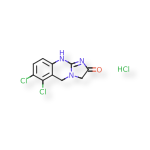
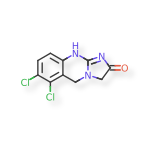
O.Cl.ClC1=CC=C2NC3=NC(=O)CN3CC2=C1Cl
InChI
InChIKey=YLFXXKJQBOJJIX-UHFFFAOYSA-N
InChI=1S/C10H7Cl2N3O.ClH.H2O/c11-6-1-2-7-5(9(6)12)3-15-4-8(16)14-10(15)13-7;;/h1-2H,3-4H2,(H,13,14,16);1H;1H2
| Molecular Formula | H2O |
| Molecular Weight | 18.0153 |
| Charge | 0 |
| Count |
|
| Stereochemistry | ACHIRAL |
| Additional Stereochemistry | No |
| Defined Stereocenters | 0 / 0 |
| E/Z Centers | 0 |
| Optical Activity | NONE |
| Molecular Formula | C10H7Cl2N3O |
| Molecular Weight | 256.088 |
| Charge | 0 |
| Count |
|
| Stereochemistry | ACHIRAL |
| Additional Stereochemistry | No |
| Defined Stereocenters | 0 / 0 |
| E/Z Centers | 0 |
| Optical Activity | NONE |
| Molecular Formula | ClH |
| Molecular Weight | 36.461 |
| Charge | 0 |
| Count |
|
| Stereochemistry | ACHIRAL |
| Additional Stereochemistry | No |
| Defined Stereocenters | 0 / 0 |
| E/Z Centers | 0 |
| Optical Activity | NONE |
DescriptionCurator's Comment: description was created based on several sources, including:
http://www.rxlist.com/agrylin-drug.htm | https://www.drugs.com/pro/anagrelide.html | https://www.ncbi.nlm.nih.gov/pubmed/20331456
Curator's Comment: description was created based on several sources, including:
http://www.rxlist.com/agrylin-drug.htm | https://www.drugs.com/pro/anagrelide.html | https://www.ncbi.nlm.nih.gov/pubmed/20331456
Anagrelide is an orally active quinazinolone derivative that was originally developed as an antiplatelet drug. The drug inhibits cyclic nucleotide phosphodiesterase III (PDEIII) and phopholipase A2, which is thought to cause the side effects of vasodilation, positive inotropism, reduced platelet aggregation. However, significant inhibition of platelet aggregation is observed only at doses of anagrelide higher than those required to reduce platelet count. It is indicated for the treatment of patients with thrombocythemia, secondary to myeloproliferative disorders. Commonly reported side effects of anagrelide include: abdominal pain, dizziness, headache, nausea, and palpitations. Other side effects include: back pain, fever, tachycardia, vomiting, and anorexia. There is a single case report, which suggests that sucralfate may interfere with anagrelide absorption. Anagrelide is an inhibitor of cyclic AMP PDE III. The effects of medicinal products with similar properties such as inotropes milrinone, enoximone, amrinone, olprinone and cilostazol may be exacerbated by anagrelide.
Originator
Approval Year
Targets
| Primary Target | Pharmacology | Condition | Potency |
|---|---|---|---|
| 36.0 nM [IC50] | |||
Target ID: Phopholipase A2 |
|||
Target ID: P05177 Gene ID: 1544.0 Gene Symbol: CYP1A2 Target Organism: Homo sapiens (Human) |
Conditions
| Condition | Modality | Targets | Highest Phase | Product |
|---|---|---|---|---|
| Primary | AGRYLIN Approved UseAnagrelide hydrochloride capsules are indicated for the treatment of patients with thrombocythemia, secondary to myeloproliferative disorders, to reduce the elevated platelet count and the risk of thrombosis and to ameliorate associated symptoms including thrombo-hemorrhagic events (see CLINICAL STUDIES, DOSAGE AND ADMINISTRATION). Launch Date1997 |
Cmax
| Value | Dose | Co-administered | Analyte | Population |
|---|---|---|---|---|
10.28 ng/mL EXPERIMENT https://www.ncbi.nlm.nih.gov/pubmed/19302911 |
2 mg single, oral dose: 2 mg route of administration: Oral experiment type: SINGLE co-administered: |
ANAGRELIDE plasma | Homo sapiens population: HEALTHY age: ADULT sex: FEMALE / MALE food status: FASTED |
AUC
| Value | Dose | Co-administered | Analyte | Population |
|---|---|---|---|---|
28.39 ng × h/mL EXPERIMENT https://www.ncbi.nlm.nih.gov/pubmed/19302911 |
2 mg single, oral dose: 2 mg route of administration: Oral experiment type: SINGLE co-administered: |
ANAGRELIDE plasma | Homo sapiens population: HEALTHY age: ADULT sex: FEMALE / MALE food status: FASTED |
T1/2
| Value | Dose | Co-administered | Analyte | Population |
|---|---|---|---|---|
1.38 h EXPERIMENT https://www.ncbi.nlm.nih.gov/pubmed/19302911 |
2 mg single, oral dose: 2 mg route of administration: Oral experiment type: SINGLE co-administered: |
ANAGRELIDE plasma | Homo sapiens population: HEALTHY age: ADULT sex: FEMALE / MALE food status: FASTED |
Doses
| Dose | Population | Adverse events |
|---|---|---|
1.9 mg 1 times / day multiple, oral Recommended Dose: 1.9 mg, 1 times / day Route: oral Route: multiple Dose: 1.9 mg, 1 times / day Sources: |
unhealthy, 58 |
Disc. AE: Dizziness postural, Palpitations... AEs leading to discontinuation/dose reduction: Dizziness postural (6.25%) Sources: Palpitations (12.5%) Chest pain (6.25%) Sinus tachycardia (6.25%) Abdominal pain (6.25%) |
1 mg 2 times / day multiple, oral Recommended Dose: 1 mg, 2 times / day Route: oral Route: multiple Dose: 1 mg, 2 times / day Sources: |
unhealthy Health Status: unhealthy Sources: |
Disc. AE: Headache, Diarrhea... AEs leading to discontinuation/dose reduction: Headache Sources: Diarrhea Edema Palpitations Abdominal pain |
10 mg 1 times / day multiple, oral Recommended Dose: 10 mg, 1 times / day Route: oral Route: multiple Dose: 10 mg, 1 times / day Sources: |
unhealthy Health Status: unhealthy Sources: |
Disc. AE: Cardiotoxicity, QT interval prolonged... AEs leading to discontinuation/dose reduction: Cardiotoxicity Sources: QT interval prolonged Ventricular tachycardia Pulmonary hypertension Bleeding |
AEs
| AE | Significance | Dose | Population |
|---|---|---|---|
| Palpitations | 12.5% Disc. AE |
1.9 mg 1 times / day multiple, oral Recommended Dose: 1.9 mg, 1 times / day Route: oral Route: multiple Dose: 1.9 mg, 1 times / day Sources: |
unhealthy, 58 |
| Abdominal pain | 6.25% Disc. AE |
1.9 mg 1 times / day multiple, oral Recommended Dose: 1.9 mg, 1 times / day Route: oral Route: multiple Dose: 1.9 mg, 1 times / day Sources: |
unhealthy, 58 |
| Chest pain | 6.25% Disc. AE |
1.9 mg 1 times / day multiple, oral Recommended Dose: 1.9 mg, 1 times / day Route: oral Route: multiple Dose: 1.9 mg, 1 times / day Sources: |
unhealthy, 58 |
| Dizziness postural | 6.25% Disc. AE |
1.9 mg 1 times / day multiple, oral Recommended Dose: 1.9 mg, 1 times / day Route: oral Route: multiple Dose: 1.9 mg, 1 times / day Sources: |
unhealthy, 58 |
| Sinus tachycardia | 6.25% Disc. AE |
1.9 mg 1 times / day multiple, oral Recommended Dose: 1.9 mg, 1 times / day Route: oral Route: multiple Dose: 1.9 mg, 1 times / day Sources: |
unhealthy, 58 |
| Abdominal pain | Disc. AE | 1 mg 2 times / day multiple, oral Recommended Dose: 1 mg, 2 times / day Route: oral Route: multiple Dose: 1 mg, 2 times / day Sources: |
unhealthy Health Status: unhealthy Sources: |
| Diarrhea | Disc. AE | 1 mg 2 times / day multiple, oral Recommended Dose: 1 mg, 2 times / day Route: oral Route: multiple Dose: 1 mg, 2 times / day Sources: |
unhealthy Health Status: unhealthy Sources: |
| Edema | Disc. AE | 1 mg 2 times / day multiple, oral Recommended Dose: 1 mg, 2 times / day Route: oral Route: multiple Dose: 1 mg, 2 times / day Sources: |
unhealthy Health Status: unhealthy Sources: |
| Headache | Disc. AE | 1 mg 2 times / day multiple, oral Recommended Dose: 1 mg, 2 times / day Route: oral Route: multiple Dose: 1 mg, 2 times / day Sources: |
unhealthy Health Status: unhealthy Sources: |
| Palpitations | Disc. AE | 1 mg 2 times / day multiple, oral Recommended Dose: 1 mg, 2 times / day Route: oral Route: multiple Dose: 1 mg, 2 times / day Sources: |
unhealthy Health Status: unhealthy Sources: |
| Bleeding | Disc. AE | 10 mg 1 times / day multiple, oral Recommended Dose: 10 mg, 1 times / day Route: oral Route: multiple Dose: 10 mg, 1 times / day Sources: |
unhealthy Health Status: unhealthy Sources: |
| Cardiotoxicity | Disc. AE | 10 mg 1 times / day multiple, oral Recommended Dose: 10 mg, 1 times / day Route: oral Route: multiple Dose: 10 mg, 1 times / day Sources: |
unhealthy Health Status: unhealthy Sources: |
| Pulmonary hypertension | Disc. AE | 10 mg 1 times / day multiple, oral Recommended Dose: 10 mg, 1 times / day Route: oral Route: multiple Dose: 10 mg, 1 times / day Sources: |
unhealthy Health Status: unhealthy Sources: |
| QT interval prolonged | Disc. AE | 10 mg 1 times / day multiple, oral Recommended Dose: 10 mg, 1 times / day Route: oral Route: multiple Dose: 10 mg, 1 times / day Sources: |
unhealthy Health Status: unhealthy Sources: |
| Ventricular tachycardia | Disc. AE | 10 mg 1 times / day multiple, oral Recommended Dose: 10 mg, 1 times / day Route: oral Route: multiple Dose: 10 mg, 1 times / day Sources: |
unhealthy Health Status: unhealthy Sources: |
Overview
| CYP3A4 | CYP2C9 | CYP2D6 | hERG |
|---|---|---|---|
OverviewOther
| Other Inhibitor | Other Substrate | Other Inducer |
|---|---|---|
Drug as perpetrator
| Target | Modality | Activity | Metabolite | Clinical evidence |
|---|---|---|---|---|
| likely | ||||
| no | ||||
| no | ||||
| no | ||||
| no | ||||
| no | ||||
| no | ||||
| no | ||||
| no | ||||
| no | ||||
| no | ||||
| no | ||||
| no | ||||
| no | ||||
| no | ||||
| yes [IC50 26.8 uM] | ||||
| yes |
Drug as victim
| Target | Modality | Activity | Metabolite | Clinical evidence |
|---|---|---|---|---|
| major | ||||
| no | ||||
| no | ||||
| no | ||||
| no | ||||
| yes | ||||
| yes |
Tox targets
| Target | Modality | Activity | Metabolite | Clinical evidence |
|---|---|---|---|---|
PubMed
| Title | Date | PubMed |
|---|---|---|
| Molecular basis of the diagnosis and treatment of polycythemia vera and essential thrombocythemia. | 2006-06-01 |
|
| Essential thrombocythemia: scientific advances and current practice. | 2006-03 |
|
| Bilateral adrenal hemorrhage associated with essential thrombocytosis. | 2006-02 |
|
| 'Double hit' from streptococcal pneumonia and hypersensitivity pneumonitis associated with anagrelide. | 2006-02 |
|
| A preliminary investigation into the action of anagrelide: thrombopoietin-c-Mpl receptor interactions. | 2006-01 |
|
| Anagrelide: a review of its use in the management of essential thrombocythaemia. | 2006 |
|
| Definition of subtypes of essential thrombocythaemia and relation to polycythaemia vera based on JAK2 V617F mutation status: a prospective study. | 2005-12-03 |
|
| [Treatment of essential thrombocythemia]. | 2005-12 |
|
| Essential thrombocythemia. | 2005-10 |
|
| Anagrelide does not exert a myelodysplastic effect on megakaryopoiesis: a comparative immunohistochemical and morphometric study with hydroxyurea. | 2005-10 |
|
| Comparison of the biological activities of anagrelide and its major metabolites in haematopoietic cell cultures. | 2005-10 |
|
| Successful outcome with anagrelide in pregnancy. | 2005-10 |
|
| Myeloproliferative disorders. | 2005-09-06 |
|
| Treatment of symptomatic patients with essential thrombocythemia: effectiveness of anagrelide. | 2005-09 |
|
| Risk-adapted therapy in essential thrombocythemia and polycythemia vera. | 2005-09 |
|
| High-output heart failure associated with anagrelide therapy for essential thrombocytosis. | 2005-08-16 |
|
| High-performance liquid chromatography-mass spectrometry method for determination of anagrelide in human plasma. | 2005-08-05 |
|
| Moyamoya syndrome in an adolescent with essential thrombocythemia: successful intracranial carotid stent placement. | 2005-08 |
|
| When and how to treat essential thrombocythemia. | 2005-07-07 |
|
| Hydroxyurea compared with anagrelide in high-risk essential thrombocythemia. | 2005-07-07 |
|
| Prediction of genotoxicity of chemical compounds by statistical learning methods. | 2005-06 |
|
| Management of patients with polycythaemia vera: results of a survey among Swedish haematologists. | 2005-06 |
|
| A critical review of anagrelide therapy in essential thrombocythemia and related disorders. | 2005-05 |
|
| Anagrelide: analysis of long-term efficacy, safety and leukemogenic potential in myeloproliferative disorders. | 2005-05 |
|
| Renal tubular injury associated with anagrelide use. | 2005-05 |
|
| [Diagnostic and therapeutic management of essential thrombocythemia in children]. | 2005-04-29 |
|
| Current treatment of myelofibrosis. | 2005-04 |
|
| Primary and secondary thrombocytosis in childhood. | 2005-04 |
|
| PDGF-A, PDGF-B, TGFbeta, and bFGF mRNA levels in patients with essential thrombocythemia treated with anagrelide. | 2005-02 |
|
| Anagrelide is effective in treating patients with hydroxyurea-resistant thrombocytosis in patients with chronic myeloid leukemia. | 2005-01 |
|
| [Anagrelide in the treatment of thrombocythemia essential (ET)]. | 2004-12 |
|
| [Retrospective analysis of the clinical course of 12 children given the diagnosis essential thrombocythemia]. | 2004-11-27 |
|
| Anagrelide for thrombocytosis in myeloproliferative disorders: a prospective study to assess efficacy and adverse event profile. | 2004-11-15 |
|
| Anagrelide-associated cardiomyopathy in polycythemia vera and essential thrombocythemia. | 2004-11 |
|
| A long-term study of young patients with essential thrombocythemia treated with anagrelide. | 2004-11 |
|
| [Unclear liver fibrosis in a 42-year-old patient with polycythemia vera]. | 2004-11 |
|
| Anagrelide therapy in pregnancy: report of a case of essential thrombocythemia. | 2004-11 |
|
| Anagrelide treatment in 52 patients with chronic myeloproliferative diseases. | 2004-10 |
|
| Effects of anagrelide on platelet factor 4 and vascular endothelial growth factor levels in patients with essential thrombocythemia. | 2004-09 |
|
| Anagrelide-induced visual hallucinations in a patient with essential thrombocythemia. | 2004-09 |
|
| Anagrelide: an update on its mechanisms of action and therapeutic potential. | 2004-08 |
|
| Anagrelide: a decade of clinical experience with its use for the treatment of primary thrombocythaemia. | 2004-08 |
|
| Thrombocytosis. | 2004-06-10 |
|
| Essential thrombocythemia-related acute ST-segment elevation myocardial infarction. A case report and literature review. | 2004-05-25 |
|
| Essential thrombocythaemia in children: is a treatment needed? | 2004-05 |
|
| Adverse effects and benefits of two years of anagrelide treatment for thrombocythemia in chronic myeloproliferative disorders. | 2004-05 |
|
| Treatment paradigms in the management of myeloproliferative disorders. | 2004-04 |
|
| The leukemia controversy in myeloproliferative disorders: is it a natural progression of disease, a secondary sequela of therapy, or a combination of both? | 2004-04 |
|
| Management of the myeloproliferative disorders : distinguishing data from dogma. | 2004 |
|
| New approaches to the treatment of thrombocytosis. | 2003-02 |
Sample Use Guides
0.5 mg qid or 1 mg bid (2 capsules of 0.5 mg twice a day) for at least one week
Route of Administration:
Oral
Anagrelide was studied as an inhibitor of PDE fractions I, II and III separated from each other from rabbit heart supernatant. Anagrelide did not inhibit PDE I or II except at a concentration of 10(-4) M where inhibition of 33 and 39%, respectively, was noted. As expected, anagrelide inhibited PDE fraction III with a dose-response curve that was closely similar to that seen in the human platelet preparation. The IC50 for inhibition of the rabbit heart PDE fraction III was 7 x 10(-8) M.
| Substance Class |
Chemical
Created
by
admin
on
Edited
Mon Mar 31 20:04:46 GMT 2025
by
admin
on
Mon Mar 31 20:04:46 GMT 2025
|
| Record UNII |
YTM763Y5C8
|
| Record Status |
Validated (UNII)
|
| Record Version |
|
-
Download
| Name | Type | Language | ||
|---|---|---|---|---|
|
Preferred Name | English | ||
|
Official Name | English | ||
|
Systematic Name | English | ||
|
Common Name | English | ||
|
Brand Name | English | ||
|
Common Name | English | ||
|
Common Name | English | ||
|
Common Name | English | ||
|
Brand Name | English | ||
|
Common Name | English | ||
|
Systematic Name | English | ||
|
Code | English | ||
|
Common Name | English | ||
|
Brand Name | English | ||
|
Common Name | English | ||
|
Common Name | English | ||
|
Code | English |
| Classification Tree | Code System | Code | ||
|---|---|---|---|---|
|
EMA ASSESSMENT REPORTS |
XAGRID (AUTHORIZED: THROMBOCYTHEMIA, ESSENTIAL)
Created by
admin on Mon Mar 31 20:04:46 GMT 2025 , Edited by admin on Mon Mar 31 20:04:46 GMT 2025
|
| Code System | Code | Type | Description | ||
|---|---|---|---|---|---|
|
100000137355
Created by
admin on Mon Mar 31 20:04:46 GMT 2025 , Edited by admin on Mon Mar 31 20:04:46 GMT 2025
|
PRIMARY | |||
|
135565321
Created by
admin on Mon Mar 31 20:04:46 GMT 2025 , Edited by admin on Mon Mar 31 20:04:46 GMT 2025
|
PRIMARY | |||
|
YTM763Y5C8
Created by
admin on Mon Mar 31 20:04:46 GMT 2025 , Edited by admin on Mon Mar 31 20:04:46 GMT 2025
|
PRIMARY | |||
|
1034738
Created by
admin on Mon Mar 31 20:04:46 GMT 2025 , Edited by admin on Mon Mar 31 20:04:46 GMT 2025
|
PRIMARY | |||
|
823178-43-4
Created by
admin on Mon Mar 31 20:04:46 GMT 2025 , Edited by admin on Mon Mar 31 20:04:46 GMT 2025
|
PRIMARY | |||
|
C183131
Created by
admin on Mon Mar 31 20:04:46 GMT 2025 , Edited by admin on Mon Mar 31 20:04:46 GMT 2025
|
PRIMARY | |||
|
SUB75321
Created by
admin on Mon Mar 31 20:04:46 GMT 2025 , Edited by admin on Mon Mar 31 20:04:46 GMT 2025
|
PRIMARY | |||
|
YTM763Y5C8
Created by
admin on Mon Mar 31 20:04:46 GMT 2025 , Edited by admin on Mon Mar 31 20:04:46 GMT 2025
|
PRIMARY |
| Related Record | Type | Details | ||
|---|---|---|---|---|
|
BASIS OF STRENGTH->SUBSTANCE |
ASSAY (HPLC)
USP
|
||
|
ANHYDROUS->SOLVATE |
|
||
|
|
PARENT -> SALT/SOLVATE |
|
| Related Record | Type | Details | ||
|---|---|---|---|---|
|
IMPURITY -> PARENT |
|
||
|
IMPURITY -> PARENT |
CHROMATOGRAPHIC PURITY (HPLC/UV)
USP
|
||
|
|
IMPURITY -> PARENT |
Starting Material of AGL KSM
|
||
|
IMPURITY -> PARENT |
CHROMATOGRAPHIC PURITY (HPLC/UV)
USP
|
||
|
|
IMPURITY -> PARENT |
|
||
|
IMPURITY -> PARENT |
CHROMATOGRAPHIC PURITY (HPLC/UV)
USP
|
||
|
IMPURITY -> PARENT |
|
||
|
IMPURITY -> PARENT |
CHROMATOGRAPHIC PURITY (HPLC/UV)
USP
|
||
|
IMPURITY -> PARENT |
CHROMATOGRAPHIC PURITY (HPLC/UV)
USP
|
| Related Record | Type | Details | ||
|---|---|---|---|---|
|
|
ACTIVE MOIETY |
|