


Details
| Stereochemistry | ACHIRAL |
| Molecular Formula | C8H8NO2.Na |
| Molecular Weight | 173.1444 |
| Optical Activity | NONE |
| Defined Stereocenters | 0 / 0 |
| E/Z Centers | 0 |
| Charge | 0 |
SHOW SMILES / InChI
SMILES
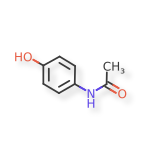
[Na+].CC(=O)NC1=CC=C([O-])C=C1
InChI
InChIKey=QOGCGSWEVWTHNX-UHFFFAOYSA-M
InChI=1S/C8H9NO2.Na/c1-6(10)9-7-2-4-8(11)5-3-7;/h2-5,11H,1H3,(H,9,10);/q;+1/p-1
| Molecular Formula | C8H8NO2 |
| Molecular Weight | 150.1546 |
| Charge | -1 |
| Count |
|
| Stereochemistry | ACHIRAL |
| Additional Stereochemistry | No |
| Defined Stereocenters | 0 / 0 |
| E/Z Centers | 0 |
| Optical Activity | NONE |
| Molecular Formula | Na |
| Molecular Weight | 22.98976928 |
| Charge | 1 |
| Count |
|
| Stereochemistry | ACHIRAL |
| Additional Stereochemistry | No |
| Defined Stereocenters | 0 / 0 |
| E/Z Centers | 0 |
| Optical Activity | NONE |
Acetaminophen, also known as paracetamol, is commonly used for its analgesic and antipyretic effects. Its therapeutic effects are similar to salicylates, but it lacks anti-inflammatory, antiplatelet, and gastric ulcerative effects. Acetaminophen (USAN) or Paracetamol (INN) is a widely used analgesic and antipyretic drug that is used for the relief of fever, headaches, and other minor aches and pains. It is a major ingredient in numerous cold and flu medications and many prescription analgesics. It is extremely safe in standard doses, but because of its wide availability, deliberate or accidental overdoses are not uncommon. Acetaminophen, unlike other common analgesics such as aspirin and ibuprofen, has no anti-inflammatory properties or effects on platelet function, and it is not a member of the class of drugs known as non-steroidal anti-inflammatory drugs or NSAIDs. At therapeutic doses, acetaminophen does not irritate the lining of the stomach nor affect blood coagulation, kidney function, or the fetal ductus arteriosus (as NSAIDs can). Acetaminophen is thought to act primarily in the CNS, increasing the pain threshold by inhibiting both isoforms of cyclooxygenase, COX-1, COX-2, and COX-3 enzymes involved in prostaglandin (PG) synthesis. Unlike NSAIDs, acetaminophen does not inhibit cyclooxygenase in peripheral tissues and, thus, has no peripheral anti-inflammatory affects. Acetaminophen indirectly blocks COX, and that this blockade is ineffective in the presence of peroxides. This might explain why acetaminophen is effective in the central nervous system and in endothelial cells but not in platelets and immune cells, which have high levels of peroxides. Studies also report data suggesting that acetaminophen selectively blocks a variant of the COX enzyme that is different from the known variants COX-1 and COX-2. This enzyme is now referred to as COX-3. Its exact mechanism of action is still poorly understood, but future research may provide further insight into how it works. The antipyretic properties of acetaminophen are likely due to direct effects on the heat-regulating centers of the hypothalamus resulting in peripheral vasodilation, sweating and hence heat dissipation.
CNS Activity
Approval Year
Targets
| Primary Target | Pharmacology | Condition | Potency |
|---|---|---|---|
Target ID: CHEMBL2094253 |
Conditions
| Condition | Modality | Targets | Highest Phase | Product |
|---|---|---|---|---|
| Palliative | TYLENOL Approved UseUses temporarily relieves minor aches and pains due to: minor pain of arthritis, muscular aches, backache, premenstrual abd menstrual cramps, the common cold, headache, toochache; temporary reduce fever Launch Date1994 |
|||
| Palliative | TYLENOL Approved UseUses temporarily relieves minor aches and pains due to: minor pain of arthritis, muscular aches, backache, premenstrual abd menstrual cramps, the common cold, headache, toochache; temporary reduce fever Launch Date1994 |
|||
| Palliative | TYLENOL Approved UseUses temporarily relieves minor aches and pains due to: minor pain of arthritis, muscular aches, backache, premenstrual abd menstrual cramps, the common cold, headache, toochache; temporary reduce fever Launch Date1994 |
|||
| Palliative | TYLENOL Approved UseUses temporarily relieves minor aches and pains due to: minor pain of arthritis, muscular aches, backache, premenstrual abd menstrual cramps, the common cold, headache, toochache; temporary reduce fever Launch Date1994 |
|||
| Palliative | TYLENOL Approved UseUses temporarily relieves minor aches and pains due to: minor pain of arthritis, muscular aches, backache, premenstrual abd menstrual cramps, the common cold, headache, toochache; temporary reduce fever Launch Date1994 |
Cmax
| Value | Dose | Co-administered | Analyte | Population |
|---|---|---|---|---|
28 μg/mL |
1000 mg single, intravenous dose: 1000 mg route of administration: Intravenous experiment type: SINGLE co-administered: |
ACETAMINOPHEN plasma | Homo sapiens population: UNKNOWN age: ADULT sex: UNKNOWN food status: UNKNOWN |
AUC
| Value | Dose | Co-administered | Analyte | Population |
|---|---|---|---|---|
43 μg × h/mL |
1000 mg single, intravenous dose: 1000 mg route of administration: Intravenous experiment type: SINGLE co-administered: |
ACETAMINOPHEN plasma | Homo sapiens population: UNKNOWN age: ADULT sex: UNKNOWN food status: UNKNOWN |
T1/2
| Value | Dose | Co-administered | Analyte | Population |
|---|---|---|---|---|
2.4 h |
1000 mg single, intravenous dose: 1000 mg route of administration: Intravenous experiment type: SINGLE co-administered: |
ACETAMINOPHEN plasma | Homo sapiens population: UNKNOWN age: ADULT sex: UNKNOWN food status: UNKNOWN |
Overview
| CYP3A4 | CYP2C9 | CYP2D6 | hERG |
|---|---|---|---|
OverviewOther
Drug as perpetrator
| Target | Modality | Activity | Metabolite | Clinical evidence |
|---|---|---|---|---|
Page: - |
no | |||
Page: - |
yes [Ki 2300 uM] | |||
Page: - |
yes [Ki 5300 uM] |
Drug as victim
| Target | Modality | Activity | Metabolite | Clinical evidence |
|---|---|---|---|---|
| major | ||||
| no | ||||
| no | ||||
Page: - |
no | |||
Page: - |
no | |||
Page: - |
no | |||
Page: - |
no | |||
Page: - |
yes [Km 1500 uM] | |||
Page: - |
yes [Km 1900 uM] | |||
Page: - |
yes [Km 2300 uM] | |||
Page: - |
yes [Km 3700 uM] | |||
Page: - |
yes [Km 4000 uM] | |||
Page: - |
yes [Km 5500 uM] | |||
| yes | ||||
| yes | ||||
| yes | ||||
| yes | ||||
| yes | ||||
| yes | ||||
Page: - |
yes | |||
Page: - |
yes | |||
Page: - |
yes | |||
Page: - |
yes | |||
Page: - |
yes |
PubMed
| Title | Date | PubMed |
|---|---|---|
| Pharmacokinetics of oral diclofenac and acetaminophen in children after surgery. | 2001-03 |
|
| Experimental and theoretical microdialysis studies of in situ metabolism. | 2001-03 |
|
| Pediatric acetaminophen poisoning. | 2001-03 |
|
| A comparison of ropivacaine and bupivacaine for cervical plexus block. | 2001-03 |
|
| Allergic reactions due to ibuprofen in children. | 2001-02-24 |
|
| Idiosyncratic acute hepatitis caused by paracetamol in two patients with melanoma treated with high-dose interferon-alpha. | 2001-02-20 |
|
| The role of acetaminophen in the management of patients with osteoarthritis. | 2001-02-19 |
|
| [About paracetamol again]. | 2001-02-18 |
|
| Hemolytic anemia after acetaminophen overdose in patient with glucose-6-phosphate dehydrogenase deficiency. | 2001-02-15 |
|
| Clinical trial of an air-circulating cooling blanket for fever control in critically ill neurologic patients. | 2001-02-13 |
|
| Pragmatic randomised controlled trial of two prescribing strategies for childhood acute otitis media. | 2001-02-10 |
|
| ABC of diseases of liver, pancreas, and biliary system. Other causes of parenchymal liver disease. | 2001-02-03 |
|
| Thermodynamic analysis of compact formation; compaction, unloading, and ejection. II. Mechanical energy (work) and thermal energy (heat) determinations of compact unloading and ejection. | 2001-02-01 |
|
| Protective effect of stiripentol on acetaminophen-induced hepatotoxicity in rat. | 2001-02-01 |
|
| Let the user beware. OTC drugs aren't necessarily 'safe when taken as directed.'. | 2001-02 |
|
| Opioids for chronic nonmalignant pain. Attitudes and practices of primary care physicians in the UCSF/Stanford Collaborative Research Network. University of California, San Francisco. | 2001-02 |
|
| Pharmacokinetics of acetaminophen from rapidly disintegrating compressed tablet prepared using microcrystalline cellulose (PH-M-06) and spherical sugar granules. | 2001-02 |
|
| Preparation of rapidly disintegrating tablet using new types of microcrystalline cellulose (PH-M series) and low substituted-hydroxypropylcellulose or spherical sugar granules by direct compression method. | 2001-02 |
|
| Effect of coadministered drugs and ethanol on the binding of therapeutic drugs to human serum in vitro. | 2001-02 |
|
| Urine drug screens in overdose patients do not contribute to immediate clinical management. | 2001-02 |
|
| A novel pH-sensitive membrane from chitosan--TEOS IPN; preparation and its drug permeation characteristics. | 2001-02 |
|
| Management of drug-induced liver disease. | 2001-02 |
|
| Postoperative analgesia at home after ambulatory hand surgery: a controlled comparison of tramadol, metamizol, and paracetamol. | 2001-02 |
|
| Stroke severity determines body temperature in acute stroke. | 2001-02 |
|
| Unexpected and pronounced antinociceptive synergy between spinal acetaminophen (paracetamol) and phentolamine. | 2001-01-26 |
|
| Prevention of acetaminophen-induced liver toxicity by 2(R,S)-n-propylthiazolidine-4(R)-carboxylic acid in mice. | 2001-01-15 |
|
| [Dexketoprofen-trometamol and tramadol in acute lumbago]. | 2001-01-11 |
|
| Using evidence from different sources: an example using paracetamol 1000 mg plus codeine 60 mg. | 2001-01-10 |
|
| Nonsteroidal anti-inflammatory drugs: overused or underused in osteoarthritis? | 2001-01-08 |
|
| Paracetamol (acetaminophen)-induced toxicity: molecular and biochemical mechanisms, analogues and protective approaches. | 2001-01 |
|
| Acetaminophen toxicity induced non-oliguric acute tubular necrosis. | 2001-01 |
|
| Simultaneous determination of paracetamol and methocarbamol in tablets by ratio spectra derivative spectrophotometry and LC. | 2001-01 |
|
| NSAID impairment of orthodontic tooth movement. | 2001-01 |
|
| Separation of cold medicine ingredients by capillary electrophoresis. | 2001-01 |
|
| Single and multiple dose pharmacokinetics of acetaminophen (paracetamol) in polymedicated very old patients with rheumatic pain. | 2001-01 |
|
| Misoprostol therapeutics revisited. | 2001-01 |
|
| Economic evaluation alongside n-of-1 trials: getting closer to the margin. | 2001-01 |
|
| Successful use of propranolol in migraine associated with electroconvulsive therapy. | 2001-01 |
|
| Risk factors in the development of adverse reactions to N-acetylcysteine in patients with paracetamol poisoning. | 2001-01 |
|
| The dark side of a 'detoxification' mechanism. | 2001-01 |
|
| A comparison of the effect of nitroparacetamol and paracetamol on liver injury. | 2001-01 |
|
| One hundred percent online identity check of pharmaceutical products by near-infrared spectroscopy on the packaging line. | 2001-01 |
|
| Preoperative rectal diclofenac versus paracetamol for tonsillectomy: effects on pain and blood loss. | 2001-01 |
|
| Treatment with paracetamol in infants. | 2001-01 |
|
| Risk of upper gastrointestinal bleeding and perforation associated with low-dose aspirin as plain and enteric-coated formulations. | 2001 |
|
| The risk of upper gastrointestinal complications associated with nonsteroidal anti-inflammatory drugs, glucocorticoids, acetaminophen, and combinations of these agents. | 2001 |
|
| p-Aminophenol-induced liver toxicity: tentative evidence of a role for acetaminophen. | 2001 |
|
| Administering granulocyte colony-stimulating factor to acute liver failure patients corrects neutrophil defects. | 2000-12 |
|
| Tissue distribution and interindividual variation in human UDP-glucuronosyltransferase activity: relationship between UGT1A1 promoter genotype and variability in a liver bank. | 2000-11 |
|
| Establishment of a human hepatoma cell line, HLE/2E1, suitable for detection of p450 2E1-related cytotoxicity. | 2000-10 |
Patents
Sample Use Guides
2 caplets every 8 hours with water; don't take more than 6 caplets in 24 hours
Route of Administration:
Oral
| Substance Class |
Chemical
Created
by
admin
on
Edited
Wed Apr 02 12:59:42 GMT 2025
by
admin
on
Wed Apr 02 12:59:42 GMT 2025
|
| Record UNII |
V9E6HW6ZAG
|
| Record Status |
Validated (UNII)
|
| Record Version |
|
-
Download
| Name | Type | Language | ||
|---|---|---|---|---|
|
Preferred Name | English | ||
|
Common Name | English | ||
|
Common Name | English | ||
|
Systematic Name | English | ||
|
Common Name | English |
| Code System | Code | Type | Description | ||
|---|---|---|---|---|---|
|
V9E6HW6ZAG
Created by
admin on Wed Apr 02 12:59:42 GMT 2025 , Edited by admin on Wed Apr 02 12:59:42 GMT 2025
|
PRIMARY | |||
|
16958-94-4
Created by
admin on Wed Apr 02 12:59:42 GMT 2025 , Edited by admin on Wed Apr 02 12:59:42 GMT 2025
|
PRIMARY | |||
|
23667500
Created by
admin on Wed Apr 02 12:59:42 GMT 2025 , Edited by admin on Wed Apr 02 12:59:42 GMT 2025
|
PRIMARY |
| Related Record | Type | Details | ||
|---|---|---|---|---|
|
PARENT -> SALT/SOLVATE |
|
| Related Record | Type | Details | ||
|---|---|---|---|---|
|
ACTIVE MOIETY |
|