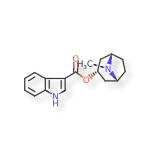
Details
| Stereochemistry | ACHIRAL |
| Molecular Formula | C17H20N2O2.C6H8O7 |
| Molecular Weight | 476.4764 |
| Optical Activity | UNSPECIFIED |
| Defined Stereocenters | 3 / 3 |
| E/Z Centers | 0 |
| Charge | 0 |
SHOW SMILES / InChI
SMILES
OC(=O)CC(O)(CC(O)=O)C(O)=O.CN1[C@H]2CC[C@@H]1C[C@@H](C2)OC(=O)C3=CNC4=C3C=CC=C4
InChI
InChIKey=YFGSHODXSPKSDQ-LUNMCBQDSA-N
InChI=1S/C17H20N2O2.C6H8O7/c1-19-11-6-7-12(19)9-13(8-11)21-17(20)15-10-18-16-5-3-2-4-14(15)16;7-3(8)1-6(13,5(11)12)2-4(9)10/h2-5,10-13,18H,6-9H2,1H3;13H,1-2H2,(H,7,8)(H,9,10)(H,11,12)/t11-,12+,13+;
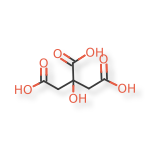
| Molecular Formula | C6H8O7 |
| Molecular Weight | 192.1235 |
| Charge | 0 |
| Count |
|
| Stereochemistry | ACHIRAL |
| Additional Stereochemistry | No |
| Defined Stereocenters | 0 / 0 |
| E/Z Centers | 0 |
| Optical Activity | NONE |
| Molecular Formula | C17H20N2O2 |
| Molecular Weight | 284.3529 |
| Charge | 0 |
| Count |
|
| Stereochemistry | ABSOLUTE |
| Additional Stereochemistry | No |
| Defined Stereocenters | 3 / 3 |
| E/Z Centers | 0 |
| Optical Activity | UNSPECIFIED |
DescriptionCurator's Comment: description was created based on several sources, including
https://www.ncbi.nlm.nih.gov/pubmed/7507039
Curator's Comment: description was created based on several sources, including
https://www.ncbi.nlm.nih.gov/pubmed/7507039
Tropisetron (Tropisetron-AFT) is a potent and selective serotonin 3 (5-hydroxytryptamine3; 5-HT3) receptor antagonist with antiemetic properties, probably mediated via antagonism of receptors both at peripheral sites and in the central nervous system. Surgery and treatment with certain substances, including some chemotherapeutic agents, may trigger the release of serotonin from enterochromaffin-like cells in the visceral mucosa and initiate the emesis reflex and its accompanying feeling of nausea. Tropisetron (Tropisetron-AFT) selectively blocks the excitation of the presynaptic 5-HT3 receptors of the peripheral neurons in this reflex, and may exert additional direct actions within the CNS on 5-HT3 receptors mediating the actions of vagal input to the area postrema.
CNS Activity
Approval Year
Targets
| Primary Target | Pharmacology | Condition | Potency |
|---|---|---|---|
Target ID: CHEMBL1899 |
8.48 null [pKi] |
Conditions
| Condition | Modality | Targets | Highest Phase | Product |
|---|---|---|---|---|
| Curative | Tropisetron-AFT Approved UseFor the prevention of nausea and vomiting induced by cytotoxic therapy (5 mg/5 mL ampoule only).
For the treatment and prevention of post-operative nausea and vomiting in adults (2 mg/2 mL ampoule only). Launch Date2012 |
|||
| Preventing | Tropisetron-AFT Approved UseFor the prevention of nausea and vomiting induced by cytotoxic therapy (5 mg/5 mL ampoule only).
For the treatment and prevention of post-operative nausea and vomiting in adults (2 mg/2 mL ampoule only). Launch Date2012 |
|||
| Preventing | Tropisetron-AFT Approved UseFor the prevention of nausea and vomiting induced by cytotoxic therapy (5 mg/5 mL ampoule only).
For the treatment and prevention of post-operative nausea and vomiting in adults (2 mg/2 mL ampoule only). Launch Date2012 |
Cmax
| Value | Dose | Co-administered | Analyte | Population |
|---|---|---|---|---|
15.1 ng/mL CLINICAL TRIAL https://pubmed.ncbi.nlm.nih.gov/11736884/ |
2 mg single, intravenous dose: 2 mg route of administration: Intravenous experiment type: SINGLE co-administered: |
TROPISETRON plasma | Homo sapiens population: HEALTHY age: ADULT sex: FEMALE / MALE food status: FASTED |
|
3.46 ng/mL CLINICAL TRIAL https://pubmed.ncbi.nlm.nih.gov/11736884/ |
5 mg single, oral dose: 5 mg route of administration: Oral experiment type: SINGLE co-administered: |
TROPISETRON plasma | Homo sapiens population: HEALTHY age: ADULT sex: FEMALE / MALE food status: FASTED |
|
84 mg/mL |
10 mg single, oral dose: 10 mg route of administration: Oral experiment type: SINGLE co-administered: |
TROPISETRON plasma | Homo sapiens population: HEALTHY age: UNKNOWN sex: UNKNOWN food status: UNKNOWN |
|
76 mg/mL |
10 mg single, oral dose: 10 mg route of administration: Oral experiment type: SINGLE co-administered: |
TROPISETRON plasma | Homo sapiens population: UNHEALTHY age: ADULT sex: UNKNOWN food status: UNKNOWN |
|
150 mg/mL |
10 mg single, oral dose: 10 mg route of administration: Oral experiment type: SINGLE co-administered: |
TROPISETRON plasma | Homo sapiens population: UNHEALTHY age: ADULT sex: UNKNOWN food status: UNKNOWN |
|
211 mg/mL |
10 mg single, oral dose: 10 mg route of administration: Oral experiment type: SINGLE co-administered: |
TROPISETRON plasma | Homo sapiens population: UNHEALTHY age: ADULT sex: UNKNOWN food status: UNKNOWN |
|
82 mg/mL |
10 mg single, oral dose: 10 mg route of administration: Oral experiment type: SINGLE co-administered: |
TROPISETRON plasma | Homo sapiens population: HEALTHY age: ADULT sex: UNKNOWN food status: UNKNOWN |
AUC
| Value | Dose | Co-administered | Analyte | Population |
|---|---|---|---|---|
20.7 ng × h/mL CLINICAL TRIAL https://pubmed.ncbi.nlm.nih.gov/11736884/ |
2 mg single, intravenous dose: 2 mg route of administration: Intravenous experiment type: SINGLE co-administered: |
TROPISETRON plasma | Homo sapiens population: HEALTHY age: ADULT sex: FEMALE / MALE food status: FASTED |
|
32.9 ng × h/mL CLINICAL TRIAL https://pubmed.ncbi.nlm.nih.gov/11736884/ |
5 mg single, oral dose: 5 mg route of administration: Oral experiment type: SINGLE co-administered: |
TROPISETRON plasma | Homo sapiens population: HEALTHY age: ADULT sex: FEMALE / MALE food status: FASTED |
|
239 mg × h/mL |
10 mg single, oral dose: 10 mg route of administration: Oral experiment type: SINGLE co-administered: |
TROPISETRON plasma | Homo sapiens population: HEALTHY age: UNKNOWN sex: UNKNOWN food status: UNKNOWN |
|
195 mg × h/mL |
10 mg single, oral dose: 10 mg route of administration: Oral experiment type: SINGLE co-administered: |
TROPISETRON plasma | Homo sapiens population: UNHEALTHY age: ADULT sex: UNKNOWN food status: UNKNOWN |
|
410 mg × h/mL |
10 mg single, oral dose: 10 mg route of administration: Oral experiment type: SINGLE co-administered: |
TROPISETRON plasma | Homo sapiens population: UNHEALTHY age: ADULT sex: UNKNOWN food status: UNKNOWN |
|
450 mg × h/mL |
10 mg single, oral dose: 10 mg route of administration: Oral experiment type: SINGLE co-administered: |
TROPISETRON plasma | Homo sapiens population: UNHEALTHY age: ADULT sex: UNKNOWN food status: UNKNOWN |
|
1192 mg × h/mL |
10 mg single, oral dose: 10 mg route of administration: Oral experiment type: SINGLE co-administered: |
TROPISETRON plasma | Homo sapiens population: HEALTHY age: ADULT sex: UNKNOWN food status: UNKNOWN |
T1/2
| Value | Dose | Co-administered | Analyte | Population |
|---|---|---|---|---|
5.6 h CLINICAL TRIAL https://pubmed.ncbi.nlm.nih.gov/11736884/ |
2 mg single, intravenous dose: 2 mg route of administration: Intravenous experiment type: SINGLE co-administered: |
TROPISETRON plasma | Homo sapiens population: HEALTHY age: ADULT sex: FEMALE / MALE food status: FASTED |
|
5.7 h CLINICAL TRIAL https://pubmed.ncbi.nlm.nih.gov/11736884/ |
5 mg single, oral dose: 5 mg route of administration: Oral experiment type: SINGLE co-administered: |
TROPISETRON plasma | Homo sapiens population: HEALTHY age: ADULT sex: FEMALE / MALE food status: FASTED |
|
7.3 h |
10 mg single, oral dose: 10 mg route of administration: Oral experiment type: SINGLE co-administered: |
TROPISETRON plasma | Homo sapiens population: HEALTHY age: UNKNOWN sex: UNKNOWN food status: UNKNOWN |
|
6.7 h |
10 mg single, oral dose: 10 mg route of administration: Oral experiment type: SINGLE co-administered: |
TROPISETRON plasma | Homo sapiens population: UNHEALTHY age: ADULT sex: UNKNOWN food status: UNKNOWN |
|
13.5 h |
10 mg single, oral dose: 10 mg route of administration: Oral experiment type: SINGLE co-administered: |
TROPISETRON plasma | Homo sapiens population: UNHEALTHY age: ADULT sex: UNKNOWN food status: UNKNOWN |
|
12.1 h |
10 mg single, oral dose: 10 mg route of administration: Oral experiment type: SINGLE co-administered: |
TROPISETRON plasma | Homo sapiens population: UNHEALTHY age: ADULT sex: UNKNOWN food status: UNKNOWN |
|
30.3 h |
10 mg single, oral dose: 10 mg route of administration: Oral experiment type: SINGLE co-administered: |
TROPISETRON plasma | Homo sapiens population: HEALTHY age: ADULT sex: UNKNOWN food status: UNKNOWN |
Funbound
| Value | Dose | Co-administered | Analyte | Population |
|---|---|---|---|---|
41% |
TROPISETRON plasma | Homo sapiens population: UNKNOWN age: UNKNOWN sex: UNKNOWN food status: UNKNOWN |
Doses
| Dose | Population | Adverse events |
|---|---|---|
15 mg 1 times / day multiple, oral Highest studied dose Dose: 15 mg, 1 times / day Route: oral Route: multiple Dose: 15 mg, 1 times / day Sources: |
unhealthy, ADULT Health Status: unhealthy Age Group: ADULT Sex: M+F Food Status: FASTED Sources: |
Disc. AE: Nausea, Hypoglycemia... AEs leading to discontinuation/dose reduction: Nausea (2.4%) Sources: Hypoglycemia (2.4%) |
50 mg 1 times / day multiple, oral Highest studied dose Dose: 50 mg, 1 times / day Route: oral Route: multiple Dose: 50 mg, 1 times / day Sources: |
unhealthy, ADULT Health Status: unhealthy Age Group: ADULT Sex: M+F Food Status: FASTED Sources: |
Disc. AE: Constipation, Skin reaction... AEs leading to discontinuation/dose reduction: Constipation (4%) Sources: Skin reaction (4%) |
20 mg 1 times / day multiple, oral Recommended Dose: 20 mg, 1 times / day Route: oral Route: multiple Dose: 20 mg, 1 times / day Sources: |
unhealthy, ADULT Health Status: unhealthy Age Group: ADULT Sex: F Food Status: UNKNOWN Sources: |
Disc. AE: Fever, Macular rash... AEs leading to discontinuation/dose reduction: Fever Sources: Macular rash Hypotension (grade 1) Joint aches Lymphadenopathy cervical |
AEs
| AE | Significance | Dose | Population |
|---|---|---|---|
| Hypoglycemia | 2.4% Disc. AE |
15 mg 1 times / day multiple, oral Highest studied dose Dose: 15 mg, 1 times / day Route: oral Route: multiple Dose: 15 mg, 1 times / day Sources: |
unhealthy, ADULT Health Status: unhealthy Age Group: ADULT Sex: M+F Food Status: FASTED Sources: |
| Nausea | 2.4% Disc. AE |
15 mg 1 times / day multiple, oral Highest studied dose Dose: 15 mg, 1 times / day Route: oral Route: multiple Dose: 15 mg, 1 times / day Sources: |
unhealthy, ADULT Health Status: unhealthy Age Group: ADULT Sex: M+F Food Status: FASTED Sources: |
| Constipation | 4% Disc. AE |
50 mg 1 times / day multiple, oral Highest studied dose Dose: 50 mg, 1 times / day Route: oral Route: multiple Dose: 50 mg, 1 times / day Sources: |
unhealthy, ADULT Health Status: unhealthy Age Group: ADULT Sex: M+F Food Status: FASTED Sources: |
| Skin reaction | 4% Disc. AE |
50 mg 1 times / day multiple, oral Highest studied dose Dose: 50 mg, 1 times / day Route: oral Route: multiple Dose: 50 mg, 1 times / day Sources: |
unhealthy, ADULT Health Status: unhealthy Age Group: ADULT Sex: M+F Food Status: FASTED Sources: |
| Fever | Disc. AE | 20 mg 1 times / day multiple, oral Recommended Dose: 20 mg, 1 times / day Route: oral Route: multiple Dose: 20 mg, 1 times / day Sources: |
unhealthy, ADULT Health Status: unhealthy Age Group: ADULT Sex: F Food Status: UNKNOWN Sources: |
| Joint aches | Disc. AE | 20 mg 1 times / day multiple, oral Recommended Dose: 20 mg, 1 times / day Route: oral Route: multiple Dose: 20 mg, 1 times / day Sources: |
unhealthy, ADULT Health Status: unhealthy Age Group: ADULT Sex: F Food Status: UNKNOWN Sources: |
| Lymphadenopathy cervical | Disc. AE | 20 mg 1 times / day multiple, oral Recommended Dose: 20 mg, 1 times / day Route: oral Route: multiple Dose: 20 mg, 1 times / day Sources: |
unhealthy, ADULT Health Status: unhealthy Age Group: ADULT Sex: F Food Status: UNKNOWN Sources: |
| Macular rash | Disc. AE | 20 mg 1 times / day multiple, oral Recommended Dose: 20 mg, 1 times / day Route: oral Route: multiple Dose: 20 mg, 1 times / day Sources: |
unhealthy, ADULT Health Status: unhealthy Age Group: ADULT Sex: F Food Status: UNKNOWN Sources: |
| Hypotension | grade 1 Disc. AE |
20 mg 1 times / day multiple, oral Recommended Dose: 20 mg, 1 times / day Route: oral Route: multiple Dose: 20 mg, 1 times / day Sources: |
unhealthy, ADULT Health Status: unhealthy Age Group: ADULT Sex: F Food Status: UNKNOWN Sources: |
Overview
| CYP3A4 | CYP2C9 | CYP2D6 | hERG |
|---|---|---|---|
OverviewOther
| Other Inhibitor | Other Substrate | Other Inducer |
|---|---|---|
Drug as perpetrator
| Target | Modality | Activity | Metabolite | Clinical evidence |
|---|---|---|---|---|
| inconclusive [IC50 0.5012 uM] | ||||
| inconclusive [IC50 31.6228 uM] | ||||
| moderate [IC50 31.3 uM] | ||||
| no [IC50 >10 uM] | ||||
| no [IC50 >10 uM] | ||||
| no [IC50 >10 uM] | ||||
| no [IC50 >10 uM] | ||||
| no [IC50 >10 uM] | ||||
| no | ||||
| yes [IC50 1.6 uM] | ||||
| yes [IC50 8.5 uM] | yes (pharmacogenomic study) Comment: Patients with two loss-of-function OCT1 alleles had higher tropisetron plasma concentrations (n ¼ 59, Po0.04) and higher clinical efficacy (n ¼ 91, P ¼ 0.009) compared with carriers of fully active OCT1. |
Drug as victim
| Target | Modality | Activity | Metabolite | Clinical evidence |
|---|---|---|---|---|
| inconclusive | ||||
| likely | ||||
| likely | ||||
| likely | ||||
| major | yes (pharmacogenomic study) Comment: Genetically defined poor metabolizers had higher serum concentrations of tropisetron than all other patients (P <.03). |
|||
| minor |
Tox targets
| Target | Modality | Activity | Metabolite | Clinical evidence |
|---|---|---|---|---|
PubMed
| Title | Date | PubMed |
|---|---|---|
| A comparative study of prophylactic antiemetic treatment in cancer patients receiving radiotherapy. | 2010-04-24 |
|
| [Impact of intrathecal morphine on the tolerance of early feeding after cesarean section]. | 2010-02 |
|
| Optimizing emetic control in children receiving antineoplastic therapy: beyond the guidelines. | 2010 |
|
| Palonosetron for the prevention of chemotherapy-induced nausea and vomiting: approval and efficacy. | 2009-12-10 |
|
| Liquid chromatography/tandem mass spectrometry method for the quantification of deserpidine in human plasma: Application to a pharmacokinetic study. | 2009-10-01 |
|
| Prevention of acute chemotherapy-induced nausea and vomiting: the role of palonosetron. | 2009-08-10 |
|
| [Nicotinic acetylcholine receptors are possible therapeutic targets for schizophrenia]. | 2009-02 |
|
| The antiemetic interaction of Delta9-tetrahydrocannabinol when combined with tropisetron or dexamethasone in the least shrew. | 2009-01 |
|
| [Therapeutic effect of acupuncture on cisplatin-induced nausea and vomiting]. | 2009-01 |
|
| Fibromyalgia: diagnosis and treatment options. | 2009 |
|
| New treatment options in the management of fibromyalgia: role of pregabalin. | 2008-12 |
|
| Serotonin mediates PGE2 overexpression through 5-HT2A and 5-HT3 receptor subtypes in serum-free tissue culture of macrophage-like synovial cells. | 2008-08 |
|
| Chemotherapy-and cancer-related nausea and vomiting. | 2008-01 |
|
| [Prophylactic effect of tropisetron hydrochloride against nausea and vomiting in patients receiving chemotherapy for hematological malignancies]. | 2007-09 |
|
| Translating pharmacogenomics: challenges on the road to the clinic. | 2007-08 |
|
| Postoperative colonic motility after tropisetron and a standardized meal in patients undergoing conventional colorectal surgery. | 2007-05 |
|
| Randomized, double-blind trial comparing the antiemetic effect of tropisetron plus metopimazine with tropisetron plus placebo in patients receiving multiple cycles of multiple-day cisplatin-based chemotherapy. | 2007-04 |
|
| 5-HT acts on nociceptive primary afferents through an indirect mechanism to induce hyperalgesia in the subcutaneous tissue. | 2007-03-16 |
|
| Systemic anticancer therapy in gynecological cancer patients with renal dysfunction. | 2007-02-21 |
|
| A randomized, placebo-controlled trial of a single dose of tropisetron for the prevention of vomiting after strabismus surgery in children. | 2006-12 |
|
| [5-HT3 receptor antagonist als analgetics in rheumatic diseases]. | 2006-10 |
|
| Increased 5-HT(3)-mediated signalling in pelvic afferent neurons from mice deficient in P2X(2) and/or P2X (3) receptor subunits. | 2006-09 |
|
| Luminal hypotonicity increases duodenal mucosal permeability by a mechanism involving 5-hydroxytryptamine. | 2006-01 |
|
| New treatment options using 5-HT3 receptor antagonists in rheumatic diseases. | 2006 |
|
| Tropisetron improves deficits in auditory P50 suppression in schizophrenia. | 2005-07-01 |
|
| Stimulation of the lateral hypothalamus produces antinociception mediated by 5-HT1A, 5-HT1B and 5-HT3 receptors in the rat spinal cord dorsal horn. | 2005 |
|
| Selective serotonin 5-HT3 receptor antagonists for postoperative nausea and vomiting: are they all the same? | 2005 |
|
| Tamoxifen treatment reverses the adverse effects of chemotherapy-induced ovarian failure on serum lipids. | 2004-08-02 |
|
| Cloning, pharmacological characterisation and tissue distribution of a novel 5-HT4 receptor splice variant, 5-HT4(i). | 2004-06 |
|
| The assessment of vegetative and functional symptoms in fibromyalgia patients: the tropisetron experience. | 2004 |
|
| Intravenous treatment of fibromyalgia with the 5-HT3 receptor antagonist tropisetron in a rheumatological practice. | 2004 |
|
| The influence of the 5-HT3 receptor antagonist tropisetron on pain in fibromyalgia: a functional magnetic resonance imaging pilot study. | 2004 |
|
| Participation of the serotonin system in rofecoxib-induced antinociception. | 2004 |
|
| [What's new in the therapy of fibromyalgia?]. | 2003-12 |
|
| Effect of the CYP2D6 genotype on the pharmacokinetics of tropisetron in healthy Korean subjects. | 2003-06 |
|
| [5-HT3-receptor-antagonists in therapy of rheumatic diseases]. | 2003-02 |
|
| Plasma serotonin and histamine levels in hemodialysis-related pruritus are not significantly influenced by 5-HT3 receptor blocker and antihistaminic therapy. | 2003-02 |
|
| Effects of serotonin-3 receptor antagonists on the intracranial self-administration of ethanol within the ventral tegmental area of Wistar rats. | 2003-01 |
|
| Further evidence that the discriminative stimulus properties of indorenate are mediated by 5-HT 1A/1B/2C receptors. | 2003-01 |
|
| Low-dose dexamethasone reduces nausea and vomiting after tympanomastoid surgery: a comparison of tropisetron with saline. | 2002-09-20 |
|
| Small-dose dexamethasone reduces nausea and vomiting after laparoscopic cholecystectomy: a comparison of tropisetron with saline. | 2002-07 |
|
| [Pharmacoeconomical model for cost calculation using a study on prophylaxis of nausea and vomiting in the postoperative phase as an example. Cost effectiveness analysis of a tropisetron supplemented desflurane anaesthesia in comparison to a propofol total intravenous anaesthesia (TIVA)]. | 2002-06 |
|
| 5-HT(4) receptor antagonists: structure-affinity relationships and ligand-receptor interactions. | 2002-06 |
|
| Simultaneous determination of ondansetron and tropisetron in human plasma using HPLC with UV detection. | 2002-05 |
|
| [Pilot study with 5-HT3 antagonists. Good outcome in fibromyalgia pain]. | 2002-03-14 |
|
| The prophylactic effect of tropisetron on epidural morphine-related nausea and vomiting: a comparison of dexamethasone with saline. | 2002-03 |
|
| Infusional 5-fluorouracil, cisplatin and mitomycin C in advanced gastric cancer: a low cost effective regimen. | 2002-01-21 |
|
| Inhibition of ganglionic long-term potentiation decreases blood pressure in spontaneously hypertensive rats. | 2001-12 |
|
| Relaxation induced by serotonin and sumatriptan in isolated guinea pig gallbladder strips. | 2001-03 |
|
| [3H]5-hydroxytryptamine labels the agonist high affinity state of the cloned rat 5-HT4 receptor. | 1996-05-23 |
Sample Use Guides
Prevention of nausea and vomiting induced by cytotoxic therapy:
Tropisetron-AFT is recommended as six-day courses of 5 mg per day, given intravenously on day 1 immediately before cancer chemotherapy followed by oral administration on days 2 to 6.
Treatment and prevention of post-operative nausea and vomiting:
Tropisetron-AFT is recommended as a 2 mg dose given intravenously. For the prevention of post- operative nausea and vomiting, tropisetron should be administered shortly before the induction of anaesthesia.
Route of Administration:
Intravenous
The effects of tropisetron on 5-HT3 receptors were examined in N1E-115 mouse neuroblastoma x rat glioma hybrid cells. The 5HT3 receptor ligand [3H] quipazine was displaced by tropisetron with Ki value of 2.25 nM. IC50 value for inhibition of 5HT-induced inward current by tropisetron was 0.22 nM at a holding potential of -65 mV.
| Substance Class |
Chemical
Created
by
admin
on
Edited
Wed Apr 02 16:29:39 GMT 2025
by
admin
on
Wed Apr 02 16:29:39 GMT 2025
|
| Record UNII |
TAX4GZ9E39
|
| Record Status |
Validated (UNII)
|
| Record Version |
|
-
Download
| Name | Type | Language | ||
|---|---|---|---|---|
|
Preferred Name | English | ||
|
Common Name | English | ||
|
Systematic Name | English |
| Code System | Code | Type | Description | ||
|---|---|---|---|---|---|
|
300000037348
Created by
admin on Wed Apr 02 16:29:39 GMT 2025 , Edited by admin on Wed Apr 02 16:29:39 GMT 2025
|
PRIMARY | |||
|
TAX4GZ9E39
Created by
admin on Wed Apr 02 16:29:39 GMT 2025 , Edited by admin on Wed Apr 02 16:29:39 GMT 2025
|
PRIMARY | |||
|
1251773-00-8
Created by
admin on Wed Apr 02 16:29:39 GMT 2025 , Edited by admin on Wed Apr 02 16:29:39 GMT 2025
|
PRIMARY |
| Related Record | Type | Details | ||
|---|---|---|---|---|
|
|
PARENT -> SALT/SOLVATE |
|
||
|
|
PARENT -> SALT/SOLVATE |
|