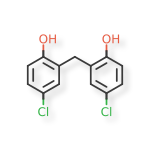
Details
| Stereochemistry | ACHIRAL |
| Molecular Formula | C13H9Cl2O2.Na |
| Molecular Weight | 291.105 |
| Optical Activity | NONE |
| Defined Stereocenters | 0 / 0 |
| E/Z Centers | 0 |
| Charge | 0 |
SHOW SMILES / InChI
SMILES
[Na+].OC1=CC=C(Cl)C=C1CC2=CC(Cl)=CC=C2[O-]
InChI
InChIKey=DDJNZEZALAEEON-UHFFFAOYSA-M
InChI=1S/C13H10Cl2O2.Na/c14-10-1-3-12(16)8(6-10)5-9-7-11(15)2-4-13(9)17;/h1-4,6-7,16-17H,5H2;/q;+1/p-1
| Molecular Formula | C13H9Cl2O2 |
| Molecular Weight | 268.115 |
| Charge | -1 |
| Count |
|
| Stereochemistry | ACHIRAL |
| Additional Stereochemistry | No |
| Defined Stereocenters | 0 / 0 |
| E/Z Centers | 0 |
| Optical Activity | NONE |
| Molecular Formula | Na |
| Molecular Weight | 22.98976928 |
| Charge | 1 |
| Count |
|
| Stereochemistry | ACHIRAL |
| Additional Stereochemistry | No |
| Defined Stereocenters | 0 / 0 |
| E/Z Centers | 0 |
| Optical Activity | NONE |
DescriptionCurator's Comment: Description was created based on several sources, including http://www.ncbi.nlm.nih.gov/pubmed/15162836 and http://datasheets.scbt.com/sc-255083.pdf
Curator's Comment: Description was created based on several sources, including http://www.ncbi.nlm.nih.gov/pubmed/15162836 and http://datasheets.scbt.com/sc-255083.pdf
Dichlorophene is a halogenated phenolic compound that functions as a bacteriocide and fungicide in cosmetics. Dichlorophene was reported to be used in a total of five cosmetic formulations at concentrations of 0% to 1.0%. Dichlorophen is used in the treatment of tapeworm infestation in man and animals and is the basis of a preparation against athlete’s foot. As a fungicide and bactericide it is recommended for the protection of textiles and materials including horticultural benches and equipment against moulds and algae.
Approval Year
Targets
| Primary Target | Pharmacology | Condition | Potency |
|---|---|---|---|
Target ID: CHEMBL4685 |
70.0 µM [IC50] | ||
Target ID: G. lamblia growth |
|||
Target ID: T. vaginalis growth |
|||
Target ID: 2-propanol-supported respiration of Entamoeba histolytica |
Conditions
| Condition | Modality | Targets | Highest Phase | Product |
|---|---|---|---|---|
| Curative | Unknown Approved UseUnknown |
|||
| Curative | Unknown Approved UseUnknown |
|||
| Curative | Unknown Approved UseUnknown |
|||
| Curative | Unknown Approved UseUnknown |
|||
| Curative | Mycota spray Approved UseFor the treatment and prevention of athletes foot. Launch Date2002 |
Doses
| Dose | Population | Adverse events |
|---|---|---|
1 % 1 times / day single, topical Studied dose Dose: 1 %, 1 times / day Route: topical Route: single Dose: 1 %, 1 times / day Sources: |
unhealthy, 29 years |
Other AEs: Contact dermatitis... |
360 g 1 times / day single, oral Studied dose Dose: 360 g, 1 times / day Route: oral Route: single Dose: 360 g, 1 times / day Sources: |
healthy, 59 years |
Other AEs: Death... |
72 g 1 times / day single, oral Studied dose Dose: 72 g, 1 times / day Route: oral Route: single Dose: 72 g, 1 times / day Sources: |
unhealthy, 74 years |
Other AEs: Epigastric pain, Nausea... Other AEs: Epigastric pain Sources: Nausea Diarrhea Disturbance of liver function tests Injury to kidney Rhabdomyolysis |
AEs
| AE | Significance | Dose | Population |
|---|---|---|---|
| Contact dermatitis | 1 % 1 times / day single, topical Studied dose Dose: 1 %, 1 times / day Route: topical Route: single Dose: 1 %, 1 times / day Sources: |
unhealthy, 29 years |
|
| Death | 360 g 1 times / day single, oral Studied dose Dose: 360 g, 1 times / day Route: oral Route: single Dose: 360 g, 1 times / day Sources: |
healthy, 59 years |
|
| Diarrhea | 72 g 1 times / day single, oral Studied dose Dose: 72 g, 1 times / day Route: oral Route: single Dose: 72 g, 1 times / day Sources: |
unhealthy, 74 years |
|
| Disturbance of liver function tests | 72 g 1 times / day single, oral Studied dose Dose: 72 g, 1 times / day Route: oral Route: single Dose: 72 g, 1 times / day Sources: |
unhealthy, 74 years |
|
| Epigastric pain | 72 g 1 times / day single, oral Studied dose Dose: 72 g, 1 times / day Route: oral Route: single Dose: 72 g, 1 times / day Sources: |
unhealthy, 74 years |
|
| Injury to kidney | 72 g 1 times / day single, oral Studied dose Dose: 72 g, 1 times / day Route: oral Route: single Dose: 72 g, 1 times / day Sources: |
unhealthy, 74 years |
|
| Nausea | 72 g 1 times / day single, oral Studied dose Dose: 72 g, 1 times / day Route: oral Route: single Dose: 72 g, 1 times / day Sources: |
unhealthy, 74 years |
|
| Rhabdomyolysis | 72 g 1 times / day single, oral Studied dose Dose: 72 g, 1 times / day Route: oral Route: single Dose: 72 g, 1 times / day Sources: |
unhealthy, 74 years |
PubMed
| Title | Date | PubMed |
|---|---|---|
| Activity profiles of 309 ToxCast™ chemicals evaluated across 292 biochemical targets. | 2011-03-28 |
|
| Profiles and some initial identifications of (anti)androgenic compounds in fish exposed to wastewater treatment works effluents. | 2010-02-01 |
|
| Fate of organohalogens in US wastewater treatment plants and estimated chemical releases to soils nationwide from biosolids recycling. | 2009-12 |
|
| The old and new therapeutic approaches to the treatment of giardiasis: where are we? | 2009 |
|
| Late patch test reaction to dichlorophene. | 2008 |
|
| Prediction of estrogen receptor agonists and characterization of associated molecular descriptors by statistical learning methods. | 2006-11 |
|
| [Contact sensitization to pharmaceutic aids in dermatologic cosmetic and external use preparations]. | 2004-05 |
|
| Safety assessment of dichlorophene and chlorophene. | 2004 |
|
| Acute fatal poisoning with dichlorophen. | 1997 |
|
| Wheezing in a commercial diver due to disinfectant. | 1991-07 |
|
| [Allergy to preservatives]. | 1982 |
|
| A Comparative Study of Hymenolepicides in Hymenolepis Mana Infestation of Rats. | 1962-07 |
Patents
Sample Use Guides
In Vivo Use Guide
Curator's Comment: Can also be applied topically for treatment of Athlete’s Foot https://imedi.co.uk/mycota-spray
A dose of 5 g is given usually in the morning to treat cestode infections
Route of Administration:
Oral
| Substance Class |
Chemical
Created
by
admin
on
Edited
Mon Mar 31 19:14:13 GMT 2025
by
admin
on
Mon Mar 31 19:14:13 GMT 2025
|
| Record UNII |
S75BB68Q3X
|
| Record Status |
Validated (UNII)
|
| Record Version |
|
-
Download
| Name | Type | Language | ||
|---|---|---|---|---|
|
Common Name | English | ||
|
Preferred Name | English | ||
|
Systematic Name | English | ||
|
Common Name | English | ||
|
Systematic Name | English |
| Classification Tree | Code System | Code | ||
|---|---|---|---|---|
|
EPA PESTICIDE CODE |
55005
Created by
admin on Mon Mar 31 19:14:13 GMT 2025 , Edited by admin on Mon Mar 31 19:14:13 GMT 2025
|
| Code System | Code | Type | Description | ||
|---|---|---|---|---|---|
|
233-457-1
Created by
admin on Mon Mar 31 19:14:13 GMT 2025 , Edited by admin on Mon Mar 31 19:14:13 GMT 2025
|
PRIMARY | |||
|
23670853
Created by
admin on Mon Mar 31 19:14:13 GMT 2025 , Edited by admin on Mon Mar 31 19:14:13 GMT 2025
|
PRIMARY | |||
|
10254-48-5
Created by
admin on Mon Mar 31 19:14:13 GMT 2025 , Edited by admin on Mon Mar 31 19:14:13 GMT 2025
|
NON-SPECIFIC STOICHIOMETRY | |||
|
10187-52-7
Created by
admin on Mon Mar 31 19:14:13 GMT 2025 , Edited by admin on Mon Mar 31 19:14:13 GMT 2025
|
PRIMARY | |||
|
DTXSID3058610
Created by
admin on Mon Mar 31 19:14:13 GMT 2025 , Edited by admin on Mon Mar 31 19:14:13 GMT 2025
|
PRIMARY | |||
|
S75BB68Q3X
Created by
admin on Mon Mar 31 19:14:13 GMT 2025 , Edited by admin on Mon Mar 31 19:14:13 GMT 2025
|
PRIMARY |
| Related Record | Type | Details | ||
|---|---|---|---|---|
|
|
PARENT -> SALT/SOLVATE |