


Details
| Stereochemistry | RACEMIC |
| Molecular Formula | C18H26ClN3.2ClH |
| Molecular Weight | 392.794 |
| Optical Activity | ( + / - ) |
| Defined Stereocenters | 0 / 1 |
| E/Z Centers | 0 |
| Charge | 0 |
SHOW SMILES / InChI
SMILES
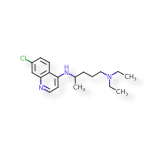
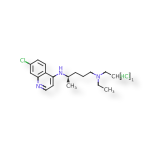
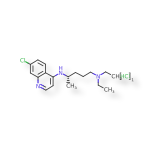
Cl.Cl.CCN(CC)CCCC(C)NC1=C2C=CC(Cl)=CC2=NC=C1
InChI
InChIKey=PCFGECQRSMVKCC-UHFFFAOYSA-N
InChI=1S/C18H26ClN3.2ClH/c1-4-22(5-2)12-6-7-14(3)21-17-10-11-20-18-13-15(19)8-9-16(17)18;;/h8-11,13-14H,4-7,12H2,1-3H3,(H,20,21);2*1H
| Molecular Formula | ClH |
| Molecular Weight | 36.461 |
| Charge | 0 |
| Count |
|
| Stereochemistry | ACHIRAL |
| Additional Stereochemistry | No |
| Defined Stereocenters | 0 / 0 |
| E/Z Centers | 0 |
| Optical Activity | NONE |
| Molecular Formula | C18H26ClN3 |
| Molecular Weight | 319.872 |
| Charge | 0 |
| Count |
|
| Stereochemistry | RACEMIC |
| Additional Stereochemistry | No |
| Defined Stereocenters | 0 / 1 |
| E/Z Centers | 0 |
| Optical Activity | ( + / - ) |
Chloroquine (brand name Aralen) is indicated for the suppressive treatment and for acute attacks of malaria due to P. vivax, P.malariae, P. ovale, and susceptible strains of P. falciparum. The drug is also indicated for the treatment of extraintestinal amebiasis. In addition, chloroquine is in clinical trials as an investigational antiretroviral in humans with HIV-1/AIDS and as a potential antiviral agent against chikungunya fever. The mechanism of plasmodicidal action of chloroquine is not completely certain. However, is existed theory, that like other quinoline derivatives, it is thought to inhibit heme polymerase activity. The heme moiety consists of a porphyrin ring called Fe(II)-protoporphyrin IX (FP). To avoid destruction by this molecule, the parasite biocrystallizes heme to form hemozoin, a non-toxic molecule. Chloroquine enters the red blood cell, inhabiting parasite cell, and digestive vacuole by simple diffusion. Chloroquine then becomes protonated (to CQ2+), as the digestive vacuole is known to be acidic (pH 4.7); chloroquine then cannot leave by diffusion. Chloroquine caps hemozoin molecules to prevent further biocrystallization of heme, thus leading to heme buildup. Chloroquine binds to heme (or FP) to form what is known as the FP-Chloroquine complex; this complex is highly toxic to the cell and disrupts membrane function.
Approval Year
Targets
| Primary Target | Pharmacology | Condition | Potency |
|---|---|---|---|
Target ID: CHEMBL613897 |
|||
Target ID: P13774 Gene ID: NA Gene Symbol: NA Target Organism: Plasmodium falciparum |
|||
Target ID: CHEMBL364 |
Conditions
| Condition | Modality | Targets | Highest Phase | Product |
|---|---|---|---|---|
| Curative | ARALEN Approved UseARALEN is indicated for the suppressive treatment and for acute attacks of malaria due to P. vivax, P.malariae, P. ovale, and susceptible strains of P. falciparum. The drug is also indicated for the treatment of extraintestinal amebiasis. ARALEN does not prevent relapses in patients with vivax or malariae malaria because it is not effective against exoerythrocytic forms of the parasite, nor will it prevent vivax or malariae infection when administered as a prophylactic. It is highly effective as a suppressive agent in patients with vivax or malariae malaria, in terminating acute attacks, and significantly lengthening the interval between treatment and relapse. In patients with falciparum malaria it abolishes the acute attack and effects complete cure of the infection, unless due to a resistant strain of P. falciparum. Launch Date1949 |
|||
| Curative | ARALEN Approved UseARALEN is indicated for the suppressive treatment and for acute attacks of malaria due to P. vivax, P.malariae, P. ovale, and susceptible strains of P. falciparum. The drug is also indicated for the treatment of extraintestinal amebiasis. ARALEN does not prevent relapses in patients with vivax or malariae malaria because it is not effective against exoerythrocytic forms of the parasite, nor will it prevent vivax or malariae infection when administered as a prophylactic. It is highly effective as a suppressive agent in patients with vivax or malariae malaria, in terminating acute attacks, and significantly lengthening the interval between treatment and relapse. In patients with falciparum malaria it abolishes the acute attack and effects complete cure of the infection, unless due to a resistant strain of P. falciparum. Launch Date1949 |
|||
| Primary | Unknown Approved UseUnknown |
Cmax
| Value | Dose | Co-administered | Analyte | Population |
|---|---|---|---|---|
700 ng/mL EXPERIMENT https://pubmed.ncbi.nlm.nih.gov/18594802/ |
5 mg/kg 1 times / day multiple, oral dose: 5 mg/kg route of administration: Oral experiment type: MULTIPLE co-administered: |
CHLOROQUINE plasma | Homo sapiens population: UNHEALTHY age: ADULT sex: FEMALE food status: UNKNOWN |
AUC
| Value | Dose | Co-administered | Analyte | Population |
|---|---|---|---|---|
134087 ng × h/mL EXPERIMENT https://pubmed.ncbi.nlm.nih.gov/18594802/ |
5 mg/kg 1 times / day multiple, oral dose: 5 mg/kg route of administration: Oral experiment type: MULTIPLE co-administered: |
CHLOROQUINE plasma | Homo sapiens population: UNHEALTHY age: ADULT sex: FEMALE food status: UNKNOWN |
T1/2
| Value | Dose | Co-administered | Analyte | Population |
|---|---|---|---|---|
209 h EXPERIMENT https://pubmed.ncbi.nlm.nih.gov/18594802/ |
5 mg/kg 1 times / day multiple, oral dose: 5 mg/kg route of administration: Oral experiment type: MULTIPLE co-administered: |
CHLOROQUINE plasma | Homo sapiens population: UNHEALTHY age: ADULT sex: FEMALE food status: UNKNOWN |
Funbound
| Value | Dose | Co-administered | Analyte | Population |
|---|---|---|---|---|
45% EXPERIMENT https://pubmed.ncbi.nlm.nih.gov/18594802/ |
5 mg/kg 1 times / day multiple, oral dose: 5 mg/kg route of administration: Oral experiment type: MULTIPLE co-administered: |
CHLOROQUINE plasma | Homo sapiens population: UNHEALTHY age: ADULT sex: FEMALE food status: UNKNOWN |
Doses
| Dose | Population | Adverse events |
|---|---|---|
3 g single, oral Overdose |
unknown, 14 years |
Other AEs: Cardiac arrest... |
600 mg 2 times / day multiple, oral Highest studied dose Dose: 600 mg, 2 times / day Route: oral Route: multiple Dose: 600 mg, 2 times / day Sources: |
pregnant, 20.7 years |
Other AEs: Dizziness, Vomiting... Other AEs: Dizziness (19%) Sources: Vomiting (17%) Palpitations (5%) Headache (6%) Nausea (5%) Abdominal pain (2%) |
AEs
| AE | Significance | Dose | Population |
|---|---|---|---|
| Cardiac arrest | 3 g single, oral Overdose |
unknown, 14 years |
|
| Vomiting | 17% | 600 mg 2 times / day multiple, oral Highest studied dose Dose: 600 mg, 2 times / day Route: oral Route: multiple Dose: 600 mg, 2 times / day Sources: |
pregnant, 20.7 years |
| Dizziness | 19% | 600 mg 2 times / day multiple, oral Highest studied dose Dose: 600 mg, 2 times / day Route: oral Route: multiple Dose: 600 mg, 2 times / day Sources: |
pregnant, 20.7 years |
| Abdominal pain | 2% | 600 mg 2 times / day multiple, oral Highest studied dose Dose: 600 mg, 2 times / day Route: oral Route: multiple Dose: 600 mg, 2 times / day Sources: |
pregnant, 20.7 years |
| Nausea | 5% | 600 mg 2 times / day multiple, oral Highest studied dose Dose: 600 mg, 2 times / day Route: oral Route: multiple Dose: 600 mg, 2 times / day Sources: |
pregnant, 20.7 years |
| Palpitations | 5% | 600 mg 2 times / day multiple, oral Highest studied dose Dose: 600 mg, 2 times / day Route: oral Route: multiple Dose: 600 mg, 2 times / day Sources: |
pregnant, 20.7 years |
| Headache | 6% | 600 mg 2 times / day multiple, oral Highest studied dose Dose: 600 mg, 2 times / day Route: oral Route: multiple Dose: 600 mg, 2 times / day Sources: |
pregnant, 20.7 years |
Overview
| CYP3A4 | CYP2C9 | CYP2D6 | hERG |
|---|---|---|---|
OverviewOther
| Other Inhibitor | Other Substrate | Other Inducer |
|---|---|---|
Drug as perpetrator
| Target | Modality | Activity | Metabolite | Clinical evidence |
|---|---|---|---|---|
| no | no (co-administration study) Comment: chloroquine did not affect the activities of CYP1A2, CYP2C19, CYP2E1, CYP3A4 |
|||
| no | no (co-administration study) Comment: chloroquine did not affect the activities of CYP1A2, CYP2C19, CYP2E1, CYP3A4 |
|||
| no | no (co-administration study) Comment: chloroquine did not affect the activities of CYP1A2, CYP2C19, CYP2E1, CYP3A4 |
|||
| no | no (co-administration study) Comment: chloroquine did not affect the activities of CYP1A2, CYP2C19, CYP2E1, CYP3A4 |
|||
| yes [IC50 1096 uM] | ||||
| yes [IC50 2.5 uM] | ||||
| yes [Ki 12 uM] | weak (co-administration study) Comment: selective inhibiton; Chloroquine produced a reduction in the metabolism of debrisoquine as evaluated by the debrisoquine recovery ratio, a measure of CYP2D6 activity. This reduction was progressive from the first to the seventh dose. This decrease in metabolism was modest (about 7% after the first dose and about 18% after seven doses) but statistically significant |
Drug as victim
| Target | Modality | Activity | Metabolite | Clinical evidence |
|---|---|---|---|---|
| yes | ||||
| yes | ||||
| yes | yes (co-administration study) Comment: Concomitant administration of a single dose of chloroquine and cimetidine daily starting 4 days prior to chloroquine, resulted in a 50% increase in chloroquine half-life, associated with a 50% decrease in its clearance.Since the AUC of desethylchloroquine decreased by 47%, cimetidine probably decreased chloroquine clearance by inhibiting its hepatic desethylation. |
|||
| yes | yes (co-administration study) Comment: Concomitant administration of a single dose of chloroquine and cimetidine daily starting 4 days prior to chloroquine, resulted in a 50% increase in chloroquine half-life, associated with a 50% decrease in its clearance.Since the AUC of desethylchloroquine decreased by 47%, cimetidine probably decreased chloroquine clearance by inhibiting its hepatic desethylation. |
Tox targets
| Target | Modality | Activity | Metabolite | Clinical evidence |
|---|---|---|---|---|
Page: 44.0 |
PubMed
| Title | Date | PubMed |
|---|---|---|
| Conduction disorder and QT prolongation secondary to long-term treatment with chloroquine. | 2008-07-04 |
|
| A randomised controlled trial to assess the efficacy of dihydroartemisinin-piperaquine for the treatment of uncomplicated falciparum malaria in Peru. | 2007-10-31 |
|
| Chloroquine-induced recurrent psychosis. | 2007-08-02 |
|
| Effect of chloroquine on gene expression of Plasmodium yoelii nigeriensis during its sporogonic development in the mosquito vector. | 2007-07-02 |
|
| [Reversible restrictive cardiomyopathy secondary to chloroquine]. | 2007-06-23 |
|
| Heart conduction disorders related to antimalarials toxicity: an analysis of electrocardiograms in 85 patients treated with hydroxychloroquine for connective tissue diseases. | 2007-05 |
|
| [Complete auriculoventricular block during chloroquine treatment]. | 2007-02 |
|
| Crystal structure of an FIV/HIV chimeric protease complexed with the broad-based inhibitor, TL-3. | 2007-01-09 |
|
| Expression of autophagy-associated genes in skeletal muscle: an experimental model of chloroquine-induced myopathy. | 2007 |
|
| Cardiomyopathy related to antimalarial therapy with illustrative case report. | 2007 |
|
| Selective enhancement of cellular oxidative stress by chloroquine: implications for the treatment of glioblastoma multiforme. | 2006-12-15 |
|
| CpG-B oligodeoxynucleotide promotes cell survival via up-regulation of Hsp70 to increase Bcl-xL and to decrease apoptosis-inducing factor translocation. | 2006-12-15 |
|
| Tetrahydrocurcumin: effect on chloroquine-mediated oxidative damage in rat kidney. | 2006-11 |
|
| Effects of CpG-B ODN on the protein expression profile of swine PBMC. | 2006-09-15 |
|
| Images in cardiovascular medicine. Contrast-enhanced magnetic resonance imaging of a patient with chloroquine-induced cardiomyopathy confirmed by endomyocardial biopsy. | 2006-08-22 |
|
| Plasmodium berghei: development of an irreversible experimental malaria model in Wistar rats. | 2006-07 |
|
| Mefloquine toxicity presenting with polyneuropathy - a report of two cases in India. | 2006-06 |
|
| Frequency of high-risk use of QT-prolonging medications. | 2006-06 |
|
| Antimalarial myopathy: an underdiagnosed complication? Prospective longitudinal study of 119 patients. | 2006-03 |
|
| [Complete auriculoventricular block secondary to cardiac toxicity due to chloroquine]. | 2006-02 |
|
| [Cytochrome P-450 and the response to antimalarial drugs]. | 2006-01 |
|
| Ginkgo biloba leaf extract (EGb 761) enhances catalepsy induced by haloperidol and L-nitroarginine in mice. | 2005-11 |
|
| Protective effects of different antioxidants and amrinone on vancomycin-induced nephrotoxicity. | 2005-11 |
|
| [Acute hydroxychloroquine poisoning. The danger of rapid or excessive correction of initial hypokalemia]. | 2005-07-23 |
|
| Chloroquine-induced lipidosis mimicking Fabry disease. | 2005-05 |
|
| Chloroquine-induced cardiomyopathy-echocardiographic features. | 2005-04 |
|
| Skeletal muscle expression of clathrin and mannose 6-phosphate receptor in experimental chloroquine-induced myopathy. | 2005-04 |
|
| cAMP has distinct acute and chronic effects on aquaporin-5 in lung epithelial cells. | 2005-02-04 |
|
| Enhanced anticryptococcal activity of chloroquine in phosphatidylserine-containing liposomes in a murine model. | 2005-02 |
|
| [Malaria chemoprophylaxis in traveling children]. | 2005-01 |
|
| The ability of chloroquine to prevent tat-induced cytokine secretion by monocytes is implicated in its in vivo anti-human immunodeficiency virus type 1 activity. | 2004-11 |
|
| Attenuation of chloroquine-induced renal damage by alpha-lipoic acid: possible antioxidant mechanism. | 2004-09 |
|
| The antimalarial potential of 4-quinolinecarbinolamines may be limited due to neurotoxicity and cross-resistance in mefloquine-resistant Plasmodium falciparum strains. | 2004-07 |
|
| Reactive oxygen species mediate chloroquine-induced expression of chemokines by human astroglial cells. | 2004-07 |
|
| Inhibition of human P450 enzymes by multiple constituents of the Ginkgo biloba extract. | 2004-06-11 |
|
| Survival and surface adherence ability of bacterial pathogens in oral liquid pharmaceuticals and their containers. | 2004-06 |
|
| Heart transplantation in a patient with chloroquine-induced cardiomyopathy. | 2004-02 |
|
| [Infectious diseases in 2003]. | 2004 |
|
| The multifocal pattern electroretinogram in chloroquine retinopathy. | 2003-08-19 |
|
| Therapy of glioblastoma multiforme improved by the antimutagenic chloroquine. | 2003-02-15 |
|
| Seizures associated with chloroquine therapy. | 1992-08 |
|
| [Heart conduction disorders in long-term treatment with chloroquine. Two new cases]. | 1992-05-02 |
|
| Involvement of GABAergic mechanisms in chloroquine-induced seizures in mice. | 1992-03 |
|
| Chloroquine related complete heart block with blindness: case report. | 1992-01 |
|
| Amrinone for refractory cardiogenic shock following chloroquine poisoning. | 1991 |
|
| Persisting chloroquine-induced myasthenia? | 1991 |
|
| Inhibition of human immunodeficiency virus infectivity by chloroquine. | 1990-04 |
|
| Drug-induced haemolysis and renal failure in children with glucose-6-phosphate dehydrogenase deficiency in Central Asia. | 1990 |
|
| Tumor- and drug-induced cutaneous neuro-phospholipidosis. | 1975 |
|
| A Comparative Study of Hymenolepicides in Hymenolepis Mana Infestation of Rats. | 1962-07 |
Patents
Sample Use Guides
The dosage of chloroquine phosphate is often expressed in terms of equivalentchloroquine base. Each 500 mg tablet of ARALEN (chloroquine phosphate) contains the equivalent of 300 mg chloroquine base. In infants and children the dosage is preferably calculated by body weight.Malaria: Suppression—Adult Dose: 500 mg (= 300 mg base) on exactly the same day of each week. Pediatric Dose: The weekly suppressive dosage is 5 mg calculated as base, per kg of body weight, but should not exceed the adult dose regardless of weight. If circumstances permit, suppressive therapy should begin two weeks prior to exposure. However, failing this in adults, an initial double (loading) dose of 1 g (= 600 mg base), or in children 10 mg base/kg may be taken in two divided doses, six hours apart. The suppressive therapy should be continued for eight weeks after leaving the endemic area.For Treatment of Acute Attack. Adults: An initial dose of 1 g (=600 mg base) followed by an additional 500 mg (= 300 mg base) after six to eight hours and a single dose of 500 mg (= 300 mg base) on each of two consecutive days. This represents a total dose of 2.5 g chloroquine phosphate or 1.5 g base in three days. The dosage for adults of low body weight and for infants and children should be determined as follows: First dose: 10 mg base per kg (but not exceeding a single dose of 600 mg base) Second dose: (6 hours after first dose) 5 mg base per kg (but not exceeding a single dose of 300 mg base) Third dose: (24 hours after first dose) 5mg base per kg Fourth dose: (36 hours after first dose) 5 mg base per kg For radical cure of vivax and malariae malaria concomitant therapy with an 8-aminoquinoline compound is necessary. Extraintestinal Amebiasis: Adults, 1 g (600 mg base) daily for two days, followed by 500 mg (300 mg base) daily for at least two to three weeks. Treatment is usually combined with an effective intestinal amebicide.
Route of Administration:
Oral
Chloroquine inhibited mouse colon cancer cell line CT26 cells proliferation by concentration- and time-dependent manner. This effect was associated with apoptosis induction and decreased level of phosphorylated p42/44 mitogen-activated protein kinase and phosphorylated Akt. The cytotoxicity of chloroquine on CT26 cells was determined by the MTT assay. Cells were seeded in 96-well plates at the density of 2000/well and cultured for 24 hr, followed by chloroquine treatment (100, 50, 25, 12.5, 6.25, and 3.125 μ mol/L) for 24, 48, and 72 hr, respectively.
| Substance Class |
Chemical
Created
by
admin
on
Edited
Mon Mar 31 18:28:42 GMT 2025
by
admin
on
Mon Mar 31 18:28:42 GMT 2025
|
| Record UNII |
NT0J0815S5
|
| Record Status |
Validated (UNII)
|
| Record Version |
|
-
Download
| Name | Type | Language | ||
|---|---|---|---|---|
|
Preferred Name | English | ||
|
Common Name | English | ||
|
Common Name | English | ||
|
Common Name | English | ||
|
Common Name | English | ||
|
Common Name | English | ||
|
Common Name | English | ||
|
Common Name | English | ||
|
Common Name | English |
| Classification Tree | Code System | Code | ||
|---|---|---|---|---|
|
NCI_THESAURUS |
C271
Created by
admin on Mon Mar 31 18:28:42 GMT 2025 , Edited by admin on Mon Mar 31 18:28:42 GMT 2025
|
| Code System | Code | Type | Description | ||
|---|---|---|---|---|---|
|
C65318
Created by
admin on Mon Mar 31 18:28:42 GMT 2025 , Edited by admin on Mon Mar 31 18:28:42 GMT 2025
|
PRIMARY | |||
|
3545-67-3
Created by
admin on Mon Mar 31 18:28:42 GMT 2025 , Edited by admin on Mon Mar 31 18:28:42 GMT 2025
|
PRIMARY | |||
|
DBSALT001317
Created by
admin on Mon Mar 31 18:28:42 GMT 2025 , Edited by admin on Mon Mar 31 18:28:42 GMT 2025
|
PRIMARY | |||
|
222-592-1
Created by
admin on Mon Mar 31 18:28:42 GMT 2025 , Edited by admin on Mon Mar 31 18:28:42 GMT 2025
|
PRIMARY | |||
|
NT0J0815S5
Created by
admin on Mon Mar 31 18:28:42 GMT 2025 , Edited by admin on Mon Mar 31 18:28:42 GMT 2025
|
PRIMARY | |||
|
100000084735
Created by
admin on Mon Mar 31 18:28:42 GMT 2025 , Edited by admin on Mon Mar 31 18:28:42 GMT 2025
|
PRIMARY | |||
|
CHEMBL76
Created by
admin on Mon Mar 31 18:28:42 GMT 2025 , Edited by admin on Mon Mar 31 18:28:42 GMT 2025
|
PRIMARY | |||
|
SUB01237MIG
Created by
admin on Mon Mar 31 18:28:42 GMT 2025 , Edited by admin on Mon Mar 31 18:28:42 GMT 2025
|
PRIMARY | |||
|
DTXSID501026664
Created by
admin on Mon Mar 31 18:28:42 GMT 2025 , Edited by admin on Mon Mar 31 18:28:42 GMT 2025
|
PRIMARY | |||
|
451796
Created by
admin on Mon Mar 31 18:28:42 GMT 2025 , Edited by admin on Mon Mar 31 18:28:42 GMT 2025
|
PRIMARY | RxNorm | ||
|
83820
Created by
admin on Mon Mar 31 18:28:42 GMT 2025 , Edited by admin on Mon Mar 31 18:28:42 GMT 2025
|
PRIMARY |
| Related Record | Type | Details | ||
|---|---|---|---|---|
|
|
PARENT -> SALT/SOLVATE | |||
|
|
ENANTIOMER -> RACEMATE | |||
|
|
ENANTIOMER -> RACEMATE |
| Related Record | Type | Details | ||
|---|---|---|---|---|
|
|
ACTIVE MOIETY |