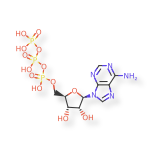
Details
| Stereochemistry | ABSOLUTE |
| Molecular Formula | C10H13N5O13P3.3Na |
| Molecular Weight | 573.1265 |
| Optical Activity | UNSPECIFIED |
| Defined Stereocenters | 4 / 4 |
| E/Z Centers | 0 |
| Charge | 0 |
SHOW SMILES / InChI
SMILES
[Na+].[Na+].[Na+].NC1=NC=NC2=C1N=CN2[C@@H]3O[C@H](COP(O)(=O)OP([O-])(=O)OP([O-])([O-])=O)[C@@H](O)[C@H]3O
InChI
InChIKey=VGTKNLQPBHGQOU-MSQVLRTGSA-K
InChI=1S/C10H16N5O13P3.3Na/c11-8-5-9(13-2-12-8)15(3-14-5)10-7(17)6(16)4(26-10)1-25-30(21,22)28-31(23,24)27-29(18,19)20;;;/h2-4,6-7,10,16-17H,1H2,(H,21,22)(H,23,24)(H2,11,12,13)(H2,18,19,20);;;/q;3*+1/p-3/t4-,6-,7-,10-;;;/m1.../s1
| Molecular Formula | C10H13N5O13P3 |
| Molecular Weight | 504.1572 |
| Charge | -3 |
| Count |
|
| Stereochemistry | ABSOLUTE |
| Additional Stereochemistry | No |
| Defined Stereocenters | 4 / 4 |
| E/Z Centers | 0 |
| Optical Activity | UNSPECIFIED |
| Molecular Formula | Na |
| Molecular Weight | 22.98976928 |
| Charge | 1 |
| Count |
|
| Stereochemistry | ACHIRAL |
| Additional Stereochemistry | No |
| Defined Stereocenters | 0 / 0 |
| E/Z Centers | 0 |
| Optical Activity | NONE |
Adenosine triphosphate (ATP) is an adenine nucleotide containing three phosphate groups esterified to the sugar moiety. Adenosine triphosphate is the energy source in living cells. In physiological conditions, the average concentration varies from 3150 mM in mammalian cells to 1500–1900 mM in human blood cells. Extracellular adenosine and adenosine triphosphate (ATP) are involved in biological processes including neurotransmission, muscle contraction, cardiac function, platelet function, vasodilatation, signal transduction and secretion in a variety of cell types. A large family of membrane-bound receptors mediates cell signalling by ATP and adenosine. These purinergic receptors ultimately determine the variety of effects induced by extracellular ATP and adenosine. ATP and adenosine have strong negative chronotropic and dromotropic effects on the mammalian heart. The sensitivity of the sinus node and the atrioventricular node to ATP and adenosine manifests pronounced variability among species. For more than three decades, ATP has been used routinely in Europe in the acute therapy of paroxysmal supraventricular tachycardia. ATPace™, an injectable formulation of adenosine 5′-triphosphate (ATP), was developed by Cordex Pharma, Inc. (Cordex) as a diagnostic and therapeutic drug for the management of cardiac bradyarrhythmias. Extracellular ATP exerts multiple effects in various cell types by activating cell-surface receptors known as P2 receptors. In the heart, ATP suppresses the automaticity of cardiac pacemakers and atrioventricular (AV) nodal conduction via adenosine, the product of its degradation by ecto-enzymes, as well as by triggering a cardio-cardiac vagal reflex. ATP, given as a rapid intravenous bolus injection, has been used since the late 1940s as a highly effective and safe therapeutic agent for the acute termination of reentrant paroxysmal supraventricular tachycardia (PSVT) involving the AV node. In addition, preliminary studies have shown that ATP can also be used as a diagnostic agent for the identification of several cardiac disorders including sinus node dysfunction (sick sinus syndrome), dual AV nodal pathways, long QT syndrome, and bradycardic syncope. The US Food and Drug Administration has approved Cordex formulation for ATP as an Investigational New Drug and two pathways for its marketing approval; one therapeutic, i.e., acute termination of paroxysmal PSVT, and the other diagnostic, i.e., the identification of patients with bradycardic syncope who can benefit from pacemaker therapy. However later ATPace development for the treatment of bradycardia and paroxysmal supraventricular tachycardia was discontinued.
Approval Year
PubMed
| Title | Date | PubMed |
|---|---|---|
| ATP-dependent activation of the intermediate conductance, Ca2+-activated K+ channel, hIK1, is conferred by a C-terminal domain. | 2001-04-06 |
|
| Rotavirus nonstructural protein NSP2 self-assembles into octamers that undergo ligand-induced conformational changes. | 2001-03-30 |
|
| Dissection of the ATP-binding domain of the chaperone hsc70 for interaction with the cofactor Hap46. | 2001-03-30 |
|
| Equilibrium binding of single-stranded DNA to the secondary DNA binding site of the bacterial recombinase RecA. | 2001-03-30 |
|
| Possible roles of protein kinase A in cell motility and excystation of the early diverging eukaryote Giardia lamblia. | 2001-03-30 |
|
| Correlation between steady-state ATP hydrolysis and vanadate-induced ADP trapping in Human P-glycoprotein. Evidence for ADP release as the rate-limiting step in the catalytic cycle and its modulation by substrates. | 2001-03-23 |
|
| ADP is the cognate ligand for the orphan G protein-coupled receptor SP1999. | 2001-03-16 |
|
| ATP modulation of ATP-sensitive potassium channel ATP sensitivity varies with the type of SUR subunit. | 2001-03-09 |
|
| Functional relationships between capacitation-dependent cell signaling and compartmentalized metabolic pathways in murine spermatozoa. | 2001-03-09 |
|
| Cytosolic phospholipase A2 is required for optimal ATP activation of BK channels in GH(3) cells. | 2001-03-09 |
|
| Transporters on demand: intrahepatic pools of canalicular ATP binding cassette transporters in rat liver. | 2001-03-09 |
|
| The dhb operon of Bacillus subtilis encodes the biosynthetic template for the catecholic siderophore 2,3-dihydroxybenzoate-glycine-threonine trimeric ester bacillibactin. | 2001-03-09 |
|
| Molecular mechanism for functional interaction between DnaA protein and acidic phospholipids: identification of important amino acids. | 2001-03-09 |
|
| Cystic fibrosis transmembrane conductance regulator gating requires cytosolic electrolytes. | 2001-03-02 |
|
| Modulation of the herpes simplex virus type-1 UL9 DNA helicase by its cognate single-strand DNA-binding protein, ICP8. | 2001-03-02 |
|
| Cystic fibrosis transmembrane conductance regulator facilitates ATP release by stimulating a separate ATP release channel for autocrine control of cell volume regulation. | 2001-03-02 |
|
| The DNA binding properties of the parsley bZIP transcription factor CPRF4a are regulated by light. | 2001-03-02 |
|
| Exogenous Mg-ATP induces a large inhibition of pyruvate kinase in intact rat hepatocytes. | 2001-03-02 |
|
| Interleukin-3 withdrawal induces an early increase in mitochondrial membrane potential unrelated to the Bcl-2 family. Roles of intracellular pH, ADP transport, and F(0)F(1)-ATPase. | 2001-03-02 |
|
| Mitochondrial Hsp70 Ssc1: role in protein folding. | 2001-03-02 |
|
| Glucose deprivation and chemical hypoxia: neuroprotection by P2 receptor antagonists. | 2001-03 |
|
| Fidelity of nucleotide insertion at 8-oxo-7,8-dihydroguanine by mammalian DNA polymerase delta. Steady-state and pre-steady-state kinetic analysis. | 2001-02-09 |
|
| Energetics of growth and penicillin production in a high-producing strain of Penicillium chrysogenum. | 2001-01-20 |
|
| Differential effects of bcl-2 on cell death triggered under ATP-depleting conditions. | 2001-01-01 |
|
| Novel properties of the protein kinase CK2-site-regulated nuclear- localization sequence of the interferon-induced nuclear factor IFI 16. | 2001-01-01 |
|
| Noninvasive measurements of transmural myocardial metabolites using 3-D (31)P NMR spectroscopy. | 2001-01 |
|
| Activation of the heat shock response: relationship to energy metabolites. A (31)P NMR study in rat hearts. | 2001-01 |
|
| Protection of cardiac myocytes via delta(1)-opioid receptors, protein kinase C, and mitochondrial K(ATP) channels. | 2001-01 |
|
| Myocardial oxygenation and high-energy phosphate levels during graded coronary hypoperfusion. | 2001-01 |
|
| Role of mitochondrial and sarcolemmal K(ATP) channels in ischemic preconditioning of the canine heart. | 2001-01 |
|
| Dual roles of mitochondrial K(ATP) channels in diazoxide-mediated protection in isolated rabbit hearts. | 2001-01 |
|
| Minimal protection of the liver by ischemic preconditioning in pigs. | 2001-01 |
|
| Short-term hibernation in adult cardiomyocytes is PO(2) dependent and Ca(2+) mediated. | 2001-01 |
|
| Role of K(ATP)(+) channels in regulation of systemic, pulmonary, and coronary vasomotor tone in exercising swine. | 2001-01 |
|
| Properties of ATP-dependent K(+) channels in adrenocortical cells. | 2001-01 |
|
| Modulation of P2Z/P2X(7) receptor activity in macrophages infected with Chlamydia psittaci. | 2001-01 |
|
| Impairment of endothelial nitric oxide production by acute glucose overload. | 2001-01 |
|
| Actin dynamics. | 2001-01 |
|
| Identification of receptor tyrosine kinase (RTK) substrates by the cloning of receptor targets (CORT) strategy. | 2001 |
|
| Detection of phosphorylation-dependent interactions by far-western gel overlay. | 2001 |
|
| Protein histidine kinase. | 2001 |
|
| Cyclin-dependent kinases and cyclin-dependent kinase inhibitors. Detection methods and activity measurements. | 2001 |
|
| Assays for glycogen synthase kinase-3 (GSK-3). | 2001 |
|
| Assays for mitogen-activated protein kinase (MAPK) subtypes and MAPK activating protein kinase-2 (MAPKAP K-2) using a common cell lysate. | 2001 |
|
| Two-dimensional phosphoamino acid analysis. | 2001 |
|
| Use of a real-time, coupled assay to measure the ATPase activity of DNA topoisomerase II. | 2001 |
|
| Topoisomerase II-catalyzed ATP hydrolysis as monitored by thin-layer chromatography. | 2001 |
|
| Analyzing reverse gyrase activity. | 2001 |
|
| Assaying DNA topoisomerase I relaxation activity. | 2001 |
|
| Purinergic and adrenergic agonists synergize in stimulating vasopressin and oxytocin release. | 2000-12-01 |
Patents
Sample Use Guides
Forty-two episodes of spontaneous paroxysmal supraventricular tachycardia, observed in 33 patients (16 men and 17 women, mean age 51 years) were treated with intravenous boluses. These were given in 10 mg increments at increasing doses from 10 to 50 mg at intervals of three minutes if the arrhythmia persisted despite the previous dose. When using a dose less than or equal to 40 mg, tachycardia was terminated in 37 of 42 episodes in less than 50 seconds. More than half of the treated episodes of supraventricular tachycardia terminated with the minimal dose of 10 mg and 7.1% required 40 mg.
Route of Administration:
Intravenous
| Substance Class |
Chemical
Created
by
admin
on
Edited
Wed Apr 02 21:14:03 GMT 2025
by
admin
on
Wed Apr 02 21:14:03 GMT 2025
|
| Record UNII |
NK35BN464R
|
| Record Status |
Validated (UNII)
|
| Record Version |
|
-
Download
| Name | Type | Language | ||
|---|---|---|---|---|
|
Common Name | English | ||
|
Preferred Name | English | ||
|
Common Name | English | ||
|
Common Name | English | ||
|
Systematic Name | English | ||
|
Common Name | English |
| Code System | Code | Type | Description | ||
|---|---|---|---|---|---|
|
NK35BN464R
Created by
admin on Wed Apr 02 21:14:03 GMT 2025 , Edited by admin on Wed Apr 02 21:14:03 GMT 2025
|
PRIMARY | |||
|
20978-32-9
Created by
admin on Wed Apr 02 21:14:03 GMT 2025 , Edited by admin on Wed Apr 02 21:14:03 GMT 2025
|
PRIMARY | |||
|
118705329
Created by
admin on Wed Apr 02 21:14:03 GMT 2025 , Edited by admin on Wed Apr 02 21:14:03 GMT 2025
|
PRIMARY |
| Related Record | Type | Details | ||
|---|---|---|---|---|
|
PARENT -> SALT/SOLVATE |
|