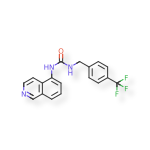
Details
| Stereochemistry | ACHIRAL |
| Molecular Formula | C18H14F3N3O |
| Molecular Weight | 345.3185 |
| Optical Activity | NONE |
| Defined Stereocenters | 0 / 0 |
| E/Z Centers | 0 |
| Charge | 0 |
SHOW SMILES / InChI
SMILES
FC(F)(F)C1=CC=C(CNC(=O)NC2=CC=CC3=CN=CC=C23)C=C1
InChI
InChIKey=SJGVXVZUSQLLJB-UHFFFAOYSA-N
InChI=1S/C18H14F3N3O/c19-18(20,21)14-6-4-12(5-7-14)10-23-17(25)24-16-3-1-2-13-11-22-9-8-15(13)16/h1-9,11H,10H2,(H2,23,24,25)
| Molecular Formula | C18H14F3N3O |
| Molecular Weight | 345.3185 |
| Charge | 0 |
| Count |
|
| Stereochemistry | ACHIRAL |
| Additional Stereochemistry | No |
| Defined Stereocenters | 0 / 0 |
| E/Z Centers | 0 |
| Optical Activity | NONE |
1-isoquinolin-5-yl-3-(4-trifluoromethyl-benzyl)-urea (A-425619), a novel, potent, and selective transient receptor potential type V1 (TRPV1) antagonist, attenuates pain associated with inflammation and tissue injury in rats. A-425619 was found to potently block capsaicin-evoked increases in intracellular calcium concentrations in HEK293 cells expressing recombinant human TRPV1 receptors (IC50 = 5 nM). A-425619 showed similar potency (IC50 = 3-4 nM) to block TRPV1 receptor activation by anandamide and N-arachidonoyl-dopamine. Electrophysiological experiments showed that A-425619 also potently blocked the activation of native TRPV1 channels in rat dorsal root ganglion neurons (IC50 = 9 nM). In vivo, A-425619 dose dependently reduced capsaicin-induced mechanical hyperalgesia (ED50 = 45 umol/kg p.o.). A-425619 was also effective in models of inflammatory pain and postoperative pain. A-425619 potently reduced complete Freund's adjuvant-induced chronic inflammatory pain after oral administration (ED50 = 40 umol/kg p.o.) and was also effective after either i.t. administration or local injection into the inflamed paw. Furthermore, A-425619 maintained efficacy in the postoperative pain model after twice daily dosing p.o. for 5 days. A-425619 also showed partial efficacy in models of neuropathic pain. A-425619 did not alter motor performance at the highest dose tested (300 micromol/kg p.o.). A-425619, a potent and selective antagonist of TRPV1 receptors, effectively relieves acute and chronic inflammatory pain and postoperative pain.
Originator
Approval Year
PubMed
| Title | Date | PubMed |
|---|---|---|
| Moving towards supraspinal TRPV1 receptors for chronic pain relief. | 2010-10-11 |
|
| Spinal nerve ligation in mouse upregulates TRPV1 heat function in injured IB4-positive nociceptors. | 2010-06 |
|
| Physiological basis of tingling paresthesia evoked by hydroxy-alpha-sanshool. | 2010-03-24 |
|
| Additive antinociceptive effects of the selective Nav1.8 blocker A-803467 and selective TRPV1 antagonists in rat inflammatory and neuropathic pain models. | 2009-03 |
|
| Characterization of A-425619 at native TRPV1 receptors: a comparison between dorsal root ganglia and trigeminal ganglia. | 2008-10-31 |
|
| Effects of the transient receptor potential vanilloid 1 antagonist A-425619 on body temperature and thermoregulation in the rat. | 2008-09-22 |
|
| TRPV1: a target for next generation analgesics. | 2008-06 |
|
| ThermoTRP channels in nociceptors: taking a lead from capsaicin receptor TRPV1. | 2008-03 |
|
| Use of the novel Contact Heat Evoked Potential Stimulator (CHEPS) for the assessment of small fibre neuropathy: correlations with skin flare responses and intra-epidermal nerve fibre counts. | 2007-08-03 |
|
| Systemic and site-specific effects of A-425619, a selective TRPV1 receptor antagonist, on wide dynamic range neurons in CFA-treated and uninjured rats. | 2006-01 |
|
| Acidification of rat TRPV1 alters the kinetics of capsaicin responses. | 2005-09-28 |
|
| A-425619 [1-isoquinolin-5-yl-3-(4-trifluoromethyl-benzyl)-urea], a novel and selective transient receptor potential type V1 receptor antagonist, blocks channel activation by vanilloids, heat, and acid. | 2005-07 |
|
| A-425619 [1-isoquinolin-5-yl-3-(4-trifluoromethyl-benzyl)-urea], a novel transient receptor potential type V1 receptor antagonist, relieves pathophysiological pain associated with inflammation and tissue injury in rats. | 2005-07 |
|
| Novel transient receptor potential vanilloid 1 receptor antagonists for the treatment of pain: structure-activity relationships for ureas with quinoline, isoquinoline, quinazoline, phthalazine, quinoxaline, and cinnoline moieties. | 2005-02-10 |
Sample Use Guides
In Vivo Use Guide
Curator's Comment: Capsaicin-induced mechanical hyperalgesia model was used to
demonstrate that in vivo, A-425619 blocks TRPV1 receptor activation
by capsaicin. In the first experiment, A-425619 was injected into
the paw 15 min before the injection of capsaicin. In the second
experiment, A-425619 was injected orally 60 min before the intraplantar
injection of capsaicin.
Rats: A-425619 following oral administration fully prevented
capsaicin-induced mechanical hyperalgesia with an ED50 of
45 umol/kg p.o. and showed full efficacy at 100 umol/kg p.o.
Route of Administration:
Oral
A-425619 blocked the 500 nM capsaicin response in both dorsal root ganglion with trigeminal ganglion cultures with IC(50) values of 78 nM and 115 nM, respectively. A-425619 was potent in blocking the 3 uM NADA-evoked response in both dorsal root ganglia (IC(50)=36 nM) and trigeminal ganglia (IC(50)=37 nM). Electrophysiology studies showed that 100 nM A-425619 completely inhibited TRPV1-mediated acid activated currents in dorsal root ganglia and trigeminal ganglia neurons.
| Substance Class |
Chemical
Created
by
admin
on
Edited
Mon Mar 31 22:10:53 GMT 2025
by
admin
on
Mon Mar 31 22:10:53 GMT 2025
|
| Record UNII |
N2NOA4CE04
|
| Record Status |
Validated (UNII)
|
| Record Version |
|
-
Download
| Name | Type | Language | ||
|---|---|---|---|---|
|
Preferred Name | English | ||
|
Common Name | English | ||
|
Systematic Name | English |
| Code System | Code | Type | Description | ||
|---|---|---|---|---|---|
|
8068410
Created by
admin on Mon Mar 31 22:10:53 GMT 2025 , Edited by admin on Mon Mar 31 22:10:53 GMT 2025
|
PRIMARY | |||
|
581809-67-8
Created by
admin on Mon Mar 31 22:10:53 GMT 2025 , Edited by admin on Mon Mar 31 22:10:53 GMT 2025
|
PRIMARY | |||
|
DTXSID20206906
Created by
admin on Mon Mar 31 22:10:53 GMT 2025 , Edited by admin on Mon Mar 31 22:10:53 GMT 2025
|
PRIMARY | |||
|
N2NOA4CE04
Created by
admin on Mon Mar 31 22:10:53 GMT 2025 , Edited by admin on Mon Mar 31 22:10:53 GMT 2025
|
PRIMARY |
| Related Record | Type | Details | ||
|---|---|---|---|---|
|
|
ACTIVE MOIETY |