Details
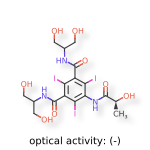
| Stereochemistry | ABSOLUTE |
| Molecular Formula | C17H22I3N3O8 |
| Molecular Weight | 777.0853 |
| Optical Activity | ( - ) |
| Defined Stereocenters | 1 / 1 |
| E/Z Centers | 0 |
| Charge | 0 |
SHOW SMILES / InChI
SMILES
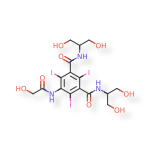
C[C@H](O)C(=O)NC1=C(I)C(C(=O)NC(CO)CO)=C(I)C(C(=O)NC(CO)CO)=C1I
InChI
InChIKey=XQZXYNRDCRIARQ-LURJTMIESA-N
InChI=1S/C17H22I3N3O8/c1-6(28)15(29)23-14-12(19)9(16(30)21-7(2-24)3-25)11(18)10(13(14)20)17(31)22-8(4-26)5-27/h6-8,24-28H,2-5H2,1H3,(H,21,30)(H,22,31)(H,23,29)/t6-/m0/s1
| Molecular Formula | C17H22I3N3O8 |
| Molecular Weight | 777.0853 |
| Charge | 0 |
| Count |
|
| Stereochemistry | ABSOLUTE |
| Additional Stereochemistry | No |
| Defined Stereocenters | 1 / 1 |
| E/Z Centers | 0 |
| Optical Activity | UNSPECIFIED |
DescriptionCurator's Comment: description was created based on several sources, including:
https://dailymed.nlm.nih.gov/dailymed/drugInfo.cfm?setid=ae8c18c9-3e7d-4515-b980-120025a88fc1
http://www.rxlist.com/isovue-drug.htm
Curator's Comment: description was created based on several sources, including:
https://dailymed.nlm.nih.gov/dailymed/drugInfo.cfm?setid=ae8c18c9-3e7d-4515-b980-120025a88fc1
http://www.rxlist.com/isovue-drug.htm
Iopamidol is a nonionic, low-osmolar iodinated contrast agent. Iopamidol is indicated for angiography, pediatric angiocardiography, selective visceral arteriography and aortography, peripheral venography, and adult and pediatric intravenous excretory urography and intravenous adult and pediatric contrast enhancement of computed tomographic. Renal toxicity has been reported in a few patients with liver dysfunction who were given oral cholecystographic agents followed by intravascular contrast agents. Intravascular injection of contrast media is frequently associated with the sensation of warmth and pain especially in peripheral arteriography and venography. In angiocardiography the adverse reactions are: hot flashes, angina pectoris, flushing, bradycardia, hypotension, hives.
Originator
Approval Year
Targets
| Primary Target | Pharmacology | Condition | Potency |
|---|---|---|---|
Target ID: vessels and anatomical structures |
Conditions
| Condition | Modality | Targets | Highest Phase | Product |
|---|---|---|---|---|
| Diagnostic | ISOVUE-M 300 Approved UseISOVUE-M (lopamidol Injection) is indicated for intrathecal administration in adult neuroradiology including myelography (lumbar, thoracic, cervical, total columnar), and for contrast enhancement of computed tomographic (CECT) cisternography and ventriculography. ISOVUE-M 200 (lopamidol Injection) is indicated for thoraco-lumbar myelography in children over the age of two years. Launch Date1985 |
|||
| Diagnostic | ISOVUE-M 300 Approved UseISOVUE-M (lopamidol Injection) is indicated for intrathecal administration in adult neuroradiology including myelography (lumbar, thoracic, cervical, total columnar), and for contrast enhancement of computed tomographic (CECT) cisternography and ventriculography. ISOVUE-M 200 (lopamidol Injection) is indicated for thoraco-lumbar myelography in children over the age of two years. Launch Date1985 |
|||
| Diagnostic | ISOVUE-M 300 Approved UseISOVUE-M (lopamidol Injection) is indicated for intrathecal administration in adult neuroradiology including myelography (lumbar, thoracic, cervical, total columnar), and for contrast enhancement of computed tomographic (CECT) cisternography and ventriculography. ISOVUE-M 200 (lopamidol Injection) is indicated for thoraco-lumbar myelography in children over the age of two years. Launch Date1985 |
Cmax
| Value | Dose | Co-administered | Analyte | Population |
|---|---|---|---|---|
112.7 μg/mL EXPERIMENT https://pubmed.ncbi.nlm.nih.gov/3096110 |
15 mL single, intrathecal dose: 15 mL route of administration: Intrathecal experiment type: SINGLE co-administered: |
IOPAMIDOL plasma | Homo sapiens population: UNHEALTHY age: ADULT sex: FEMALE / MALE food status: UNKNOWN |
AUC
| Value | Dose | Co-administered | Analyte | Population |
|---|---|---|---|---|
931 μg × h/mL EXPERIMENT https://pubmed.ncbi.nlm.nih.gov/3096110 |
15 mL single, intrathecal dose: 15 mL route of administration: Intrathecal experiment type: SINGLE co-administered: |
IOPAMIDOL plasma | Homo sapiens population: UNHEALTHY age: ADULT sex: FEMALE / MALE food status: UNKNOWN |
T1/2
| Value | Dose | Co-administered | Analyte | Population |
|---|---|---|---|---|
2 h |
single, intravenous |
IOPAMIDOL plasma | Homo sapiens population: HEALTHY age: ADULT sex: UNKNOWN food status: UNKNOWN |
Funbound
| Value | Dose | Co-administered | Analyte | Population |
|---|---|---|---|---|
100% EXPERIMENT https://pubmed.ncbi.nlm.nih.gov/9084958 |
IOPAMIDOL plasma | Homo sapiens population: UNKNOWN age: UNKNOWN sex: UNKNOWN food status: UNKNOWN |
Doses
| Dose | Population | Adverse events |
|---|---|---|
61 % single, intravenous Dose: 61 % Route: intravenous Route: single Dose: 61 % Sources: |
unhealthy, 21 years |
Disc. AE: Hepatotoxicity... AEs leading to discontinuation/dose reduction: Hepatotoxicity (1 patient) Sources: |
612 mg/mL single, intrathecal Dose: 612 mg/mL Route: intrathecal Route: single Dose: 612 mg/mL Sources: |
unknown, 45 years |
Disc. AE: Generalized tonic-clonic seizure... AEs leading to discontinuation/dose reduction: Generalized tonic-clonic seizure (1 patient) Sources: |
54250 mg single, intravenous Dose: 54250 mg Route: intravenous Route: single Dose: 54250 mg Sources: |
unknown, adult and children Health Status: unknown Age Group: adult and children Sex: unknown Sources: |
Other AEs: Extravasation... |
62775 mg single, intravenous Dose: 62775 mg Route: intravenous Route: single Dose: 62775 mg Sources: |
unknown, adult and children Health Status: unknown Age Group: adult and children Sex: unknown Sources: |
Other AEs: Extravasation... |
68544 mg single, intravenous Dose: 68544 mg Route: intravenous Route: single Dose: 68544 mg Sources: |
unknown, adult and children Health Status: unknown Age Group: adult and children Sex: unknown Sources: |
Other AEs: Extravasation... |
69768 mg single, intravenous Dose: 69768 mg Route: intravenous Route: single Dose: 69768 mg Sources: |
unknown, adult and children Health Status: unknown Age Group: adult and children Sex: unknown Sources: |
Other AEs: Extravasation... |
83700 mg single, intravenous Dose: 83700 mg Route: intravenous Route: single Dose: 83700 mg Sources: |
unknown, adult and children Health Status: unknown Age Group: adult and children Sex: unknown Sources: |
Other AEs: Allergic reaction... |
87516 mg single, intravenous Dose: 87516 mg Route: intravenous Route: single Dose: 87516 mg Sources: |
unknown, adult and children Health Status: unknown Age Group: adult and children Sex: unknown Sources: |
Other AEs: Allergic reaction... |
88740 mg single, intravenous Dose: 88740 mg Route: intravenous Route: single Dose: 88740 mg Sources: |
unknown, adult and children Health Status: unknown Age Group: adult and children Sex: unknown Sources: |
Other AEs: Allergic reaction... |
612 mg/mL single, intravenous Dose: 612 mg/mL Route: intravenous Route: single Dose: 612 mg/mL Sources: |
unknown, adult and children Health Status: unknown Age Group: adult and children Sex: unknown Sources: |
Other AEs: Adverse event... |
612 mg/mL single, intravenous Dose: 612 mg/mL Route: intravenous Route: single Dose: 612 mg/mL Sources: |
unknown, adult and children Health Status: unknown Age Group: adult and children Sex: unknown Sources: |
Other AEs: Adverse event... |
61225 mg/mL single, intravenous Dose: 61225 mg/mL Route: intravenous Route: single Dose: 61225 mg/mL Sources: |
unknown, adult and children Health Status: unknown Age Group: adult and children Sex: unknown Sources: |
Other AEs: Allergic reaction... |
775 mg/mL single, intravenous Dose: 775 mg/mL Route: intravenous Route: single Dose: 775 mg/mL Sources: |
unknown, adult and children Health Status: unknown Age Group: adult and children Sex: unknown Sources: |
Other AEs: Adverse event... |
775 mg/mL single, intravenous Dose: 775 mg/mL Route: intravenous Route: single Dose: 775 mg/mL Sources: |
unknown, adult and children Health Status: unknown Age Group: adult and children Sex: unknown Sources: |
Other AEs: Adverse event... |
AEs
| AE | Significance | Dose | Population |
|---|---|---|---|
| Hepatotoxicity | 1 patient Disc. AE |
61 % single, intravenous Dose: 61 % Route: intravenous Route: single Dose: 61 % Sources: |
unhealthy, 21 years |
| Generalized tonic-clonic seizure | 1 patient Disc. AE |
612 mg/mL single, intrathecal Dose: 612 mg/mL Route: intrathecal Route: single Dose: 612 mg/mL Sources: |
unknown, 45 years |
| Extravasation | 18 patients | 54250 mg single, intravenous Dose: 54250 mg Route: intravenous Route: single Dose: 54250 mg Sources: |
unknown, adult and children Health Status: unknown Age Group: adult and children Sex: unknown Sources: |
| Extravasation | 5 patients | 62775 mg single, intravenous Dose: 62775 mg Route: intravenous Route: single Dose: 62775 mg Sources: |
unknown, adult and children Health Status: unknown Age Group: adult and children Sex: unknown Sources: |
| Extravasation | 23 patients | 68544 mg single, intravenous Dose: 68544 mg Route: intravenous Route: single Dose: 68544 mg Sources: |
unknown, adult and children Health Status: unknown Age Group: adult and children Sex: unknown Sources: |
| Extravasation | 32 patients | 69768 mg single, intravenous Dose: 69768 mg Route: intravenous Route: single Dose: 69768 mg Sources: |
unknown, adult and children Health Status: unknown Age Group: adult and children Sex: unknown Sources: |
| Allergic reaction | 3 patients | 83700 mg single, intravenous Dose: 83700 mg Route: intravenous Route: single Dose: 83700 mg Sources: |
unknown, adult and children Health Status: unknown Age Group: adult and children Sex: unknown Sources: |
| Allergic reaction | 46 patients | 87516 mg single, intravenous Dose: 87516 mg Route: intravenous Route: single Dose: 87516 mg Sources: |
unknown, adult and children Health Status: unknown Age Group: adult and children Sex: unknown Sources: |
| Allergic reaction | 42 patients | 88740 mg single, intravenous Dose: 88740 mg Route: intravenous Route: single Dose: 88740 mg Sources: |
unknown, adult and children Health Status: unknown Age Group: adult and children Sex: unknown Sources: |
| Adverse event | 74 patients | 612 mg/mL single, intravenous Dose: 612 mg/mL Route: intravenous Route: single Dose: 612 mg/mL Sources: |
unknown, adult and children Health Status: unknown Age Group: adult and children Sex: unknown Sources: |
| Adverse event | 69 patients | 612 mg/mL single, intravenous Dose: 612 mg/mL Route: intravenous Route: single Dose: 612 mg/mL Sources: |
unknown, adult and children Health Status: unknown Age Group: adult and children Sex: unknown Sources: |
| Allergic reaction | 8 patients | 61225 mg/mL single, intravenous Dose: 61225 mg/mL Route: intravenous Route: single Dose: 61225 mg/mL Sources: |
unknown, adult and children Health Status: unknown Age Group: adult and children Sex: unknown Sources: |
| Adverse event | 8 patients | 775 mg/mL single, intravenous Dose: 775 mg/mL Route: intravenous Route: single Dose: 775 mg/mL Sources: |
unknown, adult and children Health Status: unknown Age Group: adult and children Sex: unknown Sources: |
| Adverse event | 26 patients | 775 mg/mL single, intravenous Dose: 775 mg/mL Route: intravenous Route: single Dose: 775 mg/mL Sources: |
unknown, adult and children Health Status: unknown Age Group: adult and children Sex: unknown Sources: |
PubMed
| Title | Date | PubMed |
|---|---|---|
| CT arthrography of the glenohumeral joint: CT fluoroscopy versus conventional CT and fluoroscopy--comparison of image-guidance techniques. | 2003-10 |
|
| Assessment of small bowel Crohn disease: noninvasive peroral CT enterography compared with other imaging methods and endoscopy--feasibility study. | 2003-10 |
|
| Fate of pharmaceuticals--photodegradation by simulated solar UV-light. | 2003-09 |
|
| Effect of contrast injection protocol with dose tailored to patient weight and fixed injection duration on aortic and hepatic enhancement at multidetector-row helical CT. | 2003-09 |
|
| Assessment of pancreatic CT enhancement using a high concentration of contrast material. | 2003-06-21 |
|
| Nonionic contrast media are less nephrotoxic than ionic contrast media to rat renal cortical slices. | 2003-06-05 |
|
| [Successful use of transvenous angio-multidetector-CT in diagnosing cecal angiodysplasia as the cause of peranal hemorrhage]. | 2003-06 |
|
| [Feasibility and optimization of the combined injection of contrast medium and normal saline with a single-syringe CT injection system]. | 2003-06 |
|
| Three-dimensional CT angiography of the hepatic artery: use of multi-detector row helical CT and a contrast agent. | 2003-06 |
|
| Effectiveness of theophylline prophylaxis of renal impairment after coronary angiography in patients with chronic renal insufficiency. | 2003-05-15 |
|
| [Prospects of the use of non-ionic X-ray contrast media during endoscopic retrograde cholangiopancreatography]. | 2003-05-02 |
|
| Simultaneous voiding cystourethrography and voiding urosonography. | 2003-05 |
|
| Intrathecal injection of contrast medium to prevent polymethylmethacrylate leakage during percutaneous vertebroplasty. | 2003-05 |
|
| Cartilage lesions in the ankle joint: comparison of MR arthrography and CT arthrography. | 2003-05 |
|
| Sonographic versus magnetic resonance arthrographic evaluation of full-thickness rotator cuff tears in millimeters. | 2003-04-18 |
|
| Effects of contrast media on erythrocyte aggregation during sedimentation. | 2003-04 |
|
| Ozonation: a tool for removal of pharmaceuticals, contrast media and musk fragrances from wastewater? | 2003-04 |
|
| Roles of intracellular Ca2+ and cyclic AMP in mast cell histamine release induced by radiographic contrast media. | 2003-04 |
|
| Comparison of carbon dioxide and iodinated contrast for cavography prior to inferior vena cava filter placement. | 2003-04 |
|
| Delayed side effects induced by iodinated contrast media, especially those associated with iodixanol. | 2003-03 |
|
| Early and late reactions following the use of iopamidol 340, iomeprol 350 and iodixanol 320 in cardiac catheterization. | 2003-03 |
|
| Acetylcysteine for prevention of acute deterioration of renal function following elective coronary angiography and intervention: a randomized controlled trial. | 2003-02-05 |
|
| Interstitial CT lymphography-guided localization of breast sentinel lymph node: preliminary results. | 2003-02 |
|
| Nephrotoxicity of iopamidol in pediatric, adolescent, and young adult patients who have undergone allogeneic bone marrow transplantation. | 2003-02 |
|
| Visualization of breast lymphatic pathways with an indirect computed tomography lymphography using a nonionic monometric contrast medium iopamidol: preliminary results. | 2003-02 |
|
| Usefulness of electron beam tomography in the prone position for detecting atrial thrombi in chronic atrial fibrillation. | 2003-01-25 |
|
| Conditions of iodine contrast transfer from lumbosacral CSF to blood. | 2003-01-15 |
|
| Nonionic contrast neurotoxicity after coronary angiography mimicking subarachnoid hemorrhage. | 2003 |
|
| [CO2 angiography of transplanted kidneys]. | 2003 |
|
| Administration of nonionic iodinated contrast medium does not influence the outcome of patients with ischemic brain infarction. | 2003 |
|
| Effective prophylactic protocol in delayed hypersensitivity to contrast media: report of a case involving lymphocyte transformation studies with different compounds. | 2002-11 |
|
| Acetylcysteine protects against acute renal damage in patients with abnormal renal function undergoing a coronary procedure. | 2002-10-16 |
|
| [A case of gastrectomy under continuous subdural anesthesia]. | 2002-10 |
|
| A nonadhesive liquid embolic agent composed of ethylene vinyl alcohol copolymer and ethanol mixture for the treatment of cerebral arteriovenous malformations: experimental study. | 2002-10 |
|
| Experience of intravenous digital subtraction angiography (IV-DSA) in evaluation of neoadjuvant chemotherapy for advanced breast cancer. | 2002-10 |
|
| Role of contrast-enhanced dynamic CT in the diagnosis of active tuberculoma. | 2002-10 |
|
| Iodinated contrast medium-induced potassium release: the effect of mixing ratios. | 2002-09-26 |
|
| Aortic and hepatic enhancement and tumor-to-liver contrast: analysis of the effect of different concentrations of contrast material at multi-detector row helical CT. | 2002-09 |
|
| Enhanced radio sensitivity with iodinated contrast agents using monochromatic synchrotron X-rays on human cancerous cells. | 2002-08 |
|
| Optimization of contrast agent administration in MSCT angiography. | 2002-08 |
|
| Nonionic contrast media iohexol and iomeprol decrease renal arterial tone: comparative studies on human and porcine isolated vascular segments. | 2002-08 |
|
| Optimum iodine concentration of contrast material through microcatheters: hydrodynamic analysis of experimental results. | 2002-07-21 |
|
| [Method of injection of contrast medium for brain perfusion CT]. | 2002-07 |
|
| Erythrodermic psoriasis precipitated by radiologic contrast media. | 2002-06 |
|
| Plasma endothelin, nitric oxide and atrial natriuretic peptide levels in humans after abdominal angiography. | 2002-05 |
|
| Mechanisms of blood pressure change after bolus injections of X-ray contrast media. | 2002-05 |
|
| The rabbit renal toxicity test: a sensitive in vivo test for the nephrotoxicity of contrast agents. | 2002-05 |
|
| Comparative tolerability of contrast media used for coronary interventions. | 2002 |
|
| [Effects of high iodine doses in parenteral roentgen contrast media administration on parameters of the pro-/antioxidant balance]. | 2002 |
|
| [Iotrolan versus iopamidol. A controlled double-blind study with lumbar myelography]. | 1992-08 |
Patents
Sample Use Guides
In Vivo Use Guide
Curator's Comment: Dosage and administration depends on analysis type, patient age and contrast agent concentration. ISOVUE is available in different concentrations: 128, 200, 250, 300 and 370 mgI/ml.
Peripheral Arteriograghy: For injection into the femoral artery or subclavian artery, 5 to 40 mL of ISOVUE-300 may be used; for injection into the aorta for a distal runoff, 25 to 50 mL may be used. Doses up to a total of 250 mL of ISOVUE-300 have been administered during peripheral arteriography.
Route of Administration:
Intravascular
In Vitro Use Guide
Curator's Comment: Iopamidol increases the clotting time.
http://www.ncbi.nlm.nih.gov/pubmed/2745021
Diffusion of iopamidol (300 and 200 mgI/ml) was studied in the cerebrospinal fluid (CSF). Test tubes containing CSF were kept in a waterbath at 37 degrees C. Contrast medium was injected along the wall into the tubes, and diffusion of contrast media in the tubes was followed with repeated computed tomography for 5 h. The contents of the tubes were then mixed by shaking, and the tubes were scanned immediately and 8 h later.
| Substance Class |
Chemical
Created
by
admin
on
Edited
Mon Mar 31 17:34:41 GMT 2025
by
admin
on
Mon Mar 31 17:34:41 GMT 2025
|
| Record UNII |
JR13W81H44
|
| Record Status |
Validated (UNII)
|
| Record Version |
|
-
Download
| Name | Type | Language | ||
|---|---|---|---|---|
|
Official Name | English | ||
|
Preferred Name | English | ||
|
Common Name | English | ||
|
Common Name | English | ||
|
Common Name | English | ||
|
Common Name | English | ||
|
Systematic Name | English | ||
|
Code | English | ||
|
Systematic Name | English | ||
|
Common Name | English | ||
|
Systematic Name | English | ||
|
Brand Name | English | ||
|
Common Name | English | ||
|
Code | English | ||
|
Common Name | English | ||
|
Common Name | English | ||
|
Systematic Name | English | ||
|
Common Name | English | ||
|
Common Name | English | ||
|
Common Name | English |
| Classification Tree | Code System | Code | ||
|---|---|---|---|---|
|
NCI_THESAURUS |
C28500
Created by
admin on Mon Mar 31 17:34:41 GMT 2025 , Edited by admin on Mon Mar 31 17:34:41 GMT 2025
|
||
|
WHO-VATC |
QV08AB04
Created by
admin on Mon Mar 31 17:34:41 GMT 2025 , Edited by admin on Mon Mar 31 17:34:41 GMT 2025
|
||
|
WHO-ATC |
V08AB04
Created by
admin on Mon Mar 31 17:34:41 GMT 2025 , Edited by admin on Mon Mar 31 17:34:41 GMT 2025
|
||
|
NDF-RT |
N0000010258
Created by
admin on Mon Mar 31 17:34:41 GMT 2025 , Edited by admin on Mon Mar 31 17:34:41 GMT 2025
|
||
|
NDF-RT |
N0000180185
Created by
admin on Mon Mar 31 17:34:41 GMT 2025 , Edited by admin on Mon Mar 31 17:34:41 GMT 2025
|
| Code System | Code | Type | Description | ||
|---|---|---|---|---|---|
|
1464
Created by
admin on Mon Mar 31 17:34:41 GMT 2025 , Edited by admin on Mon Mar 31 17:34:41 GMT 2025
|
PRIMARY | |||
|
IOPAMIDOL
Created by
admin on Mon Mar 31 17:34:41 GMT 2025 , Edited by admin on Mon Mar 31 17:34:41 GMT 2025
|
PRIMARY | |||
|
CHEMBL1200932
Created by
admin on Mon Mar 31 17:34:41 GMT 2025 , Edited by admin on Mon Mar 31 17:34:41 GMT 2025
|
PRIMARY | |||
|
JR13W81H44
Created by
admin on Mon Mar 31 17:34:41 GMT 2025 , Edited by admin on Mon Mar 31 17:34:41 GMT 2025
|
PRIMARY | |||
|
31711
Created by
admin on Mon Mar 31 17:34:41 GMT 2025 , Edited by admin on Mon Mar 31 17:34:41 GMT 2025
|
PRIMARY | |||
|
100000091432
Created by
admin on Mon Mar 31 17:34:41 GMT 2025 , Edited by admin on Mon Mar 31 17:34:41 GMT 2025
|
PRIMARY | |||
|
60166-93-0
Created by
admin on Mon Mar 31 17:34:41 GMT 2025 , Edited by admin on Mon Mar 31 17:34:41 GMT 2025
|
PRIMARY | |||
|
D007479
Created by
admin on Mon Mar 31 17:34:41 GMT 2025 , Edited by admin on Mon Mar 31 17:34:41 GMT 2025
|
PRIMARY | |||
|
262-093-6
Created by
admin on Mon Mar 31 17:34:41 GMT 2025 , Edited by admin on Mon Mar 31 17:34:41 GMT 2025
|
PRIMARY | |||
|
1344702
Created by
admin on Mon Mar 31 17:34:41 GMT 2025 , Edited by admin on Mon Mar 31 17:34:41 GMT 2025
|
PRIMARY | |||
|
SUB08239MIG
Created by
admin on Mon Mar 31 17:34:41 GMT 2025 , Edited by admin on Mon Mar 31 17:34:41 GMT 2025
|
PRIMARY | |||
|
m6370
Created by
admin on Mon Mar 31 17:34:41 GMT 2025 , Edited by admin on Mon Mar 31 17:34:41 GMT 2025
|
PRIMARY | Merck Index | ||
|
65492
Created by
admin on Mon Mar 31 17:34:41 GMT 2025 , Edited by admin on Mon Mar 31 17:34:41 GMT 2025
|
PRIMARY | |||
|
8075
Created by
admin on Mon Mar 31 17:34:41 GMT 2025 , Edited by admin on Mon Mar 31 17:34:41 GMT 2025
|
PRIMARY | |||
|
C47567
Created by
admin on Mon Mar 31 17:34:41 GMT 2025 , Edited by admin on Mon Mar 31 17:34:41 GMT 2025
|
PRIMARY | |||
|
Iopamidol
Created by
admin on Mon Mar 31 17:34:41 GMT 2025 , Edited by admin on Mon Mar 31 17:34:41 GMT 2025
|
PRIMARY | |||
|
DB08947
Created by
admin on Mon Mar 31 17:34:41 GMT 2025 , Edited by admin on Mon Mar 31 17:34:41 GMT 2025
|
PRIMARY | |||
|
JR13W81H44
Created by
admin on Mon Mar 31 17:34:41 GMT 2025 , Edited by admin on Mon Mar 31 17:34:41 GMT 2025
|
PRIMARY | |||
|
DTXSID1023158
Created by
admin on Mon Mar 31 17:34:41 GMT 2025 , Edited by admin on Mon Mar 31 17:34:41 GMT 2025
|
PRIMARY | |||
|
4399
Created by
admin on Mon Mar 31 17:34:41 GMT 2025 , Edited by admin on Mon Mar 31 17:34:41 GMT 2025
|
PRIMARY | |||
|
5966
Created by
admin on Mon Mar 31 17:34:41 GMT 2025 , Edited by admin on Mon Mar 31 17:34:41 GMT 2025
|
PRIMARY | RxNorm |
| Related Record | Type | Details | ||
|---|---|---|---|---|
|
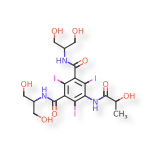
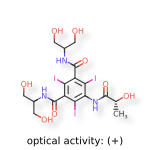
RACEMATE -> ENANTIOMER |
|
||
|
ENANTIOMER -> ENANTIOMER |
|
| Related Record | Type | Details | ||
|---|---|---|---|---|
|
|
IMPURITY -> PARENT |
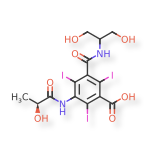
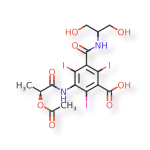
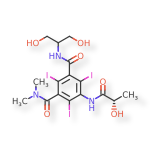
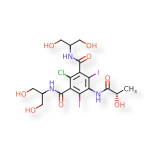
Iopamidol related compound C3 and 2-chloro derivative are integrated together.
USP
|
||
|
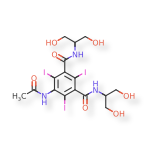
IMPURITY -> PARENT |
USP
|
||
|
|
IMPURITY -> PARENT | |||
|
|
IMPURITY -> PARENT |
|
||
|
|
IMPURITY -> PARENT |
Iopamidol related compound C and 2-chloro derivative are integrated together to determine conformance.
USP
|
||
|
IMPURITY -> PARENT |
USP
|
| Related Record | Type | Details | ||
|---|---|---|---|---|
|
|
ACTIVE MOIETY |
|