Details
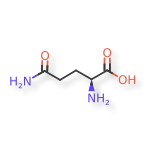
| Stereochemistry | ABSOLUTE |
| Molecular Formula | C5H9N2O3.Na |
| Molecular Weight | 168.1263 |
| Optical Activity | UNSPECIFIED |
| Defined Stereocenters | 1 / 1 |
| E/Z Centers | 0 |
| Charge | 0 |
SHOW SMILES / InChI
SMILES
[Na+].N[C@@H](CCC(N)=O)C([O-])=O
InChI
InChIKey=YWOPZILGDZKFFC-DFWYDOINSA-M
InChI=1S/C5H10N2O3.Na/c6-3(5(9)10)1-2-4(7)8;/h3H,1-2,6H2,(H2,7,8)(H,9,10);/q;+1/p-1/t3-;/m0./s1
| Molecular Formula | Na |
| Molecular Weight | 22.98976928 |
| Charge | 1 |
| Count |
|
| Stereochemistry | ACHIRAL |
| Additional Stereochemistry | No |
| Defined Stereocenters | 0 / 0 |
| E/Z Centers | 0 |
| Optical Activity | NONE |
| Molecular Formula | C5H9N2O3 |
| Molecular Weight | 145.1366 |
| Charge | -1 |
| Count |
|
| Stereochemistry | ABSOLUTE |
| Additional Stereochemistry | No |
| Defined Stereocenters | 1 / 1 |
| E/Z Centers | 0 |
| Optical Activity | UNSPECIFIED |
DescriptionSources: http://www.drugbank.ca/drugs/DB00130Curator's Comment: Description was created based on several sources, including
Sources: http://www.drugbank.ca/drugs/DB00130
Curator's Comment: Description was created based on several sources, including
Glutamine is a non-essential amino acid present abundantly throughout the body and is involved in many metabolic processes. It is synthesized from glutamic acid and ammonia. It is the principal carrier of nitrogen in the body and is an important energy source for many cells. Supplemental L-glutamine's possible immunomodulatory role may be accounted for in a number of ways. L-glutamine appears to play a major role in protecting the integrity of the gastrointestinal tract and, in particular, the large intestine. During catabolic states, the integrity of the intestinal mucosa may be compromised with consequent increased intestinal permeability and translocation of Gram-negative bacteria from the large intestine into the body. The demand for L-glutamine by the intestine, as well as by cells such as lymphocytes, appears to be much greater than that supplied by skeletal muscle, the major storage tissue for L-glutamine. L-glutamine is the preferred respiratory fuel for enterocytes, colonocytes and lymphocytes. Therefore, supplying supplemental L-glutamine under these conditions may do a number of things. For one, it may reverse the catabolic state by sparing skeletal muscle L-glutamine. It also may inhibit translocation of Gram-negative bacteria from the large intestine. L-glutamine helps maintain secretory IgA, which functions primarily by preventing the attachment of bacteria to mucosal cells. L-glutamine appears to be required to support the proliferation of mitogen-stimulated lymphocytes, as well as the production of interleukin-2 (IL-2) and interferon-gamma (IFN-gamma). It is also required for the maintenance of lymphokine-activated killer cells (LAK). L-glutamine can enhance phagocytosis by neutrophils and monocytes. It can lead to an increased synthesis of glutathione in the intestine, which may also play a role in maintaining the integrity of the intestinal mucosa by ameliorating oxidative stress. The exact mechanism of the possible immunomodulatory action of supplemental L-glutamine, however, remains unclear. It is conceivable that the major effect of L-glutamine occurs at the level of the intestine. Perhaps enteral L-glutamine acts directly on intestine-associated lymphoid tissue and stimulates overall immune function by that mechanism, without passing beyond the splanchnic bed. Glutamine is used for nutritional supplementation, also for treating dietary shortage or imbalance.
Approval Year
Targets
| Primary Target | Pharmacology | Condition | Potency |
|---|---|---|---|
Target ID: P17812 Gene ID: 1503.0 Gene Symbol: CTPS1 Target Organism: Homo sapiens (Human) Sources: http://www.drugbank.ca/drugs/DB00130 |
|||
Target ID: CHEMBL2146302 Sources: http://www.drugbank.ca/drugs/DB00130 |
|||
Target ID: CHEMBL2730 Sources: http://www.drugbank.ca/drugs/DB00130 |
|||
Target ID: GO:0006915 |
Conditions
| Condition | Modality | Targets | Highest Phase | Product |
|---|---|---|---|---|
| Primary | Nutrestore Approved UseNutrestore® [L-glutamine powder for oral solution] is indicated for the treatment of Short Bowel Syndrome (SBS) in patients receiving specialized nutritional support when used in conjunction with a recombinant human growth hormone that is approved for this indication Launch Date2004 |
Cmax
| Value | Dose | Co-administered | Analyte | Population |
|---|---|---|---|---|
22.67 μg/mL EXPERIMENT https://pubmed.ncbi.nlm.nih.gov/24771050 |
2 g single, oral dose: 2 g route of administration: Oral experiment type: SINGLE co-administered: |
GLUTAMINE plasma | Homo sapiens population: HEALTHY age: ADULT sex: MALE food status: FASTED |
|
35.34 μg/mL EXPERIMENT https://pubmed.ncbi.nlm.nih.gov/24771050 |
4 g single, oral dose: 4 g route of administration: Oral experiment type: SINGLE co-administered: |
GLUTAMINE plasma | Homo sapiens population: HEALTHY age: ADULT sex: MALE food status: FASTED |
AUC
| Value | Dose | Co-administered | Analyte | Population |
|---|---|---|---|---|
31.83 μg × h/mL EXPERIMENT https://pubmed.ncbi.nlm.nih.gov/24771050 |
2 g single, oral dose: 2 g route of administration: Oral experiment type: SINGLE co-administered: |
GLUTAMINE plasma | Homo sapiens population: HEALTHY age: ADULT sex: MALE food status: FASTED |
|
57.13 μg × h/mL EXPERIMENT https://pubmed.ncbi.nlm.nih.gov/24771050 |
4 g single, oral dose: 4 g route of administration: Oral experiment type: SINGLE co-administered: |
GLUTAMINE plasma | Homo sapiens population: HEALTHY age: ADULT sex: MALE food status: FASTED |
T1/2
| Value | Dose | Co-administered | Analyte | Population |
|---|---|---|---|---|
1.5 h EXPERIMENT https://pubmed.ncbi.nlm.nih.gov/24771050 |
2 g single, oral dose: 2 g route of administration: Oral experiment type: SINGLE co-administered: |
GLUTAMINE plasma | Homo sapiens population: HEALTHY age: ADULT sex: MALE food status: FASTED |
|
1.77 h EXPERIMENT https://pubmed.ncbi.nlm.nih.gov/24771050 |
4 g single, oral dose: 4 g route of administration: Oral experiment type: SINGLE co-administered: |
GLUTAMINE plasma | Homo sapiens population: HEALTHY age: ADULT sex: MALE food status: FASTED |
Doses
| Dose | Population | Adverse events |
|---|---|---|
0.86 g/kg 1 times / day multiple, intravenous Highest studied dose Dose: 0.86 g/kg, 1 times / day Route: intravenous Route: multiple Dose: 0.86 g/kg, 1 times / day Sources: |
unhealthy, 22-88 |
|
0.7 g/kg 1 times / day multiple, oral Highest studied dose Dose: 0.7 g/kg, 1 times / day Route: oral Route: multiple Dose: 0.7 g/kg, 1 times / day Sources: |
unhealthy, children |
PubMed
| Title | Date | PubMed |
|---|---|---|
| Oral bovine serum concentrate improves cryptosporidial enteritis in calves. | 2002-03 |
|
| Antiapoptotic and proapoptotic action of various amino acids and analogs in starving MOLT-4 cells. | 2002-02-01 |
|
| MR proton spectroscopy in liver examinations of healthy individuals in vivo. | 2002-02 |
|
| [Association between the genetic polymorphisms of beta2-adrenergic receptor gene and the asthma susceptibility and clinical phenotypes in a Chinese population]. | 2002-02 |
|
| The effects of high-dose glutamine ingestion on weightlifting performance. | 2002-02 |
|
| Glutamine promotes triglyceride absorption in a dose-dependent manner. | 2002-02 |
|
| The influence of L-glutamine on the depression of hepatic cytochrome P450 activity in male rats caused by total parenteral nutrition. | 2002-02 |
|
| Effects of cytochalasin B and D upon insulin release and pancreatic islet cell metabolism. | 2002-02 |
|
| Characterization of cell death induced by vinflunine, the most recent Vinca alkaloid in clinical development. | 2002-01-07 |
|
| Acute effects of intravenous glutamine supplementation on protein metabolism in very low birth weight infants: a stable isotope study. | 2002-01 |
|
| Coupled and uncoupled proton movement by amino acid transport system N. | 2001-12-17 |
|
| Total solid phase syntheses of the quinazoline alkaloids: verrucines A and B and anacine. | 2001-12 |
|
| Gamma-glutamyl transpeptidase and glutathione biosynthesis in non-tumorigenic and tumorigenic rat liver oval cell lines. | 2001-12 |
|
| Expression of c-myc is not critical for cell proliferation in established human leukemia lines. | 2001-11-16 |
|
| Amino acid residues important for substrate specificity of the amino acid permeases Can1p and Gnp1p in Saccharomyces cerevisiae. | 2001-11 |
|
| The development of low-grade cerebral edema in cirrhosis is supported by the evolution of (1)H-magnetic resonance abnormalities after liver transplantation. | 2001-11 |
|
| [Use of biologically active substances in preventing the toxic action of some heavy metals]. | 2001-10-23 |
|
| Brain amino acid metabolism and ketosis. | 2001-10-15 |
|
| Signaling to the nucleus by an L-type calcium channel-calmodulin complex through the MAP kinase pathway. | 2001-10-12 |
|
| System y+L-like activities account for high and low amino-acid transport phenotypes in chicken erythrocytes. | 2001-10-01 |
|
| Human L-type amino acid transporter 1 (LAT1): characterization of function and expression in tumor cell lines. | 2001-10-01 |
|
| Amino acids protect epithelial cells from local toxicity by absorption enhancer, sodium laurate. | 2001-10 |
|
| Na+ transport by the neural glutamine transporter ATA1. | 2001-10 |
|
| Characterization of inhibitors acting at the synthetase site of Escherichia coli asparagine synthetase B. | 2001-09-18 |
|
| Significance of interferon-gamma in coronary artery bypass surgery. | 2001-09-11 |
|
| [Experimental research of host endothelialization of transplanted hetero-heart valve by transfer of VEGF gene]. | 2001-09-10 |
|
| Amino acid supplementation affects hematological and biochemical parameters in elite rugby players. | 2001-09 |
|
| Comparison of calcitonin, alendronate and fluorophosphate effects on ovariectomized rat bone. | 2001-09 |
|
| [A study for optimal method of separating and cultivating embryonic rat cerebral neurons]. | 2001-09 |
|
| The stability constants of copper(II) complexes with some alpha-amino acids in dioxan-water mixtures. | 2001-08-15 |
|
| Heterogeneity of transport systems for L-glutamine in mouse mammary gland. | 2001-08 |
|
| L-glutamine. | 2001-08 |
|
| The glutamine/glutamate couplet and cellular function. | 2001-08 |
|
| Effects of the garlic compound diallyl disulfide on the metabolism, adherence and cell cycle of HT-29 colon carcinoma cells: evidence of sensitive and resistant sub-populations. | 2001-08 |
|
| Comparative effects of diet supplementation with l-carnitine and dl-carnitine on ammonia toxicity and hepatic metabolism in rats. | 2001-04 |
|
| Receptor protein tyrosine kinase EphB4 is up-regulated in colon cancer. | 2001 |
|
| A sensitive and rapid assay for homologous recombination in mosquito cells: impact of vector topology and implications for gene targeting. | 2001 |
|
| Dietary antioxidants protect gut epithelial cells from oxidant-induced apoptosis. | 2001 |
|
| Connexin-mimetic peptide Gap 27 decreases osteoclastic activity. | 2001 |
|
| Cloning, expression and nuclear localization of human NPM3, a member of the nucleophosmin/nucleoplasmin family of nuclear chaperones. | 2001 |
|
| Early response genes induced in chondrocytes stimulated with the inflammatory cytokine interleukin-1beta. | 2001 |
|
| Limited heat-shock protein 72 induction in Caco-2 cells by L-glutamine. | 2001 |
|
| Genomic-scale measurement of mRNA turnover and the mechanisms of action of the anti-cancer drug flavopiridol. | 2001 |
|
| Estimation of apparent L-amino acid diffusion in porcine jejunal enterocyte brush border membrane vesicles. | 2001 |
|
| MtnK, methylthioribose kinase, is a starvation-induced protein in Bacillus subtilis. | 2001 |
|
| HIPK2 overexpression leads to stabilization of p53 protein and increased p53 transcriptional activity by decreasing Mdm2 protein levels. | 2001 |
|
| Gene targeting in mosquito cells: a demonstration of 'knockout' technology in extrachromosomal gene arrays. | 2001 |
|
| Flow cytometric assessment of the reactivity of a panel of monoclonal antibodies (mAb) against two populations of human dendritic cells (DC). | 2001 |
|
| [Proton magnetic-resonance spectroscopy in remitting and secondary-progressive multiple sclerosis]. | 2001 |
|
| TNF-alpha induced endothelial MAdCAM-1 expression is regulated by exogenous, not endogenous nitric oxide. | 2001 |
Sample Use Guides
Usual Adult Dose for Dietary Supplement
Average Dose: 10 g orally 3 times per day
Dosing range: 5 g to 30 g orally per day
Route of Administration:
Oral
| Substance Class |
Chemical
Created
by
admin
on
Edited
Mon Mar 31 22:34:57 GMT 2025
by
admin
on
Mon Mar 31 22:34:57 GMT 2025
|
| Record UNII |
IA7707HOQ8
|
| Record Status |
Validated (UNII)
|
| Record Version |
|
-
Download
| Name | Type | Language | ||
|---|---|---|---|---|
|
Systematic Name | English | ||
|
Preferred Name | English | ||
|
Common Name | English | ||
|
Common Name | English | ||
|
Systematic Name | English | ||
|
Systematic Name | English | ||
|
Common Name | English |
| Code System | Code | Type | Description | ||
|---|---|---|---|---|---|
|
23677240
Created by
admin on Mon Mar 31 22:34:57 GMT 2025 , Edited by admin on Mon Mar 31 22:34:57 GMT 2025
|
PRIMARY | |||
|
DBSALT002231
Created by
admin on Mon Mar 31 22:34:57 GMT 2025 , Edited by admin on Mon Mar 31 22:34:57 GMT 2025
|
PRIMARY | |||
|
IA7707HOQ8
Created by
admin on Mon Mar 31 22:34:57 GMT 2025 , Edited by admin on Mon Mar 31 22:34:57 GMT 2025
|
PRIMARY | |||
|
73477-31-3
Created by
admin on Mon Mar 31 22:34:57 GMT 2025 , Edited by admin on Mon Mar 31 22:34:57 GMT 2025
|
PRIMARY |
| Related Record | Type | Details | ||
|---|---|---|---|---|
|
|
ACTIVE MOIETY |