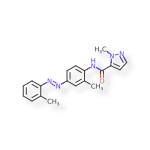
Details
| Stereochemistry | ACHIRAL |
| Molecular Formula | C19H19N5O |
| Molecular Weight | 333.3871 |
| Optical Activity | NONE |
| Defined Stereocenters | 0 / 0 |
| E/Z Centers | 1 |
| Charge | 0 |
SHOW SMILES / InChI
SMILES
CN1N=CC=C1C(=O)NC2=CC=C(C=C2C)\N=N\C3=CC=CC=C3C
InChI
InChIKey=LKTNEXPODAWWFM-GHVJWSGMSA-N
InChI=1S/C19H19N5O/c1-13-6-4-5-7-17(13)23-22-15-8-9-16(14(2)12-15)21-19(25)18-10-11-20-24(18)3/h4-12H,1-3H3,(H,21,25)/b23-22+
| Molecular Formula | C19H19N5O |
| Molecular Weight | 333.3871 |
| Charge | 0 |
| Count |
|
| Stereochemistry | ACHIRAL |
| Additional Stereochemistry | No |
| Defined Stereocenters | 0 / 0 |
| E/Z Centers | 1 |
| Optical Activity | NONE |
Approval Year
PubMed
| Title | Date | PubMed |
|---|---|---|
| Kynurenine Signaling Increases DNA Polymerase Kappa Expression and Promotes Genomic Instability in Glioblastoma Cells. | 2016-01-19 |
|
| Aryl hydrocarbon receptor-dependent up-regulation of the heterodimeric amino acid transporter LAT1 (SLC7A5)/CD98hc (SLC3A2) by diesel exhaust particle extract in human bronchial epithelial cells. | 2016-01-01 |
|
| PCB126-Induced Disruption in Gluconeogenesis and Fatty Acid Oxidation Precedes Fatty Liver in Male Rats. | 2016-01 |
|
| Covalent binding of quinones activates the Ah receptor in Hepa1c1c7 cells. | 2015-12 |
|
| Activation of the aryl hydrocarbon receptor by carcinogenic aromatic amines and modulatory effects of their N-acetylated metabolites. | 2015-12 |
|
| Arylhydrocarbon receptor-dependent mIndy (Slc13a5) induction as possible contributor to benzo[a]pyrene-induced lipid accumulation in hepatocytes. | 2015-11-04 |
|
| Cytokine responses induced by diesel exhaust particles are suppressed by PAR-2 silencing and antioxidant treatment, and driven by polar and non-polar soluble constituents. | 2015-10-14 |
|
| Benzo[a]pyrene-induced nitric oxide production acts as a survival signal targeting mitochondrial membrane potential. | 2015-10 |
|
| Differential Effects of Glycyrrhiza Species on Genotoxic Estrogen Metabolism: Licochalcone A Downregulates P450 1B1, whereas Isoliquiritigenin Stimulates It. | 2015-08-17 |
|
| Aryl Hydrocarbon Receptor Ligand 5F 203 Induces Oxidative Stress That Triggers DNA Damage in Human Breast Cancer Cells. | 2015-05-18 |
|
| Enhanced thyroid hormone breakdown in hepatocytes by mutual induction of the constitutive androstane receptor (CAR, NR1I3) and arylhydrocarbon receptor by benzo[a]pyrene and phenobarbital. | 2015-02-03 |
|
| PCB126 inhibits adipogenesis of human preadipocytes. | 2015-02 |
|
| The aryl hydrocarbon receptor suppresses osteoblast proliferation and differentiation through the activation of the ERK signaling pathway. | 2014-11-01 |
|
| Aryl hydrocarbon receptor-dependent regulation of miR-196a expression controls lung fibroblast apoptosis but not proliferation. | 2014-11-01 |
|
| Combination effects of (tri)azole fungicides on hormone production and xenobiotic metabolism in a human placental cell line. | 2014-09-17 |
|
| Aryl hydrocarbon receptor (AhR) attenuation of subchronic cigarette smoke-induced pulmonary neutrophilia is associated with retention of nuclear RelB and suppression of intercellular adhesion molecule-1 (ICAM-1). | 2014-07 |
|
| A novel MDCKII in vitro model for assessing ABCG2-drug interactions and regulation of ABCG2 transport activity in the caprine mammary gland by environmental pollutants and pesticides. | 2014-04 |
|
| Differentiation of human placental BeWo cells by the environmental contaminant benzo(a)pyrene. | 2014-03-05 |
|
| Penta- and octa-bromodiphenyl ethers promote proinflammatory protein expression in human bronchial epithelial cells in vitro. | 2014-03 |
|
| The aryl hydrocarbon receptor: differential contribution to T helper 17 and T cytotoxic 17 cell development. | 2014 |
|
| Aryl hydrocarbon receptor-dependent cell cycle arrest in isolated mouse oval cells. | 2013-10-23 |
|
| AhR-mediated effects of dioxin on neuronal acetylcholinesterase expression in vitro. | 2013-05 |
|
| Aryl phosphate esters within a major PentaBDE replacement product induce cardiotoxicity in developing zebrafish embryos: potential role of the aryl hydrocarbon receptor. | 2013-05 |
|
| AhR-mediated changes in global gene expression in rat liver progenitor cells. | 2013-04 |
|
| 2,3,7,8-Tetrachlorodibenzo-p-dioxin-mediated production of reactive oxygen species is an essential step in the mechanism of action to accelerate human keratinocyte differentiation. | 2013-03 |
|
| Cyprodinil as an activator of aryl hydrocarbon receptor. | 2013-02-08 |
|
| Cigarette smoke condensate induces aryl hydrocarbon receptor-dependent changes in gene expression in spermatocytes. | 2012-12 |
|
| The androgenic anabolic steroid tetrahydrogestrinone produces dioxin-like effects via the aryl hydrocarbon receptor. | 2012-10 |
|
| FOXA1 is essential for aryl hydrocarbon receptor-dependent regulation of cyclin G2. | 2012-05 |
|
| 2,3,7,8-Tetrachlorodibenzo-p-dioxin's suppression of 1-nitropyrene-induced p53 expression is mediated by cytochrome P450 1A1. | 2011-12-19 |
|
| The aryl hydrocarbon receptor agonist 2,3,7,8-tetrachloro-dibenzo-p-dioxin (TCDD) alters early embryonic development in a rat IVF exposure model. | 2011-11 |
|
| Aryl hydrocarbon receptor-dependent upregulation of Cyp1b1 by TCDD and diesel exhaust particles in rat brain microvessels. | 2011-08-25 |
|
| 2,3,7,8-Tetrachlorodibenzo-p-dioxin-induced MUC5AC expression: aryl hydrocarbon receptor-independent/EGFR/ERK/p38-dependent SP1-based transcription. | 2011-08 |
|
| Effects of PCB126 and 17β-oestradiol on endothelium-derived vasoactive factors in human endothelial cells. | 2011-07-11 |
|
| Identification of a high-affinity ligand that exhibits complete aryl hydrocarbon receptor antagonism. | 2011-07 |
|
| CH223191 is a ligand-selective antagonist of the Ah (Dioxin) receptor. | 2010-10 |
|
| Direct assessment of cumulative aryl hydrocarbon receptor agonist activity in sera from experimentally exposed mice and environmentally exposed humans. | 2010-05 |
|
| Up-regulation of CYP1A1 by rutaecarpine is dependent on aryl hydrocarbon receptor and calcium. | 2009-12-21 |
|
| Inhibition of UV-C light-induced apoptosis in liver cells by 2,3,7,8-tetrachlorodibenzo-p-dioxin. | 2009-09 |
|
| Novel compound 2-methyl-2H-pyrazole-3-carboxylic acid (2-methyl-4-o-tolylazo-phenyl)-amide (CH-223191) prevents 2,3,7,8-TCDD-induced toxicity by antagonizing the aryl hydrocarbon receptor. | 2006-06 |
Patents
Sample Use Guides
in mice: 10 mg/kg/day in corn oil for 25 days potently prevents TCDD-caused cytochrome P450 induction, liver toxicity, and wasting syndrome in mice.
Route of Administration:
Oral
It was tested the ability of CH-223191 to block TCDD-mediated cytochrome P450 expression by using Western blot assay and RT-PCR in HepG2 cells. Treatment with TCDD caused an increase in the level of cytochrome P450 1A1 protein and mRNA compared with the DMSO control. Such cytochrome P450 1A1 induction was inhibited by CH-223191 in dose-dependent manner. After pretreatment with 0.1, 1, or 10 μM CH-223191 for 1 h, HepG2 cells were treated with 3 nM TCDD for 24 h. Cytochrome P450 activity was determined in intact cells by ethoxyresorufin-O-deethylase (EROD) assay. CH-223191 alone had no inductive effects at any concentration, whereas 10 μM flavone slightly increased cytochrome P450 1A1 expression and cytochrome P450 activity. Therefore, these results support the conclusion that CH-223191 has only AhR antagonist effects without agonist-like activity and unlike that observed for flavone.
| Substance Class |
Chemical
Created
by
admin
on
Edited
Mon Mar 31 22:03:38 GMT 2025
by
admin
on
Mon Mar 31 22:03:38 GMT 2025
|
| Record UNII |
HYE7315Z4C
|
| Record Status |
Validated (UNII)
|
| Record Version |
|
-
Download
| Name | Type | Language | ||
|---|---|---|---|---|
|
Common Name | English | ||
|
Preferred Name | English | ||
|
Systematic Name | English |
| Code System | Code | Type | Description | ||
|---|---|---|---|---|---|
|
DTXSID5058698
Created by
admin on Mon Mar 31 22:03:38 GMT 2025 , Edited by admin on Mon Mar 31 22:03:38 GMT 2025
|
PRIMARY | |||
|
HYE7315Z4C
Created by
admin on Mon Mar 31 22:03:38 GMT 2025 , Edited by admin on Mon Mar 31 22:03:38 GMT 2025
|
PRIMARY | |||
|
3091786
Created by
admin on Mon Mar 31 22:03:38 GMT 2025 , Edited by admin on Mon Mar 31 22:03:38 GMT 2025
|
PRIMARY | |||
|
301326-22-7
Created by
admin on Mon Mar 31 22:03:38 GMT 2025 , Edited by admin on Mon Mar 31 22:03:38 GMT 2025
|
PRIMARY |
| Related Record | Type | Details | ||
|---|---|---|---|---|
|
|
ACTIVE MOIETY |