


Details
| Stereochemistry | ACHIRAL |
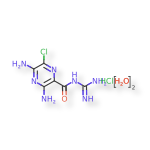
| Molecular Formula | C6H8ClN7O.ClH.2H2O |
| Molecular Weight | 302.119 |
| Optical Activity | NONE |
| Defined Stereocenters | 0 / 0 |
| E/Z Centers | 0 |
| Charge | 0 |
SHOW SMILES / InChI
SMILES
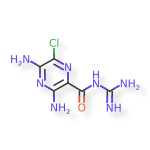
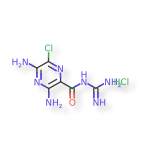
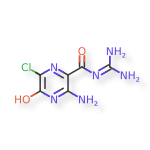
O.O.Cl.NC(=N)NC(=O)C1=C(N)N=C(N)C(Cl)=N1
InChI
InChIKey=LTKVFMLMEYCWMK-UHFFFAOYSA-N
InChI=1S/C6H8ClN7O.ClH.2H2O/c7-2-4(9)13-3(8)1(12-2)5(15)14-6(10)11;;;/h(H4,8,9,13)(H4,10,11,14,15);1H;2*1H2
| Molecular Formula | C6H8ClN7O |
| Molecular Weight | 229.627 |
| Charge | 0 |
| Count |
|
| Stereochemistry | ACHIRAL |
| Additional Stereochemistry | No |
| Defined Stereocenters | 0 / 0 |
| E/Z Centers | 0 |
| Optical Activity | NONE |
| Molecular Formula | H2O |
| Molecular Weight | 18.0153 |
| Charge | 0 |
| Count |
|
| Stereochemistry | ACHIRAL |
| Additional Stereochemistry | No |
| Defined Stereocenters | 0 / 0 |
| E/Z Centers | 0 |
| Optical Activity | NONE |
| Molecular Formula | ClH |
| Molecular Weight | 36.461 |
| Charge | 0 |
| Count |
|
| Stereochemistry | ACHIRAL |
| Additional Stereochemistry | No |
| Defined Stereocenters | 0 / 0 |
| E/Z Centers | 0 |
| Optical Activity | NONE |
DescriptionSources: http://www.drugbank.ca/drugs/DB00594Curator's Comment: Description was created based on several sources, including
http://www.accessdata.fda.gov/drugsatfda_docs/nda/2002/18-200S024_Midamor_Prntlbl.pdf
Sources: http://www.drugbank.ca/drugs/DB00594
Curator's Comment: Description was created based on several sources, including
http://www.accessdata.fda.gov/drugsatfda_docs/nda/2002/18-200S024_Midamor_Prntlbl.pdf
Amiloride, an antikaliuretic-diuretic agent, is a pyrazine-carbonyl-guanidine that is unrelated chemically to other known antikaliuretic or diuretic agents. It is an antihypertensive, potassium-sparing diuretic that was first approved for use in 1967 and helps to treat hypertension and congestive heart failure. The drug is often used in conjunction with thiazide or loop diuretics. Due to its potassium-sparing capacities, hyperkalemia (high blood potassium levels) are occasionally observed in patients taking amiloride. Amiloride works by inhibiting sodium reabsorption in the distal convoluted tubules and collecting ducts in the kidneys by binding to the amiloride-sensitive sodium channels. This promotes the loss of sodium and water from the body, but without depleting potassium. It is used for as adjunctive treatment with thiazide diuretics or other kaliuretic-diuretic agents in congestive heart failure or hypertension.
Approval Year
Targets
| Primary Target | Pharmacology | Condition | Potency |
|---|---|---|---|
Target ID: CHEMBL1791 Sources: http://www.drugbank.ca/drugs/DB00594 |
776.0 nM [IC50] | ||
Target ID: P51168 Gene ID: 6338.0 Gene Symbol: SCNN1B Target Organism: Homo sapiens (Human) Sources: http://www.drugbank.ca/drugs/DB00594 |
|||
Target ID: P51170|||Q96TD2 Gene ID: 6340.0 Gene Symbol: SCNN1G Target Organism: Homo sapiens (Human) Sources: http://www.drugbank.ca/drugs/DB00594 |
|||
Target ID: CHEMBL5368 |
4.4 µM [IC50] |
Conditions
| Condition | Modality | Targets | Highest Phase | Product |
|---|---|---|---|---|
| Primary | Midamor Approved UsePreventing development of low blood potassium or helping to restore normal blood potassium in patients with high blood pressure or heart failure. Launch Date1981 |
|||
| Primary | Midamor Approved UsePreventing development of low blood potassium or helping to restore normal blood potassium in patients with high blood pressure or heart failure. Launch Date1981 |
Cmax
| Value | Dose | Co-administered | Analyte | Population |
|---|---|---|---|---|
20.6 ng/mL EXPERIMENT https://www.ncbi.nlm.nih.gov/pubmed/9085317 |
10 mg single, oral dose: 10 mg route of administration: Oral experiment type: SINGLE co-administered: |
AMILORIDE plasma | Homo sapiens population: UNHEALTHY age: ADULT sex: UNKNOWN food status: FASTED |
|
1.57 ng/mL EXPERIMENT https://www.ncbi.nlm.nih.gov/pubmed/9085317 |
17 mmol single, respiratory dose: 17 mmol route of administration: Respiratory experiment type: SINGLE co-administered: |
AMILORIDE plasma | Homo sapiens population: UNHEALTHY age: ADULT sex: UNKNOWN food status: UNKNOWN |
AUC
| Value | Dose | Co-administered | Analyte | Population |
|---|---|---|---|---|
275 ng × h/mL EXPERIMENT https://www.ncbi.nlm.nih.gov/pubmed/9085317 |
10 mg single, oral dose: 10 mg route of administration: Oral experiment type: SINGLE co-administered: |
AMILORIDE plasma | Homo sapiens population: UNHEALTHY age: ADULT sex: UNKNOWN food status: FASTED |
T1/2
| Value | Dose | Co-administered | Analyte | Population |
|---|---|---|---|---|
16 h EXPERIMENT https://www.ncbi.nlm.nih.gov/pubmed/9085317 |
10 mg single, oral dose: 10 mg route of administration: Oral experiment type: SINGLE co-administered: |
AMILORIDE plasma | Homo sapiens population: UNHEALTHY age: ADULT sex: UNKNOWN food status: FASTED |
Funbound
| Value | Dose | Co-administered | Analyte | Population |
|---|---|---|---|---|
77% |
AMILORIDE plasma | Homo sapiens population: UNKNOWN age: UNKNOWN sex: UNKNOWN food status: UNKNOWN |
Doses
| Dose | Population | Adverse events |
|---|---|---|
25 mg 3 times / day multiple, oral Highest studied dose Dose: 25 mg, 3 times / day Route: oral Route: multiple Dose: 25 mg, 3 times / day Sources: |
healthy, 25-44 |
|
10 mg 1 times / day multiple, oral Recommended Dose: 10 mg, 1 times / day Route: oral Route: multiple Dose: 10 mg, 1 times / day Sources: |
unhealthy, 58 |
Disc. AE: Dry mouth, Constipation... AEs leading to discontinuation/dose reduction: Dry mouth (5.5%) Sources: Constipation (5.5%) Malaise (moderate, 5.5%) |
5 mg 3 times / day multiple, oral Recommended Dose: 5 mg, 3 times / day Route: oral Route: multiple Dose: 5 mg, 3 times / day Sources: |
unhealthy |
Disc. AE: Nausea, Weakness... AEs leading to discontinuation/dose reduction: Nausea (severe, 16.7%) Sources: Weakness (severe, 16.7%) |
AEs
| AE | Significance | Dose | Population |
|---|---|---|---|
| Constipation | 5.5% Disc. AE |
10 mg 1 times / day multiple, oral Recommended Dose: 10 mg, 1 times / day Route: oral Route: multiple Dose: 10 mg, 1 times / day Sources: |
unhealthy, 58 |
| Dry mouth | 5.5% Disc. AE |
10 mg 1 times / day multiple, oral Recommended Dose: 10 mg, 1 times / day Route: oral Route: multiple Dose: 10 mg, 1 times / day Sources: |
unhealthy, 58 |
| Malaise | moderate, 5.5% Disc. AE |
10 mg 1 times / day multiple, oral Recommended Dose: 10 mg, 1 times / day Route: oral Route: multiple Dose: 10 mg, 1 times / day Sources: |
unhealthy, 58 |
| Nausea | severe, 16.7% Disc. AE |
5 mg 3 times / day multiple, oral Recommended Dose: 5 mg, 3 times / day Route: oral Route: multiple Dose: 5 mg, 3 times / day Sources: |
unhealthy |
| Weakness | severe, 16.7% Disc. AE |
5 mg 3 times / day multiple, oral Recommended Dose: 5 mg, 3 times / day Route: oral Route: multiple Dose: 5 mg, 3 times / day Sources: |
unhealthy |
Overview
| CYP3A4 | CYP2C9 | CYP2D6 | hERG |
|---|---|---|---|
Drug as perpetrator
| Target | Modality | Activity | Metabolite | Clinical evidence |
|---|---|---|---|---|
| likely | ||||
| weak [IC50 1091 uM] | ||||
| weak [IC50 840 uM] | ||||
| yes [IC50 2.41 uM] | ||||
| yes [IC50 3.06 uM] | ||||
| yes [IC50 62 uM] | ||||
| yes |
Drug as victim
| Target | Modality | Activity | Metabolite | Clinical evidence |
|---|---|---|---|---|
| yes | ||||
| yes | ||||
| yes | ||||
| yes |
PubMed
| Title | Date | PubMed |
|---|---|---|
| Na(+)-dependent pH regulation by the amitochondriate protozoan parasite Giardia intestinalis. | 2001-08-03 |
|
| Activation of epithelial sodium channels by prostasin in Xenopus oocytes. | 2001-06 |
|
| NHE and ICAM-1 expression in hypoxic/reoxygenated coronary microvascular endothelial cells. | 2001-06 |
|
| cAMP-dependent fluid secretion in rat inner medullary collecting ducts. | 2001-06 |
|
| Epithelial Na(+) channels are regulated by flow. | 2001-06 |
|
| Acute adaptive cellular base uptake in rat duodenal epithelium. | 2001-06 |
|
| Mechanisms of TNF-alpha stimulation of amiloride-sensitive sodium transport across alveolar epithelium. | 2001-06 |
|
| Bafilomycin A(1) inhibits rhinovirus infection in human airway epithelium: effects on endosome and ICAM-1. | 2001-06 |
|
| Protease-activated receptor-2-mediated inhibition of ion transport in human bronchial epithelial cells. | 2001-06 |
|
| A standing Na+ conductance in rat carotid body type I cells. | 2001-05-25 |
|
| Amiloride-sensitive sodium currents in identified taste cells of the frog. | 2001-05-25 |
|
| Molecular cloning and characterization of a novel (Na+,K+)/H+ exchanger localized to the trans-Golgi network. | 2001-05-18 |
|
| Dependence of the acid-sensitive ion channel, ASIC1a, on extracellular Ca(2+) ions. | 2001-05-11 |
|
| Simultaneous direct determination of amiloride and triamterene in urine using isopotential fluorometry. | 2001-05-01 |
|
| Lung epithelial ion transport in neonatal lung disease. | 2001-05 |
|
| Alveolar epithelial barrier functions in ventilated perfused rabbit lungs. | 2001-05 |
|
| Nongenomic effect of testosterone on chloride secretion in cultured rat efferent duct epithelia. | 2001-05 |
|
| Roles of the C termini of alpha -, beta -, and gamma -subunits of epithelial Na+ channels (ENaC) in regulating ENaC and mediating its inhibition by cytosolic Na+. | 2001-04-27 |
|
| Angiotensin II type I receptor modulates intracellular free Mg2+ in renally derived cells via Na+-dependent Ca2+-independent mechanisms. | 2001-04-27 |
|
| Effect of 2',4'-dichlorobenzamil hydrochloride, a Na(+)-Ca(2+) exchange inhibitor, on human spermatozoa. | 2001-04-20 |
|
| Oxygen-evoked Na+ transport in rat fetal distal lung epithelial cells. | 2001-04-01 |
|
| Maxi K+ channels co-localised with CFTR in the apical membrane of an exocrine gland acinus: possible involvement in secretion. | 2001-04 |
|
| Regulation of Na(+) transport across leech skin by peptide hormones and neurotransmitters. | 2001-04 |
|
| Effects of SNP, ouabain, and amiloride on electrical potential profile of isolated sheep pleura. | 2001-04 |
|
| Contribution of amiloride-insensitive pathways to alveolar fluid clearance in adult rats. | 2001-04 |
|
| Characterization of stretch-activated cation current in coronary smooth muscle cells. | 2001-04 |
|
| Platelet hyperactivity and abnormal Ca(2+) homeostasis in diabetes mellitus. | 2001-04 |
|
| Involvement of calcium influx in hypoxia-induced bleb formation in human umbilical vein endothelial cells. | 2001-03-27 |
|
| Endothelin-1 has a unique oxygen-saving effect by increasing contractile efficiency in the isolated rat heart. | 2001-03-20 |
|
| [Lithium intoxication due to simultaneous use of trimethoprim]. | 2001-03-17 |
|
| No-flow ischemia inhibits insulin signaling in heart by decreasing intracellular pH. | 2001-03-16 |
|
| L-arginine effects on Na+ transport in M-1 mouse cortical collecting duct cells--a cationic amino acid absorbing epithelium. | 2001-03-15 |
|
| Inhibition of Na+-H+ exchanger-3 interferes with apical receptor-mediated endocytosis via vesicle fusion. | 2001-03-15 |
|
| The essential role of cytosolic Cl- in Ca2+ regulation of an amiloride-sensitive channel in fetal rat pneumocyte. | 2001-03-01 |
|
| Gramicidin-perforated patch analysis on HCO3- secretion through a forskolin-activated anion channel in rat parotid intralobular duct cells. | 2001-03-01 |
|
| Effects of SM-20550, a selective Na+-H+ exchange inhibitor, on the ion transport of myocardial mitochondria. | 2001-03 |
|
| Subtypes of low voltage-activated Ca2+ channels in laterodorsal thalamic neurons: possible localization and physiological roles. | 2001-03 |
|
| NaCl detection thresholds: comparison of Fischer 344 and Wistar rats. | 2001-03 |
|
| New quinolone, grepafloxacin, inhibits Cl- secretion across bovine airway epithelium in culture. | 2001-03 |
|
| The use of a response surface methodology on HPLC analysis of methyldopa, amiloride and hydrochlorothiazide in tablets. | 2001-03 |
|
| Beta1-adrenergic agonist is a potent stimulator of alveolar fluid clearance in hyperoxic rat lungs. | 2001-02 |
|
| Oral irritation by sodium chloride: sensitization, self-desensitization, and cross-sensitization to capsaicin. | 2001-02 |
|
| Na+-dependent recovery of intracellular pH from acid loading in mouse colonic crypt cells. | 2001-01 |
|
| Isolated working rat heart adaptation after abrupt changes in extracellular Ca2+ concentration. | 2001-01 |
|
| Inhibition of pig liver and Zea mays L. polyamine oxidase: a comparative study. | 2001 |
|
| Regulation of tubular cell MCP-1 production by intracellular ions: a role for sodium and calcium. | 2001 |
|
| Response of alkalinization or acidification by phytohemagglutinin is dependent on the activity of protein kinase C in human peripheral T Cells. | 2001 |
|
| The myocardial Na+/H+ exchanger: a potential therapeutic target for the prevention of myocardial ischaemic and reperfusion injury and attenuation of postinfarction heart failure. | 2001 |
|
| Hypertonicity stimulates Cl(-) transport in the intestine of fresh water acclimated eel, Anguilla anguilla. | 2001 |
|
| Impaired sodium excretion, decreased glomerular filtration rate and elevated blood pressure in endothelin receptor type B deficient rats. | 2001 |
Sample Use Guides
MIDAMOR (Amiloride), one 5 mg tablet daily, should be added to the usual antihypertensive or diuretic dosage of a kaliuretic diuretic. The dosage may be increased to 10 mg per day, if necessary. More than two 5 mg tablets of MIDAMOR daily usually are not needed, and there is little controlled experience with such doses. If persistent hypokalemia is documented with 10 mg, the dose can be increased to 15 mg, then 20 mg, with careful monitoring of electrolytes.
If it is necessary to use MIDAMOR alone (see INDICATIONS), the starting dosage should be one 5 mg tablet daily. This dosage may be increased to 10 mg per day, if necessary. More than two 5 mg tablets usually are not needed, and there is little controlled experience with such doses. If persistent hypokalemia is documented with 10 mg, the dose can be increased to 15 mg, then 20 mg, with careful monitoring of electrolytes.
Route of Administration:
Oral
| Substance Class |
Chemical
Created
by
admin
on
Edited
Mon Mar 31 18:45:32 GMT 2025
by
admin
on
Mon Mar 31 18:45:32 GMT 2025
|
| Record UNII |
FZJ37245UC
|
| Record Status |
Validated (UNII)
|
| Record Version |
|
-
Download
| Name | Type | Language | ||
|---|---|---|---|---|
|
Official Name | English | ||
|
Preferred Name | English | ||
|
Code | English | ||
|
Common Name | English | ||
|
Common Name | English | ||
|
Common Name | English | ||
|
Common Name | English | ||
|
Common Name | English | ||
|
Common Name | English | ||
|
Common Name | English | ||
|
Common Name | English | ||
|
Common Name | English | ||
|
Common Name | English | ||
|
Common Name | English | ||
|
Systematic Name | English | ||
|
Common Name | English | ||
|
Common Name | English | ||
|
Common Name | English | ||
|
Brand Name | English | ||
|
Common Name | English |
| Classification Tree | Code System | Code | ||
|---|---|---|---|---|
|
NCI_THESAURUS |
C49186
Created by
admin on Mon Mar 31 18:45:32 GMT 2025 , Edited by admin on Mon Mar 31 18:45:32 GMT 2025
|
||
|
FDA ORPHAN DRUG |
48190
Created by
admin on Mon Mar 31 18:45:32 GMT 2025 , Edited by admin on Mon Mar 31 18:45:32 GMT 2025
|
||
|
EU-Orphan Drug |
EU/3/03/147
Created by
admin on Mon Mar 31 18:45:32 GMT 2025 , Edited by admin on Mon Mar 31 18:45:32 GMT 2025
|
||
|
NCI_THESAURUS |
C582
Created by
admin on Mon Mar 31 18:45:32 GMT 2025 , Edited by admin on Mon Mar 31 18:45:32 GMT 2025
|
| Code System | Code | Type | Description | ||
|---|---|---|---|---|---|
|
68540
Created by
admin on Mon Mar 31 18:45:32 GMT 2025 , Edited by admin on Mon Mar 31 18:45:32 GMT 2025
|
PRIMARY | |||
|
CHEMBL945
Created by
admin on Mon Mar 31 18:45:32 GMT 2025 , Edited by admin on Mon Mar 31 18:45:32 GMT 2025
|
PRIMARY | |||
|
142424
Created by
admin on Mon Mar 31 18:45:32 GMT 2025 , Edited by admin on Mon Mar 31 18:45:32 GMT 2025
|
PRIMARY | RxNorm | ||
|
84743
Created by
admin on Mon Mar 31 18:45:32 GMT 2025 , Edited by admin on Mon Mar 31 18:45:32 GMT 2025
|
PRIMARY | |||
|
755847
Created by
admin on Mon Mar 31 18:45:32 GMT 2025 , Edited by admin on Mon Mar 31 18:45:32 GMT 2025
|
PRIMARY | |||
|
m1671
Created by
admin on Mon Mar 31 18:45:32 GMT 2025 , Edited by admin on Mon Mar 31 18:45:32 GMT 2025
|
PRIMARY | Merck Index | ||
|
AMILORIDE HYDROCHLORIDE
Created by
admin on Mon Mar 31 18:45:32 GMT 2025 , Edited by admin on Mon Mar 31 18:45:32 GMT 2025
|
PRIMARY | Description: A pale yellow to greenish yellow powder; odourless or almost odourless. Solubility: Slightly soluble in water and ethanol (~750 g/l) TS; practically insoluble in ether R. Category: Diuretic. Storage: Amiloride hydrochloride should be kept in a well-closed container, protected from light. Definition: Amiloride hydrochloride contains not less than 98.0% and not more than 101.0% of C6H8ClN7O,HCl, calculated with reference to the dried substance. | ||
|
SUB00445MIG
Created by
admin on Mon Mar 31 18:45:32 GMT 2025 , Edited by admin on Mon Mar 31 18:45:32 GMT 2025
|
PRIMARY | |||
|
FZJ37245UC
Created by
admin on Mon Mar 31 18:45:32 GMT 2025 , Edited by admin on Mon Mar 31 18:45:32 GMT 2025
|
PRIMARY | |||
|
FZJ37245UC
Created by
admin on Mon Mar 31 18:45:32 GMT 2025 , Edited by admin on Mon Mar 31 18:45:32 GMT 2025
|
PRIMARY | |||
|
SUB21895
Created by
admin on Mon Mar 31 18:45:32 GMT 2025 , Edited by admin on Mon Mar 31 18:45:32 GMT 2025
|
PRIMARY | |||
|
100000088483
Created by
admin on Mon Mar 31 18:45:32 GMT 2025 , Edited by admin on Mon Mar 31 18:45:32 GMT 2025
|
PRIMARY | |||
|
DTXSID80169826
Created by
admin on Mon Mar 31 18:45:32 GMT 2025 , Edited by admin on Mon Mar 31 18:45:32 GMT 2025
|
PRIMARY | |||
|
1019701
Created by
admin on Mon Mar 31 18:45:32 GMT 2025 , Edited by admin on Mon Mar 31 18:45:32 GMT 2025
|
PRIMARY | |||
|
DBSALT001807
Created by
admin on Mon Mar 31 18:45:32 GMT 2025 , Edited by admin on Mon Mar 31 18:45:32 GMT 2025
|
PRIMARY | |||
|
17440-83-4
Created by
admin on Mon Mar 31 18:45:32 GMT 2025 , Edited by admin on Mon Mar 31 18:45:32 GMT 2025
|
PRIMARY | |||
|
C47390
Created by
admin on Mon Mar 31 18:45:32 GMT 2025 , Edited by admin on Mon Mar 31 18:45:32 GMT 2025
|
PRIMARY |
| Related Record | Type | Details | ||
|---|---|---|---|---|
|
BASIS OF STRENGTH->SUBSTANCE |
ASSAY (TITRATION)
EP
|
||
|
|
PARENT -> SALT/SOLVATE | |||
|
BASIS OF STRENGTH->SUBSTANCE |
ASSAY (TITRATION)
USP
|
||
|
ANHYDROUS->SOLVATE |
| Related Record | Type | Details | ||
|---|---|---|---|---|
|
IMPURITY -> PARENT |
CHROMATOGRAPHIC PURITY (HPLC/UV)
EP
|
||
|
IMPURITY -> PARENT |
CHROMATOGRAPHIC PURITY (HPLC/UV)
EP
|
||
|
IMPURITY -> PARENT |
CHROMATOGRAPHIC PURITY (HPLC/UV)
EP
|
| Related Record | Type | Details | ||
|---|---|---|---|---|
|
|
ACTIVE MOIETY |