


Details
| Stereochemistry | ACHIRAL |
| Molecular Formula | C21H21ClN4OS.2H2O.H2O4S |
| Molecular Weight | 547.045 |
| Optical Activity | NONE |
| Defined Stereocenters | 0 / 0 |
| E/Z Centers | 0 |
| Charge | 0 |
SHOW SMILES / InChI
SMILES
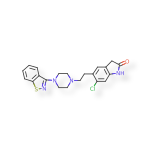
O.O.OS(O)(=O)=O.ClC1=C(CCN2CCN(CC2)C3=NSC4=CC=CC=C34)C=C5CC(=O)NC5=C1
InChI
InChIKey=AYJWTFZQWKSSGV-UHFFFAOYSA-N
InChI=1S/C21H21ClN4OS.H2O4S.2H2O/c22-17-13-18-15(12-20(27)23-18)11-14(17)5-6-25-7-9-26(10-8-25)21-16-3-1-2-4-19(16)28-24-21;1-5(2,3)4;;/h1-4,11,13H,5-10,12H2,(H,23,27);(H2,1,2,3,4);2*1H2
| Molecular Formula | C21H21ClN4OS |
| Molecular Weight | 412.936 |
| Charge | 0 |
| Count |
|
| Stereochemistry | ACHIRAL |
| Additional Stereochemistry | No |
| Defined Stereocenters | 0 / 0 |
| E/Z Centers | 0 |
| Optical Activity | NONE |
| Molecular Formula | H2O |
| Molecular Weight | 18.0153 |
| Charge | 0 |
| Count |
|
| Stereochemistry | ACHIRAL |
| Additional Stereochemistry | No |
| Defined Stereocenters | 0 / 0 |
| E/Z Centers | 0 |
| Optical Activity | NONE |
| Molecular Formula | H2O4S |
| Molecular Weight | 98.078 |
| Charge | 0 |
| Count |
|
| Stereochemistry | ACHIRAL |
| Additional Stereochemistry | No |
| Defined Stereocenters | 0 / 0 |
| E/Z Centers | 0 |
| Optical Activity | NONE |
DescriptionCurator's Comment: description was created based on several sources, including
https://effectivehealthcare.ahrq.gov/ehc/products/150/786/CER43_Off-LabelAntipsychotics_execsumm_20110928.pdf
Curator's Comment: description was created based on several sources, including
https://effectivehealthcare.ahrq.gov/ehc/products/150/786/CER43_Off-LabelAntipsychotics_execsumm_20110928.pdf
Ziprasidone is atypical antipsychotic, approved by the U.S. Food and Drug Administration for the treatment of schizophrenia, and acute mania and mixed states associated with bipolar disorder. Intramuscilar injections of Ziprasidone are indicated for rapid control of the agitation in schizophrenic patients. Ziprasidone is used off-label for treatment of major depressive disorder, anxiety, obsessive compulsive disorder, borderline personality disorder. Ziprasidone functions as an antagonist at the D2, 5HT2A, and 5HT1D receptors, and as an agonist at the 5HT1A receptor.
Originator
Approval Year
Targets
| Primary Target | Pharmacology | Condition | Potency |
|---|---|---|---|
Target ID: CHEMBL217 |
4.8 nM [Ki] | ||
Target ID: CHEMBL3737 |
3.4 nM [Ki] | ||
| 0.4 nM [Ki] | |||
Target ID: CHEMBL1983 |
2.0 nM [Ki] |
Conditions
| Condition | Modality | Targets | Highest Phase | Product |
|---|---|---|---|---|
| Primary | GEODON Approved UseZiprasidone hydrochloride capsule is an atypical antipsychotic. In choosing among treatments, prescribers should be aware of the capacity of ziprasidone hydrochloride capsule to prolong the QT interval and may consider the use of other drugs first. Launch Date2001 |
|||
| Primary | GEODON Approved UseZiprasidone hydrochloride capsule is an atypical antipsychotic. In choosing among treatments, prescribers should be aware of the capacity of ziprasidone hydrochloride capsule to prolong the QT interval and may consider the use of other drugs first. Ziprasidone intramuscular is indicated for the treatment of acute agitation in schizophrenic patients for whom treatment with ziprasidone is appropriate and who need intramuscular antipsychotic medication for rapid control of the agitation. “Psychomotor agitation” is defined in DSM-IV as “excessive motor activity associated with a feeling of inner tension.” Launch Date2001 |
Cmax
| Value | Dose | Co-administered | Analyte | Population |
|---|---|---|---|---|
51 ng/mL EXPERIMENT https://pubmed.ncbi.nlm.nih.gov/16721322 |
20 mg single, oral dose: 20 mg route of administration: Oral experiment type: SINGLE co-administered: |
ZIPRASIDONE serum | Homo sapiens population: UNHEALTHY age: ADOLESCENT sex: FEMALE / MALE food status: FED |
AUC
| Value | Dose | Co-administered | Analyte | Population |
|---|---|---|---|---|
457 ng × h/mL EXPERIMENT https://pubmed.ncbi.nlm.nih.gov/16721322 |
20 mg single, oral dose: 20 mg route of administration: Oral experiment type: SINGLE co-administered: |
ZIPRASIDONE serum | Homo sapiens population: UNHEALTHY age: ADOLESCENT sex: FEMALE / MALE food status: FED |
T1/2
| Value | Dose | Co-administered | Analyte | Population |
|---|---|---|---|---|
4.1 h EXPERIMENT https://pubmed.ncbi.nlm.nih.gov/16721322 |
20 mg single, oral dose: 20 mg route of administration: Oral experiment type: SINGLE co-administered: |
ZIPRASIDONE serum | Homo sapiens population: UNHEALTHY age: ADOLESCENT sex: FEMALE / MALE food status: FED |
Funbound
| Value | Dose | Co-administered | Analyte | Population |
|---|---|---|---|---|
1% |
ZIPRASIDONE plasma | Homo sapiens population: UNKNOWN age: UNKNOWN sex: UNKNOWN food status: UNKNOWN |
Doses
| Dose | Population | Adverse events |
|---|---|---|
4480 mg single, oral Overdose Dose: 4480 mg Route: oral Route: single Dose: 4480 mg Sources: |
unhealthy, 22 years |
Disc. AE: Sedation, Hypotension... AEs leading to discontinuation/dose reduction: Sedation (1 patient) Sources: Hypotension (1 patient) |
20 mg single, oral Overdose |
healthy, 30 month |
Disc. AE: Respiratory depression... AEs leading to discontinuation/dose reduction: Respiratory depression (1 patient) Sources: |
780 mg single, oral Overdose |
unhealthy, 31 years |
Disc. AE: Drowsiness... AEs leading to discontinuation/dose reduction: Drowsiness (1 patient) Sources: |
1120 mg single, oral Overdose Dose: 1120 mg Route: oral Route: single Dose: 1120 mg Sources: |
unhealthy, 35 years |
|
4400 mg single, oral Overdose Dose: 4400 mg Route: oral Route: single Dose: 4400 mg Sources: |
unhealthy, 57 years |
Disc. AE: Drowsiness, Tremor... AEs leading to discontinuation/dose reduction: Drowsiness (1 patient) Sources: Tremor (1 patient) Anxiety (1 patient) |
20 mg 2 times / day steady, intramuscular Studied dose Dose: 20 mg, 2 times / day Route: intramuscular Route: steady Dose: 20 mg, 2 times / day Sources: |
unhealthy, 60 – 81 years Health Status: unhealthy Age Group: 60 – 81 years Sex: M+F Sources: |
Other AEs: Blurred vision, Sedation... Other AEs: Blurred vision (1 patient) Sources: Sedation (1 patient) |
40 mg 1 times / day steady, oral Studied dose Dose: 40 mg, 1 times / day Route: oral Route: steady Dose: 40 mg, 1 times / day Sources: |
unhealthy, 7 – 17 years Health Status: unhealthy Age Group: 7 – 17 years Sex: M+F Sources: |
Other AEs: Somnolence, Akathisia... Other AEs: Somnolence (1 patient) Sources: Akathisia (1 patient) |
20 mg single, oral |
unhealthy, 7-16 years Health Status: unhealthy Age Group: 7-16 years Sex: M+F Sources: |
Other AEs: Somnolence, Syncope hypotensive... Other AEs: Somnolence (16 patients) Sources: Syncope hypotensive (2 patients) |
AEs
| AE | Significance | Dose | Population |
|---|---|---|---|
| Hypotension | 1 patient Disc. AE |
4480 mg single, oral Overdose Dose: 4480 mg Route: oral Route: single Dose: 4480 mg Sources: |
unhealthy, 22 years |
| Sedation | 1 patient Disc. AE |
4480 mg single, oral Overdose Dose: 4480 mg Route: oral Route: single Dose: 4480 mg Sources: |
unhealthy, 22 years |
| Respiratory depression | 1 patient Disc. AE |
20 mg single, oral Overdose |
healthy, 30 month |
| Drowsiness | 1 patient Disc. AE |
780 mg single, oral Overdose |
unhealthy, 31 years |
| Anxiety | 1 patient Disc. AE |
4400 mg single, oral Overdose Dose: 4400 mg Route: oral Route: single Dose: 4400 mg Sources: |
unhealthy, 57 years |
| Drowsiness | 1 patient Disc. AE |
4400 mg single, oral Overdose Dose: 4400 mg Route: oral Route: single Dose: 4400 mg Sources: |
unhealthy, 57 years |
| Tremor | 1 patient Disc. AE |
4400 mg single, oral Overdose Dose: 4400 mg Route: oral Route: single Dose: 4400 mg Sources: |
unhealthy, 57 years |
| Blurred vision | 1 patient | 20 mg 2 times / day steady, intramuscular Studied dose Dose: 20 mg, 2 times / day Route: intramuscular Route: steady Dose: 20 mg, 2 times / day Sources: |
unhealthy, 60 – 81 years Health Status: unhealthy Age Group: 60 – 81 years Sex: M+F Sources: |
| Sedation | 1 patient | 20 mg 2 times / day steady, intramuscular Studied dose Dose: 20 mg, 2 times / day Route: intramuscular Route: steady Dose: 20 mg, 2 times / day Sources: |
unhealthy, 60 – 81 years Health Status: unhealthy Age Group: 60 – 81 years Sex: M+F Sources: |
| Akathisia | 1 patient | 40 mg 1 times / day steady, oral Studied dose Dose: 40 mg, 1 times / day Route: oral Route: steady Dose: 40 mg, 1 times / day Sources: |
unhealthy, 7 – 17 years Health Status: unhealthy Age Group: 7 – 17 years Sex: M+F Sources: |
| Somnolence | 1 patient | 40 mg 1 times / day steady, oral Studied dose Dose: 40 mg, 1 times / day Route: oral Route: steady Dose: 40 mg, 1 times / day Sources: |
unhealthy, 7 – 17 years Health Status: unhealthy Age Group: 7 – 17 years Sex: M+F Sources: |
| Somnolence | 16 patients | 20 mg single, oral |
unhealthy, 7-16 years Health Status: unhealthy Age Group: 7-16 years Sex: M+F Sources: |
| Syncope hypotensive | 2 patients | 20 mg single, oral |
unhealthy, 7-16 years Health Status: unhealthy Age Group: 7-16 years Sex: M+F Sources: |
Overview
| CYP3A4 | CYP2C9 | CYP2D6 | hERG |
|---|---|---|---|
OverviewOther
| Other Inhibitor | Other Substrate | Other Inducer |
|---|---|---|
Drug as perpetrator
| Target | Modality | Activity | Metabolite | Clinical evidence |
|---|---|---|---|---|
| no [IC50 >100 uM] | ||||
| no [IC50 >100 uM] | ||||
| no [IC50 >100 uM] | ||||
| no [IC50 >133 uM] | ||||
| no [IC50 >133 uM] | ||||
| no [IC50 >133 uM] | ||||
| no [IC50 >133 uM] | ||||
| no | ||||
Page: 16, (ClinPharm) 16, (ClinPharm4) 58-60 |
yes [IC50 5.8 uM] | no (co-administration study) Comment: Estimated Cfree,plasma = 0.29-0.73 nM (80mg BID); Coadministration of Ziprasidone had no effect on the urinary Dextromethorphan/Dextrophan ratio. Page: 16, (ClinPharm) 16, (ClinPharm4) 58-60 |
||
| yes [Ki 64 uM] |
Drug as victim
| Target | Modality | Activity | Metabolite | Clinical evidence |
|---|---|---|---|---|
Sources: https://www.accessdata.fda.gov/drugsatfda_docs/nda/2001/20-825_Geodan_biopharmr_P3.pdf#page=68 Page: (ClinPharm3) 68 |
likely | |||
Page: 15-16, (ClinPhar) 15-16, (ClinPharm3) 65-66, (ClinPharm4) 35-38, 64-66 |
major | yes (co-administration study) Comment: Ketoconazole inhibited formation of Ziprasidone sulfoxide by 77% in vitro.; Coadministration of Ketoconazoke (strong CYP3A4 inhibitor) increased Ziprasidone AUC and Cmax by about 30%. Coadministration of Carbamazepine (strong CYP3A4 inducer) decreased Ziprasidone AUC by 36% and Cmax by 27%. Page: 15-16, (ClinPhar) 15-16, (ClinPharm3) 65-66, (ClinPharm4) 35-38, 64-66 |
||
| minor | ||||
| yes |
Tox targets
| Target | Modality | Activity | Metabolite | Clinical evidence |
|---|---|---|---|---|
PubMed
| Title | Date | PubMed |
|---|---|---|
| Ziprasidone-associated galactorrhea in a female teenager. | 2003-01 |
|
| Constitutive coupling of a chimeric dopamine D2/alpha 1B receptor to the phospholipase C pathway: inverse agonism to silent antagonism by neuroleptic drugs. | 2003-01 |
|
| Cholinergic modulation of basal and amphetamine-induced dopamine release in rat medial prefrontal cortex and nucleus accumbens. | 2002-12-20 |
|
| Recent developments in pharmacotherapy for the acutely psychotic patient. | 2002-12 |
|
| Aripiprazole: profile on efficacy and safety. | 2002-12 |
|
| Neuroleptic Malignant Syndrome with ziprasidone. | 2002-12 |
|
| Atypical antipsychotic drugs, quetiapine, iloperidone, and melperone, preferentially increase dopamine and acetylcholine release in rat medial prefrontal cortex: role of 5-HT1A receptor agonism. | 2002-11-29 |
|
| Antipsychotics: impact on prolactin levels. | 2002-10 |
|
| Cataract occurrence with antipsychotic drugs. | 2002-09-26 |
|
| Comprehensive understanding of schizophrenia and its treatment. | 2002-09-01 |
|
| Clinical issues associated with maintenance treatment of patients with schizophrenia. | 2002-09-01 |
|
| Continuum of care: stabilizing the acutely agitated patient. | 2002-09-01 |
|
| Ziprasidone alternative for olanzapine-induced hyperglycemia. | 2002-09 |
|
| A 1-year, double-blind, placebo-controlled trial of ziprasidone 40, 80 and 160 mg/day in chronic schizophrenia: the Ziprasidone Extended Use in Schizophrenia (ZEUS) study. | 2002-09 |
|
| Optimal dosing of atypical antipsychotics in adults: a review of the current evidence. | 2002-08-31 |
|
| A comparison of the receptor binding and HERG channel affinities for a series of antipsychotic drugs. | 2002-08-16 |
|
| Priapism associated with two atypical antipsychotic agents. | 2002-08 |
|
| Case series: use of ziprasidone for maladaptive symptoms in youths with autism. | 2002-08 |
|
| Tardive dyskinesia and ziprasidone. | 2002-08 |
|
| Rhabdomyolysis, pancreatitis, and hyperglycemia with ziprasidone. | 2002-08 |
|
| Ziprasidone and migraine headache. | 2002-08 |
|
| The glial growth factors deficiency and synaptic destabilization hypothesis of schizophrenia. | 2002-07-03 |
|
| Brief report on Ziprasidone. | 2002-07 |
|
| New antipsychotic agents for schizophrenia: pharmacokinetics and metabolism update. | 2002-07 |
|
| The value of atypical antipsychotics in the treatment of schizophrenia. | 2002-07 |
|
| Stimulation by antipsychotic agents of mitogen-activated protein kinase (MAPK) coupled to cloned, human (h)serotonin (5-HT)(1A) receptors. | 2002-07 |
|
| The role of atypical antipsychotics in the treatment of delirium. | 2002-06-21 |
|
| 5-HT(1A) and 5-HT(2A) receptors minimally contribute to clozapine-induced acetylcholine release in rat medial prefrontal cortex. | 2002-06-07 |
|
| A 28-week comparison of ziprasidone and haloperidol in outpatients with stable schizophrenia. | 2002-06 |
|
| Prolongation of QTc interval and antipsychotics. | 2002-06 |
|
| Overdose of ziprasidone. | 2002-06 |
|
| [Exercising caution in choice of psychotropic drugs. Avoid drug-induced weight gain]. | 2002-05-06 |
|
| [Psychopharmacological treatment of bipolar disease]. | 2002-05-06 |
|
| Experience with ziprasidone. | 2002-05 |
|
| Ziprasidone: the fifth atypical antipsychotic. | 2002-05 |
|
| Effects of typical and atypical antipsychotics and receptor selective compounds on acetylcholine efflux in the hippocampus of the rat. | 2002-05 |
|
| Ziprasidone treatment of delirium. | 2002-04-03 |
|
| Ziprasidone induction of hypomania in depression? | 2002-04 |
|
| Improving outcome in schizophrenia: the potential importance of EPS and neuroleptic dysphoria. | 2002-03 |
|
| Schizophrenia: genesis, receptorology and current therapeutics. | 2002-03 |
|
| New drugs 2002, part 1. | 2002-01 |
|
| Clinical significance of drug binding, protein binding, and binding displacement drug interactions. | 2002 |
|
| Safety and tolerability: how do newer generation "atypical" antipsychotics compare? | 2002 |
|
| Antipsychotic-induced hyperprolactinemia and sexual dysfunction. | 2002 |
|
| Spotlight on ziprasidone in schizophrenia and schizoaffective disorder. | 2002 |
|
| Antipsychotic-related QTc prolongation, torsade de pointes and sudden death. | 2002 |
|
| Ziprasidone: a review of its use in schizophrenia and schizoaffective disorder. | 2002 |
|
| Advances in atypical antipsychotics for the treatment of schizophrenia: new formulations and new agents. | 2002 |
|
| Pharmacological treatment of psychotic agitation. | 2002 |
|
| Ziprasidone and the QTc interval: pharmacokinetic and pharmacodynamic considerations. | 2001 |
Sample Use Guides
For treatment of schizophrenia, GEODON capsules should be administered at an initial daily dose of 20 mg BID with food. Daily dosage may subsequently be adjusted on the basis of individual clinical status up to 80 mg BID. Systematic evaluation of ziprasidone has shown that its efficacy in schizophrenia is maintained for periods of up to 52 weeks at a dose of 20 to 80 mg BID. For treatment of bipolar mania, oral ziprasidone should be administered at an initial daily dose of 40 mg BID with food. The dose should then be increased to 60 mg or 80 mg BID on the second day of treatment and subsequently adjusted on the basis of toleration and efficacy within the range 40-80 mg BID. The recommended dose for intramuscular administration is 10 to 20 mg administered as required up to a maximum dose of 40 mg per day. Doses of 10 mg may be administered every two hours; doses of 20 mg may be administered every four hours up to a maximum of 40 mg/day.
Route of Administration:
Other
Standard receptor-binding methods were used to label dopamine D2 receptors using [3H]spiperone. Briefly, rats were sacrificed by decapitation and the brains rapidly removed. The corpus striatum was dissected and homogenized in 20 vol at 50 mM Tris HCl (pH 7.2) buffer using a Brinkman Polytron homogenizer (setting 7 for 15 s). The homogenate was centrifuged for 10 min at 40000g. The pellet was resuspended in fresh ice-cold 50 mM Tris (pH 7.2) buffer with the Polytron homogenizer and recentrifuged. The final pellet was resuspended in 50 mM Tris HCl buffer (pH 7.2) containing 1 mM MgCl2 and 100 mM NaCl. Assays were initiated by the addition of tissue to tubes containing [3H]spiperone (0.2 nM) and drug or buffer in a final volume of 1 mL. Blocking agents (500 nM cinanserin and 1 mM prazosin) were present to prevent [3H]spiperone from labeling 5-HT2 and R1 noradrenergic receptors. Nonspecific binding was defined as the radioligand bound in the presence of 10 uM (+)-butaclamol. After a 15 min incubation at 37 °C, tissue samples were filtered onto Whatman GF/B glass fiber filters using a Brandel harvester and rinsed two times with 5 mL of ice-cold 50 mM Tris HCl (pH 7.4) buffer. Filters were soaked in 10 mL of Ready-Safe (Beckman Instruments), and the radioactivity was quantified using liquid scintillation counting. Ziprasidone binds to D2 receptors with pKi of 8.32 nM.
| Substance Class |
Chemical
Created
by
admin
on
Edited
Mon Mar 31 19:26:07 GMT 2025
by
admin
on
Mon Mar 31 19:26:07 GMT 2025
|
| Record UNII |
AO4E1LXT7Z
|
| Record Status |
Validated (UNII)
|
| Record Version |
|
-
Download
| Name | Type | Language | ||
|---|---|---|---|---|
|
Common Name | English | ||
|
Preferred Name | English | ||
|
Common Name | English |
| Code System | Code | Type | Description | ||
|---|---|---|---|---|---|
|
1165647-81-3
Created by
admin on Mon Mar 31 19:26:07 GMT 2025 , Edited by admin on Mon Mar 31 19:26:07 GMT 2025
|
PRIMARY | |||
|
DTXSID80151428
Created by
admin on Mon Mar 31 19:26:07 GMT 2025 , Edited by admin on Mon Mar 31 19:26:07 GMT 2025
|
PRIMARY | |||
|
100000163571
Created by
admin on Mon Mar 31 19:26:07 GMT 2025 , Edited by admin on Mon Mar 31 19:26:07 GMT 2025
|
PRIMARY | |||
|
AO4E1LXT7Z
Created by
admin on Mon Mar 31 19:26:07 GMT 2025 , Edited by admin on Mon Mar 31 19:26:07 GMT 2025
|
PRIMARY | |||
|
69143307
Created by
admin on Mon Mar 31 19:26:07 GMT 2025 , Edited by admin on Mon Mar 31 19:26:07 GMT 2025
|
PRIMARY |
| Related Record | Type | Details | ||
|---|---|---|---|---|
|
|
PARENT -> SALT/SOLVATE |
|
| Related Record | Type | Details | ||
|---|---|---|---|---|
|
|
ACTIVE MOIETY |
|