


DescriptionCurator's Comment: description was created based on several sources, including
http://reference.medscape.com/drug/neo-fradin-myciguent-neomycin-po-342515
Curator's Comment: description was created based on several sources, including
http://reference.medscape.com/drug/neo-fradin-myciguent-neomycin-po-342515
Neomycin is an aminoglycoside antibiotic found in many topical medications such as creams, ointments, and eye drops. In vitro tests have demonstrated that neomycin is bactericidal and acts by inhibiting the synthesis of protein in susceptible bacterial cells. It is effective primarily against gram-negative bacilli but does have some activity against gram-positive organisms. Neomycin is active in vitro against Escherichia coli and the Klebsiella-Entero. Topical uses include treatment for superficial eye infections caused by susceptible bacteria (used in combination with other anti-infective), treatment of otitis externa caused by susceptible bacteria, treatment or prevention of bacterial infections in skin lesions, and use as a continuous short-term irrigant or rinse to prevent bacteriuria and gram negative rod bacteremia in bacteriuria patients with indwelling catheters. May be used orally to treat hepatic encephalopathy, as a perioperative prophylactic agent, and as an adjunct to fluid and electrolyte replacement in the treatment of diarrhea caused to enter pathogenic E. coli (EPEC). Neomycin sulfate has been shown to be effective adjunctive therapy in hepatic coma by reduction of the ammonia forming bacteria in the intestinal tract. The subsequent reduction in blood ammonia has resulted in neurologic improvement. To reduce the development of drug-resistant bacteria and maintain the effectiveness of Neomycin Sulfate Oral Solution and other antibacterial drugs, susceptible bacteria should use Neomycin Sulfate Oral Solution only to treat or prevent infections that are proven or strongly suspected to be caused. When culture and susceptibility information are available, they should be considered in selecting or modifying antibacterial therapy. In the absence of such data, local epidemiology and susceptibility patterns may contribute to the empiric selection of therapy. Neomycin binds to four nucleotides of 16S rRNA and a single amino acid of protein S12. This interferes with decoding site near nucleotide 1400 in 16S rRNA of 30S subunit. This region interacts with the wobble base in the anticodon of tRNA. This leads to interference with the initiation complex, misreading of mRNA so incorrect amino acids are inserted into the polypeptide leading to nonfunctional or toxic peptides and the breakup of polysomes into nonfunctional monosomes
CNS Activity
Approval Year
Targets
| Primary Target | Pharmacology | Condition | Potency |
|---|---|---|---|
Target ID: CHEMBL2363135 |
Conditions
| Condition | Modality | Targets | Highest Phase | Product |
|---|---|---|---|---|
| Preventing | CVP TRIPLE ANTIBIOTIC Approved UseUses: first aid to help prevent infection in minor: cuts, scrapes, burns Launch Date1995 |
|||
| Palliative | NEO-FRADIN Approved UseHepatic coma (portal-systemic encephalopathy): Neomycin sulfate has been shown to be effective adjunctive therapy in hepatic coma by reduction of the ammonia forming bacteria in the intestinal tract. The subsequent reduction in blood ammonia has resulted in neurologic improvement. To reduce the development of drug-resistant bacteria and maintain the effectiveness of Neomycin Sulfate Oral Solution and other antibacterial drugs, Neomycin Sulfate Oral Solution should be used only to treat or prevent infections that are proven or strongly suspected to be caused by susceptible bacteria. When culture and susceptibility information are available, they should be considered in selecting or modifying antibacterial therapy. In the absence of such data, local epidemiology and susceptibility patterns may contribute to the empiric selection of therapy. Launch Date2001 |
PubMed
| Title | Date | PubMed |
|---|---|---|
| Determination of neomycin sulfate and impurities using high-performance anion-exchange chromatography with integrated pulsed amperometric detection. | 2007-01-04 |
|
| Synthesis and antibacterial activity of novel neamine derivatives. | 2006-12-15 |
|
| Selectively guanidinylated derivatives of neamine. Syntheses and inhibition of anthrax lethal factor protease. | 2006-10-01 |
|
| Removal of p-xylene with Pseudomonas sp. NBM21 in biofilter. | 2006-10 |
|
| Rapid analysis of native neomycin components on a portable capillary electrophoresis system with potential gradient detection. | 2006-08 |
|
| Neonatal deafness results in degraded topographic specificity of auditory nerve projections to the cochlear nucleus in cats. | 2006-07-01 |
|
| Mixed-type noncompetitive inhibition of anthrax lethal factor protease by aminoglycosides. | 2006-07 |
|
| Biosolids from two-stage bioleaching could produce compost for unrestricted use. | 2006-06 |
|
| Prevalence of methicillin-resistant Staphylococcus aureus (MRSA) in community-acquired primary pyoderma. | 2006-05-19 |
|
| Neamine derivatives having a nucleobase with a lysine or an arginine as a linker, their synthesis and evaluation as potential inhibitors for HIV TAR-Tat. | 2006-04-15 |
|
| Trisaccharide mimetics of the aminoglycoside antibiotic neomycin. | 2006-04-07 |
|
| The role of phospholipase D and phosphatidic acid in the mechanical activation of mTOR signaling in skeletal muscle. | 2006-03-21 |
|
| Elucidation of ATP-stimulated stress protein expression of RBA-2 type-2 astrocytes: ATP potentiate HSP60 and Cu/Zn SOD expression and stimulates pI shift of peroxiredoxin II. | 2006-02-01 |
|
| Exploring the use of conformationally locked aminoglycosides as a new strategy to overcome bacterial resistance. | 2006-01-11 |
|
| Mitsunobu dehydration of N-Boc neomycin B. | 2006-01-07 |
|
| Identification and quantitation of polymyxin B, framycetin, and dexamethasone in an ointment by using thin-layer chromatography with densitometry. | 2006-01-03 |
|
| Targeted infection of HIV-1 Env expressing cells by HIV(CD4/CXCR4) vectors reveals a potential new rationale for HIV-1 mediated down-modulation of CD4. | 2005-12-21 |
|
| Neamine inhibits xenografic human tumor growth and angiogenesis in athymic mice. | 2005-12-15 |
|
| Neamine dimers targeting the HIV-1 TAR RNA. | 2005-11-01 |
|
| Quantitative analysis of shape-specific interactions of Rev response element with a positively charged Rev peptide by capillary electrophoresis. | 2005-11 |
|
| Branched aminoglycosides: biochemical studies and antibacterial activity of neomycin B derivatives. | 2005-10-15 |
|
| Contact allergy to neomycin sulfate: results of a multifactorial analysis. | 2005-10 |
|
| Analysis of neomycin sulfate and framycetin sulfate by high-performance liquid chromatography using evaporative light scattering detection. | 2005-09-16 |
|
| Prescription pattern for treatment of hemorrhoids under the universal coverage policy of Thailand. | 2005-07 |
|
| Disruption and restoration of cell-cell junctions in mouse vestibular epithelia following aminoglycoside treatment. | 2005-07 |
|
| The RNA-bound conformation of neamine as determined by transferred NOE experiments. | 2005-07 |
|
| A simple structural-based approach to prevent aminoglycoside inactivation by bacterial defense proteins. Conformational restriction provides effective protection against neomycin-B nucleotidylation by ANT4. | 2005-06-15 |
|
| Introduction of a substituent at the 5"-position of N-Boc neomycin B under Mitsunobu reaction conditions. | 2005-06-07 |
|
| tRNAPhe cleavage by aminoglycosides is triggered off by formation of an abasic site. | 2005-05-27 |
|
| Aminoglycosides induce acute cell signaling and chronic cell death in renal cells that express the calcium-sensing receptor. | 2005-05 |
|
| A blinded in-vitro study to compare the efficacy of five topical ear drops in clearing grommets blocked with thick middle ear effusion fluid. | 2005-02 |
|
| Binding of manganese(II) to a tertiary stabilized hammerhead ribozyme as studied by electron paramagnetic resonance spectroscopy. | 2005-01 |
|
| [The effectiveness of some methods in eliminating bacteria from the root canal of a tooth with chronic apical periodontitis]. | 2005 |
|
| The use of perioperative Sofradex eardrops in preventing tympanostomy tube blockage: a prospective double-blinded randomized-controlled trial. | 2004-12 |
|
| Lipoprotein lipase in hemodialysis patients: indications that low molecular weight heparin depletes functional stores, despite low plasma levels of the enzyme. | 2004-11-03 |
|
| Molecular evaluation of residual endodontic microorganisms after instrumentation, irrigation and medication with either calcium hydroxide or Septomixine. | 2004-11 |
|
| Chemoenzymatic synthesis and high-throughput screening of an aminoglycoside-polyamine library: identification of high-affinity displacers and DNA-binding ligands. | 2004-10-06 |
|
| Delayed neurotrophic treatment preserves nerve survival and electrophysiological responsiveness in neomycin-deafened guinea pigs. | 2004-10-01 |
|
| The efficacies of affected-limb care with penicillin diethylcarbamazine, the combination of both drugs or antibiotic ointment, in the prevention of acute adenolymphangitis during bancroftian filariasis. | 2004-10 |
|
| A peptide nucleic acid-neamine conjugate that targets and cleaves HIV-1 TAR RNA inhibits viral replication. | 2004-09-23 |
|
| Disaccharide mimetics of the aminoglycoside antibiotic neamine. | 2004-09-06 |
|
| Efficacy and safety of topical ciprofloxacin/dexamethasone versus neomycin/polymyxin B/hydrocortisone for otitis externa. | 2004-08 |
|
| Randomized, double-blind trial comparing topical nitroglycerine with xylocaine and Proctosedyl in idiopathic chronic anal fissure. | 2004-07-15 |
|
| Ototoxicity after use of neomycin eardrops is unrelated to A1555G point mutation in mitochondrial DNA. | 2004-07 |
|
| Optimizing the quadruple-potential waveform for the pulsed amperometric detection of neomycin. | 2004-06-11 |
|
| Inhibition of the proteolytic activity of anthrax lethal factor by aminoglycosides. | 2004-04-21 |
|
| Interactions of the antibiotics neomycin B and chlortetracycline with the hammerhead ribozyme as studied by Zn2+-dependent RNA cleavage. | 2004-03-01 |
|
| Changing patterns of contact allergy in chronic inflammatory ear disease. | 2004-02 |
|
| Integrated, long term, sustainable, cost effective biosolids management at a large Canadian wastewater treatment facility. | 2004 |
|
| The evaluation of neomycin and other antimicrobial agents of bacterial and fungal origin, and substances from higher plants. | 1949-12-14 |
Sample Use Guides
Hepatic coma: 4-12 grams per day given in the following regimen:
1. Withdraw protein from diet. Avoid use of diuretic agents.
2. Give supportive therapy including blood products, as indicated.
3. Give NEO-FRADIN Oral Solution in doses of four to twelve grams of neomycin sulfate per day in divided doses. Treatment should be continued over a period of five to six days during which time protein should be returned incrementally to the diet.
Route of Administration:
Oral
In Vitro Use Guide
Curator's Comment: TRMU, tRNA 5-methylaminomethyl-2-thiouridylate methyltransferase, is expressed in both hair cells and HEI-OC-1 cells, and its expression is significantly decreased after 24 h neomycin treatment. Downregulated TRMU expression with siRNA and found that cell death and apoptosis were significantly increased after neomycin injury.
Unknown
| Substance Class |
Mixture
Created
by
admin
on
Edited
Mon Mar 31 23:18:15 GMT 2025
by
admin
on
Mon Mar 31 23:18:15 GMT 2025
|
| Record UNII |
9G18FG07BB
|
| Record Status |
Validated (UNII)
|
| Record Version |
|
-
Download
| Name | Type | Language | ||
|---|---|---|---|---|
|
Preferred Name | English | ||
|
Common Name | English |
| Code System | Code | Type | Description | ||
|---|---|---|---|---|---|
|
9G18FG07BB
Created by
admin on Mon Mar 31 23:18:15 GMT 2025 , Edited by admin on Mon Mar 31 23:18:15 GMT 2025
|
PRIMARY | |||
|
100000085713
Created by
admin on Mon Mar 31 23:18:15 GMT 2025 , Edited by admin on Mon Mar 31 23:18:15 GMT 2025
|
PRIMARY | |||
|
1406-02-6
Created by
admin on Mon Mar 31 23:18:15 GMT 2025 , Edited by admin on Mon Mar 31 23:18:15 GMT 2025
|
PRIMARY | |||
|
SUB03407MIG
Created by
admin on Mon Mar 31 23:18:15 GMT 2025 , Edited by admin on Mon Mar 31 23:18:15 GMT 2025
|
PRIMARY |
All of the following components must be present:
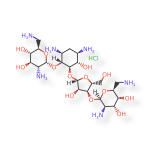
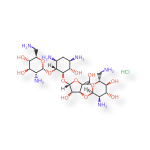
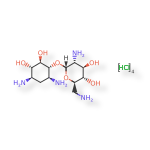
| Related Record | Type | Details | ||
|---|---|---|---|---|
|
|
ACTIVE MOIETY |
