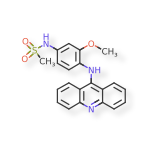
Details
| Stereochemistry | RACEMIC |
| Molecular Formula | C21H19N3O3S.C3H6O3 |
| Molecular Weight | 483.537 |
| Optical Activity | ( + / - ) |
| Defined Stereocenters | 0 / 1 |
| E/Z Centers | 0 |
| Charge | 0 |
SHOW SMILES / InChI
SMILES
CC(O)C(O)=O.COC1=C(NC2=C3C=CC=CC3=NC4=CC=CC=C24)C=CC(NS(C)(=O)=O)=C1
InChI
InChIKey=NYGZSXVEKMITFN-UHFFFAOYSA-N
InChI=1S/C21H19N3O3S.C3H6O3/c1-27-20-13-14(24-28(2,25)26)11-12-19(20)23-21-15-7-3-5-9-17(15)22-18-10-6-4-8-16(18)21;1-2(4)3(5)6/h3-13,24H,1-2H3,(H,22,23);2,4H,1H3,(H,5,6)
| Molecular Formula | C21H19N3O3S |
| Molecular Weight | 393.459 |
| Charge | 0 |
| Count |
|
| Stereochemistry | ACHIRAL |
| Additional Stereochemistry | No |
| Defined Stereocenters | 0 / 0 |
| E/Z Centers | 0 |
| Optical Activity | NONE |
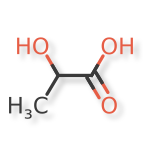
| Molecular Formula | C3H6O3 |
| Molecular Weight | 90.0779 |
| Charge | 0 |
| Count |
|
| Stereochemistry | RACEMIC |
| Additional Stereochemistry | No |
| Defined Stereocenters | 0 / 1 |
| E/Z Centers | 0 |
| Optical Activity | ( + / - ) |
DescriptionCurator's Comment: description was created based on several sources, including
https://www.ncbi.nlm.nih.gov/pubmed/2602146
https://www.ncbi.nlm.nih.gov/pubmed/16330449
Curator's Comment: description was created based on several sources, including
https://www.ncbi.nlm.nih.gov/pubmed/2602146
https://www.ncbi.nlm.nih.gov/pubmed/16330449
Aminoacridine derivative that is a potent intercalating antineoplastic agent. It is effective in the treatment of acute leukemias and malignant lymphomas, but has poor activity in the treatment of solid tumors. It is frequently used in combination with other antineoplastic agents in chemotherapy protocols. It produces consistent but acceptable myelosuppression and cardiotoxic effects. Although its mechanism of action is incompletely defined, amsacrine inhibits DNA synthesis by binding to and intercalating with DNA. Amsacrine also inhibits topoisomerase II activity and may exert an effect on cell membranes. This agent also possesses immunosuppressive and antiviral properties. While amsacrine is not cell cycle phase-specific, cytotoxicity is maximal during the G2 and S phases.
Approval Year
PubMed
| Title | Date | PubMed |
|---|---|---|
| Adaphostin and other anticancer drugs quench the fluorescence of mitochondrial potential probes. | 2006-01 |
|
| In vitro activity of the flt3-inhibitor su5614 and standard cytotoxic agents in tumour cells from patients with wild type and mutated flt3 acute myeloid leukaemia. | 2005-09 |
|
| Highly sensitive analysis of the anti-tumor agent 1-[4-(furo[2,3-b]-quinolin-4-ylamino)phenyl]ethanone in rat plasma by high-performance liquid chromatography using electrochemical detection. | 2005-07-01 |
|
| BAVC regimen and autologous bone marrow transplantation for APL patients in second molecular remission: updated results. | 2005-07 |
|
| Potent antitumor 9-anilinoacridines bearing an alkylating N-mustard residue on the anilino ring: synthesis and biological activity. | 2005-06-02 |
|
| Prognostic value of the age-adjusted International Prognostic Index in chemosensitive recurrent or refractory non-Hodgkin's lymphomas treated with high-dose BEAM therapy and autologous stem cell transplantation. | 2005-06 |
|
| E1A specifically enhances sensitivity to topoisomerase IIalpha targeting anticancer drug by up-regulating the promoter activity. | 2005-05 |
|
| Synthesis and antitumor activity of sulfur-containing 9-anilinoacridines. | 2005-04-05 |
|
| [Disseminated cutaneous and visceral fusariosis in an aplastic patient: an unusual digestive entry]. | 2005-03 |
|
| Random mutagenesis of the B'A' core domain of yeast DNA topoisomerase II and large-scale screens of mutants resistant to the anticancer drug etoposide. | 2005-02-11 |
|
| Synthesis, antitumour activity and structure-activity relationships of 5H-benzo[b]carbazoles. | 2005-02-01 |
|
| Induction chemotherapy for acute myelogenous leukemia. | 2005-01 |
|
| Cardiotoxicity of cancer chemotherapy: implications for children. | 2005 |
|
| Characterisation of cytotoxicity and DNA damage induced by the topoisomerase II-directed bisdioxopiperazine anti-cancer agent ICRF-187 (dexrazoxane) in yeast and mammalian cells. | 2004-12-02 |
|
| Translocation t(12;21) is related to in vitro cellular drug sensitivity to doxorubicin and etoposide in childhood acute lymphoblastic leukemia. | 2004-10-15 |
|
| Establishment and characterisation of a human carcinoma cell line with acquired resistance to Aplidin. | 2004-10-04 |
|
| The antitumor triazoloacridone C-1305 is a topoisomerase II poison with unusual properties. | 2004-10 |
|
| Potent antitumor N-mustard derivatives of 9-anilinoacridine, synthesis and antitumor evaluation. | 2004-09-20 |
|
| Mutation E522K in human DNA topoisomerase IIbeta confers resistance to methyl N-(4'-(9-acridinylamino)-phenyl)carbamate hydrochloride and methyl N-(4'-(9-acridinylamino)-3-methoxy-phenyl) methane sulfonamide but hypersensitivity to etoposide. | 2004-09 |
|
| Intensive chemotherapy with idarubicin, cytarabine, etoposide, and G-CSF priming in patients with advanced myelodysplastic syndrome and high-risk acute myeloid leukemia. | 2004-08 |
|
| Dissecting the cell-killing mechanism of the topoisomerase II-targeting drug ICRF-193. | 2004-07-02 |
|
| Increased susceptibility of poly(ADP-ribose) polymerase-1 knockout cells to antitumor triazoloacridone C-1305 is associated with permanent G2 cell cycle arrest. | 2004-07-01 |
|
| A novel DNA-dependent protein kinase inhibitor, NU7026, potentiates the cytotoxicity of topoisomerase II poisons used in the treatment of leukemia. | 2004-06-15 |
|
| Inhibition of cardiac HERG currents by the DNA topoisomerase II inhibitor amsacrine: mode of action. | 2004-06 |
|
| Risk-adapted induction and consolidation therapy in adults with de novo AML aged | 2004-06 |
|
| Differences in the longevity of topo IIalpha and topo IIbeta drug-stabilized cleavable complexes and the relationship to drug sensitivity. | 2004-02 |
|
| Topoisomerase I and II inhibitors control caspase-2 pre-messenger RNA splicing in human cells. | 2004-01 |
|
| Comparison of BAVC to BuCy regimens in autologous stem cell transplantation for adult patients with acute myeloid leukemia. | 2004-01 |
|
| Investigations into the biological relevance of in vitro clastogenic and aneugenic activity. | 2004 |
|
| Maintenance therapy in childhood acute myeloid leukemia. | 2004 |
|
| Rescue therapy combining intermediate-dose cytarabine with amsacrine and etoposide in relapsed adult acute lymphoblastic leukemia. | 2004 |
|
| A feasibility study of simultaneous administration of gemtuzumab ozogamicin with intensive chemotherapy in induction and consolidation in younger patients with acute myeloid leukemia. | 2003-12-15 |
|
| More efficient mobilisation of peripheral blood stem cells with HiDAC+AMSA+G-CSF than with mini-ICE+G-CSF in patients with AML. | 2003-12 |
|
| Mechanisms of action of DNA intercalating acridine-based drugs: how important are contributions from electron transfer and oxidative stress? | 2003-12 |
|
| [Topotecan-based combined chemotherapy for refractory or relapsed hematologic malignancies]. | 2003-11 |
|
| Dinucleoside monophosphates containing AZT and 1-methyladenosine or 7-methylguanosine. | 2003-10-21 |
|
| Acute pericarditis and pleural effusion complicating cytarabine chemotherapy. | 2003-08 |
|
| Antitumor triptycene bisquinones: a novel synthetic class of dual inhibitors of DNA topoisomerase I and II activities. | 2003-08 |
|
| Increased in vitro cellular drug resistance is related to poor outcome in high-risk childhood acute lymphoblastic leukaemia. | 2003-08 |
|
| Stem cell transplantation after salvage therapy with high-dose cytarabine and amsacrine in adults with high-risk leukaemia. | 2003-08 |
|
| A preliminary evaluation of a new selective agar supplemented with desferrioxamine for detection of methicillin-resistant Staphylococcus aureus. | 2003-07 |
|
| In vitro chemosensitivity testing of selected myeloid cells in acute myeloid leukemia. | 2003-05 |
|
| Phosphorylation of serine 1106 in the catalytic domain of topoisomerase II alpha regulates enzymatic activity and drug sensitivity. | 2003-04-11 |
|
| Amino acid substitutions at position 43 of NaeI endonuclease. Evidence for changes in NaeI structure. | 2003-03-14 |
|
| Salvage therapy in refractory acute myeloid leukemia: prediction of outcome based on analysis of prognostic factors. | 2003-03 |
|
| Free radical scavengers can differentially modulate the genotoxicity of amsacrine in normal and cancer cells. | 2003-02-05 |
|
| Crystallization and preliminary X-ray analysis of anti-cancer agent 3-(9-acridinylamino)-5-(hydroxymethyl)aniline complexed with the DNA hexamer d(CGTACG)2. | 2003-01-03 |
|
| [Effect of etoposide and amsacrine on mitotic progression of GM-130 and Hep-2 cell lines. The flow cytometry assay]. | 2003 |
|
| Favorable outcome with STI571 (imatinib mesylate) and allogeneic stem cell transplantation in a case of Ph+ chemorefractory acute lymphocytic leukaemia. | 2002-12 |
|
| Design of new anti-cancer agents based on topoisomerase poisons targeted to specific DNA sequences. | 2001-11 |
Sample Use Guides
Adults: Cycle Length 3-4 weeks, induction: 75-125 mg/m2 IV once daily for 5 consecutive days starting on day 1 (total dose per cycle 375-625 mg/m2) dose should be increased by 20% in the second and each subsequent cycle if marrow hypoplasia has not been achieved and the patient has had no significant toxicity in the preceding cycle.
4-8 weeks, maintenance: approximately half of the induction dose dependant on blood counts
Route of Administration:
Intravenous
| Substance Class |
Chemical
Created
by
admin
on
Edited
Mon Mar 31 19:14:31 GMT 2025
by
admin
on
Mon Mar 31 19:14:31 GMT 2025
|
| Record UNII |
959PWE0Q2E
|
| Record Status |
Validated (UNII)
|
| Record Version |
|
-
Download
| Name | Type | Language | ||
|---|---|---|---|---|
|
Common Name | English | ||
|
Preferred Name | English |
| Classification Tree | Code System | Code | ||
|---|---|---|---|---|
|
NCI_THESAURUS |
C582
Created by
admin on Mon Mar 31 19:14:31 GMT 2025 , Edited by admin on Mon Mar 31 19:14:31 GMT 2025
|
| Code System | Code | Type | Description | ||
|---|---|---|---|---|---|
|
DTXSID701001137
Created by
admin on Mon Mar 31 19:14:31 GMT 2025 , Edited by admin on Mon Mar 31 19:14:31 GMT 2025
|
PRIMARY | |||
|
959PWE0Q2E
Created by
admin on Mon Mar 31 19:14:31 GMT 2025 , Edited by admin on Mon Mar 31 19:14:31 GMT 2025
|
PRIMARY | |||
|
C96771
Created by
admin on Mon Mar 31 19:14:31 GMT 2025 , Edited by admin on Mon Mar 31 19:14:31 GMT 2025
|
PRIMARY | |||
|
88124
Created by
admin on Mon Mar 31 19:14:31 GMT 2025 , Edited by admin on Mon Mar 31 19:14:31 GMT 2025
|
PRIMARY | |||
|
80277-11-8
Created by
admin on Mon Mar 31 19:14:31 GMT 2025 , Edited by admin on Mon Mar 31 19:14:31 GMT 2025
|
PRIMARY |
| Related Record | Type | Details | ||
|---|---|---|---|---|
|
|
PARENT -> SALT/SOLVATE |
| Related Record | Type | Details | ||
|---|---|---|---|---|
|
|
ACTIVE MOIETY |