


Details
| Stereochemistry | ACHIRAL |
| Molecular Formula | C16H13ClN2O.ClH |
| Molecular Weight | 321.201 |
| Optical Activity | NONE |
| Defined Stereocenters | 0 / 0 |
| E/Z Centers | 0 |
| Charge | 0 |
SHOW SMILES / InChI
SMILES
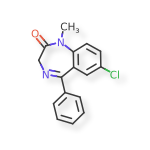
Cl.CN1C2=CC=C(Cl)C=C2C(=NCC1=O)C3=CC=CC=C3
InChI
InChIKey=BPYZIOINRAWEQL-UHFFFAOYSA-N
InChI=1S/C16H13ClN2O.ClH/c1-19-14-8-7-12(17)9-13(14)16(18-10-15(19)20)11-5-3-2-4-6-11;/h2-9H,10H2,1H3;1H
| Molecular Formula | ClH |
| Molecular Weight | 36.461 |
| Charge | 0 |
| Count |
|
| Stereochemistry | ACHIRAL |
| Additional Stereochemistry | No |
| Defined Stereocenters | 0 / 0 |
| E/Z Centers | 0 |
| Optical Activity | NONE |
| Molecular Formula | C16H13ClN2O |
| Molecular Weight | 284.74 |
| Charge | 0 |
| Count |
|
| Stereochemistry | ACHIRAL |
| Additional Stereochemistry | No |
| Defined Stereocenters | 0 / 0 |
| E/Z Centers | 0 |
| Optical Activity | NONE |
DescriptionCurator's Comment: description was created based on several sources, including https://www.ncbi.nlm.nih.gov/pubmed/24552479
Curator's Comment: description was created based on several sources, including https://www.ncbi.nlm.nih.gov/pubmed/24552479
Diazepam is a benzodiazepine first discovered at Hoffman-La Roche in the late 1950s. Diazepam was approved by FDA for the treatment of anxiety disorders as well as for such conditions as skeletal muscle spasm, alcohol withdrawal syndrom and convulsions (under the most known brand Valium). The drug acts by binding to GABA-A receptors and potentiating GABA evoked current. Chronic diazepam use is associated with tolerance, dependence, and withdrawal.
CNS Activity
Approval Year
Targets
| Primary Target | Pharmacology | Condition | Potency |
|---|---|---|---|
Target ID: CHEMBL2109243 |
8.6 nM [Ki] |
Conditions
| Condition | Modality | Targets | Highest Phase | Product |
|---|---|---|---|---|
| Primary | VALIUM Approved UseValium is indicated for the management of anxiety disorders or for the shortterm relief of the symptoms of anxiety. In acute alcohol withdrawal, Valium may be useful in the symptomatic relief of acute agitation, tremor, impending or acute delirium tremens and hallucinosis. Valium is a useful adjunct for the relief of skeletal muscle spasm due to reflex spasm to local pathology (such as inflammation of the muscles or joints, or secondary to trauma), spasticity caused by upper motor neuron disorders (such as cerebral palsy and paraplegia), athetosis, and stiff-man syndrome. Oral Valium may be used adjunctively in convulsive disorders, although it has not proved useful as the sole therapy. Launch Date1963 |
|||
| Palliative | VALIUM Approved UseValium is indicated for the management of anxiety disorders or for the shortterm relief of the symptoms of anxiety. In acute alcohol withdrawal, Valium may be useful in the symptomatic relief of acute agitation, tremor, impending or acute delirium tremens and hallucinosis. Valium is a useful adjunct for the relief of skeletal muscle spasm due to reflex spasm to local pathology (such as inflammation of the muscles or joints, or secondary to trauma), spasticity caused by upper motor neuron disorders (such as cerebral palsy and paraplegia), athetosis, and stiff-man syndrome. Oral Valium may be used adjunctively in convulsive disorders, although it has not proved useful as the sole therapy. Launch Date1963 |
|||
| Palliative | VALIUM Approved UseValium is indicated for the management of anxiety disorders or for the shortterm relief of the symptoms of anxiety. In acute alcohol withdrawal, Valium may be useful in the symptomatic relief of acute agitation, tremor, impending or acute delirium tremens and hallucinosis. Valium is a useful adjunct for the relief of skeletal muscle spasm due to reflex spasm to local pathology (such as inflammation of the muscles or joints, or secondary to trauma), spasticity caused by upper motor neuron disorders (such as cerebral palsy and paraplegia), athetosis, and stiff-man syndrome. Oral Valium may be used adjunctively in convulsive disorders, although it has not proved useful as the sole therapy. Launch Date1963 |
|||
| Palliative | VALIUM Approved UseValium is indicated for the management of anxiety disorders or for the shortterm relief of the symptoms of anxiety. In acute alcohol withdrawal, Valium may be useful in the symptomatic relief of acute agitation, tremor, impending or acute delirium tremens and hallucinosis. Valium is a useful adjunct for the relief of skeletal muscle spasm due to reflex spasm to local pathology (such as inflammation of the muscles or joints, or secondary to trauma), spasticity caused by upper motor neuron disorders (such as cerebral palsy and paraplegia), athetosis, and stiff-man syndrome. Oral Valium may be used adjunctively in convulsive disorders, although it has not proved useful as the sole therapy. Launch Date1963 |
Cmax
| Value | Dose | Co-administered | Analyte | Population |
|---|---|---|---|---|
208 ng/mL Clinical Trial https://clinicaltrials.gov/ct2/show/NCT01417078 |
20 mg single, intranasal dose: 20 mg route of administration: intranasal experiment type: single co-administered: |
DIAZEPAM plasma | Homo sapiens population: unhealthy age: sex: food status: |
|
75 ng/mL EXPERIMENT https://pubmed.ncbi.nlm.nih.gov/1505149 |
2 mg single, oral dose: 2 mg route of administration: Oral experiment type: SINGLE co-administered: |
DIAZEPAM plasma | Homo sapiens population: HEALTHY age: ADULT sex: FEMALE / MALE food status: FASTED |
|
172 ng/mL EXPERIMENT https://pubmed.ncbi.nlm.nih.gov/1505149 |
5 mg single, oral dose: 5 mg route of administration: Oral experiment type: SINGLE co-administered: |
DIAZEPAM plasma | Homo sapiens population: HEALTHY age: ADULT sex: FEMALE / MALE food status: FASTED |
|
317 ng/mL EXPERIMENT https://pubmed.ncbi.nlm.nih.gov/1505149 |
10 mg single, oral dose: 10 mg route of administration: Oral experiment type: SINGLE co-administered: |
DIAZEPAM plasma | Homo sapiens population: HEALTHY age: ADULT sex: FEMALE / MALE food status: FASTED |
AUC
| Value | Dose | Co-administered | Analyte | Population |
|---|---|---|---|---|
1227 ng*h/mL Clinical Trial https://clinicaltrials.gov/ct2/show/NCT01417078 |
20 mg single, intranasal dose: 20 mg route of administration: intranasal experiment type: single co-administered: |
DIAZEPAM plasma | Homo sapiens population: unhealthy age: sex: food status: |
|
330 ng × h/mL EXPERIMENT https://pubmed.ncbi.nlm.nih.gov/1505149 |
2 mg single, oral dose: 2 mg route of administration: Oral experiment type: SINGLE co-administered: |
DIAZEPAM plasma | Homo sapiens population: HEALTHY age: ADULT sex: FEMALE / MALE food status: FASTED |
|
779 ng × h/mL EXPERIMENT https://pubmed.ncbi.nlm.nih.gov/1505149 |
5 mg single, oral dose: 5 mg route of administration: Oral experiment type: SINGLE co-administered: |
DIAZEPAM plasma | Homo sapiens population: HEALTHY age: ADULT sex: FEMALE / MALE food status: FASTED |
|
1530 ng × h/mL EXPERIMENT https://pubmed.ncbi.nlm.nih.gov/1505149 |
10 mg single, oral dose: 10 mg route of administration: Oral experiment type: SINGLE co-administered: |
DIAZEPAM plasma | Homo sapiens population: HEALTHY age: ADULT sex: FEMALE / MALE food status: FASTED |
T1/2
| Value | Dose | Co-administered | Analyte | Population |
|---|---|---|---|---|
48 h |
unknown, oral |
DIAZEPAM plasma | Homo sapiens population: UNKNOWN age: UNKNOWN sex: UNKNOWN food status: UNKNOWN |
Funbound
| Value | Dose | Co-administered | Analyte | Population |
|---|---|---|---|---|
2% |
unknown, oral |
DIAZEPAM plasma | Homo sapiens population: UNKNOWN age: UNKNOWN sex: UNKNOWN food status: UNKNOWN |
Doses
| Dose | Population | Adverse events |
|---|---|---|
2000 mg single, oral Overdose |
healthy, 28 years |
|
500 mg single, oral Overdose |
unhealthy, 61 years |
|
0.2 mg/kg 2 times / day multiple, rectal Recommended Dose: 0.2 mg/kg, 2 times / day Route: rectal Route: multiple Dose: 0.2 mg/kg, 2 times / day Sources: |
unhealthy, > 12 years Health Status: unhealthy Age Group: > 12 years Sources: |
Other AEs: Respiratory depression, Abuse... Other AEs: Respiratory depression (serious|grade 5) Sources: Abuse (serious|grade 5) |
0.2 mg/kg 2 times / day multiple, rectal Recommended Dose: 0.2 mg/kg, 2 times / day Route: rectal Route: multiple Dose: 0.2 mg/kg, 2 times / day Sources: |
unhealthy, > 12 years Health Status: unhealthy Age Group: > 12 years Sources: |
Disc. AE: Somnolence, Hypoventilation... AEs leading to discontinuation/dose reduction: Somnolence (3 patients) Sources: Hypoventilation (2 patients) Rash (2 patients) Asthenia (1 patient) Hyperkinesia (1 patient) Incoordination (1 patient) Vasodilatation (1 patient) Urticaria (1 patient) |
10 mg 2 times / day multiple, intranasal Recommended Dose: 10 mg, 2 times / day Route: intranasal Route: multiple Dose: 10 mg, 2 times / day Sources: |
unhealthy, adult Health Status: unhealthy Age Group: adult Sources: |
Other AEs: Respiratory depression... Other AEs: Respiratory depression (serious|grade 5) Sources: |
10 mg 4 times / day multiple, intramuscular Recommended Dose: 10 mg, 4 times / day Route: intramuscular Route: multiple Dose: 10 mg, 4 times / day Sources: |
unhealthy, adult Health Status: unhealthy Age Group: adult Sources: |
Other AEs: Respiratory depression, Abuse... Other AEs: Respiratory depression (serious|grade 5) Sources: Abuse (serious|grade 5) |
10 mg 4 times / day multiple, oral Recommended Dose: 10 mg, 4 times / day Route: oral Route: multiple Dose: 10 mg, 4 times / day Sources: |
unhealthy, adult Health Status: unhealthy Age Group: adult Sources: |
Other AEs: Respiratory depression... Other AEs: Respiratory depression (serious|grade 5) Sources: |
AEs
| AE | Significance | Dose | Population |
|---|---|---|---|
| Abuse | serious|grade 5 | 0.2 mg/kg 2 times / day multiple, rectal Recommended Dose: 0.2 mg/kg, 2 times / day Route: rectal Route: multiple Dose: 0.2 mg/kg, 2 times / day Sources: |
unhealthy, > 12 years Health Status: unhealthy Age Group: > 12 years Sources: |
| Respiratory depression | serious|grade 5 | 0.2 mg/kg 2 times / day multiple, rectal Recommended Dose: 0.2 mg/kg, 2 times / day Route: rectal Route: multiple Dose: 0.2 mg/kg, 2 times / day Sources: |
unhealthy, > 12 years Health Status: unhealthy Age Group: > 12 years Sources: |
| Asthenia | 1 patient Disc. AE |
0.2 mg/kg 2 times / day multiple, rectal Recommended Dose: 0.2 mg/kg, 2 times / day Route: rectal Route: multiple Dose: 0.2 mg/kg, 2 times / day Sources: |
unhealthy, > 12 years Health Status: unhealthy Age Group: > 12 years Sources: |
| Hyperkinesia | 1 patient Disc. AE |
0.2 mg/kg 2 times / day multiple, rectal Recommended Dose: 0.2 mg/kg, 2 times / day Route: rectal Route: multiple Dose: 0.2 mg/kg, 2 times / day Sources: |
unhealthy, > 12 years Health Status: unhealthy Age Group: > 12 years Sources: |
| Incoordination | 1 patient Disc. AE |
0.2 mg/kg 2 times / day multiple, rectal Recommended Dose: 0.2 mg/kg, 2 times / day Route: rectal Route: multiple Dose: 0.2 mg/kg, 2 times / day Sources: |
unhealthy, > 12 years Health Status: unhealthy Age Group: > 12 years Sources: |
| Urticaria | 1 patient Disc. AE |
0.2 mg/kg 2 times / day multiple, rectal Recommended Dose: 0.2 mg/kg, 2 times / day Route: rectal Route: multiple Dose: 0.2 mg/kg, 2 times / day Sources: |
unhealthy, > 12 years Health Status: unhealthy Age Group: > 12 years Sources: |
| Vasodilatation | 1 patient Disc. AE |
0.2 mg/kg 2 times / day multiple, rectal Recommended Dose: 0.2 mg/kg, 2 times / day Route: rectal Route: multiple Dose: 0.2 mg/kg, 2 times / day Sources: |
unhealthy, > 12 years Health Status: unhealthy Age Group: > 12 years Sources: |
| Hypoventilation | 2 patients Disc. AE |
0.2 mg/kg 2 times / day multiple, rectal Recommended Dose: 0.2 mg/kg, 2 times / day Route: rectal Route: multiple Dose: 0.2 mg/kg, 2 times / day Sources: |
unhealthy, > 12 years Health Status: unhealthy Age Group: > 12 years Sources: |
| Rash | 2 patients Disc. AE |
0.2 mg/kg 2 times / day multiple, rectal Recommended Dose: 0.2 mg/kg, 2 times / day Route: rectal Route: multiple Dose: 0.2 mg/kg, 2 times / day Sources: |
unhealthy, > 12 years Health Status: unhealthy Age Group: > 12 years Sources: |
| Somnolence | 3 patients Disc. AE |
0.2 mg/kg 2 times / day multiple, rectal Recommended Dose: 0.2 mg/kg, 2 times / day Route: rectal Route: multiple Dose: 0.2 mg/kg, 2 times / day Sources: |
unhealthy, > 12 years Health Status: unhealthy Age Group: > 12 years Sources: |
| Respiratory depression | serious|grade 5 | 10 mg 2 times / day multiple, intranasal Recommended Dose: 10 mg, 2 times / day Route: intranasal Route: multiple Dose: 10 mg, 2 times / day Sources: |
unhealthy, adult Health Status: unhealthy Age Group: adult Sources: |
| Abuse | serious|grade 5 | 10 mg 4 times / day multiple, intramuscular Recommended Dose: 10 mg, 4 times / day Route: intramuscular Route: multiple Dose: 10 mg, 4 times / day Sources: |
unhealthy, adult Health Status: unhealthy Age Group: adult Sources: |
| Respiratory depression | serious|grade 5 | 10 mg 4 times / day multiple, intramuscular Recommended Dose: 10 mg, 4 times / day Route: intramuscular Route: multiple Dose: 10 mg, 4 times / day Sources: |
unhealthy, adult Health Status: unhealthy Age Group: adult Sources: |
| Respiratory depression | serious|grade 5 | 10 mg 4 times / day multiple, oral Recommended Dose: 10 mg, 4 times / day Route: oral Route: multiple Dose: 10 mg, 4 times / day Sources: |
unhealthy, adult Health Status: unhealthy Age Group: adult Sources: |
Overview
| CYP3A4 | CYP2C9 | CYP2D6 | hERG |
|---|---|---|---|
Drug as perpetrator
| Target | Modality | Activity | Metabolite | Clinical evidence |
|---|---|---|---|---|
| no | ||||
| no | ||||
| no | ||||
Page: 1.0 |
strong [IC50 2 uM] |
Drug as victim
| Target | Modality | Activity | Metabolite | Clinical evidence |
|---|---|---|---|---|
Page: 1.0 |
major | |||
| major | ||||
| major | ||||
Page: 1.0 |
major | |||
Page: 1.0 |
yes | |||
Page: 1.0 |
yes | |||
Page: 1.0 |
yes | |||
Page: 1.0 |
yes | |||
Page: 1.0 |
yes | |||
Page: 1.0 |
yes |
Tox targets
| Target | Modality | Activity | Metabolite | Clinical evidence |
|---|---|---|---|---|
PubMed
| Title | Date | PubMed |
|---|---|---|
| Female gastrin-releasing peptide receptor (GRP-R)-deficient mice exhibit altered social preference for male conspecifics: implications for GRP/GRP-R modulation of GABAergic function. | 2001-03-16 |
|
| Dual effects of melatonin on barbiturate-induced narcosis in rats. | 2001-03-16 |
|
| Evidence for a common binding cavity for three general anesthetics within the GABAA receptor. | 2001-03-15 |
|
| The R100Q mutation of the GABA(A) alpha(6) receptor subunit may contribute to voluntary aversion to ethanol in the sNP rat line. | 2001-03-05 |
|
| Systemic EMD 68843 injections reduce anxiety in the shock-probe, but not the plus-maze test. | 2001-03-02 |
|
| The octadecaneuropeptide [diazepam-binding inhibitor (33-50)] exerts potent anorexigenic effects in rodents. | 2001-03-02 |
|
| Trimethylolpropane phosphate induces epileptiform discharges in the CA1 region of the rat hippocampus. | 2001-03-01 |
|
| A behavioral economic analysis of polydrug abuse in alcoholics: asymmetrical substitution of alcohol and cocaine. | 2001-03-01 |
|
| Brain-derived neurotrophic factor superinduction parallels anti-epileptic--neuroprotective treatment in the pilocarpine epilepsy model. | 2001-03 |
|
| [3H]Ro 15-1788 binding sites to brain membrane of the saltwater Mugil cephalus. | 2001-03 |
|
| Topical anesthesia for cataract surgery: a population-based perspective. | 2001-03 |
|
| Effect of leaf essential oil from Piper solmsianum C.DC. in mice behaviour. | 2001-03 |
|
| Molecular targets for the myorelaxant action of diazepam. | 2001-03 |
|
| Anxiogenic-like effects limit rewarding effects of cocaine in balb/cbyj mice. | 2001-03 |
|
| Modulation of GABA(A) receptors by benzodiazepines and barbiturates is autonomous of PKC activation. | 2001-03 |
|
| [Febrile convulsions, Treatment and prognosis]. | 2001-02-19 |
|
| A model of atypical absence seizures: EEG, pharmacology, and developmental characterization. | 2001-02-13 |
|
| [Premedication in ambulatory surgery]. | 2001-02-12 |
|
| Effects of a novel uncompetitive NMDA receptor antagonist, MRZ 2/579 on ethanol self-administration and ethanol withdrawal seizures in the rat. | 2001-02-09 |
|
| Evaluation of native GABA(A) receptors containing an alpha 5 subunit. | 2001-02-09 |
|
| Chronic benzodiazepine administration facilitates the subsequent development of ethanol dependence. | 2001-02-09 |
|
| Alterations in cerebral diazepam binding inhibitor expression in drug dependence: a possible biochemical alteration common to drug dependence. | 2001-02-02 |
|
| [Premedication for endoscopy]. | 2001-02-02 |
|
| Inhibition of shock-induced foot tapping behaviour in the gerbil by a tachykinin NK1 receptor antagonist. | 2001-02-02 |
|
| Negative inotropic effect of diazepam in isolated guinea pig heart. | 2001-02 |
|
| [Prevention of postoperative nausea and vomiting in gynecologic surgery with 3 fixed doses of metoclopramide, droperidol or placebo]. | 2001-02 |
|
| Extracellular serotonin is enhanced in the striatum, but not in the dorsal hippocampus or prefrontal cortex, in rats subjected to an operant conflict procedure. | 2001-02 |
|
| Molecular modeling and QSAR analysis of the interaction of flavone derivatives with the benzodiazepine binding site of the GABA(A) receptor complex. | 2001-02 |
|
| Prenatal stress and postnatal development of neonatal rats--sex-dependent effects on emotional behavior and learning ability of neonatal rats. | 2001-02 |
|
| Acyl-CoA binding protein is essential in bloodstream form Trypanosoma brucei. | 2001-02 |
|
| Lack of reinforcing effect of the benzodiazepine and tricyclic antidepressant combination of diazepam and dothiepin. | 2001-02 |
|
| Effects of different preparations of propofol, diazepam, and etomidate on human neutrophils in vitro. | 2001-02 |
|
| Regional and subunit-specific downregulation of acid-sensing ion channels in the pilocarpine model of epilepsy. | 2001-02 |
|
| Diazepam in the treatment of GHB dependence. | 2001-02 |
|
| In vivo, the direct and seizure-induced neuronal cytotoxicity of kainate and AMPA is modified by the non-competitive antagonist, GYKI 52466. | 2001-01-26 |
|
| Detection of aneuploidy in rodent and human sperm by multicolor FISH after chronic exposure to diazepam. | 2001-01-25 |
|
| Intranasal midazolam for treating febrile seizures in children. Buccal midazolam for childhood seizures at home preferred to rectal diazepam. | 2001-01-13 |
|
| Effects of melatonin, morphine and diazepam on formalin-induced nociception in mice. | 2001-01-12 |
|
| Simple and sensitive high-performance liquid chromatographic method for the determination of 1,5-benzodiazepine clobazam and its active metabolite N-desmethylclobazam in human serum and urine with application to 1,4-benzodiazepines analysis. | 2001-01-05 |
|
| The role of nitrergic system in lidocaine-induced convulsion in the mouse. | 2001-01 |
|
| [Anesthesia for a patient with cardiac sarcoidosis]. | 2001-01 |
|
| Development of differential tolerance to the sedative and anti-stress effects of benzodiazepines. | 2001-01 |
|
| Effect of diazepam and midazolam on the antinociceptive effect of morphine, metamizol and indomethacin in mice. | 2001-01 |
|
| [Effect of diazepam on apnea attacks in a 6-year-old girl with Rett syndrome: a polysomnographic study]. | 2001-01 |
|
| Neuropharmacological actions of some binuclear lanthanide(III) complexes. | 2001-01 |
|
| Sedative properties of the decoction of the rhizome of Cyperus articulatus. | 2001-01 |
|
| Treatment of nonfebrile status epilepticus in Rochester, Minn, from 1965 through 1984. | 2001-01 |
|
| [Potentiation of local anesthesia in endonasal surgery]. | 2001 |
|
| The effect of cold and diazepam on the toxicity of fenfluramine in mice. | 1975-03-15 |
|
| [The mechanism of the anticonvulsive action of diazepam]. | 1975-03 |
| Substance Class |
Chemical
Created
by
admin
on
Edited
Mon Mar 31 19:51:50 GMT 2025
by
admin
on
Mon Mar 31 19:51:50 GMT 2025
|
| Record UNII |
6JD21U639H
|
| Record Status |
Validated (UNII)
|
| Record Version |
|
-
Download
| Name | Type | Language | ||
|---|---|---|---|---|
|
Common Name | English | ||
|
Preferred Name | English |
| Classification Tree | Code System | Code | ||
|---|---|---|---|---|
|
NCI_THESAURUS |
C1012
Created by
admin on Mon Mar 31 19:51:50 GMT 2025 , Edited by admin on Mon Mar 31 19:51:50 GMT 2025
|
| Code System | Code | Type | Description | ||
|---|---|---|---|---|---|
|
DTXSID80200460
Created by
admin on Mon Mar 31 19:51:50 GMT 2025 , Edited by admin on Mon Mar 31 19:51:50 GMT 2025
|
PRIMARY | |||
|
DBSALT002258
Created by
admin on Mon Mar 31 19:51:50 GMT 2025 , Edited by admin on Mon Mar 31 19:51:50 GMT 2025
|
PRIMARY | |||
|
SUB32951
Created by
admin on Mon Mar 31 19:51:50 GMT 2025 , Edited by admin on Mon Mar 31 19:51:50 GMT 2025
|
PRIMARY | |||
|
6452650
Created by
admin on Mon Mar 31 19:51:50 GMT 2025 , Edited by admin on Mon Mar 31 19:51:50 GMT 2025
|
PRIMARY | |||
|
100000125956
Created by
admin on Mon Mar 31 19:51:50 GMT 2025 , Edited by admin on Mon Mar 31 19:51:50 GMT 2025
|
PRIMARY | |||
|
52468-36-7
Created by
admin on Mon Mar 31 19:51:50 GMT 2025 , Edited by admin on Mon Mar 31 19:51:50 GMT 2025
|
PRIMARY | |||
|
C98133
Created by
admin on Mon Mar 31 19:51:50 GMT 2025 , Edited by admin on Mon Mar 31 19:51:50 GMT 2025
|
PRIMARY | |||
|
6JD21U639H
Created by
admin on Mon Mar 31 19:51:50 GMT 2025 , Edited by admin on Mon Mar 31 19:51:50 GMT 2025
|
PRIMARY | |||
|
257-935-4
Created by
admin on Mon Mar 31 19:51:50 GMT 2025 , Edited by admin on Mon Mar 31 19:51:50 GMT 2025
|
PRIMARY |
| Related Record | Type | Details | ||
|---|---|---|---|---|
|
|
PARENT -> SALT/SOLVATE |
| Related Record | Type | Details | ||
|---|---|---|---|---|
|
|
ACTIVE MOIETY |