


Details
| Stereochemistry | ACHIRAL |
| Molecular Formula | C22H26NO2.Na |
| Molecular Weight | 359.4371 |
| Optical Activity | NONE |
| Defined Stereocenters | 0 / 0 |
| E/Z Centers | 0 |
| Charge | 0 |
SHOW SMILES / InChI
SMILES
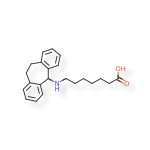
[Na+].[O-]C(=O)CCCCCCNC1C2=C(CCC3=C1C=CC=C3)C=CC=C2
InChI
InChIKey=RXWWSYJKVIBAAU-UHFFFAOYSA-M
InChI=1S/C22H27NO2.Na/c24-21(25)13-3-1-2-8-16-23-22-19-11-6-4-9-17(19)14-15-18-10-5-7-12-20(18)22;/h4-7,9-12,22-23H,1-3,8,13-16H2,(H,24,25);/q;+1/p-1
| Molecular Formula | Na |
| Molecular Weight | 22.98976928 |
| Charge | 1 |
| Count |
|
| Stereochemistry | ACHIRAL |
| Additional Stereochemistry | No |
| Defined Stereocenters | 0 / 0 |
| E/Z Centers | 0 |
| Optical Activity | NONE |
| Molecular Formula | C22H26NO2 |
| Molecular Weight | 336.4473 |
| Charge | -1 |
| Count |
|
| Stereochemistry | ACHIRAL |
| Additional Stereochemistry | No |
| Defined Stereocenters | 0 / 0 |
| E/Z Centers | 0 |
| Optical Activity | NONE |
Amineptine is a selective inhibitor of dopamine reuptake. The drug was developed in France and was marketed for the treatment of depressive disorders under the name Survector among the others. Amineptine was withdrawn from the French market in 1999 because of abuse and drug dependence and because of its hepatic (cholestatic injuries) and cutaneous (acne) adverse effects.
CNS Activity
Approval Year
PubMed
| Title | Date | PubMed |
|---|---|---|
| Development of a list of potentially inappropriate drugs for the korean elderly using the delphi method. | 2010-12 |
|
| Amineptine treatment of persistent catatonic symptoms in schizophrenia: a controlled study. | 2010-12 |
|
| Management of anorexia and bulimia nervosa: An evidence-based review. | 2010-04 |
|
| Research on antidepressants in India. | 2010-01 |
|
| Molecular biology research in neuropsychiatry: India's contribution. | 2010-01 |
|
| A new strategy for antidepressant prescription. | 2010 |
|
| Prevalence of antidepressants and biosimilars in elite sport. | 2009-06 |
|
| Treatment-emergent sexual dysfunction related to antidepressants: a meta-analysis. | 2009-06 |
|
| Treatment for amphetamine withdrawal. | 2009-04-15 |
|
| Spectroscopic and electrochemical analysis of psychotropic drugs. | 2009-01 |
|
| Pharmacological and combined interventions for the acute depressive episode: focus on efficacy and tolerability. | 2009 |
|
| Update on the management of symptoms in schizophrenia: focus on amisulpride. | 2009 |
|
| Venlafaxine dependence in a patient with a history of alcohol and amineptine misuse. | 2008-09 |
|
| Improving pain management communication: how patients understand the terms "opioid" and "narcotic". | 2008-09 |
|
| Addressing the paradoxes of satisfaction with hospital care. | 2008 |
|
| Utility of 7,7,8,8-tetracyanoquinodimethane charge transfer reagent for the spectrophotometric determination of trazodone, amineptine and amitriptyline hydrochlorides. | 2007-12-31 |
|
| Is it possible to be dependent to Tianeptine, an antidepressant? A case report. | 2007-04-13 |
|
| Spectrophotometric determination of trazodone, amineptine and amitriptyline hydrochlorides through ion-pair formation with molybdenum and thiocyanate. | 2006-12 |
|
| Spectrophotometric determination of trazodone, amineptine and amitriptyline hydrochlorides through ion-pair formation using methyl orange and bromocresol green reagents. | 2006-09 |
|
| Antidepressants for anorexia nervosa. | 2006-01-25 |
|
| [A case of tianeptine abuse]. | 2006 |
|
| [Acne induced by amineptine]. | 2005-09-16 |
|
| Fluoxetine dependence in a former amineptine abuser. | 2005-03-15 |
|
| Role of presynaptic alpha2-adrenoceptors in antidepressant action: recent findings from microdialysis studies. | 2004-08 |
|
| Discriminating different classes of toxicants by transcript profiling. | 2004-08 |
|
| Sex-dependent modulation of treatment response. | 2004-03 |
|
| [Does addiction to antidepressants exist? About a case of one addiction to tianeptine]. | 2003-11-15 |
|
| Sleep-wake mechanisms and drug discovery: sleep EEG as a tool for the development of CNS-acting drugs. | 2002-12 |
|
| [A case of Parkinson syndrome secondary to combined amineptine and bromazepam abuse]. | 1998-12-16 |
|
| Amineptine in the treatment of amphetamine withdrawal: a placebo-controlled, randomised, double-blind study. | 1997-09 |
|
| [Acne induced by amineptin: adnexal toxiderma]. | 1996 |
|
| The serotonin syndrome. | 1992-10 |
|
| [Immediate acute hepatic cytolysis after the administration of a single amineptin tablet]. | 1992 |
|
| [Amineptin dependence and iatrogenic acne. Review of the literature apropos of a case]. | 1991-12 |
|
| [Amineptin dependence. Detection of patients at risk. Report of 8 cases]. | 1990-09-01 |
|
| [Amineptin abuse. Analysis of 155 cases. An evaluation of the official cooperative survey of the Regional Centers of Pharmacovigilance]. | 1990-09-01 |
|
| Genetic predisposition to drug hepatotoxicity: role in hepatitis caused by amineptine, a tricyclic antidepressant. | 1989-08 |
|
| [Acneiform eruption induced by amineptin (Survector)]. | 1989 |
|
| [Rosaceous drug eruption caused by amineptin (Survector)]. | 1988 |
|
| [Iatrogenic acne caused by amineptin (Survector). Apropos of 8 cases]. | 1988 |
|
| [Value of amineptin in the treatment of different depressive states. Apropos of 112 cases treated as part of a national multi-centric study]. | 1985-07-01 |
|
| [Amineptin-induced hepatitis: differential diagnosis of biliary microlithiasis]. | 1982-11 |
|
| [Hepatitis due to amineptin. 4 cases]. | 1982-11 |
|
| [A study of three potential antidepressants (amineptin, mianserin and nomifensin) on the cardiovascular system and isolated intestine (author's transl)]. | 1982-06-10 |
|
| [Effects of thymo-analeptics and acceptability of amineptin compared to those of imipramine]. | 1982 |
|
| [Extensive multicentric study of 1354 cases of depressed subjects treated with amineptin]. | 1982 |
|
| [Hepatitis, cholestasis and amineptine (author's transl)]. | 1981-12-18 |
|
| [Hepatitis caused by amineptine : a case with reintroduction of the drug]. | 1981-11 |
|
| [The problem of side-effects: cardiotoxicity (author's transl)]. | 1981 |
|
| [Amineptine-induced cholestatic hepatitis. 5 cases (author's transl)]. | 1980-12-20 |
Patents
Sample Use Guides
Patients receive 200 mg of amineptine (survector) daily, in two divided doses at 8 A.M. and 12 noon for 6 weeks.
Route of Administration:
Oral
| Substance Class |
Chemical
Created
by
admin
on
Edited
Mon Mar 31 18:44:27 GMT 2025
by
admin
on
Mon Mar 31 18:44:27 GMT 2025
|
| Record UNII |
6BYR55117P
|
| Record Status |
Validated (UNII)
|
| Record Version |
|
-
Download
| Name | Type | Language | ||
|---|---|---|---|---|
|
Preferred Name | English | ||
|
Common Name | English | ||
|
Common Name | English | ||
|
Common Name | English |
| Code System | Code | Type | Description | ||
|---|---|---|---|---|---|
|
DTXSID70219006
Created by
admin on Mon Mar 31 18:44:27 GMT 2025 , Edited by admin on Mon Mar 31 18:44:27 GMT 2025
|
PRIMARY | |||
|
100000085154
Created by
admin on Mon Mar 31 18:44:27 GMT 2025 , Edited by admin on Mon Mar 31 18:44:27 GMT 2025
|
PRIMARY | |||
|
SUB00448MIG
Created by
admin on Mon Mar 31 18:44:27 GMT 2025 , Edited by admin on Mon Mar 31 18:44:27 GMT 2025
|
PRIMARY | |||
|
68946-01-0
Created by
admin on Mon Mar 31 18:44:27 GMT 2025 , Edited by admin on Mon Mar 31 18:44:27 GMT 2025
|
PRIMARY | |||
|
6BYR55117P
Created by
admin on Mon Mar 31 18:44:27 GMT 2025 , Edited by admin on Mon Mar 31 18:44:27 GMT 2025
|
PRIMARY | |||
|
71587238
Created by
admin on Mon Mar 31 18:44:27 GMT 2025 , Edited by admin on Mon Mar 31 18:44:27 GMT 2025
|
PRIMARY |
| Related Record | Type | Details | ||
|---|---|---|---|---|
|
|
PARENT -> SALT/SOLVATE |
| Related Record | Type | Details | ||
|---|---|---|---|---|
|
|
ACTIVE MOIETY |