


Details
| Stereochemistry | ACHIRAL |
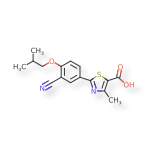
| Molecular Formula | 2C16H15N2O3S.Mg |
| Molecular Weight | 655.039 |
| Optical Activity | NONE |
| Defined Stereocenters | 0 / 0 |
| E/Z Centers | 0 |
| Charge | 0 |
SHOW SMILES / InChI
SMILES
[Mg++].CC(C)COC1=C(C=C(C=C1)C2=NC(C)=C(S2)C([O-])=O)C#N.CC(C)COC3=C(C=C(C=C3)C4=NC(C)=C(S4)C([O-])=O)C#N
InChI
InChIKey=BNABHEFFEDHWIR-UHFFFAOYSA-L
InChI=1S/2C16H16N2O3S.Mg/c2*1-9(2)8-21-13-5-4-11(6-12(13)7-17)15-18-10(3)14(22-15)16(19)20;/h2*4-6,9H,8H2,1-3H3,(H,19,20);/q;;+2/p-2
| Molecular Formula | C16H15N2O3S |
| Molecular Weight | 315.367 |
| Charge | -1 |
| Count |
|
| Stereochemistry | ACHIRAL |
| Additional Stereochemistry | No |
| Defined Stereocenters | 0 / 0 |
| E/Z Centers | 0 |
| Optical Activity | NONE |
| Molecular Formula | Mg |
| Molecular Weight | 24.305 |
| Charge | 2 |
| Count |
|
| Stereochemistry | ACHIRAL |
| Additional Stereochemistry | No |
| Defined Stereocenters | 0 / 0 |
| E/Z Centers | 0 |
| Optical Activity | NONE |
DescriptionSources: http://www.drugbank.ca/drugs/DB04854Curator's Comment: Description was created based on several sources, including
https://www.drugs.com/uloric.html
Sources: http://www.drugbank.ca/drugs/DB04854
Curator's Comment: Description was created based on several sources, including
https://www.drugs.com/uloric.html
Febuxostat (ULORIC) is a novel, xanthine oxidase/dehydrogenase (XO/XDH) inhibitor being developed by Teijin, TAP Pharmaceuticals, and Ipsen for the treatment of gout. The currently available XO inhibitor, allopurinol, has been associated with serious instances of severe hypersensitivity, in some cases leading to fatalities. There is some suggestion that febuxostat is less prone to excacerbate systemic inflammatory events in animal studies. Febuxostat, a xanthine oxidase inhibitor, achieves its therapeutic effect by decreasing serum uric acid. Febuxostat is not expected to inhibit other enzymes involved in purine and pyrimidine synthesis and metabolism at therapeutic concentrations. Febuxostat is used for the treatment of hyperuricemia in patients with gout.
Originator
Approval Year
Targets
| Primary Target | Pharmacology | Condition | Potency |
|---|---|---|---|
Target ID: CHEMBL1929 |
1.26 nM [IC50] |
Conditions
| Condition | Modality | Targets | Highest Phase | Product |
|---|---|---|---|---|
| Primary | Uloric Approved UseUloric is a xanthine oxidase (XO) inhibitor indicated for the chronic management of hyperuricemia in patients with gout. Launch Date2009 |
Cmax
| Value | Dose | Co-administered | Analyte | Population |
|---|---|---|---|---|
1.53 μg/mL EXPERIMENT https://www.ncbi.nlm.nih.gov/pubmed/16884320 |
40 mg 1 times / day multiple, oral dose: 40 mg route of administration: Oral experiment type: MULTIPLE co-administered: |
FEBUXOSTAT plasma | Homo sapiens population: HEALTHY age: ADULT sex: FEMALE / MALE food status: UNKNOWN |
AUC
| Value | Dose | Co-administered | Analyte | Population |
|---|---|---|---|---|
3.98 μg × h/mL EXPERIMENT https://www.ncbi.nlm.nih.gov/pubmed/16884320 |
40 mg 1 times / day multiple, oral dose: 40 mg route of administration: Oral experiment type: MULTIPLE co-administered: |
FEBUXOSTAT plasma | Homo sapiens population: HEALTHY age: ADULT sex: FEMALE / MALE food status: UNKNOWN |
T1/2
| Value | Dose | Co-administered | Analyte | Population |
|---|---|---|---|---|
4.2 h EXPERIMENT https://www.ncbi.nlm.nih.gov/pubmed/16884320 |
40 mg 1 times / day multiple, oral dose: 40 mg route of administration: Oral experiment type: MULTIPLE co-administered: |
FEBUXOSTAT plasma | Homo sapiens population: HEALTHY age: ADULT sex: FEMALE / MALE food status: UNKNOWN |
Funbound
| Value | Dose | Co-administered | Analyte | Population |
|---|---|---|---|---|
1% EXPERIMENT https://www.ncbi.nlm.nih.gov/pubmed/16884320 |
40 mg 1 times / day multiple, oral dose: 40 mg route of administration: Oral experiment type: MULTIPLE co-administered: |
FEBUXOSTAT plasma | Homo sapiens population: HEALTHY age: ADULT sex: FEMALE / MALE food status: UNKNOWN |
Overview
| CYP3A4 | CYP2C9 | CYP2D6 | hERG |
|---|---|---|---|
OverviewOther
| Other Inhibitor | Other Substrate | Other Inducer |
|---|---|---|
Drug as perpetrator
| Target | Modality | Activity | Metabolite | Clinical evidence |
|---|---|---|---|---|
| low | ||||
| low | ||||
| low | ||||
| low | ||||
| low | ||||
| moderate [Ki 40 uM] | weak (co-administration study) Comment: competitive inhibition; Administration with desipramine resulted in an increase in Cmax (16%) and AUC (22%) of desipramine Page: 38,13 |
|||
| no [Ki >100 uM] | ||||
| no [Ki >100 uM] | ||||
| no [Ki >100 uM] | ||||
| no [Ki >100 uM] |
Drug as victim
| Target | Modality | Activity | Metabolite | Clinical evidence |
|---|---|---|---|---|
| inconclusive | ||||
| yes | ||||
| yes | ||||
| yes | ||||
| yes | ||||
| yes | ||||
| yes | ||||
| yes | ||||
| yes | no (co-administration study) Comment: warfarin: no effect at steady-state Sources: https://www.accessdata.fda.gov/drugsatfda_docs/nda/2009/021856s000_ClinPharmR_P1.pdf#page=12 Page: 12,20,38 |
PubMed
| Title | Date | PubMed |
|---|---|---|
| Update on gout and hyperuricemia. | 2010-02 |
|
| Update on gout: new therapeutic strategies and options. | 2010-01 |
|
| Approach to the treatment of hyperuricemia. | 2009-11 |
|
| [Crystal-induced activation of the inflammasome: gout and pseudogout]. | 2009-11 |
|
| Febuxostat for the treatment of hyperuricaemia in people with gout: a single technology appraisal. | 2009-10 |
|
| Gout Study Group: update on hyperuricemia and gout. | 2009-07 |
|
| Gout--what are the treatment options? | 2009-06 |
|
| Clinical efficacy and safety of successful longterm urate lowering with febuxostat or allopurinol in subjects with gout. | 2009-06 |
|
| Febuxostat (Uloric) for chronic treatment of gout. | 2009-05-18 |
|
| New drugs: Febuxostat, lacosamide, and rufinamide. | 2009-05-16 |
|
| Febuxostat: a new treatment for hyperuricaemia in gout. | 2009-05 |
|
| Nickel-catalyzed biaryl coupling of heteroarenes and aryl halides/triflates. | 2009-04-16 |
|
| New gout treatment approved. | 2009-04-01 |
|
| Febuxostat: new drug. Hyperuricaemia: risk of gout attacks. | 2009-04 |
|
| Gateways to clinical trials. | 2009-04 |
|
| Febuxostat: a new agent for lowering serum urate. | 2009-04 |
|
| A critical reappraisal of allopurinol dosing, safety, and efficacy for hyperuricemia in gout. | 2009-04 |
|
| Update on emerging urate-lowering therapies. | 2009-03 |
|
| Febuxostat. | 2009-03 |
|
| Febuxostat in the treatment of gout: 5-yr findings of the FOCUS efficacy and safety study. | 2009-02 |
|
| The role of urate and xanthine oxidase in vascular oxidative stress: future directions. | 2009 |
|
| Gout. Hyperuricemia and cardiovascular disease: how strong is the evidence for a causal link? | 2009 |
|
| Gout. Novel therapies for treatment of gout and hyperuricemia. | 2009 |
|
| Role of urate, xanthine oxidase and the effects of allopurinol in vascular oxidative stress. | 2009 |
|
| Febuxostat in the management of hyperuricemia and chronic gout: a review. | 2008-12 |
|
| Effects of febuxostat versus allopurinol and placebo in reducing serum urate in subjects with hyperuricemia and gout: a 28-week, phase III, randomized, double-blind, parallel-group trial. | 2008-11-15 |
|
| Gout management: let's get it right this time. | 2008-11-15 |
|
| Xanthine oxidase inhibition with febuxostat attenuates systolic overload-induced left ventricular hypertrophy and dysfunction in mice. | 2008-11 |
|
| Gateways to clinical trials. | 2008-10 |
|
| The effect of age and gender on pharmacokinetics, pharmacodynamics, and safety of febuxostat, a novel nonpurine selective inhibitor of xanthine oxidase. | 2008-09 |
|
| Determinants of the clinical outcomes of gout during the first year of urate-lowering therapy. | 2008-06 |
|
| In vitro drug-drug interaction studies with febuxostat, a novel non-purine selective inhibitor of xanthine oxidase: plasma protein binding, identification of metabolic enzymes and cytochrome P450 inhibition. | 2008-05 |
|
| Gateways to clinical trials. | 2008-04 |
|
| [New antihyperuricemic medicine: febuxostat, Puricase, etc]. | 2008-04 |
|
| [Inhibitors of xanthine oxidoreductase]. | 2008-04 |
|
| Effects of febuxostat on metabolic and renal alterations in rats with fructose-induced metabolic syndrome. | 2008-04 |
|
| Treatment with the xanthine oxidase inhibitor febuxostat lowers uric acid and alleviates systemic and glomerular hypertension in experimental hyperuricaemia. | 2008-04 |
|
| Refractory gout: what is it and what to do about it? | 2008-03 |
|
| Effect of food or antacid on pharmacokinetics and pharmacodynamics of febuxostat in healthy subjects. | 2008-03 |
|
| Chronic xanthine oxidase inhibition following myocardial infarction in rabbits: effects of early versus delayed treatment. | 2008-02-27 |
|
| Crystal structures of mammalian xanthine oxidoreductase bound with various inhibitors: allopurinol, febuxostat, and FYX-051. | 2008-02 |
|
| Developments in the scientific and clinical understanding of gout. | 2008 |
|
| Febuxostat : a viewpoint by N. Lawrence Edwards. | 2008 |
|
| Febuxostat : a viewpoint by Naomi Schlesinger. | 2008 |
|
| Febuxostat: a viewpoint by H. Ralph Schumacher Jr and Lan X. Chen. | 2008 |
|
| Febuxostat. | 2008 |
|
| A benefit-risk assessment of benzbromarone in the treatment of gout. Was its withdrawal from the market in the best interest of patients? | 2008 |
|
| Effect of febuxostat on the progression of renal disease in 5/6 nephrectomy rats with and without hyperuricemia. | 2008 |
|
| Gateways to clinical trials. | 2007-12 |
|
| Febuxostat: a novel non-purine selective inhibitor of xanthine oxidase for the treatment of hyperuricemia in gout. | 2007-02 |
Sample Use Guides
In Vivo Use Guide
Sources: https://www.drugs.com/uloric.html
For treatment of hyperuricemia in patients with gout, the recommended dose is 40 mg or 80 mg once daily.
Route of Administration:
Oral
| Substance Class |
Chemical
Created
by
admin
on
Edited
Wed Apr 02 00:03:12 GMT 2025
by
admin
on
Wed Apr 02 00:03:12 GMT 2025
|
| Record UNII |
4UB2J8Q7HG
|
| Record Status |
Validated (UNII)
|
| Record Version |
|
-
Download
| Name | Type | Language | ||
|---|---|---|---|---|
|
Common Name | English | ||
|
Preferred Name | English |
| Code System | Code | Type | Description | ||
|---|---|---|---|---|---|
|
141336381
Created by
admin on Wed Apr 02 00:03:12 GMT 2025 , Edited by admin on Wed Apr 02 00:03:12 GMT 2025
|
PRIMARY | |||
|
1456533-39-3
Created by
admin on Wed Apr 02 00:03:12 GMT 2025 , Edited by admin on Wed Apr 02 00:03:12 GMT 2025
|
PRIMARY | |||
|
4UB2J8Q7HG
Created by
admin on Wed Apr 02 00:03:12 GMT 2025 , Edited by admin on Wed Apr 02 00:03:12 GMT 2025
|
PRIMARY |
| Related Record | Type | Details | ||
|---|---|---|---|---|
|
PARENT -> SALT/SOLVATE |
|
| Related Record | Type | Details | ||
|---|---|---|---|---|
|
ACTIVE MOIETY |
|
| Name | Property Type | Amount | Referenced Substance | Defining | Parameters | References |
|---|---|---|---|---|---|---|
| Biological Half-life | PHARMACOKINETIC |
|
|
|||
| Volume of Distribution | PHARMACOKINETIC |
|
|
|||