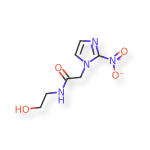
Details
| Stereochemistry | ACHIRAL |
| Molecular Formula | C7H10N4O4 |
| Molecular Weight | 214.1787 |
| Optical Activity | NONE |
| Defined Stereocenters | 0 / 0 |
| E/Z Centers | 0 |
| Charge | 0 |
SHOW SMILES / InChI
SMILES
OCCNC(=O)CN1C=CN=C1[N+]([O-])=O
InChI
InChIKey=WCDWBPCFGJXFJZ-UHFFFAOYSA-N
InChI=1S/C7H10N4O4/c12-4-2-8-6(13)5-10-3-1-9-7(10)11(14)15/h1,3,12H,2,4-5H2,(H,8,13)
| Molecular Formula | C7H10N4O4 |
| Molecular Weight | 214.1787 |
| Charge | 0 |
| Count |
|
| Stereochemistry | ACHIRAL |
| Additional Stereochemistry | No |
| Defined Stereocenters | 0 / 0 |
| E/Z Centers | 0 |
| Optical Activity | NONE |
Etanidazole (also known as Radinyl) is a 2-nitroimidazole with radiosensitizing properties. Etanidazole exerts its therapeutic action by depleting glutathione and inhibiting glutathione S-transferase, thus enhancing the anticancer effects of radiation therapy. Etanidazole was tested in Phase III clinical trials in patients with advanced head and neck cancer, however, its development was stopped. A fluorinated etanidazole (EF5) may also be useful as an imaging agent for identification of hypoxic, drug-resistant regions of primary tumors and metastases.
Originator
Approval Year
Cmax
| Value | Dose | Co-administered | Analyte | Population |
|---|---|---|---|---|
287 μg/mL EXPERIMENT https://pubmed.ncbi.nlm.nih.gov/2522918 |
2 g/m² single, intravenous dose: 2 g/m² route of administration: Intravenous experiment type: SINGLE co-administered: |
ETANIDAZOLE plasma | Homo sapiens population: UNHEALTHY age: ADULT sex: UNKNOWN food status: UNKNOWN |
AUC
| Value | Dose | Co-administered | Analyte | Population |
|---|---|---|---|---|
2.55 mM × h EXPERIMENT https://pubmed.ncbi.nlm.nih.gov/1826961 |
4 g/m² single, intravenous dose: 4 g/m² route of administration: Intravenous experiment type: SINGLE co-administered: |
ETANIDAZOLE serum | Homo sapiens population: UNHEALTHY age: ADULT sex: UNKNOWN food status: UNKNOWN |
T1/2
| Value | Dose | Co-administered | Analyte | Population |
|---|---|---|---|---|
5.8 h EXPERIMENT https://pubmed.ncbi.nlm.nih.gov/2522918 |
2 g/m² single, intravenous dose: 2 g/m² route of administration: Intravenous experiment type: SINGLE co-administered: |
ETANIDAZOLE plasma | Homo sapiens population: UNHEALTHY age: ADULT sex: UNKNOWN food status: UNKNOWN |
Overview
| CYP3A4 | CYP2C9 | CYP2D6 | hERG |
|---|---|---|---|
OverviewOther
| Other Inhibitor | Other Substrate | Other Inducer |
|---|---|---|
Drug as perpetrator
| Target | Modality | Activity | Metabolite | Clinical evidence |
|---|---|---|---|---|
| no [Activation 5.0119 uM] | ||||
| no | ||||
| no | ||||
| no | ||||
| no | ||||
| yes [Inhibition 10 uM] | ||||
| yes [Inhibition 10 uM] |
Drug as victim
| Target | Modality | Activity | Metabolite | Clinical evidence |
|---|---|---|---|---|
| no |
PubMed
| Title | Date | PubMed |
|---|---|---|
| Biodistribution and dosimetry of (18)F-EF5 in cancer patients with preliminary comparison of (18)F-EF5 uptake versus EF5 binding in human glioblastoma. | 2010-11 |
|
| Stereotactic ablative radiotherapy should be combined with a hypoxic cell radiosensitizer. | 2010-10-01 |
|
| Voltammetry of hypoxic cells radiosensitizer etanidazole radical anion in water. | 2010-06 |
|
| Inhibitor of DNA binding/differentiation 2 induced by hypoxia promotes synovial fibroblast-dependent osteoclastogenesis. | 2009-12 |
|
| A fast radiotherapy paradigm for anal cancer with volumetric modulated arc therapy (VMAT). | 2009-10-25 |
|
| Atrasentan (ABT-627) enhances perfusion and reduces hypoxia in a human tumor xenograft model. | 2009-10 |
|
| A Novel Docetaxel-Loaded Poly (ε-Caprolactone)/Pluronic F68 Nanoparticle Overcoming Multidrug Resistance for Breast Cancer Treatment. | 2009-09-16 |
|
| Immunohistochemical detection of changes in tumor hypoxia. | 2009-03-15 |
|
| Imaging and analytical methods as applied to the evaluation of vasculature and hypoxia in human brain tumors. | 2008-12 |
|
| 18F-EF5: a new PET tracer for imaging hypoxia in head and neck cancer. | 2008-12 |
|
| Noninvasive molecular imaging of hypoxia in human xenografts: comparing hypoxia-induced gene expression with endogenous and exogenous hypoxia markers. | 2008-10-15 |
|
| Regulation of cell survival and death signals induced by oxidative stress. | 2008-09 |
|
| Changes in tumor hypoxia induced by mild temperature hyperthermia as assessed by dual-tracer immunohistochemistry. | 2008-08 |
|
| Importance of antibody concentration in the assessment of cellular hypoxia by flow cytometry: EF5 and pimonidazole. | 2008-06 |
|
| Pharmaceutical particle engineering via spray drying. | 2008-05 |
|
| A phase I-B trial of the radiosensitizer: etanidazole (SR-2508) with radiosurgery for the treatment of recurrent previously irradiated primary brain tumors or brain metastases (RTOG Study 95-02). | 2008-04 |
|
| In vivo measurement of the hypoxia marker EF5 in Shionogi tumours using (19)F magnetic resonance spectroscopy. | 2008-03 |
|
| Hyperbaric oxygen reduces tissue hypoxia and hypoxia-inducible factor-1 alpha expression in focal cerebral ischemia. | 2008-03 |
|
| Imaging of tumor hypoxia to predict treatment sensitivity. | 2008 |
|
| Patterns and levels of hypoxia in head and neck squamous cell carcinomas and their relationship to patient outcome. | 2007-11-15 |
|
| The radiosensitizing effect of doranidazole on human colorectal cancer cells exposed to high doses of irradiation. | 2007-10-06 |
|
| Radiosensitization of paclitaxel, etanidazole and paclitaxel+etanidazole nanoparticles on hypoxic human tumor cells in vitro. | 2007-09 |
|
| Radiosensitization by the combination of SR-2508 and paclitaxel in hypoxic human tumor cells in vitro. | 2007-05 |
|
| In situ oxygen utilization in the rat intervertebral disc. | 2007-03 |
|
| In vivo performance of implantable biodegradable preparations delivering Paclitaxel and Etanidazole for the treatment of glioma. | 2007-02 |
|
| Identifying and targeting hypoxia in head and neck cancer: a brief overview of current approaches. | 2007 |
|
| Motexafin gadolinium injection for the treatment of brain metastases in patients with non-small cell lung cancer. | 2007 |
|
| New methods for direct delivery of chemotherapy for treating brain tumors. | 2006-12 |
|
| Oxygen levels in normal and previously irradiated human skin as assessed by EF5 binding. | 2006-12 |
|
| Detection of tumour hypoxia: comparison between EF5 adducts and [18F]EF3 uptake on an individual mouse tumour basis. | 2006-05 |
|
| EF5 binding and clinical outcome in human soft tissue sarcomas. | 2006-03-01 |
|
| Immunomodulatory effects of etanercept in an experimental model of spinal cord injury. | 2006-03 |
|
| MCT-4, A511/Basigin and EF5 expression patterns during early chick cardiomyogenesis indicate cardiac cell differentiation occurs in a hypoxic environment. | 2006-01 |
|
| Significance of hypoxia in malignant glioma. Re: Evans et al. Hypoxia is important in the biology and aggression of human glial brain tumors. Clin Cancer Res 2004;10:8177-84. | 2005-05-15 |
|
| Etanidazole in pH-sensitive liposomes: design, characterization and in vitro/in vivo anti-Trypanosoma cruzi activity. | 2005-04-18 |
|
| Stabilization of the retinal vascular network by reciprocal feedback between blood vessels and astrocytes. | 2005-04 |
|
| Hypoxia is important in the biology and aggression of human glial brain tumors. | 2004-12-15 |
|
| Utility of 19F MRS detection of the hypoxic cell marker EF5 to assess cellular hypoxia in solid tumors. | 2004-12 |
|
| HER-2/neu overexpression increases the viable hypoxic cell population within solid tumors without causing changes in tumor vascularization. | 2004-11 |
|
| Hypoxia and Photofrin uptake in the intraperitoneal carcinomatosis and sarcomatosis of photodynamic therapy patients. | 2004-07-15 |
|
| Quality of life of men treated with brachytherapies for prostate cancer. | 2004-06-15 |
|
| In vivo evaluation of [18F]fluoroetanidazole as a new marker for imaging tumour hypoxia with positron emission tomography. | 2004-06-01 |
|
| Acute hypoxia enhances spontaneous lymph node metastasis in an orthotopic murine model of human cervical carcinoma. | 2004-03-15 |
|
| Role of myocardial hypoxia in the remodeling of the embryonic avian cardiac outflow tract. | 2004-03-15 |
|
| In vitro activity of Etanidazole against the protozoan parasite Trypanosoma cruzi. | 2004-03 |
|
| Pneumocystis carinii is resistant to imidazole antifungal agents. | 1994-08 |
|
| Combined-modality therapy of esophageal cancer with radiotherapy, etanidazole, and cisplatin-fluorouracil, with or without surgery: neurotoxicity, other toxicities and outcome. | 1994-06-15 |
|
| Phase I/pharmacokinetic/biochemical study of the nitroimadazole hypoxic cell sensitiser SR2508 (etanidazole) in combination with cyclophosphamide. | 1993-10 |
|
| Enhancement in the aerobic toxicity of misonidazole and SR-2508 by buthionine sulfoximine and 4-hydroxypyrazole: the role of hydrogen peroxide. | 1986-07 |
|
| Oncogenic transformation systems involving mammalian cells in vitro to determine the relative risks of different treatment modalities. | 1984-12 |
Patents
Sample Use Guides
Etanidazole is given at a dose of 2.0 g/m(2), three
times per week for 5.5 weeks in 17 doses up to a total dose of 34 g/m(2). The drug is dissolved in saline and infused i.v., over 10 to 15 min. Radiotherapy is to begin 30 to 60 min after the start of the Etanidazole infusion.
Route of Administration:
Intravenous
Human leukemia cell lines HL60 and MOLT-4 were treated with 10 mM etanidazole by incubating cells (10(6) ml(-1)) in growth medium at 37 Celsius for 1 h before X-irradiation (15 Gy). The treatment of cells with etanidazole enhanced X-ray-induced apoptosis and the ladder-like DNA fragmentation under the hypoxic conditions.
| Substance Class |
Chemical
Created
by
admin
on
Edited
Wed Apr 02 12:46:16 GMT 2025
by
admin
on
Wed Apr 02 12:46:16 GMT 2025
|
| Record UNII |
30DKA3Q1HL
|
| Record Status |
Validated (UNII)
|
| Record Version |
|
-
Download
| Name | Type | Language | ||
|---|---|---|---|---|
|
Preferred Name | English | ||
|
Official Name | English | ||
|
Common Name | English | ||
|
Systematic Name | English | ||
|
Code | English | ||
|
Common Name | English | ||
|
Code | English | ||
|
Code | English | ||
|
Common Name | English | ||
|
Common Name | English | ||
|
Systematic Name | English |
| Classification Tree | Code System | Code | ||
|---|---|---|---|---|
|
NCI_THESAURUS |
C798
Created by
admin on Wed Apr 02 12:46:16 GMT 2025 , Edited by admin on Wed Apr 02 12:46:16 GMT 2025
|
| Code System | Code | Type | Description | ||
|---|---|---|---|---|---|
|
ETANIDAZOLE
Created by
admin on Wed Apr 02 12:46:16 GMT 2025 , Edited by admin on Wed Apr 02 12:46:16 GMT 2025
|
PRIMARY | |||
|
22668-01-5
Created by
admin on Wed Apr 02 12:46:16 GMT 2025 , Edited by admin on Wed Apr 02 12:46:16 GMT 2025
|
PRIMARY | |||
|
30DKA3Q1HL
Created by
admin on Wed Apr 02 12:46:16 GMT 2025 , Edited by admin on Wed Apr 02 12:46:16 GMT 2025
|
PRIMARY | |||
|
DTXSID8045434
Created by
admin on Wed Apr 02 12:46:16 GMT 2025 , Edited by admin on Wed Apr 02 12:46:16 GMT 2025
|
PRIMARY | |||
|
CHEMBL47405
Created by
admin on Wed Apr 02 12:46:16 GMT 2025 , Edited by admin on Wed Apr 02 12:46:16 GMT 2025
|
PRIMARY | |||
|
75473
Created by
admin on Wed Apr 02 12:46:16 GMT 2025 , Edited by admin on Wed Apr 02 12:46:16 GMT 2025
|
PRIMARY | |||
|
6142
Created by
admin on Wed Apr 02 12:46:16 GMT 2025 , Edited by admin on Wed Apr 02 12:46:16 GMT 2025
|
PRIMARY | |||
|
D017341
Created by
admin on Wed Apr 02 12:46:16 GMT 2025 , Edited by admin on Wed Apr 02 12:46:16 GMT 2025
|
PRIMARY | |||
|
Y-21
Created by
admin on Wed Apr 02 12:46:16 GMT 2025 , Edited by admin on Wed Apr 02 12:46:16 GMT 2025
|
PRIMARY | |||
|
301467
Created by
admin on Wed Apr 02 12:46:16 GMT 2025 , Edited by admin on Wed Apr 02 12:46:16 GMT 2025
|
PRIMARY | |||
|
3276
Created by
admin on Wed Apr 02 12:46:16 GMT 2025 , Edited by admin on Wed Apr 02 12:46:16 GMT 2025
|
PRIMARY | |||
|
m5038
Created by
admin on Wed Apr 02 12:46:16 GMT 2025 , Edited by admin on Wed Apr 02 12:46:16 GMT 2025
|
PRIMARY | Merck Index | ||
|
DB12736
Created by
admin on Wed Apr 02 12:46:16 GMT 2025 , Edited by admin on Wed Apr 02 12:46:16 GMT 2025
|
PRIMARY | |||
|
C1092
Created by
admin on Wed Apr 02 12:46:16 GMT 2025 , Edited by admin on Wed Apr 02 12:46:16 GMT 2025
|
PRIMARY | |||
|
SUB07261MIG
Created by
admin on Wed Apr 02 12:46:16 GMT 2025 , Edited by admin on Wed Apr 02 12:46:16 GMT 2025
|
PRIMARY | |||
|
100000082369
Created by
admin on Wed Apr 02 12:46:16 GMT 2025 , Edited by admin on Wed Apr 02 12:46:16 GMT 2025
|
PRIMARY |
| Related Record | Type | Details | ||
|---|---|---|---|---|
|
|
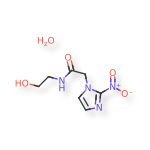
SALT/SOLVATE -> PARENT | |||
|
SOLVATE->ANHYDROUS |
| Related Record | Type | Details | ||
|---|---|---|---|---|
|
|
ACTIVE MOIETY |