Details
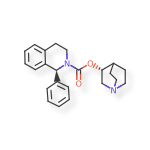
| Stereochemistry | ABSOLUTE |
| Molecular Formula | C23H26N2O2.C4H4O4 |
| Molecular Weight | 478.5369 |
| Optical Activity | UNSPECIFIED |
| Defined Stereocenters | 2 / 2 |
| E/Z Centers | 1 |
| Charge | 0 |
SHOW SMILES / InChI
SMILES
OC(=O)\C=C\C(O)=O.O=C(O[C@H]1CN2CCC1CC2)N3CCC4=CC=CC=C4[C@@H]3C5=CC=CC=C5
InChI
InChIKey=SXPMIYGGQJLCSJ-AJOGTNFDSA-N
InChI=1S/C23H26N2O2.C4H4O4/c26-23(27-21-16-24-13-10-18(21)11-14-24)25-15-12-17-6-4-5-9-20(17)22(25)19-7-2-1-3-8-19;5-3(6)1-2-4(7)8/h1-9,18,21-22H,10-16H2;1-2H,(H,5,6)(H,7,8)/b;2-1+/t21-,22-;/m0./s1
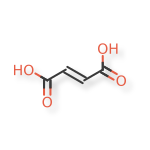
| Molecular Formula | C4H4O4 |
| Molecular Weight | 116.0722 |
| Charge | 0 |
| Count |
|
| Stereochemistry | ACHIRAL |
| Additional Stereochemistry | No |
| Defined Stereocenters | 0 / 0 |
| E/Z Centers | 1 |
| Optical Activity | NONE |
| Molecular Formula | C23H26N2O2 |
| Molecular Weight | 362.4647 |
| Charge | 0 |
| Count |
|
| Stereochemistry | ABSOLUTE |
| Additional Stereochemistry | No |
| Defined Stereocenters | 2 / 2 |
| E/Z Centers | 0 |
| Optical Activity | UNSPECIFIED |
DescriptionCurator's Comment: description was created based on several sources, including:
http://www.rxlist.com/vesicare-drug.htm
https://www.drugs.com/mtm/solifenacin.html
http://www.wikidoc.org/index.php/Solifenacin
Curator's Comment: description was created based on several sources, including:
http://www.rxlist.com/vesicare-drug.htm
https://www.drugs.com/mtm/solifenacin.html
http://www.wikidoc.org/index.php/Solifenacin
Solifenacin is a competitive muscarinic acetylcholine receptor antagonist. The binding of acetylcholine to these receptors, particularly the M3 receptor subtype, plays a critical role in the contraction of smooth muscle. By preventing the binding of acetylcholine to these receptors, solifenacin reduces smooth muscle tone in the bladder, allowing the bladder to retain larger volumes of urine. It is FDA approved for the treatment of overactive bladder with symptoms of urge urinary incontinence, urgency, and urinary frequency. Common adverse reactions include constipation, Xerostomia. Inhibitors of CYP3A4 may increase the concentration of Solifenacin. Vice versa, CYP3A4 Inducers decrease concentration.
CNS Activity
Sources: https://www.ncbi.nlm.nih.gov/pubmed/23094215 http://www.ics.org/Abstracts/Publish/46/000185.pdf
Curator's Comment: Known to be CNS penetrant in rat. Human data not available
Originator
Approval Year
Targets
| Primary Target | Pharmacology | Condition | Potency |
|---|---|---|---|
| 10.0 nM [Ki] | |||
| 125.0 nM [Ki] | |||
| 25.0 nM [Ki] | |||
| 7.73 null [pKi] | |||
| 7.46 null [pKi] |
Conditions
| Condition | Modality | Targets | Highest Phase | Product |
|---|---|---|---|---|
| Primary | VESICARE Approved UseVESIcare is a muscarinic antagonist indicated for the treatment of overactive bladder with symptoms of urge urinary incontinence, urgency, and urinary frequency. VESIcare is a muscarinic antagonist indicated for the treatment of overactive bladder with symptoms of urge urinary incontinence, urgency, and urinary frequency (1) Launch Date2004 |
Cmax
| Value | Dose | Co-administered | Analyte | Population |
|---|---|---|---|---|
14.1 ng/mL EXPERIMENT https://pubmed.ncbi.nlm.nih.gov/15206986 |
10 mg single, oral dose: 10 mg route of administration: Oral experiment type: SINGLE co-administered: |
SOLIFENACIN plasma | Homo sapiens population: HEALTHY age: ADULT sex: MALE food status: FASTED |
AUC
| Value | Dose | Co-administered | Analyte | Population |
|---|---|---|---|---|
820 ng × h/mL EXPERIMENT https://pubmed.ncbi.nlm.nih.gov/15206986 |
10 mg single, oral dose: 10 mg route of administration: Oral experiment type: SINGLE co-administered: |
SOLIFENACIN plasma | Homo sapiens population: HEALTHY age: ADULT sex: MALE food status: FASTED |
T1/2
| Value | Dose | Co-administered | Analyte | Population |
|---|---|---|---|---|
50.8 h EXPERIMENT https://pubmed.ncbi.nlm.nih.gov/15206986 |
10 mg single, oral dose: 10 mg route of administration: Oral experiment type: SINGLE co-administered: |
SOLIFENACIN plasma | Homo sapiens population: HEALTHY age: ADULT sex: MALE food status: FASTED |
Funbound
| Value | Dose | Co-administered | Analyte | Population |
|---|---|---|---|---|
2% |
SOLIFENACIN plasma | Homo sapiens population: UNKNOWN age: UNKNOWN sex: UNKNOWN food status: UNKNOWN |
Doses
| Dose | Population | Adverse events |
|---|---|---|
100 mg single, oral Highest studied dose |
healthy, 19-40 |
|
30 mg 1 times / day multiple, oral Highest studied dose Dose: 30 mg, 1 times / day Route: oral Route: multiple Dose: 30 mg, 1 times / day Sources: |
healthy, 20-35 |
|
10 mg 1 times / day multiple, oral Recommended Dose: 10 mg, 1 times / day Route: oral Route: multiple Dose: 10 mg, 1 times / day Sources: |
unhealthy Health Status: unhealthy Sources: |
Disc. AE: Angioedema, Anaphylactic reaction... AEs leading to discontinuation/dose reduction: Angioedema Sources: Anaphylactic reaction (rare) |
10 mg 1 times / day multiple, oral Recommended Dose: 10 mg, 1 times / day Route: oral Route: multiple Dose: 10 mg, 1 times / day Sources: |
unhealthy Health Status: unhealthy Sources: |
Disc. AE: Dry mouth... AEs leading to discontinuation/dose reduction: Dry mouth (1.5%) Sources: |
AEs
| AE | Significance | Dose | Population |
|---|---|---|---|
| Angioedema | Disc. AE | 10 mg 1 times / day multiple, oral Recommended Dose: 10 mg, 1 times / day Route: oral Route: multiple Dose: 10 mg, 1 times / day Sources: |
unhealthy Health Status: unhealthy Sources: |
| Anaphylactic reaction | rare Disc. AE |
10 mg 1 times / day multiple, oral Recommended Dose: 10 mg, 1 times / day Route: oral Route: multiple Dose: 10 mg, 1 times / day Sources: |
unhealthy Health Status: unhealthy Sources: |
| Dry mouth | 1.5% Disc. AE |
10 mg 1 times / day multiple, oral Recommended Dose: 10 mg, 1 times / day Route: oral Route: multiple Dose: 10 mg, 1 times / day Sources: |
unhealthy Health Status: unhealthy Sources: |
Overview
| CYP3A4 | CYP2C9 | CYP2D6 | hERG |
|---|---|---|---|
OverviewOther
| Other Inhibitor | Other Substrate | Other Inducer |
|---|---|---|
Drug as perpetrator
| Target | Modality | Activity | Metabolite | Clinical evidence |
|---|---|---|---|---|
| not significant | ||||
| not significant | ||||
| not significant | ||||
| not significant | ||||
| yes [Inhibition 1.04 uM] |
Drug as victim
| Target | Modality | Activity | Metabolite | Clinical evidence |
|---|---|---|---|---|
| major | yes (co-administration study) Comment: Label: coadministration with ketoconazole increased the mean Cmax and AUC of solifenacin by 1.5 and 2.7 fold, respectively; Sources: https://www.accessdata.fda.gov/drugsatfda_docs/nda/2004/21-518_VESIcare_biopharmr.pdf#page=22 Page: 22,52 |
|||
| minor | ||||
| minor | ||||
| minor | ||||
| minor | ||||
| minor | ||||
| no |
Tox targets
| Target | Modality | Activity | Metabolite | Clinical evidence |
|---|---|---|---|---|
PubMed
| Title | Date | PubMed |
|---|---|---|
| An unusual cause of postoperative detrusor overactivity. | 2007-10 |
|
| Comparison of the efficacy and tolerability of solifenacin succinate with or without previous use of trospium chloride. | 2007-09 |
|
| Nocturnal polyuria and nocturia relief in patients treated with solifenacin for overactive bladder symptoms. | 2007-07 |
|
| Solifenacin for overactive bladder with incontinence: symptom bother and health-related quality of life outcomes. | 2007-03 |
|
| Effect of antimuscarinic drugs used for overactive bladder on learning in a rat passive avoidance response test. | 2007-02-28 |
|
| Pharmacokinetics, safety, and tolerability of solifenacin in patients with renal insufficiency. | 2007-01 |
|
| Redefining response in overactive bladder syndrome. | 2007-01 |
|
| Pharmacological characterization of a new antimuscarinic agent, solifenacin succinate, in comparison with other antimuscarinic agents. | 2007-01 |
|
| Newer agents for the management of overactive bladder. | 2006-12-15 |
|
| New developments in the treatment of urinary incontinence. | 2006-12 |
|
| Solifenacin succinate (VESIcare): overactive bladder therapy. | 2006-12 |
|
| Open-label study of the safety and pharmacokinetics of solifenacin in subjects with hepatic impairment. | 2006-12 |
|
| [Pharmacological and clinical profile of solifenacin succinate (Vesicare) developed as a new therapeutic agent for overactive bladder]. | 2006-12 |
|
| Pharmacoeconomic evaluation of antimuscarinic agents for the treatment of overactive bladder. | 2006-12 |
|
| Solifenacin provides effective antimuscarinic therapy for the complete management of overactive bladder. | 2006-12 |
|
| Symptom bother and health-related quality of life outcomes following solifenacin treatment for overactive bladder: the VESIcare Open-Label Trial (VOLT). | 2006-11 |
|
| Gateways to clinical trials. | 2006-11 |
|
| Treatment of the overactive bladder syndrome with muscarinic receptor antagonists: a matter of metabolites? | 2006-11 |
|
| Solifenacin. | 2006-11 |
|
| Anticholinergic drugs versus placebo for overactive bladder syndrome in adults. | 2006-10-18 |
|
| Efficacy and tolerability of solifenacin in elderly subjects with overactive bladder syndrome: A pooled analysis. | 2006-09 |
|
| Solifenacin succinate for the treatment of symptoms of overactive bladder. | 2006-09 |
|
| Reductions in overactive bladder-related incontinence from pooled analysis of phase III trials evaluating treatment with solifenacin. | 2006-09 |
|
| Gateways to clinical trials. | 2006-08-09 |
|
| Patient-reported outcomes in overactive bladder: importance for determining clinical effectiveness of treatment. | 2006-08 |
|
| Solifenacin significantly improves all symptoms of overactive bladder syndrome. | 2006-08 |
|
| Multiple doses of the antimuscarinic agent solifenacin do not affect the pharmacodynamics or pharmacokinetics of warfarin or the steady-state pharmacokinetics of digoxin in healthy subjects. | 2006-08 |
|
| Pharmacokinetic effect of ketoconazole on solifenacin in healthy volunteers. | 2006-07 |
|
| Comparative evaluation of exocrine muscarinic receptor binding characteristics and inhibition of salivation of solifenacin in mice. | 2006-07 |
|
| [Comment on the STAR study: Comparison of the efficacy and tolerance of solifenacin and tolterodine retard in the treatment of overactive bladder]. | 2006-07 |
|
| [Oral anticholinergics in overactive bladder]. | 2006-07 |
|
| Short- and long-term efficacy of solifenacin treatment in patients with symptoms of mixed urinary incontinence. | 2006-06 |
|
| Gateways to clinical trials. | 2006-05 |
|
| Gateways to clinical trials. | 2006-04 |
|
| The causes and consequences of overactive bladder. | 2006-04 |
|
| Efficacy and tolerability of solifenacin in elderly subjects with overactive bladder syndrome: a pooled analysis. | 2006-03 |
|
| The emergence of new drugs for overactive bladder. | 2006-03 |
|
| Management of overactive bladder and urge urinary incontinence in the elderly patient. | 2006-03 |
|
| Pharmacologic management of overactive bladder: practical options for the primary care physician. | 2006-03 |
|
| Using anticholinergics to treat overactive bladder: the issue of treatment tolerability. | 2006-03 |
|
| Muscarinic receptors in the bladder: from basic research to therapeutics. | 2006-02 |
|
| New drugs 06, part I. | 2006-02 |
|
| Efficacy of solifenacin in patients with severe symptoms of overactive bladder: a pooled analysis. | 2006-01 |
|
| Solifenacin in overactive bladder syndrome. | 2006 |
|
| [Drug discovery in the fields of urology: tamsulosin and solifenacin]. | 2005-11 |
|
| Solifenacin in overactive bladder: a viewpoint by Hashim Hashim. | 2005 |
|
| Solifenacin in overactive bladder syndrome: a viewpoint by Scott Serels. | 2005 |
|
| Solifenacin in overactive bladder syndrome. | 2005 |
|
| Overactive bladder in the elderly: a guide to pharmacological management. | 2005 |
|
| Drug forecast--solifenacin: an investigational anticholinergic for overactive bladder. | 2004-05 |
Patents
Sample Use Guides
5 mg tablet taken once daily, and if well tolerated may be increased to 10 mg once daily.
Route of Administration:
Oral
| Substance Class |
Chemical
Created
by
admin
on
Edited
Wed Apr 02 15:16:02 GMT 2025
by
admin
on
Wed Apr 02 15:16:02 GMT 2025
|
| Record UNII |
25HF7HWP9L
|
| Record Status |
Validated (UNII)
|
| Record Version |
|
-
Download
| Name | Type | Language | ||
|---|---|---|---|---|
|
Preferred Name | English | ||
|
Common Name | English | ||
|
Systematic Name | English |
| Code System | Code | Type | Description | ||
|---|---|---|---|---|---|
|
25HF7HWP9L
Created by
admin on Wed Apr 02 15:16:02 GMT 2025 , Edited by admin on Wed Apr 02 15:16:02 GMT 2025
|
PRIMARY | |||
|
56599295
Created by
admin on Wed Apr 02 15:16:02 GMT 2025 , Edited by admin on Wed Apr 02 15:16:02 GMT 2025
|
PRIMARY | |||
|
300000056801
Created by
admin on Wed Apr 02 15:16:02 GMT 2025 , Edited by admin on Wed Apr 02 15:16:02 GMT 2025
|
PRIMARY | |||
|
1354548-49-4
Created by
admin on Wed Apr 02 15:16:02 GMT 2025 , Edited by admin on Wed Apr 02 15:16:02 GMT 2025
|
PRIMARY |
| Related Record | Type | Details | ||
|---|---|---|---|---|
|
|
PARENT -> SALT/SOLVATE |
|
||
|
|
PARENT -> SALT/SOLVATE |
|