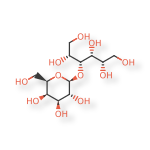
Details
| Stereochemistry | ABSOLUTE |
| Molecular Formula | C12H24O11.2H2O |
| Molecular Weight | 380.3429 |
| Optical Activity | UNSPECIFIED |
| Defined Stereocenters | 9 / 9 |
| E/Z Centers | 0 |
| Charge | 0 |
SHOW SMILES / InChI
SMILES
O.O.OC[C@H](O)[C@@H](O)[C@H](O[C@@H]1O[C@H](CO)[C@H](O)[C@H](O)[C@H]1O)[C@H](O)CO
InChI
InChIKey=VAOUPFUEMFJHKI-MTURKXFLSA-N
InChI=1S/C12H24O11.2H2O/c13-1-4(16)7(18)11(5(17)2-14)23-12-10(21)9(20)8(19)6(3-15)22-12;;/h4-21H,1-3H2;2*1H2/t4-,5+,6+,7+,8-,9-,10+,11+,12-;;/m0../s1
| Molecular Formula | C12H24O11 |
| Molecular Weight | 344.3124 |
| Charge | 0 |
| Count |
|
| Stereochemistry | ABSOLUTE |
| Additional Stereochemistry | No |
| Defined Stereocenters | 9 / 9 |
| E/Z Centers | 0 |
| Optical Activity | UNSPECIFIED |
| Molecular Formula | H2O |
| Molecular Weight | 18.0153 |
| Charge | 0 |
| Count |
|
| Stereochemistry | ACHIRAL |
| Additional Stereochemistry | No |
| Defined Stereocenters | 0 / 0 |
| E/Z Centers | 0 |
| Optical Activity | NONE |
DescriptionCurator's Comment: description was created based on several sources, including:
https://health.mail.ru/drug/importal_n/ | http://www.druginfosys.com/drug.aspx?drugcode=2283&type=1 | https://medikamio.com/fr-ch/medicaments/importal-sachets-de-poudre-10-g/pil | http://www.tabletwise.com/medicine/lactitol-monohydrate
Curator's Comment: description was created based on several sources, including:
https://health.mail.ru/drug/importal_n/ | http://www.druginfosys.com/drug.aspx?drugcode=2283&type=1 | https://medikamio.com/fr-ch/medicaments/importal-sachets-de-poudre-10-g/pil | http://www.tabletwise.com/medicine/lactitol-monohydrate
Lactitol is a sugar alcohol. This ingredient has been determined to be GRAS for specified uses as a direct food additive and foods containing lactitol are eligible for a health claim related to dental caries. Lactitol is used as an oral powder or solution in the management of hepatic encephalopathy and in case of short-term treatment of occasional constipation. Intestinal flora of large intestine is metabolize lactitol to low-molecular organic acid, which leads to an increase in osmotic pressure in intestine, increase in volume of fecal masses bowel function normalization. This drug might cause abdominal discomfort, especially flatulence and abdominal pain rarely or sometimes abdominal distension. These effects tend to diminish or disappear after a few days of regular intake of the drug. Since 'antacids and neomycin can neutralize ' acidifying effect of lactitol on stool, they should not be co-administered with lactitol in cirrhotic patients with hepatic encephalopathy; however both substances do not alter the 'laxative effect in patients with constipation.
Approval Year
Conditions
| Condition | Modality | Targets | Highest Phase | Product |
|---|---|---|---|---|
| Primary | Importal Approved UseIt is recommended for the treatment of occasional constipation, stool regulation and chronic hepatic encephalopathy. |
|||
| Primary | Importal Approved UseIt is recommended for the treatment of occasional constipation, stool regulation and chronic hepatic encephalopathy. |
Cmax
| Value | Dose | Co-administered | Analyte | Population |
|---|---|---|---|---|
776 ng/mL |
20 g single, oral dose: 20 g route of administration: Oral experiment type: SINGLE co-administered: |
LACTITOL serum | Homo sapiens population: HEALTHY age: ADULT sex: UNKNOWN food status: FED |
|
2780 ng/mL |
21 g single, oral dose: 21 g route of administration: Oral experiment type: SINGLE co-administered: |
LACTITOL plasma | Homo sapiens population: HEALTHY age: ADULT sex: UNKNOWN food status: FASTED |
|
776 ng/mL |
21 g single, oral dose: 21 g route of administration: Oral experiment type: SINGLE co-administered: |
LACTITOL plasma | Homo sapiens population: HEALTHY age: ADULT sex: UNKNOWN food status: HIGH-FAT |
AUC
| Value | Dose | Co-administered | Analyte | Population |
|---|---|---|---|---|
6.019 ng × h/mL |
20 g single, oral dose: 20 g route of administration: Oral experiment type: SINGLE co-administered: |
LACTITOL serum | Homo sapiens population: HEALTHY age: ADULT sex: UNKNOWN food status: FED |
|
14941 ng × h/mL |
21 g single, oral dose: 21 g route of administration: Oral experiment type: SINGLE co-administered: |
LACTITOL plasma | Homo sapiens population: HEALTHY age: ADULT sex: UNKNOWN food status: FASTED |
|
6019 ng × h/mL |
21 g single, oral dose: 21 g route of administration: Oral experiment type: SINGLE co-administered: |
LACTITOL plasma | Homo sapiens population: HEALTHY age: ADULT sex: UNKNOWN food status: HIGH-FAT |
T1/2
| Value | Dose | Co-administered | Analyte | Population |
|---|---|---|---|---|
2.4 h |
20 g single, oral dose: 20 g route of administration: Oral experiment type: SINGLE co-administered: |
LACTITOL serum | Homo sapiens population: HEALTHY age: ADULT sex: UNKNOWN food status: FED |
|
2.16 h |
21 g single, oral dose: 21 g route of administration: Oral experiment type: SINGLE co-administered: |
LACTITOL plasma | Homo sapiens population: HEALTHY age: ADULT sex: UNKNOWN food status: FASTED |
|
2.43 h |
21 g single, oral dose: 21 g route of administration: Oral experiment type: SINGLE co-administered: |
LACTITOL plasma | Homo sapiens population: HEALTHY age: ADULT sex: UNKNOWN food status: HIGH-FAT |
Doses
| Dose | Population | Adverse events |
|---|---|---|
20 g 1 times / day steady, oral Recommended Dose: 20 g, 1 times / day Route: oral Route: steady Dose: 20 g, 1 times / day Sources: |
unhealthy, 18-87 years Health Status: unhealthy Age Group: 18-87 years Sex: M+F Sources: |
Other AEs: Urinary tract infection, Abdominal pain... Other AEs: Urinary tract infection (5%) Sources: Abdominal pain (3%) Hypersensitivity reaction Rash Pruritus |
20 g 1 times / day steady, oral Recommended Dose: 20 g, 1 times / day Route: oral Route: steady Dose: 20 g, 1 times / day Sources: |
unhealthy, 18-88 years Health Status: unhealthy Age Group: 18-88 years Sex: M+F Sources: |
Disc. AE: Flatulence, Diarrhea... Other AEs: Upper respiratory tract infection, Flatulence... AEs leading to discontinuation/dose reduction: Flatulence (1%) Other AEs:Diarrhea (1%) Blood creatine phosphokinase increased (1%) Increased blood pressure (1%) Upper respiratory tract infection (9%) Sources: Flatulence (8%) Diarrhea (4%) Blood creatine phosphokinase increased (4%) Abdominal distension (3%) Increased blood pressure (3%) Diarrhea (grade 3, 1%) |
130 g 1 times / day single, oral Highest studied dose Dose: 130 g, 1 times / day Route: oral Route: single Dose: 130 g, 1 times / day Sources: |
healthy, 23-48 years Health Status: healthy Age Group: 23-48 years Sex: M+F Sources: |
|
74 g 1 times / day single, oral MTD Dose: 74 g, 1 times / day Route: oral Route: single Dose: 74 g, 1 times / day Sources: |
healthy, 23-48 years Health Status: healthy Age Group: 23-48 years Sex: M+F Sources: |
DLT: Diarrhea, Gastrointestinal symptom NOS... Dose limiting toxicities: Diarrhea (15 patients) Sources: Gastrointestinal symptom NOS (severe, 4 patients) |
AEs
| AE | Significance | Dose | Population |
|---|---|---|---|
| Hypersensitivity reaction | 20 g 1 times / day steady, oral Recommended Dose: 20 g, 1 times / day Route: oral Route: steady Dose: 20 g, 1 times / day Sources: |
unhealthy, 18-87 years Health Status: unhealthy Age Group: 18-87 years Sex: M+F Sources: |
|
| Pruritus | 20 g 1 times / day steady, oral Recommended Dose: 20 g, 1 times / day Route: oral Route: steady Dose: 20 g, 1 times / day Sources: |
unhealthy, 18-87 years Health Status: unhealthy Age Group: 18-87 years Sex: M+F Sources: |
|
| Rash | 20 g 1 times / day steady, oral Recommended Dose: 20 g, 1 times / day Route: oral Route: steady Dose: 20 g, 1 times / day Sources: |
unhealthy, 18-87 years Health Status: unhealthy Age Group: 18-87 years Sex: M+F Sources: |
|
| Abdominal pain | 3% | 20 g 1 times / day steady, oral Recommended Dose: 20 g, 1 times / day Route: oral Route: steady Dose: 20 g, 1 times / day Sources: |
unhealthy, 18-87 years Health Status: unhealthy Age Group: 18-87 years Sex: M+F Sources: |
| Urinary tract infection | 5% | 20 g 1 times / day steady, oral Recommended Dose: 20 g, 1 times / day Route: oral Route: steady Dose: 20 g, 1 times / day Sources: |
unhealthy, 18-87 years Health Status: unhealthy Age Group: 18-87 years Sex: M+F Sources: |
| Blood creatine phosphokinase increased | 1% Disc. AE |
20 g 1 times / day steady, oral Recommended Dose: 20 g, 1 times / day Route: oral Route: steady Dose: 20 g, 1 times / day Sources: |
unhealthy, 18-88 years Health Status: unhealthy Age Group: 18-88 years Sex: M+F Sources: |
| Diarrhea | 1% Disc. AE |
20 g 1 times / day steady, oral Recommended Dose: 20 g, 1 times / day Route: oral Route: steady Dose: 20 g, 1 times / day Sources: |
unhealthy, 18-88 years Health Status: unhealthy Age Group: 18-88 years Sex: M+F Sources: |
| Flatulence | 1% Disc. AE |
20 g 1 times / day steady, oral Recommended Dose: 20 g, 1 times / day Route: oral Route: steady Dose: 20 g, 1 times / day Sources: |
unhealthy, 18-88 years Health Status: unhealthy Age Group: 18-88 years Sex: M+F Sources: |
| Increased blood pressure | 1% Disc. AE |
20 g 1 times / day steady, oral Recommended Dose: 20 g, 1 times / day Route: oral Route: steady Dose: 20 g, 1 times / day Sources: |
unhealthy, 18-88 years Health Status: unhealthy Age Group: 18-88 years Sex: M+F Sources: |
| Abdominal distension | 3% | 20 g 1 times / day steady, oral Recommended Dose: 20 g, 1 times / day Route: oral Route: steady Dose: 20 g, 1 times / day Sources: |
unhealthy, 18-88 years Health Status: unhealthy Age Group: 18-88 years Sex: M+F Sources: |
| Increased blood pressure | 3% | 20 g 1 times / day steady, oral Recommended Dose: 20 g, 1 times / day Route: oral Route: steady Dose: 20 g, 1 times / day Sources: |
unhealthy, 18-88 years Health Status: unhealthy Age Group: 18-88 years Sex: M+F Sources: |
| Blood creatine phosphokinase increased | 4% | 20 g 1 times / day steady, oral Recommended Dose: 20 g, 1 times / day Route: oral Route: steady Dose: 20 g, 1 times / day Sources: |
unhealthy, 18-88 years Health Status: unhealthy Age Group: 18-88 years Sex: M+F Sources: |
| Diarrhea | 4% | 20 g 1 times / day steady, oral Recommended Dose: 20 g, 1 times / day Route: oral Route: steady Dose: 20 g, 1 times / day Sources: |
unhealthy, 18-88 years Health Status: unhealthy Age Group: 18-88 years Sex: M+F Sources: |
| Flatulence | 8% | 20 g 1 times / day steady, oral Recommended Dose: 20 g, 1 times / day Route: oral Route: steady Dose: 20 g, 1 times / day Sources: |
unhealthy, 18-88 years Health Status: unhealthy Age Group: 18-88 years Sex: M+F Sources: |
| Upper respiratory tract infection | 9% | 20 g 1 times / day steady, oral Recommended Dose: 20 g, 1 times / day Route: oral Route: steady Dose: 20 g, 1 times / day Sources: |
unhealthy, 18-88 years Health Status: unhealthy Age Group: 18-88 years Sex: M+F Sources: |
| Diarrhea | grade 3, 1% | 20 g 1 times / day steady, oral Recommended Dose: 20 g, 1 times / day Route: oral Route: steady Dose: 20 g, 1 times / day Sources: |
unhealthy, 18-88 years Health Status: unhealthy Age Group: 18-88 years Sex: M+F Sources: |
| Diarrhea | 15 patients DLT, Disc. AE |
74 g 1 times / day single, oral MTD Dose: 74 g, 1 times / day Route: oral Route: single Dose: 74 g, 1 times / day Sources: |
healthy, 23-48 years Health Status: healthy Age Group: 23-48 years Sex: M+F Sources: |
| Gastrointestinal symptom NOS | severe, 4 patients DLT, Disc. AE |
74 g 1 times / day single, oral MTD Dose: 74 g, 1 times / day Route: oral Route: single Dose: 74 g, 1 times / day Sources: |
healthy, 23-48 years Health Status: healthy Age Group: 23-48 years Sex: M+F Sources: |
PubMed
| Title | Date | PubMed |
|---|---|---|
| Microbial and bioconversion production of D-xylitol and its detection and application. | 2010-12-15 |
|
| Duodenal administered seal oil for patients with subjective food hypersensitivity: an explorative open pilot study. | 2010-12-06 |
|
| Successful drug development despite adverse preclinical findings part 2: examples. | 2010-12 |
|
| Lactitol or lactulose in the treatment of chronic constipation: result of a systematic. | 2010-11 |
|
| Differences between reversible (self-association) and irreversible aggregation of rHuG-CSF in carbohydrate and polyol formulations. | 2010-11 |
|
| Current and emerging strategies for treating hepatic encephalopathy. | 2010-09 |
|
| Constipation in adults. | 2010-07-05 |
|
| Synthesis of PEGylated lactose analogs for inhibition studies on T.cruzi trans-sialidase. | 2010-07 |
|
| Pharmacotherapy for hepatic encephalopathy. | 2010-06-18 |
|
| Xylo-oligosaccharides and lactitol promote the growth of Bifidobacterium lactis and Lactobacillus species in pure cultures. | 2010-06 |
|
| Synbiotic effects of lactitol and Lactobacillus acidophilus NCFM™ in a semi-continuous colon fermentation model. | 2010-06 |
|
| Freeze-drying of proteins with glass-forming oligosaccharide-derived sugar alcohols. | 2010-04-15 |
|
| Idiopathic proximal hemimegacolon in an adult woman. | 2010-04 |
|
| Recombinant human granulocyte colony stimulating factor pre-screening and screening of stabilizing carbohydrates and polyols. | 2010-03-15 |
|
| Gut microbiota in human adults with type 2 diabetes differs from non-diabetic adults. | 2010-02-05 |
|
| Standards of medical care in diabetes--2010. | 2010-01 |
|
| Sugar alcohols, caries incidence, and remineralization of caries lesions: a literature review. | 2010 |
|
| Some putative prebiotics increase the severity of Salmonella enterica serovar Typhimurium infection in mice. | 2009-11-30 |
|
| Suppressive response of confections containing the extractive from leaves of Morus Alba on postprandial blood glucose and insulin in healthy human subjects. | 2009-07-14 |
|
| Current trends in the treatment of hepatic encephalopathy. | 2009-06 |
|
| Polyols as filler-binders for disintegrating tablets prepared by direct compaction. | 2009-06 |
|
| [Elderly hereditary hemorrhagic telangiectasia female with portosystemic encephalopathy]. | 2009-05 |
|
| [Prebiotic lactitol as a component of biopreparation from aerobic bacilli]. | 2009-04-09 |
|
| Influence of a combination of Lactobacillus acidophilus NCFM and lactitol on healthy elderly: intestinal and immune parameters. | 2009-02 |
|
| Standards of medical care in diabetes--2009. | 2009-01 |
|
| Sensory properties and color measurements of dietary chocolates with different compositions during storage for up to 360 days. | 2009 |
|
| The role of rifaximin in the treatment and chemoprophylaxis of travelers' diarrhea. | 2009 |
|
| Accuracy of drug advertisements in medical journals under new law regulating the marketing of pharmaceutical products in Switzerland. | 2008-12-31 |
|
| Treatment of minimal hepatic encephalopathy. | 2008-11 |
|
| Intestinal metabolism of weaned piglets fed a typical United States or European diet with or without supplementation of tributyrin and lactitol. | 2008-11 |
|
| Rifaximin for the treatment of hepatic encephalopathy. | 2008-08 |
|
| Roles of probiotics and prebiotics in colon cancer prevention: Postulated mechanisms and in-vivo evidence. | 2008-05 |
|
| Xylitol-supplemented nutrition enhances bacterial killing and prolongs survival of rats in experimental pneumococcal sepsis. | 2008-03-11 |
|
| Human lactobacilli as supplementation of clindamycin to patients with bacterial vaginosis reduce the recurrence rate; a 6-month, double-blind, randomized, placebo-controlled study. | 2008-01-15 |
|
| Characteristic fragmentation patterns of the trimethylsilyl and trimethylsilyl-oxime derivatives of various saccharides as obtained by gas chromatography coupled to ion-trap mass spectrometry. | 2008-01-04 |
|
| Ecological characterization of the colonic microbiota of normal and diarrheic dogs. | 2008 |
|
| Prophylactic antibiotic treatment is superior to therapy on-demand in experimental necrotising pancreatitis. | 2008 |
|
| Relevance of the diversity among members of the Trypanosoma cruzi trans-sialidase family analyzed with camelids single-domain antibodies. | 2008 |
|
| [Influence of the bifidobacteria and lactitol containing products on lypoperoxidation processes and intestinal microflora]. | 2008 |
|
| The treatment of hepatic encephalopathy. | 2007-12 |
|
| The trans-sialidase from Trypanosoma cruzi efficiently transfers alpha-(2-->3)-linked N-glycolylneuraminic acid to terminal beta-galactosyl units. | 2007-11-26 |
|
| Effect of oral lactulose on clinical and immunohistochemical parameters in patients with inflammatory bowel disease: a pilot study. | 2007-09-04 |
|
| [A case of recurrent pneumatosis cystoides intestinalis associated with recurrent pneumoperitoneum]. | 2007-09 |
|
| Effects of low doses of lactitol on faecal microflora, pH, short chain fatty acids and gastrointestinal symptomology. | 2007-09 |
|
| Constipation in adults. | 2007-08-01 |
|
| A study of the properties of tablets from the mixtures of directly compressible starch and directly compressible lactitol. | 2007-07 |
|
| Characterization of the bga1-encoded glycoside hydrolase family 35 beta-galactosidase of Hypocrea jecorina with galacto-beta-D-galactanase activity. | 2007-04 |
|
| Threshold for transitory diarrhea induced by ingestion of xylitol and lactitol in young male and female adults. | 2007-02 |
|
| Anemia impairs small intestinal absorption measured by intestinal permeability in children. | 2007-01 |
|
| Health potential of polyols as sugar replacers, with emphasis on low glycaemic properties. | 2003-12 |
Patents
Sample Use Guides
Initial dose - 20 g at once during 4-5 days. Next, 10 g per day.
Route of Administration:
Oral
| Substance Class |
Chemical
Created
by
admin
on
Edited
Mon Mar 31 18:56:23 GMT 2025
by
admin
on
Mon Mar 31 18:56:23 GMT 2025
|
| Record UNII |
1F5S85F60B
|
| Record Status |
Validated (UNII)
|
| Record Version |
|
-
Download
| Name | Type | Language | ||
|---|---|---|---|---|
|
Common Name | English | ||
|
Preferred Name | English | ||
|
Common Name | English | ||
|
Common Name | English |
| Code System | Code | Type | Description | ||
|---|---|---|---|---|---|
|
157354
Created by
admin on Mon Mar 31 18:56:23 GMT 2025 , Edited by admin on Mon Mar 31 18:56:23 GMT 2025
|
PRIMARY | |||
|
1F5S85F60B
Created by
admin on Mon Mar 31 18:56:23 GMT 2025 , Edited by admin on Mon Mar 31 18:56:23 GMT 2025
|
PRIMARY | |||
|
DTXSID80230863
Created by
admin on Mon Mar 31 18:56:23 GMT 2025 , Edited by admin on Mon Mar 31 18:56:23 GMT 2025
|
PRIMARY | |||
|
m6659
Created by
admin on Mon Mar 31 18:56:23 GMT 2025 , Edited by admin on Mon Mar 31 18:56:23 GMT 2025
|
PRIMARY | Merck Index | ||
|
81025-03-8
Created by
admin on Mon Mar 31 18:56:23 GMT 2025 , Edited by admin on Mon Mar 31 18:56:23 GMT 2025
|
PRIMARY |
| Related Record | Type | Details | ||
|---|---|---|---|---|
|
|
PARENT -> SALT/SOLVATE | |||
|
ANHYDROUS->SOLVATE |