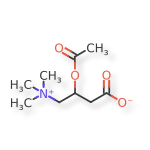
Details
| Stereochemistry | RACEMIC |
| Molecular Formula | C9H17NO4 |
| Molecular Weight | 203.2356 |
| Optical Activity | ( + / - ) |
| Defined Stereocenters | 0 / 2 |
| E/Z Centers | 0 |
| Charge | 0 |
SHOW SMILES / InChI
SMILES
CC(=O)OC(CC([O-])=O)C[N+](C)(C)C
InChI
InChIKey=RDHQFKQIGNGIED-UHFFFAOYSA-N
InChI=1S/C9H17NO4/c1-7(11)14-8(5-9(12)13)6-10(2,3)4/h8H,5-6H2,1-4H3
| Molecular Formula | C9H17NO4 |
| Molecular Weight | 203.2356 |
| Charge | 0 |
| Count |
|
| Stereochemistry | MIXED |
| Additional Stereochemistry | No |
| Defined Stereocenters | 0 / 2 |
| E/Z Centers | 0 |
| Optical Activity | ( + / - ) |
L-acetylcarnitine or acet-L-carnitine, a compound, naturally produced by the body, is necessary for fatty-acid metabolism and energy production. It is often taken as a dietary supplement. The mechanisms of action of acetylcarnitine have not been fully elucidated, but it seems that the main role of acetylcarnitine is to donate an acetyl group during fatty acid metabolism to help transport fatty acids, such as acetyl CoA, into the mitochondrial matrix where fatty acid metabolism occurs. L-acetylcarnitine is an investigational drug, which is approved in some countries, for example in Italy for diabetic neuropathy. Phase IV of clinical trials have revealed, that it also effective agent to treat the Alzheimer's disease. In contrary, the efficacy of L-acetylcarnitine as a prophylaxis in migraine patients did not provide evidence of benefit for efficacy. Besides, Acetyl-L-carnitine was in clinical trial Phase III to investigate its efficacy in the treatment of peripheral sensory neuropathy that anti-cancer chemotherapeutics induce. Recently published article unexpectedly discovered that this drug increased chemotherapy-induced peripheral neuropathy in a randomized trial.
CNS Activity
Approval Year
Doses
| Dose | Population | Adverse events |
|---|---|---|
4 g 2 times / day multiple, oral Highest studied dose Dose: 4 g, 2 times / day Route: oral Route: multiple Dose: 4 g, 2 times / day Sources: |
unhealthy, ADULT Health Status: unhealthy Age Group: ADULT Sex: M+F Food Status: UNKNOWN Sources: |
Other AEs: Nausea, Headache... Other AEs: Nausea (1.7%) Sources: Headache (grade 1, 3.3%) Abdominal pain (3.3%) |
2 g 2 times / day multiple, oral Recommended Dose: 2 g, 2 times / day Route: oral Route: multiple Dose: 2 g, 2 times / day Sources: |
unhealthy, ADULT Health Status: unhealthy Age Group: ADULT Sex: M+F Food Status: UNKNOWN Sources: |
Disc. AE: Insomnia, Nervousness... AEs leading to discontinuation/dose reduction: Insomnia (5.5%) Sources: Nervousness (5.5%) |
AEs
| AE | Significance | Dose | Population |
|---|---|---|---|
| Nausea | 1.7% | 4 g 2 times / day multiple, oral Highest studied dose Dose: 4 g, 2 times / day Route: oral Route: multiple Dose: 4 g, 2 times / day Sources: |
unhealthy, ADULT Health Status: unhealthy Age Group: ADULT Sex: M+F Food Status: UNKNOWN Sources: |
| Abdominal pain | 3.3% | 4 g 2 times / day multiple, oral Highest studied dose Dose: 4 g, 2 times / day Route: oral Route: multiple Dose: 4 g, 2 times / day Sources: |
unhealthy, ADULT Health Status: unhealthy Age Group: ADULT Sex: M+F Food Status: UNKNOWN Sources: |
| Headache | grade 1, 3.3% | 4 g 2 times / day multiple, oral Highest studied dose Dose: 4 g, 2 times / day Route: oral Route: multiple Dose: 4 g, 2 times / day Sources: |
unhealthy, ADULT Health Status: unhealthy Age Group: ADULT Sex: M+F Food Status: UNKNOWN Sources: |
| Insomnia | 5.5% Disc. AE |
2 g 2 times / day multiple, oral Recommended Dose: 2 g, 2 times / day Route: oral Route: multiple Dose: 2 g, 2 times / day Sources: |
unhealthy, ADULT Health Status: unhealthy Age Group: ADULT Sex: M+F Food Status: UNKNOWN Sources: |
| Nervousness | 5.5% Disc. AE |
2 g 2 times / day multiple, oral Recommended Dose: 2 g, 2 times / day Route: oral Route: multiple Dose: 2 g, 2 times / day Sources: |
unhealthy, ADULT Health Status: unhealthy Age Group: ADULT Sex: M+F Food Status: UNKNOWN Sources: |
PubMed
| Title | Date | PubMed |
|---|---|---|
| Two-Year Trends of Taxane-Induced Neuropathy in Women Enrolled in a Randomized Trial of Acetyl-L-Carnitine (SWOG S0715). | 2018-06-01 |
|
| Treating Painful Diabetic Peripheral Neuropathy: An Update. | 2016-08-01 |
|
| L-acetylcarnitine: a proposed therapeutic agent for painful peripheral neuropathies. | 2006-07 |
|
| Acetyl-L-carnitine (levacecarnine) in the treatment of diabetic neuropathy. A long-term, randomised, double-blind, placebo-controlled study. | 2002 |
|
| Neuroprotective activity of acetyl-L-carnitine: studies in vitro. | 1994-01 |
|
| Long-term acetyl-L-carnitine treatment in Alzheimer's disease. | 1991-11 |
Patents
Sample Use Guides
The neuroprotective properties of acetyl-L-carnitine (ALCAR) were investigated in primary cell cultures from rat hippocampal formation and cerebral cortex of 17-day-old rat embryos. ALCAR (10-50 microM for 10 days) reduced the cell mortality induced by 24 hr fetal calf serum deprivation. Protection was partial when the neuronal cells, chronically treated with ALCAR (50 microM), were exposed to glutamate (0.25-1 mM) and kainic acid (250-500 microM) for 24 hr. The neurotoxicity induced by N-methyl-D-aspartate (NMDA, 250 microM) was attenuated by the acute co-exposure with ALCAR (1 mM), the chronic treatment with ALCAR (50 microM) significantly reduced the neuronal death induced by NMDA (0.25-1 mM).
| Substance Class |
Chemical
Created
by
admin
on
Edited
Mon Mar 31 18:37:16 GMT 2025
by
admin
on
Mon Mar 31 18:37:16 GMT 2025
|
| Record UNII |
07OP6H4V4A
|
| Record Status |
Validated (UNII)
|
| Record Version |
|
-
Download
| Name | Type | Language | ||
|---|---|---|---|---|
|
Preferred Name | English | ||
|
Systematic Name | English | ||
|
Systematic Name | English | ||
|
Common Name | English | ||
|
Common Name | English | ||
|
Common Name | English | ||
|
Common Name | English | ||
|
Common Name | English | ||
|
Common Name | English | ||
|
Common Name | English | ||
|
Common Name | English |
| Code System | Code | Type | Description | ||
|---|---|---|---|---|---|
|
m1349
Created by
admin on Mon Mar 31 18:37:16 GMT 2025 , Edited by admin on Mon Mar 31 18:37:16 GMT 2025
|
PRIMARY | |||
|
1310540
Created by
admin on Mon Mar 31 18:37:16 GMT 2025 , Edited by admin on Mon Mar 31 18:37:16 GMT 2025
|
PRIMARY | RxNorm | ||
|
DTXSID2048117
Created by
admin on Mon Mar 31 18:37:16 GMT 2025 , Edited by admin on Mon Mar 31 18:37:16 GMT 2025
|
PRIMARY | |||
|
14992-62-2
Created by
admin on Mon Mar 31 18:37:16 GMT 2025 , Edited by admin on Mon Mar 31 18:37:16 GMT 2025
|
PRIMARY | |||
|
07OP6H4V4A
Created by
admin on Mon Mar 31 18:37:16 GMT 2025 , Edited by admin on Mon Mar 31 18:37:16 GMT 2025
|
PRIMARY | |||
|
1
Created by
admin on Mon Mar 31 18:37:16 GMT 2025 , Edited by admin on Mon Mar 31 18:37:16 GMT 2025
|
PRIMARY | |||
|
73024
Created by
admin on Mon Mar 31 18:37:16 GMT 2025 , Edited by admin on Mon Mar 31 18:37:16 GMT 2025
|
PRIMARY |
| Related Record | Type | Details | ||
|---|---|---|---|---|
|
|
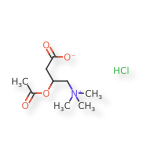
SALT/SOLVATE -> PARENT |
|
| Related Record | Type | Details | ||
|---|---|---|---|---|
|
|
ACTIVE MOIETY |
|