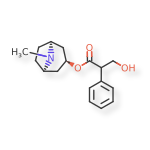
Details
| Stereochemistry | RACEMIC |
| Molecular Formula | C17H23NO3.C6H8O7 |
| Molecular Weight | 481.4929 |
| Optical Activity | ( + / - ) |
| Defined Stereocenters | 3 / 4 |
| E/Z Centers | 0 |
| Charge | 0 |
SHOW SMILES / InChI
SMILES
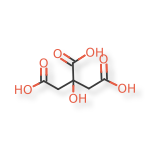
OC(=O)CC(O)(CC(O)=O)C(O)=O.CN1[C@H]2CC[C@@H]1C[C@@H](C2)OC(=O)C(CO)C3=CC=CC=C3
InChI
InChIKey=PVFKXEKWGWYDSO-RIMUKSHESA-N
InChI=1S/C17H23NO3.C6H8O7/c1-18-13-7-8-14(18)10-15(9-13)21-17(20)16(11-19)12-5-3-2-4-6-12;7-3(8)1-6(13,5(11)12)2-4(9)10/h2-6,13-16,19H,7-11H2,1H3;13H,1-2H2,(H,7,8)(H,9,10)(H,11,12)/t13-,14+,15+,16?;
| Molecular Formula | C17H23NO3 |
| Molecular Weight | 289.3694 |
| Charge | 0 |
| Count |
|
| Stereochemistry | EPIMERIC |
| Additional Stereochemistry | No |
| Defined Stereocenters | 3 / 4 |
| E/Z Centers | 0 |
| Optical Activity | UNSPECIFIED |
| Molecular Formula | C6H8O7 |
| Molecular Weight | 192.1235 |
| Charge | 0 |
| Count |
|
| Stereochemistry | ACHIRAL |
| Additional Stereochemistry | No |
| Defined Stereocenters | 0 / 0 |
| E/Z Centers | 0 |
| Optical Activity | NONE |
DescriptionCurator's Comment: description was created based on several sources, including
https://www.ncbi.nlm.nih.gov/mesh/68001285 |
http://www.accessdata.fda.gov/drugsatfda_docs/label/2014/206289s000lbl.pdf
Curator's Comment: description was created based on several sources, including
https://www.ncbi.nlm.nih.gov/mesh/68001285 |
http://www.accessdata.fda.gov/drugsatfda_docs/label/2014/206289s000lbl.pdf
Atropine inhibits the muscarinic actions of acetylcholine on structures innervated by postganglionic cholinergic nerves, and on smooth muscles which respond to endogenous acetylcholine but are not so innervated. As with other antimuscarinic agents, the major action of atropine is a competitive or surmountable antagonism which can be overcome by increasing the concentration of acetylcholine at receptor sites of the effector organ (e.g., by using anticholinesterase agents which inhibit the enzymatic destruction of acetylcholine). The receptors antagonized by atropine are the peripheral structures that are stimulated or inhibited by muscarine (i.e., exocrine glands and smooth and cardiac muscle). Responses to postganglionic cholinergic nerve stimulation also may be inhibited by atropine but this occurs less readily than with responses to injected (exogenous) choline esters. Atropine is relatively selective for muscarinic receptors. Its potency at nicotinic receptors is much lower, and actions at non-muscarinic receptors are generally undetectable clinically. Atropine does not distinguish among the M1, M2, and M3 subgroups of muscarinic receptors.
Approval Year
Targets
| Primary Target | Pharmacology | Condition | Potency |
|---|---|---|---|
Target ID: CHEMBL216 |
9.34 null [pKi] | ||
Target ID: CHEMBL211 |
8.95 null [pKi] | ||
Target ID: CHEMBL245 |
9.15 null [pKi] |
Conditions
| Condition | Modality | Targets | Highest Phase | Product |
|---|---|---|---|---|
| Primary | Atropine sulfate Approved UseAtropine sulfate is indicated for temporary blockade of severe or life threatening muscarinic effects, e.g., as an antisialagogue, an antivagal agent, an antidote for organophosphorus or muscarinic mushroom poisoning, and to treat bradyasystolic cardiac arrest. Launch Date2001 |
|||
| Primary | Atropine sulfate Approved UseAtropine sulfate is indicated for temporary blockade of severe or life threatening muscarinic effects, e.g., as an antisialagogue, an antivagal agent, an antidote for organophosphorus or muscarinic mushroom poisoning, and to treat bradyasystolic cardiac arrest. Launch Date2001 |
|||
| Primary | Atropine sulfate Approved UseAtropine sulfate is indicated for temporary blockade of severe or life threatening muscarinic effects, e.g., as an antisialagogue, an antivagal agent, an antidote for organophosphorus or muscarinic mushroom poisoning, and to treat bradyasystolic cardiac arrest. Launch Date2001 |
|||
| Primary | Atropine sulfate Approved UseAtropine sulfate is indicated for temporary blockade of severe or life threatening muscarinic effects, e.g., as an antisialagogue, an antivagal agent, an antidote for organophosphorus or muscarinic mushroom poisoning, and to treat bradyasystolic cardiac arrest. Launch Date2001 |
|||
| Primary | Atropine sulfate Approved UseAtropine sulfate is indicated for temporary blockade of severe or life threatening muscarinic effects, e.g., as an antisialagogue, an antivagal agent, an antidote for organophosphorus or muscarinic mushroom poisoning, and to treat bradyasystolic cardiac arrest. Launch Date2001 |
Cmax
| Value | Dose | Co-administered | Analyte | Population |
|---|---|---|---|---|
9.6 ng/mL |
1.67 mg single, intramuscular dose: 1.67 mg route of administration: Intramuscular experiment type: SINGLE co-administered: |
ATROPINE plasma | Homo sapiens population: UNKNOWN age: ADULT sex: UNKNOWN food status: UNKNOWN |
|
860 pg/mL EXPERIMENT https://www.ncbi.nlm.nih.gov/pubmed/3046815 |
0.4 mg single, ocular dose: 0.4 mg route of administration: Ocular experiment type: SINGLE co-administered: |
ATROPINE plasma | Homo sapiens population: UNHEALTHY age: ADULT sex: FEMALE / MALE food status: UNKNOWN |
|
11.7 ng/mL EXPERIMENT https://www.ncbi.nlm.nih.gov/pubmed/3740650 |
1.67 mg single, intramuscular dose: 1.67 mg route of administration: Intramuscular experiment type: SINGLE co-administered: |
ATROPINE plasma | Homo sapiens population: HEALTHY age: ADULT sex: MALE food status: UNKNOWN |
AUC
| Value | Dose | Co-administered | Analyte | Population |
|---|---|---|---|---|
43245 pg × min/mL EXPERIMENT https://www.ncbi.nlm.nih.gov/pubmed/3046815 |
0.4 mg single, ocular dose: 0.4 mg route of administration: Ocular experiment type: SINGLE co-administered: |
ATROPINE plasma | Homo sapiens population: UNHEALTHY age: ADULT sex: FEMALE / MALE food status: UNKNOWN |
|
47.6 ng × h/mL EXPERIMENT https://www.ncbi.nlm.nih.gov/pubmed/3740650 |
1.67 mg single, intramuscular dose: 1.67 mg route of administration: Intramuscular experiment type: SINGLE co-administered: |
ATROPINE plasma | Homo sapiens population: HEALTHY age: ADULT sex: MALE food status: UNKNOWN |
T1/2
| Value | Dose | Co-administered | Analyte | Population |
|---|---|---|---|---|
4.1 h EXPERIMENT https://www.ncbi.nlm.nih.gov/pubmed/3740650 |
1.67 mg single, intramuscular dose: 1.67 mg route of administration: Intramuscular experiment type: SINGLE co-administered: |
ATROPINE plasma | Homo sapiens population: HEALTHY age: ADULT sex: MALE food status: UNKNOWN |
Funbound
| Value | Dose | Co-administered | Analyte | Population |
|---|---|---|---|---|
82% |
1.67 mg single, intramuscular dose: 1.67 mg route of administration: Intramuscular experiment type: SINGLE co-administered: |
ATROPINE plasma | Homo sapiens population: UNKNOWN age: ADULT sex: UNKNOWN food status: UNKNOWN |
Doses
| Dose | Population | Adverse events |
|---|---|---|
0.1 mg/kg single, intravenous Dose: 0.1 mg/kg Route: intravenous Route: single Dose: 0.1 mg/kg Sources: |
unhealthy, 10 years |
Disc. AE: Kounis syndrome, Chest discomfort... AEs leading to discontinuation/dose reduction: Kounis syndrome (1 patient) Sources: Chest discomfort (1 patient) Nausea (1 patient) Vomiting (1 patient) |
0.5 % 1 times / day multiple, ophthalmic Highest studied dose Dose: 0.5 %, 1 times / day Route: ophthalmic Route: multiple Dose: 0.5 %, 1 times / day Sources: |
unhealthy, 10.3 years (range: 2.7–16.8 years) Health Status: unhealthy Age Group: 10.3 years (range: 2.7–16.8 years) Sex: M+F Sources: |
Other AEs: Photophobia, Reading disorder... Other AEs: Photophobia (70%) Sources: Reading disorder (25.9%) Headache (21.7%) Hot flushes (3.3%) Conjunctivitis (1.7%) Blepharitis (1.7%) |
1 mg single, sublingual Overdose |
unhealthy |
Other AEs: Adverse event... |
AEs
| AE | Significance | Dose | Population |
|---|---|---|---|
| Chest discomfort | 1 patient Disc. AE |
0.1 mg/kg single, intravenous Dose: 0.1 mg/kg Route: intravenous Route: single Dose: 0.1 mg/kg Sources: |
unhealthy, 10 years |
| Kounis syndrome | 1 patient Disc. AE |
0.1 mg/kg single, intravenous Dose: 0.1 mg/kg Route: intravenous Route: single Dose: 0.1 mg/kg Sources: |
unhealthy, 10 years |
| Nausea | 1 patient Disc. AE |
0.1 mg/kg single, intravenous Dose: 0.1 mg/kg Route: intravenous Route: single Dose: 0.1 mg/kg Sources: |
unhealthy, 10 years |
| Vomiting | 1 patient Disc. AE |
0.1 mg/kg single, intravenous Dose: 0.1 mg/kg Route: intravenous Route: single Dose: 0.1 mg/kg Sources: |
unhealthy, 10 years |
| Blepharitis | 1.7% | 0.5 % 1 times / day multiple, ophthalmic Highest studied dose Dose: 0.5 %, 1 times / day Route: ophthalmic Route: multiple Dose: 0.5 %, 1 times / day Sources: |
unhealthy, 10.3 years (range: 2.7–16.8 years) Health Status: unhealthy Age Group: 10.3 years (range: 2.7–16.8 years) Sex: M+F Sources: |
| Conjunctivitis | 1.7% | 0.5 % 1 times / day multiple, ophthalmic Highest studied dose Dose: 0.5 %, 1 times / day Route: ophthalmic Route: multiple Dose: 0.5 %, 1 times / day Sources: |
unhealthy, 10.3 years (range: 2.7–16.8 years) Health Status: unhealthy Age Group: 10.3 years (range: 2.7–16.8 years) Sex: M+F Sources: |
| Headache | 21.7% | 0.5 % 1 times / day multiple, ophthalmic Highest studied dose Dose: 0.5 %, 1 times / day Route: ophthalmic Route: multiple Dose: 0.5 %, 1 times / day Sources: |
unhealthy, 10.3 years (range: 2.7–16.8 years) Health Status: unhealthy Age Group: 10.3 years (range: 2.7–16.8 years) Sex: M+F Sources: |
| Reading disorder | 25.9% | 0.5 % 1 times / day multiple, ophthalmic Highest studied dose Dose: 0.5 %, 1 times / day Route: ophthalmic Route: multiple Dose: 0.5 %, 1 times / day Sources: |
unhealthy, 10.3 years (range: 2.7–16.8 years) Health Status: unhealthy Age Group: 10.3 years (range: 2.7–16.8 years) Sex: M+F Sources: |
| Hot flushes | 3.3% | 0.5 % 1 times / day multiple, ophthalmic Highest studied dose Dose: 0.5 %, 1 times / day Route: ophthalmic Route: multiple Dose: 0.5 %, 1 times / day Sources: |
unhealthy, 10.3 years (range: 2.7–16.8 years) Health Status: unhealthy Age Group: 10.3 years (range: 2.7–16.8 years) Sex: M+F Sources: |
| Photophobia | 70% | 0.5 % 1 times / day multiple, ophthalmic Highest studied dose Dose: 0.5 %, 1 times / day Route: ophthalmic Route: multiple Dose: 0.5 %, 1 times / day Sources: |
unhealthy, 10.3 years (range: 2.7–16.8 years) Health Status: unhealthy Age Group: 10.3 years (range: 2.7–16.8 years) Sex: M+F Sources: |
| Adverse event | severe | 1 mg single, sublingual Overdose |
unhealthy |
PubMed
| Title | Date | PubMed |
|---|---|---|
| Endothelin receptors in human and guinea-pig gallbladder muscle. | 2001-04-20 |
|
| Localisation and neural control of the release of calcitonin gene-related peptide (CGRP) from the isolated perfused porcine ileum. | 2001-04-20 |
|
| Orally administered atropine enhances motor cortex excitability: a transcranial magnetic stimulation study in human subjects. | 2001-03-16 |
|
| Neural-epithelial cell interplay: in vitro evidence that vagal mediators increase PGE2 production by human nasal epithelial cells. | 2001-03-03 |
|
| 5-Hydroxytryptamine and atropine inhibit nicotinic receptors in submucosal neurons. | 2001-03-02 |
|
| Activation of the parasympathetic nervous system is necessary for normal meal-induced insulin secretion in rhesus macaques. | 2001-03 |
|
| From 'captive' agonism to insurmountable antagonism: demonstrating the power of analytical pharmacology. | 2001-03 |
|
| Pharmacological characterization of locomotor sensitization induced by chronic phencyclidine administration. | 2001-03 |
|
| Low-affinity M(2) receptor binding state mediates mouse atrial bradycardia: comparative effects of carbamylcholine and the M(1) receptor agonists sabcomeline and xanomeline. | 2001-03 |
|
| Respective roles of carbamylcholine and cyclic adenosine monophosphate in their synergistic regulation of cell cycle in thyroid primary cultures. | 2001-03 |
|
| Role of a central muscarinic cholinergic pathway for relaxation of the proximal urethra during the voiding phase in rats. | 2001-03 |
|
| Initiation of distension-induced descending peristaltic reflex in opossum esophagus: role of muscle contractility. | 2001-03 |
|
| Muscarinic stimulation increases basal Ca(2+) and inhibits spontaneous Ca(2+) transients in murine colonic myocytes. | 2001-03 |
|
| Photochemical N-demethylation of alkaloids. | 2001-02-26 |
|
| Facilitation of transmitter release in the urinary bladders of neonatal and adult rats via alpha1-adrenoceptors. | 2001-02-23 |
|
| Binding of nicotinic ligands to and nicotine-induced calcium signaling in Trypanosoma cruzi. | 2001-02-23 |
|
| Sympathetic control of nasal blood flow in the rat mediated by alpha(1)-adrenoceptors. | 2001-02-16 |
|
| Characterisation of the prejunctional inhibitory muscarinic receptor on cholinergic nerves in the rat urinary bladder. | 2001-02-16 |
|
| [Availability of antidotes in French emergency medical aid units]. | 2001-02-03 |
|
| Mechanisms of hydrogen peroxide-induced relaxation in rabbit mesenteric small artery. | 2001-02-02 |
|
| Muscarinic receptor subtypes and calcium signaling in Fischer rat thyroid cells. | 2001-02-01 |
|
| Acetylcholine-evoked calcium increases in Deiters' cells of the guinea pig cochlea suggest alpha9-like receptors. | 2001-02-01 |
|
| Differences in electromechanical coupling between bradykinin and the nonpeptide kinin B2 receptor agonist, FR 190997, in the circular muscle of guinea-pig colon. | 2001-02 |
|
| Accelerated dobutamine stress testing: safety and feasibility in patients with known or suspected coronary artery disease. | 2001-02 |
|
| On the mechanisms of cholinergic control of the sinoatrial node discharge. | 2001-02 |
|
| Pharmacological characterization of muscarinic receptors in dog isolated ciliary and urinary bladder smooth muscle. | 2001-02 |
|
| Antispasmodic activity of the fruits of Helicteres isora Linn. | 2001-02 |
|
| Sublingual hyoscyamine sulfate in combination with ketorolac tromethamine for ureteral colic: a randomized, double-blind, controlled trial. | 2001-02 |
|
| Reversal of rocuronium with edrophonium during propofol versus sevoflurane anesthesia. | 2001-02 |
|
| Role of preoptic and anterior hypothalamic cholinergic input on water intake and body temperature. | 2001-01-19 |
|
| [Atropine. Principles and rules of utilization]. | 2001-01-15 |
|
| Determination of scopolamine in human serum and microdialysis samples by liquid chromatography-tandem mass spectrometry. | 2001-01-05 |
|
| Role of PAG in the antinociception evoked from the medial or central amygdala in rats. | 2001-01-01 |
|
| [Experiences with cycloplegic drops in German-speaking centers of pediatric ophthalmology and stabology--results of a 1999 survey]. | 2001-01 |
|
| Preanaesthetic use of atropine in small animals. | 2001-01 |
|
| On the interactions between antimuscarinic atropine and NMDA receptor antagonists in anticholinesterase-treated mice. | 2001-01 |
|
| Mechanisms of acetylcholine-induced vasorelaxation in high K+-stimulated rabbit renal arteries. | 2001-01 |
|
| Increase of peak expiratory flow by atropine is dependent on circadian rhythm. | 2001-01 |
|
| High concentration sevoflurane induction of anesthesia accelerates onset of vecuronium neuromuscular blockade. | 2001-01 |
|
| [Marked bradycardia during anesthetic induction treated with temporary cardiac pacing in a patient with latent sick sinus syndrome]. | 2001-01 |
|
| Tachykinins contribute to nerve-mediated contractions in the human esophagus. | 2001-01 |
|
| Influence of patient posture on oxygen saturation during fibre-optic bronchoscopy. | 2001-01 |
|
| A clinico-epidemiological study of organophosphorus poisoning at a rural-based teaching hospital in eastern Nepal. | 2001-01 |
|
| Tris(2,2'-bipyridine)ruthenium(II) electrogenerated chemiluminescence of alkaloid type drugs with solid phase extraction sample preparation. | 2001-01 |
|
| Muscarinic activation of transient inward current and contraction in canine colon circular smooth muscle cells. | 2001-01 |
|
| Hypotensive infarction of the spinal cord in a rhesus macaque (Macaca mulatta). | 2001-01 |
|
| Spectral analysis of circadian rhythms in heart rate variability of dogs. | 2001-01 |
|
| Effects of VIP and NO on the motor activity of vascularly perfused rat proximal colon. | 2001-01 |
|
| Unplanned administration of atropine, succinylcholine and lidocaine. | 2001-01 |
|
| Neuropharmacological actions of some binuclear lanthanide(III) complexes. | 2001-01 |
Sample Use Guides
Atropine as an antisialagogue or for antivagal effects: initial single dose of 0.5 mg to 1 mg; as an antidote for organophosporous or muscarinic mushroom
poisoning: initial single dose of 2 mg to 3 mg, repeated every 20-30 minutes; for bradyasystolic cardiac arrest: 1 mg dose, repeated every 3-5 minutes if asystole persists; in patients with coronary artery disease: total dose should not exceed 0.03 mg/kg to 0.04 mg/kg.
Route of Administration:
Other
| Substance Class |
Chemical
Created
by
admin
on
Edited
Mon Mar 31 18:08:37 GMT 2025
by
admin
on
Mon Mar 31 18:08:37 GMT 2025
|
| Record UNII |
058DSI3OLC
|
| Record Status |
Validated (UNII)
|
| Record Version |
|
-
Download
| Name | Type | Language | ||
|---|---|---|---|---|
|
Common Name | English | ||
|
Preferred Name | English |
| Code System | Code | Type | Description | ||
|---|---|---|---|---|---|
|
71587492
Created by
admin on Mon Mar 31 18:08:37 GMT 2025 , Edited by admin on Mon Mar 31 18:08:37 GMT 2025
|
PRIMARY | |||
|
137414-35-8
Created by
admin on Mon Mar 31 18:08:37 GMT 2025 , Edited by admin on Mon Mar 31 18:08:37 GMT 2025
|
PRIMARY | |||
|
058DSI3OLC
Created by
admin on Mon Mar 31 18:08:37 GMT 2025 , Edited by admin on Mon Mar 31 18:08:37 GMT 2025
|
PRIMARY |
| Related Record | Type | Details | ||
|---|---|---|---|---|
|
|
PARENT -> SALT/SOLVATE |
|
| Related Record | Type | Details | ||
|---|---|---|---|---|
|
|
ACTIVE MOIETY |
|