Details
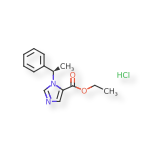
| Stereochemistry | ABSOLUTE |
| Molecular Formula | C14H16N2O2.ClH |
| Molecular Weight | 280.75 |
| Optical Activity | UNSPECIFIED |
| Defined Stereocenters | 1 / 1 |
| E/Z Centers | 0 |
| Charge | 0 |
SHOW SMILES / InChI
SMILES
Cl.CCOC(=O)C1=CN=CN1[C@H](C)C2=CC=CC=C2
InChI
InChIKey=NCDXBSVHIGDPOE-RFVHGSKJSA-N
InChI=1S/C14H16N2O2.ClH/c1-3-18-14(17)13-9-15-10-16(13)11(2)12-7-5-4-6-8-12;/h4-11H,3H2,1-2H3;1H/t11-;/m1./s1
DescriptionCurator's Comment: description was created based on several sources, including
https://www.ncbi.nlm.nih.gov/mesh/68005045 |
https://www.ncbi.nlm.nih.gov/pubmed/21263301 | https://academic.oup.com/bjaed/article/6/2/49/305039/The-molecular-mechanisms-of-general-anaesthesia
Curator's Comment: description was created based on several sources, including
https://www.ncbi.nlm.nih.gov/mesh/68005045 |
https://www.ncbi.nlm.nih.gov/pubmed/21263301 | https://academic.oup.com/bjaed/article/6/2/49/305039/The-molecular-mechanisms-of-general-anaesthesia
Etomidate (AMIDATE®) is an imidazole derivative anesthetic and hypnotic with little effect on blood gases, ventilation, or the cardiovascular system. It is intended for the induction of general anesthesia by intravenous injection. Etomidate (AMIDATE®) is also indicated for the supplementation of subpotent anesthetic agents, such as nitrous oxide in oxygen, during maintenance of anesthesia for short operative procedures such as dilation and curettage or cervical conization. It also produces a unique toxicity among anesthetic drugs - inhibition of adrenal steroid synthesis that far outlasts its hypnotic action and that may reduce survival of critically ill patients. The major molecular targets mediating anesthetic effects of etomidate (AMIDATE®) in the central nervous system are specific gamma-aminobutyric acid (GABA) type A receptor subtypes. The R(+) isomer of etomidate is 10 times more potent than its S(-) isomer at potentiating GABA-A receptor activity.
Approval Year
Targets
| Primary Target | Pharmacology | Condition | Potency |
|---|---|---|---|
| 23.0 µM [EC50] | |||
| 0.7 µM [EC50] |
Conditions
| Condition | Modality | Targets | Highest Phase | Product |
|---|---|---|---|---|
| Primary | AMIDATE Approved UseEtomidate injection, USP is indicated by intravenous injection for the induction of general anesthesia. When considering use of etomidate, the usefulness of its hemodynamic properties (see CLINICAL PHARMACOLOGY) should be weighed against the high frequency of transient skeletal muscle movements (see ADVERSE REACTIONS). Intravenous etomidate is also indicated for the supplementation of subpotent anesthetic agents, such as nitrous oxide in oxygen, during maintenance of anesthesia for short operative procedures such as dilation and curettage or cervical conization. Launch Date1982 |
Cmax
| Value | Dose | Co-administered | Analyte | Population |
|---|---|---|---|---|
87 ng/mL EXPERIMENT https://pubmed.ncbi.nlm.nih.gov/9447861/ |
25 mg 1 times / day multiple, oral dose: 25 mg route of administration: Oral experiment type: MULTIPLE co-administered: |
ETOMIDATE plasma | Homo sapiens population: HEALTHY age: ADULT sex: FEMALE food status: UNKNOWN |
|
2000 ng/mL |
0.48 mg/kg single, intravenous dose: 0.48 mg/kg route of administration: Intravenous experiment type: SINGLE co-administered: |
ETOMIDATE blood | Homo sapiens population: HEALTHY age: ADULT sex: FEMALE / MALE food status: UNKNOWN |
AUC
| Value | Dose | Co-administered | Analyte | Population |
|---|---|---|---|---|
3263 ng × min/mL EXPERIMENT https://pubmed.ncbi.nlm.nih.gov/9447861/ |
25 mg 1 times / day multiple, oral dose: 25 mg route of administration: Oral experiment type: MULTIPLE co-administered: |
ETOMIDATE plasma | Homo sapiens population: HEALTHY age: ADULT sex: FEMALE food status: UNKNOWN |
T1/2
| Value | Dose | Co-administered | Analyte | Population |
|---|---|---|---|---|
75 min EXPERIMENT https://pubmed.ncbi.nlm.nih.gov/9447861/ |
25 mg 1 times / day multiple, oral dose: 25 mg route of administration: Oral experiment type: MULTIPLE co-administered: |
ETOMIDATE plasma | Homo sapiens population: HEALTHY age: ADULT sex: FEMALE food status: UNKNOWN |
|
324 min |
0.48 mg/kg single, intravenous dose: 0.48 mg/kg route of administration: Intravenous experiment type: SINGLE co-administered: |
ETOMIDATE blood | Homo sapiens population: HEALTHY age: ADULT sex: FEMALE / MALE food status: UNKNOWN |
Funbound
| Value | Dose | Co-administered | Analyte | Population |
|---|---|---|---|---|
25% |
ETOMIDATE plasma | Homo sapiens |
PubMed
| Title | Date | PubMed |
|---|---|---|
| Prevention of etomidate-induced myoclonus: which is superior: Fentanyl, midazolam, or a combination? A Retrospective comparative study. | 2014-02-16 |
|
| Etomidate deteriorates the toxicity of advanced glycation end products to human endothelial Eahy926 cells. | 2014 |
|
| GABAA receptor open-state conformation determines non-competitive antagonist binding. | 2011-02-01 |
|
| Does lidocaine more effectively prevent pain upon induction with propofol or etomidate when given preemptively than when mixed with the drug? | 2010-11 |
|
| Reducing myoclonus after etomidate. | 1999-01 |
|
| An unexpected arousal effect of etomidate in a patient on high-dose steroids. | 1998-12 |
|
| Vascular effects of etomidate administered for electroencephalographic burst suppression in humans. | 1998-10 |
|
| Anesthesia sensitivity in mice that lack the beta3 subunit of the gamma-aminobutyric acid type A receptor. | 1998-03 |
|
| Cerebral hypoxia after etomidate administration and temporary cerebral artery occlusion. | 1997-10 |
|
| Propylene glycol toxicity caused by prolonged infusion of etomidate. | 1995-10 |
|
| Focal cerebral ischemia during anesthesia with etomidate, isoflurane, or thiopental: a comparison of the extent of cerebral injury. | 1995-10 |
|
| Propylene glycol toxicity following continuous etomidate infusion for the control of refractory cerebral edema. | 1995-08 |
|
| Total intravenous anesthesia for children undergoing brief diagnostic or therapeutic procedures. | 1995-06 |
|
| Acute toxicosis in two dogs associated with etomidate-propylene glycol infusion. | 1994-12 |
|
| Excitatory effects and electroencephalographic correlation of etomidate, thiopental, methohexital, and propofol. | 1993-11 |
|
| [Etomidate using a new solubilizer. Experimental clinical studies on venous tolerance and bioavailability]. | 1990-10 |
|
| [Anesthesia for cardioversion. A comparison of propofol and etomidate]. | 1990-05-01 |
|
| [The modification of injection pain and the incidence of thrombophlebitis following etomidate]. | 1990-01 |
|
| [A new formulation of etomidate in lipid emulsion--bioavailability and venous provocation]. | 1989-08 |
|
| Cardiovascular instability following bolus dose of etomidate. | 1989-05 |
|
| Etomidate infusions for the control of refractory status epilepticus. | 1989 |
|
| Generalised seizures after etomidate anaesthesia. | 1988-09 |
|
| Use of etomidate for elective cardioversion. | 1988-04 |
|
| Respiratory disturbance during recovery from etomidate anaesthesia. | 1988-01 |
|
| Vecuronium induced bradycardia following induction of anaesthesia with etomidate or thiopentone, with or without fentanyl. | 1988-01 |
|
| Hypertension during anaesthesia with monoamine oxidase inhibitors. | 1987-06 |
|
| [Fentanyl in the prevention of etomidate-induced myoclonus]. | 1987-05-01 |
|
| Angioneurotic oedema following etomidate/lignocaine. | 1987-03 |
|
| [Increase in somatosensory evoked potentials during anesthesia induction with etomidate]. | 1986-06 |
|
| [Increased tendency to seizures as affected by long-term infusions of etomidate in delirium tremens]. | 1985-09 |
|
| Myoclonus on recovery from etomidate. | 1985-09 |
|
| Etomidate versus thiopental for induction of anesthesia. | 1985-09 |
|
| Prolonged myoclonus after etomidate anesthesia. | 1985-01 |
|
| [Alfentanil in routine clinical use. A study of 50 patients]. | 1985-01 |
|
| Venous reactions following etomidate. | 1984-08 |
|
| Alfentanil in minor gynaecological surgery: use with etomidate and a comparison with halothane. | 1984-08 |
|
| Venous sequelae following the injection of etomidate or thiopentone i.v. | 1984-02 |
|
| The prevention of etomidate-induced myoclonus. | 1984-01 |
|
| Cardiac complications during use of etomidate. | 1983-12 |
|
| [Etomidate in Intralipid. A solution for pain-free injection]. | 1983-10 |
|
| Epileptiform seizures during prolonged etomidate sedation. | 1983-08-27 |
|
| The safety of etomidate: a new intravenous anaesthetic induction agent. | 1983-06 |
|
| Pain and myoclonus during induction with etomidate. A double-blind, controlled evaluation of the influence of droperidol and fentanyl. | 1981 |
|
| Etomidate: a foreshortened clinical trial. | 1980-11 |
|
| Venous complications after intravenous injection of diazepam, flunitrazepam, thiopentone and etomidate. | 1980-06 |
|
| Effect of premedication on etomidate anaesthesia. | 1979-12 |
|
| Comparison of etomidate in combination with fentanyl or diazepam, with thiopentone as an induction agent for general anaesthesia. | 1979-12 |
|
| Etomidate in a new solvent. A clinical evaluation. | 1977-11-01 |
|
| Respiratory effects of etomidate. | 1977-03 |
|
| Total intravenous anesthesia with etomidate. III. Some observations in adults. | 1977 |
Sample Use Guides
Etomidate (AMIDATE®) is intended for administration only by the intravenous route. The dose for induction of anesthesia in adult patients will vary between 0.2 and 0.6 mg/kg of body weight, and it must be individualized in each case. The usual dose for induction in these patients is 0.3 mg/kg, injected over a period of 30 to 60 seconds.
Route of Administration:
Intravenous
The effect of etomidate on GABA-A receptor function was studied in cultured rat hippocampal neurons. At a clinically relevant concentration of 4.1 microM, etomidate shifts the GABA dose response to the left (ED50 shift from 10.2 to 5.2 microM), with no change in the maximum current evoked by saturating concentrations of GABA. At a higher concentration of 82 microM, etomidate directly induces current in the absence of GABA. Analysis of single channels opened by GABA indicates that 8.2 microM etomidate increases the probability of channels being open 13-fold and increases the effective channel open time two-fold.
| Name | Type | Language | ||
|---|---|---|---|---|
|
Preferred Name | English | ||
|
Common Name | English | ||
|
Systematic Name | English | ||
|
Systematic Name | English |
| Code System | Code | Type | Description | ||
|---|---|---|---|---|---|
|
SUB02046MIG
Created by
admin on Mon Mar 31 19:55:29 GMT 2025 , Edited by admin on Mon Mar 31 19:55:29 GMT 2025
|
PRIMARY | |||
|
258-423-3
Created by
admin on Mon Mar 31 19:55:29 GMT 2025 , Edited by admin on Mon Mar 31 19:55:29 GMT 2025
|
PRIMARY | |||
|
53188-20-8
Created by
admin on Mon Mar 31 19:55:29 GMT 2025 , Edited by admin on Mon Mar 31 19:55:29 GMT 2025
|
PRIMARY | |||
|
198290
Created by
admin on Mon Mar 31 19:55:29 GMT 2025 , Edited by admin on Mon Mar 31 19:55:29 GMT 2025
|
PRIMARY | |||
|
100000088258
Created by
admin on Mon Mar 31 19:55:29 GMT 2025 , Edited by admin on Mon Mar 31 19:55:29 GMT 2025
|
PRIMARY | |||
|
ZUM3W5027S
Created by
admin on Mon Mar 31 19:55:29 GMT 2025 , Edited by admin on Mon Mar 31 19:55:29 GMT 2025
|
PRIMARY |
PARENT (SALT/SOLVATE)
SUBSTANCE RECORD