Details
| Stereochemistry | ACHIRAL |
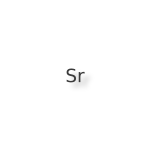
| Molecular Formula | Sr |
| Molecular Weight | 87.62 |
| Optical Activity | NONE |
| Defined Stereocenters | 0 / 0 |
| E/Z Centers | 0 |
| Charge | 0 |
SHOW SMILES / InChI
SMILES
[Sr]
InChI
InChIKey=KJNGJIPPQOFCSK-UHFFFAOYSA-N
InChI=1S/Sr.2H
Strontium is a soft, silver-yellow, alkaline-earth metal, existing either in the elemental state or as the divalent ion. Strontium occurs naturally in the earth's mantle as a mixture of four stable isotopes, i.e. Sr-84, Sr-86, Sr-87, and Sr-88. Of these, Sr-88 is the most prevalent form, comprising about 83% of natural strontium. Natural stable strontium is abundant in the environment and can be found in all plant species. Consuming 75% of production, the primary use for strontium is in glass for color television cathode ray tubes, where it prevents X-ray emission. Acantharea, a relatively large group of marine radiolarian protozoa, produce intricate mineral skeletons composed of strontium sulfate. In biological systems, calcium is substituted in a small extent by strontium. In the human body, most of the absorbed strontium is deposited in the bones. The ratio of strontium to calcium in human bones is between 1:1000 and 1:2000, roughly in the same range as in the blood serum. The human body absorbs strontium as if it were its lighter congener calcium. Because the elements are chemically very similar, stable strontium isotopes do not pose a significant health threat. The average human has an intake of about two milligrams of strontium a day.
Approval Year
PubMed
| Title | Date | PubMed |
|---|---|---|
| Strontium in the environment: Review about reactions of plants towards stable and radioactive strontium isotopes. | 2019-02-25 |
|
| Heavy metal cations permeate the TRPV6 epithelial cation channel. | 2011-01 |
|
| Analysis of 35 inorganic elements in teeth in relation to caries formation. | 2009 |
|
| Characterization and distribution of the selected metals in the scalp hair of cancer patients in comparison with normal donors. | 2007-09 |
|
| Osteoprecursor cell response to strontium-containing hydroxyapatite ceramics. | 2006-12-15 |
|
| Structural studies of human alkaline phosphatase in complex with strontium: implication for its secondary effect in bones. | 2006-07 |
|
| Role of the outer beta-sheet in divalent cation modulation of alpha7 nicotinic receptors. | 2006-07 |
|
| A novel cation-sensing mechanism in osteoblasts is a molecular target for strontium. | 2004-05 |
|
| Elevated levels of ferrimagnetic metals in foodchains supporting the Guam cluster of neurodegeneration: do metal nucleated crystal contaminants [corrected] evoke magnetic fields that initiate the progressive pathogenesis of neurodegeneration? | 2004 |
|
| Diacylglycerol activates the influx of extracellular cations in T-lymphocytes independently of intracellular calcium-store depletion and possibly involving endogenous TRP6 gene products. | 2002-05-15 |
|
| The role of endogenous human Trp4 in regulating carbachol-induced calcium oscillations in HEK-293 cells. | 2002-04-19 |
|
| Dantrolene inhibition of ryanodine receptor Ca2+ release channels. Molecular mechanism and isoform selectivity. | 2001-04-27 |
|
| The transient receptor potential protein homologue TRP6 is the essential component of vascular alpha(1)-adrenoceptor-activated Ca(2+)-permeable cation channel. | 2001-02-16 |
| Name | Type | Language | ||
|---|---|---|---|---|
|
Preferred Name | English | ||
|
Systematic Name | English | ||
|
Common Name | English | ||
|
Common Name | English | ||
|
Common Name | English | ||
|
Common Name | English |
| Classification Tree | Code System | Code | ||
|---|---|---|---|---|
|
DSLD |
144 (Number of products:114)
Created by
admin on Mon Mar 31 19:24:30 GMT 2025 , Edited by admin on Mon Mar 31 19:24:30 GMT 2025
|
||
|
NCI_THESAURUS |
C637
Created by
admin on Mon Mar 31 19:24:30 GMT 2025 , Edited by admin on Mon Mar 31 19:24:30 GMT 2025
|
| Code System | Code | Type | Description | ||
|---|---|---|---|---|---|
|
Strontium
Created by
admin on Mon Mar 31 19:24:30 GMT 2025 , Edited by admin on Mon Mar 31 19:24:30 GMT 2025
|
PRIMARY | |||
|
DTXSID3024312
Created by
admin on Mon Mar 31 19:24:30 GMT 2025 , Edited by admin on Mon Mar 31 19:24:30 GMT 2025
|
PRIMARY | |||
|
35104
Created by
admin on Mon Mar 31 19:24:30 GMT 2025 , Edited by admin on Mon Mar 31 19:24:30 GMT 2025
|
PRIMARY | |||
|
C846
Created by
admin on Mon Mar 31 19:24:30 GMT 2025 , Edited by admin on Mon Mar 31 19:24:30 GMT 2025
|
PRIMARY | |||
|
5359327
Created by
admin on Mon Mar 31 19:24:30 GMT 2025 , Edited by admin on Mon Mar 31 19:24:30 GMT 2025
|
PRIMARY | |||
|
m10235
Created by
admin on Mon Mar 31 19:24:30 GMT 2025 , Edited by admin on Mon Mar 31 19:24:30 GMT 2025
|
PRIMARY | Merck Index | ||
|
YZS2RPE8LE
Created by
admin on Mon Mar 31 19:24:30 GMT 2025 , Edited by admin on Mon Mar 31 19:24:30 GMT 2025
|
PRIMARY | |||
|
7440-24-6
Created by
admin on Mon Mar 31 19:24:30 GMT 2025 , Edited by admin on Mon Mar 31 19:24:30 GMT 2025
|
PRIMARY | |||
|
YZS2RPE8LE
Created by
admin on Mon Mar 31 19:24:30 GMT 2025 , Edited by admin on Mon Mar 31 19:24:30 GMT 2025
|
PRIMARY | |||
|
10122
Created by
admin on Mon Mar 31 19:24:30 GMT 2025 , Edited by admin on Mon Mar 31 19:24:30 GMT 2025
|
PRIMARY | RxNorm | ||
|
D013324
Created by
admin on Mon Mar 31 19:24:30 GMT 2025 , Edited by admin on Mon Mar 31 19:24:30 GMT 2025
|
PRIMARY | |||
|
SUB22920
Created by
admin on Mon Mar 31 19:24:30 GMT 2025 , Edited by admin on Mon Mar 31 19:24:30 GMT 2025
|
PRIMARY | |||
|
33324
Created by
admin on Mon Mar 31 19:24:30 GMT 2025 , Edited by admin on Mon Mar 31 19:24:30 GMT 2025
|
PRIMARY | |||
|
100000086900
Created by
admin on Mon Mar 31 19:24:30 GMT 2025 , Edited by admin on Mon Mar 31 19:24:30 GMT 2025
|
PRIMARY | |||
|
2545
Created by
admin on Mon Mar 31 19:24:30 GMT 2025 , Edited by admin on Mon Mar 31 19:24:30 GMT 2025
|
PRIMARY | |||
|
231-133-4
Created by
admin on Mon Mar 31 19:24:30 GMT 2025 , Edited by admin on Mon Mar 31 19:24:30 GMT 2025
|
PRIMARY |
ACTIVE MOIETY