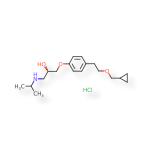
Details
| Stereochemistry | ABSOLUTE |
| Molecular Formula | C18H29NO3.ClH |
| Molecular Weight | 343.889 |
| Optical Activity | UNSPECIFIED |
| Defined Stereocenters | 1 / 1 |
| E/Z Centers | 0 |
| Charge | 0 |
SHOW SMILES / InChI
SMILES
Cl.CC(C)NC[C@@H](O)COC1=CC=C(CCOCC2CC2)C=C1
InChI
InChIKey=CHDPSNLJFOQTRK-UNTBIKODSA-N
InChI=1S/C18H29NO3.ClH/c1-14(2)19-11-17(20)13-22-18-7-5-15(6-8-18)9-10-21-12-16-3-4-16;/h5-8,14,16-17,19-20H,3-4,9-13H2,1-2H3;1H/t17-;/m1./s1
Betaxolol is a competitive, beta(1)-selective (cardioselective) adrenergic antagonist. Betaxolol is used to treat hypertension, arrhythmias, coronary heart disease, glaucoma, and is also used to reduce non-fatal cardiac events in patients with heart failure. (R)-Betaxolol (Dextrobetaxolol) is the R-isomer of Betaxolol (B328000), a cardioselective β1-adrenergic blocker. It is also an antihypertensive and antiglaucoma agent. Dextrobetaxolol had a much weaker affinity at both b1 and b2 receptors than levobetaxolol. Levobetaxolol (Kb=6 nM at b1 and Kb=39 nM at b2 receptors) more potently inhibited functional activities in cells expressing human recombinant b1 and b2 receptors than
dextrobetaxolol (Kb=350 and 278 nM, respectively). Likewise, levobetaxolol was a more potent antagonist in isolated tissues than dextrobetaxolol. In functional assays in cultured human NPE cells levobetaxolol (Ki =16.4 nM) was a potent antagonist of isoproterenol-induced cAMP production with dextrobetaxolol (Ki =2.9 uM) being considerably weaker than the latter antagonist. In ocular hypertensive cynomolgus monkeys, levobetaxolol was more effective at reducing IOP than dextrobetaxolol. The results of the study of the pharmacokinetic behavior of the R and S enantiomers of betaxolol following iv and oral administration of the racemate to healthy male subjects failed to reveal any important difference between the pharmacokinetics of the R and S enantiomer of betaxolol. Thus, the pharmacokinetic behavior of racemic betaxolol accurately reflects the behavior of betaxolol enantiomers in this subject group.
Approval Year
Targets
| Primary Target | Pharmacology | Condition | Potency |
|---|---|---|---|
Target ID: CHEMBL213 |
280.0 nM [Ki] |
Conditions
| Condition | Modality | Targets | Highest Phase | Product |
|---|---|---|---|---|
| Primary | BETAXOLOL HYDROCHLORIDE Approved UseBetaxolol hydrochloride is indicated in the management of hypertension. It may be used alone or
concomitantly with other antihypertensive agents, particularly thiazide-type diuretics. Launch Date1989 |
Cmax
| Value | Dose | Co-administered | Analyte | Population |
|---|---|---|---|---|
48.5 ng/mL EXPERIMENT https://pubmed.ncbi.nlm.nih.gov/2879735/ |
10 mg single, intravenous dose: 10 mg route of administration: Intravenous experiment type: SINGLE co-administered: |
BETAXOLOL blood | Homo sapiens population: HEALTHY age: ADULT sex: FEMALE / MALE food status: FASTED |
|
42.6 ng/mL EXPERIMENT https://pubmed.ncbi.nlm.nih.gov/2879735/ |
20 mg single, oral dose: 20 mg route of administration: Oral experiment type: SINGLE co-administered: |
BETAXOLOL blood | Homo sapiens population: HEALTHY age: ADULT sex: FEMALE / MALE food status: FASTED |
|
41 ng/mL EXPERIMENT https://pubmed.ncbi.nlm.nih.gov/1865331/ |
10 mg single, oral dose: 10 mg route of administration: Oral experiment type: SINGLE co-administered: |
BETAXOLOL, (R)- blood | Homo sapiens population: HEALTHY age: ADULT sex: MALE food status: FASTED |
AUC
| Value | Dose | Co-administered | Analyte | Population |
|---|---|---|---|---|
692 ng × h/mL EXPERIMENT https://pubmed.ncbi.nlm.nih.gov/2879735/ |
10 mg single, intravenous dose: 10 mg route of administration: Intravenous experiment type: SINGLE co-administered: |
BETAXOLOL blood | Homo sapiens population: HEALTHY age: ADULT sex: FEMALE / MALE food status: FASTED |
|
1033 ng × h/mL EXPERIMENT https://pubmed.ncbi.nlm.nih.gov/2879735/ |
20 mg single, oral dose: 20 mg route of administration: Oral experiment type: SINGLE co-administered: |
BETAXOLOL blood | Homo sapiens population: HEALTHY age: ADULT sex: FEMALE / MALE food status: FASTED |
|
314 μg × h/mL EXPERIMENT https://pubmed.ncbi.nlm.nih.gov/1865331/ |
10 mg single, intravenous dose: 10 mg route of administration: Intravenous experiment type: SINGLE co-administered: |
BETAXOLOL, (R)- blood | Homo sapiens population: HEALTHY age: ADULT sex: MALE food status: FASTED |
|
1077 μg × h/mL EXPERIMENT https://pubmed.ncbi.nlm.nih.gov/1865331/ |
10 mg single, oral dose: 10 mg route of administration: Oral experiment type: SINGLE co-administered: |
BETAXOLOL, (R)- blood | Homo sapiens population: HEALTHY age: ADULT sex: MALE food status: FASTED |
T1/2
| Value | Dose | Co-administered | Analyte | Population |
|---|---|---|---|---|
16.4 h EXPERIMENT https://pubmed.ncbi.nlm.nih.gov/2879735/ |
10 mg single, intravenous dose: 10 mg route of administration: Intravenous experiment type: SINGLE co-administered: |
BETAXOLOL blood | Homo sapiens population: HEALTHY age: ADULT sex: FEMALE / MALE food status: FASTED |
|
16.8 h EXPERIMENT https://pubmed.ncbi.nlm.nih.gov/2879735/ |
20 mg single, oral dose: 20 mg route of administration: Oral experiment type: SINGLE co-administered: |
BETAXOLOL blood | Homo sapiens population: HEALTHY age: ADULT sex: FEMALE / MALE food status: FASTED |
Funbound
| Value | Dose | Co-administered | Analyte | Population |
|---|---|---|---|---|
51% EXPERIMENT https://pubmed.ncbi.nlm.nih.gov/2892848/ |
BETAXOLOL plasma | Homo sapiens |
PubMed
| Title | Date | PubMed |
|---|---|---|
| Betaxolol attenuates retinal ischemia/reperfusion damage in the rat. | 2003-10-27 |
|
| Inner retinal neurons display differential responses to N-methyl-D-aspartate receptor activation. | 2003-10-06 |
|
| Beneficial effects of betaxolol, a selective antagonist of beta-1 adrenoceptors, on exercise-induced myocardial ischemia in patients with coronary vasospasm. | 2003-10 |
|
| Discriminative stimulus properties of antidepressant agents: a review. | 2003-09 |
|
| Betaxolol-induced deterioration of asthma and a pharmacodynamic analysis based on beta-receptor occupancy. | 2003-08 |
|
| Randomized clinical trial of topical betaxolol for persistent macular edema after vitrectomy and epiretinal membrane removal. | 2003-08 |
|
| Patient persistency with pharmacotherapy in the management of glaucoma. | 2003-07 |
|
| Medical therapy cost considerations for glaucoma. | 2003-07 |
|
| Role of epinephrine stimulation of CNS alpha1-adrenoceptors in motor activity in mice. | 2003-07 |
|
| Activation of beta1-adrenoceptors excites striatal cholinergic interneurons through a cAMP-dependent, protein kinase-independent pathway. | 2003-06-15 |
|
| Effects of commercial antiglaucoma drugs to glutamate-induced [Ca2+)]i increase in cultured neuroblastoma cells. | 2003-06 |
|
| Measuring visual field progression in the Early Manifest Glaucoma Trial. | 2003-06 |
|
| The effect of topical glaucoma medications evaluated by perimetry. | 2003-06 |
|
| Influence of topical betaxolol and timolol on visual field in Japanese open-angle glaucoma patients. | 2003-05-10 |
|
| Effects of betaxolol and flunarizine on visual fields and intraocular pressure in patients with migraine. | 2003-05 |
|
| The beta-adrenoceptor antagonists metipranolol and timolol are retinal neuroprotectants: comparison with betaxolol. | 2003-04 |
|
| Change in endothelial nitric oxide synthase in the rat retina following transient ischemia. | 2003-03-03 |
|
| Results of the betaxolol versus placebo treatment trial in ocular hypertension. | 2003-03 |
|
| Iganidipine, a new water-soluble Ca2+ antagonist: ocular and periocular penetration after instillation. | 2003-03 |
|
| Pharmacological characterization of putative beta1-beta2-adrenergic receptor heterodimers. | 2003-02 |
|
| Readability of ocular medication inserts. | 2003-02 |
|
| Atrial fibrillation in chronic dialysis patients in the United States: risk factors for hospitalization and mortality. | 2003-01-24 |
|
| Effects of beta-adrenergic blockers on glutamate-induced calcium signals in adult mouse retinal ganglion cells. | 2003-01-03 |
|
| Betaxolol improves the survival rate and changes natriuretic peptide expression in rats with heart failure. | 2003-01 |
|
| Effects of the beta1-selective adrenergic antagonist betaxolol on electroretinography in the perfused cat eye. | 2003-01 |
|
| Factors for glaucoma progression and the effect of treatment: the early manifest glaucoma trial. | 2003-01 |
|
| [Betaxolol for prevention of steroid induced intraocular pressure elevations in patients after radial keratotomy]. | 2003 |
|
| Delaying glaucoma. | 2002-12 |
|
| To treat or not to treat? That is the question. | 2002-12 |
|
| Betaxolol, a beta1-adrenoceptor antagonist, protects a transient ischemic injury of the retina. | 2002-11 |
|
| [Human trabecular cells and apoptosis: in vitro evaluation of the effect of betaxolol with or without preservative]. | 2002-10 |
|
| Effect of betaxolol on aspartate aminotransferase activity in hypoxic rat retina in vitro. | 2002-10 |
|
| Progression of retinal nerve fibre layer damage in betaxolol- and timolol-treated glaucoma patients. | 2002-10 |
|
| Expectations from clinical trials: results of the Early Manifest Glaucoma Trial. | 2002-10 |
|
| Reduction of intraocular pressure and glaucoma progression: results from the Early Manifest Glaucoma Trial. | 2002-10 |
|
| Changing antiglaucoma therapy from timolol to betaxolol: effect on ocular blood flow. | 2002-09-30 |
|
| Nitric oxide synthase expression in the transient ischemic rat retina: neuroprotection of betaxolol. | 2002-09-27 |
|
| Sympathetic control of accommodation: evidence for inter-subject variation. | 2002-09 |
|
| Effect of beta-adrenoceptor antagonists on autonomic control of ciliary smooth muscle. | 2002-09 |
|
| Effect of treatment by medicine or surgery on intraocular pressure and pulsatile ocular blood flow in normal-pressure glaucoma. | 2002-09 |
|
| Generation and analysis of constitutively active and physically destabilized mutants of the human beta(1)-adrenoceptor. | 2002-09 |
|
| Rates of discontinuation and change of glaucoma therapy in a managed care setting. | 2002-08 |
|
| Comparison of the neuroprotective effects of adrenoceptor drugs in retinal cell culture and intact retina. | 2002-08 |
|
| Effects of antidepressants in rats trained to discriminate centrally administered isoproterenol. | 2002-08 |
|
| Ocular drug delivery using 20-kHz ultrasound. | 2002-06 |
|
| (-)-Isoproterenol modulation of maxi-K(+) channel in nonpigmented ciliary epithelial cells through a G-protein gated pathway. | 2002-03 |
|
| [Neuroprotective effect of Betoptic S-considerations after 18 months of treatment]. | 2002 |
|
| [Evaluation of vascular risk factors in primary open-angle glaucoma using doppler sonography]. | 2002 |
|
| [Autonomic nervous system function and effects of beta-adrenoblockers on heart rhythm variability in patients with myocardial infarction]. | 2002 |
|
| Does glaucoma medication influence the diameter of the retinal arteriole in the human eye? (A pilot study using the retinal vessel analyser). | 2001 |
Patents
Sample Use Guides
In Vivo Use Guide
Curator's Comment: Topical use: in ocular hypertensive cynomolgus monkeys, levobetaxolol was more effective at reducing IOP than (R)-Betaxolol (Dextrobetaxolol). In a crossover study, a single dose of 150 mg/eye of levobetaxolol reduced IOP by a maximum of 25.9% whereas the same dose of dextrobetaxolol reduced IOP by only 15.5%.
Hypertension: Oral: Initial: 10 mg once daily; may increase dose to 20 mg daily after 7 to 14 days if desired response is not achieved. Increasing the dose beyond 20 mg daily has not been shown to produce further antihypertensive effect.
Route of Administration:
Oral
Levobetaxolol (Kb=6 nM at b1 and Kb=39 nM at b2 receptors) more potently inhibited functional activities in cells expressing human recombinant b1 and b2 receptors than dextrobetaxolol (Kb=350 and 278 nM, respectively). In functional assays in cultured human NPE cells levobetaxolol (Ki =16.4 nM) was a potent antagonist of isoproterenol-induced cAMP production with dextrobetaxolol (Ki =2.9 uM) being considerably weaker than the latter antagonist.
| Name | Type | Language | ||
|---|---|---|---|---|
|
Preferred Name | English | ||
|
Common Name | English | ||
|
Systematic Name | English |
| Code System | Code | Type | Description | ||
|---|---|---|---|---|---|
|
WKM694DUG8
Created by
admin on Mon Mar 31 23:14:14 GMT 2025 , Edited by admin on Mon Mar 31 23:14:14 GMT 2025
|
PRIMARY | |||
|
DTXSID90873205
Created by
admin on Mon Mar 31 23:14:14 GMT 2025 , Edited by admin on Mon Mar 31 23:14:14 GMT 2025
|
PRIMARY | |||
|
12937007
Created by
admin on Mon Mar 31 23:14:14 GMT 2025 , Edited by admin on Mon Mar 31 23:14:14 GMT 2025
|
PRIMARY | |||
|
91878-54-5
Created by
admin on Mon Mar 31 23:14:14 GMT 2025 , Edited by admin on Mon Mar 31 23:14:14 GMT 2025
|
PRIMARY |
SUBSTANCE RECORD