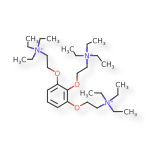
Details
| Stereochemistry | ACHIRAL |
| Molecular Formula | C30H60N3O3 |
| Molecular Weight | 510.8157 |
| Optical Activity | NONE |
| Defined Stereocenters | 0 / 3 |
| E/Z Centers | 0 |
| Charge | 3 |
SHOW SMILES / InChI
SMILES
CC[N+](CC)(CC)CCOC1=CC=CC(OCC[N+](CC)(CC)CC)=C1OCC[N+](CC)(CC)CC
InChI
InChIKey=OZLPUNFFCJDMJD-UHFFFAOYSA-N
InChI=1S/C30H60N3O3/c1-10-31(11-2,12-3)22-25-34-28-20-19-21-29(35-26-23-32(13-4,14-5)15-6)30(28)36-27-24-33(16-7,17-8)18-9/h19-21H,10-18,22-27H2,1-9H3/q+3
Gallamine triethiodide is a synthetic nondepolarizing blocking drug, which is allosteric antagonist of muscarinic M2 acetylcholine receptor and inhibitor of acetylcholinesterase. It was used under brand name flaxedil to stabilize muscle contractions during surgical procedures. However, this usage was discontinued. It was shown, that gallamine caused tachycardia by depressing the vagus nerve and, occasionally, hypertension and increased cardiac output.
CNS Activity
Originator
Approval Year
Targets
| Primary Target | Pharmacology | Condition | Potency |
|---|---|---|---|
Target ID: P08172 Gene ID: 1129.0 Gene Symbol: CHRM2 Target Organism: Homo sapiens (Human) |
|||
Target ID: P22303|||Q53F46 Gene ID: 43.0 Gene Symbol: ACHE Target Organism: Homo sapiens (Human) |
Conditions
| Condition | Modality | Targets | Highest Phase | Product |
|---|---|---|---|---|
| Curative | FLAXEDIL Approved UseUnknown |
T1/2
| Value | Dose | Co-administered | Analyte | Population |
|---|---|---|---|---|
143.78 min EXPERIMENT https://pubmed.ncbi.nlm.nih.gov/7371705/ |
2 mg/kg single, intravenous dose: 2 mg/kg route of administration: Intravenous experiment type: SINGLE co-administered: |
GALLAMINE plasma | Homo sapiens population: UNHEALTHY age: ADULT sex: UNKNOWN food status: FASTED |
|
155.58 min EXPERIMENT https://pubmed.ncbi.nlm.nih.gov/7371705/ |
2 mg/kg 2 times / day multiple, intravenous dose: 2 mg/kg route of administration: Intravenous experiment type: MULTIPLE co-administered: |
GALLAMINE plasma | Homo sapiens population: UNHEALTHY age: ADULT sex: UNKNOWN food status: FASTED |
Doses
| Dose | Population | Adverse events |
|---|---|---|
40 mg single, intrathecal Accidental dose Dose: 40 mg Route: intrathecal Route: single Dose: 40 mg Sources: |
unhealthy, 33 years |
Other AEs: Convulsions... |
6 mg/kg single, intravenous Highest studied dose Dose: 6 mg/kg Route: intravenous Route: single Dose: 6 mg/kg Sources: |
unhealthy |
|
100 mg single, intravenous Dose: 100 mg Route: intravenous Route: single Dose: 100 mg Sources: |
unhealthy |
Other AEs: Ventricular tachycardia... |
AEs
| AE | Significance | Dose | Population |
|---|---|---|---|
| Convulsions | 40 mg single, intrathecal Accidental dose Dose: 40 mg Route: intrathecal Route: single Dose: 40 mg Sources: |
unhealthy, 33 years |
|
| Ventricular tachycardia | 100 mg single, intravenous Dose: 100 mg Route: intravenous Route: single Dose: 100 mg Sources: |
unhealthy |
PubMed
| Title | Date | PubMed |
|---|---|---|
| Interactions of orthosteric and allosteric ligands with [3H]dimethyl-W84 at the common allosteric site of muscarinic M2 receptors. | 2003-07 |
|
| Pharmacological comparison of the cloned human and rat M2 muscarinic receptor genes expressed in the murine fibroblast (B82) cell line. | 1998-02 |
|
| Detection, quantitation, and verification of allosteric interactions of agents with labeled and unlabeled ligands at G protein-coupled receptors: interactions of strychnine and acetylcholine at muscarinic receptors. | 1995-08 |
|
| The inhibitory effect of gallamine on muscarinic receptors. | 1976-11 |
Patents
Sample Use Guides
The mechanisms of action of gallamine on nerve terminals, cholinergic receptors, and the threshold for propagation of end-plate potentials to the muscle fiber were investigated in rat phrenic nerve-diaphragm preparations. Intracellular studies were made with glass microelectrodes to determine changes in end-plate potentials and miniature end-plate potentials produced by gallamine at concentrations between 10(-7) M to 10(-4) M. Gallamine excited and then depressed the release of transmitter from nerve terminals.
| Name | Type | Language | ||
|---|---|---|---|---|
|
Preferred Name | English | ||
|
Common Name | English | ||
|
Systematic Name | English |
| Code System | Code | Type | Description | ||
|---|---|---|---|---|---|
|
3450
Created by
admin on Mon Mar 31 18:27:30 GMT 2025 , Edited by admin on Mon Mar 31 18:27:30 GMT 2025
|
PRIMARY | |||
|
VYJ027LZ05
Created by
admin on Mon Mar 31 18:27:30 GMT 2025 , Edited by admin on Mon Mar 31 18:27:30 GMT 2025
|
PRIMARY | |||
|
DTXSID5048392
Created by
admin on Mon Mar 31 18:27:30 GMT 2025 , Edited by admin on Mon Mar 31 18:27:30 GMT 2025
|
PRIMARY | |||
|
7006-17-9
Created by
admin on Mon Mar 31 18:27:30 GMT 2025 , Edited by admin on Mon Mar 31 18:27:30 GMT 2025
|
PRIMARY |
ACTIVE MOIETY