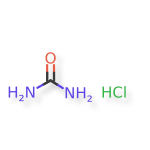
Details
| Stereochemistry | ACHIRAL |
| Molecular Formula | CH4N2O.ClH |
| Molecular Weight | 96.516 |
| Optical Activity | NONE |
| Defined Stereocenters | 0 / 0 |
| E/Z Centers | 0 |
| Charge | 0 |
SHOW SMILES / InChI
SMILES
Cl.NC(N)=O
InChI
InChIKey=VYWQTJWGWLKBQA-UHFFFAOYSA-N
InChI=1S/CH4N2O.ClH/c2-1(3)4;/h(H4,2,3,4);1H
Pastaron (Urea) is a waste product of many living organisms, and is the major organic component of human urine. It is a very important starting material in a number of chemical syntheses, and is used on an industrial scale for the manufacture of fertilizers, pharmaceuticals, and resins. Urea is an osmotic diuretic similar to mannitol but more irritant. Applied topically, urea promotes hydration of keratin and mild keratolysis in dry skin. It increases water uptake by the stratum corneum and has an antipruritic effect. Pastaron is used to soften rough or dry skin caused by skin conditions such as eczema, psoriasis, keratosis, and others.
CNS Activity
Approval Year
Targets
| Primary Target | Pharmacology | Condition | Potency |
|---|---|---|---|
Target ID: GO:0030104 |
Conditions
| Condition | Modality | Targets | Highest Phase | Product |
|---|---|---|---|---|
| Palliative | UREAPHIL Approved UsePastaron is used topically to treat hyperkeratotic conditions such as dry, rough skin, ichthyosis (rough, thick, and scaly skin), skin cracks and fissures, dermatitis (inflammation of skin), eczema, psoriasis, keratosis (rough, scaly patch on skin) and calluses (hard and thickened area on skin, especially hands or feet). Launch Date1966 |
|||
| Palliative | UREAPHIL Approved UsePastaron is used topically to treat hyperkeratotic conditions such as dry, rough skin, ichthyosis (rough, thick, and scaly skin), skin cracks and fissures, dermatitis (inflammation of skin), eczema, psoriasis, keratosis (rough, scaly patch on skin) and calluses (hard and thickened area on skin, especially hands or feet). Launch Date1966 |
|||
| Palliative | UREAPHIL Approved UsePastaron is used topically to treat hyperkeratotic conditions such as dry, rough skin, ichthyosis (rough, thick, and scaly skin), skin cracks and fissures, dermatitis (inflammation of skin), eczema, psoriasis, keratosis (rough, scaly patch on skin) and calluses (hard and thickened area on skin, especially hands or feet). Launch Date1966 |
PubMed
| Title | Date | PubMed |
|---|---|---|
| Selective inactivation of guanine-nucleotide-binding regulatory protein (G-protein) alpha and betagamma subunits by urea. | 2001-03-01 |
|
| Molecular characterization of a novel urea transporter from kidney inner medullary collecting ducts. | 2001-03 |
|
| Urea sensitizes mIMCD3 cells to heat shock-induced apoptosis: protection by NaCl. | 2001-03 |
|
| The impact of urea on viscosity of hydroxethyl cellulose and observed mobility of deoxyribonucleic acids. | 2001-03 |
|
| Evaluation of a novel vitamin E coated cellulosic membrane hollow fiber dialyzer. | 2001-02-24 |
|
| A Gaussian statistical mechanical model for the equilibrium thermodynamics of barnase folding. | 2001-02-23 |
|
| Predicting the kinetics of peptide-antibody interactions using a multivariate experimental design of sequence and chemical space. | 2001-02-17 |
|
| [Clinical value of urinary biochemical parameters]. | 2001-02-15 |
|
| Do urea and sodium chloride together increase the efficacy of moisturisers for atopic dermatitis Skin? A comparative, double-blind and randomised study. | 2001-02-15 |
|
| Cisplatin pharmacokinetics and its nephrotoxicity in diabetic rabbits. | 2001-02-15 |
|
| Determination of macromolecular folding and structure by synchrotron x-ray radiolysis techniques. | 2001-02-15 |
|
| Structural stabilization of [2Fe-2S] ferredoxin from Halobacterium salinarum. | 2001-02-06 |
|
| The combination ace-inhibitors plus canreonate in patients with anterior myocardial infarction: safety and tolerability study. | 2001-02 |
|
| Physiological and molecular characterization of urea transport by the gills of the Lake Magadi tilapia (Alcolapia grahami). | 2001-02 |
|
| Renal replacement therapy and secondary hyperoxalemia in chronic renal failure. | 2001-02 |
|
| Protein-bound uremic solutes: the forgotten toxins. | 2001-02 |
|
| DNA damage of lymphocytes in experimental chronic renal failure: beneficial effects of losartan. | 2001-02 |
|
| Carbamoylation of amino acids and proteins in uremia. | 2001-02 |
|
| Role of nitric oxide in the synthesis of guanidinosuccinic acid, an activator of the N-methyl-D-aspartate receptor. | 2001-02 |
|
| Increased reduction of dimethylarginines and lowered interdialytic blood pressure by the use of biocompatible membranes. | 2001-02 |
|
| Urea-induced inducible nitric oxide synthase inhibition and macrophage proliferation. | 2001-02 |
|
| How to determine ionic dialysance for the online assessment of delivered dialysis dose. | 2001-02 |
|
| Changing hemodialysis thresholds for optimal survival. | 2001-02 |
|
| Functional glucocorticoid receptors in the mesonephros of the ovine fetus. | 2001-02 |
|
| Urea is a product of ureidoglycolate degradation in chickpea. Purification and characterization of the ureidoglycolate urea-lyase. | 2001-02 |
|
| Quantification of benzoic, phenylacetic, and phenylbutyric acids from filter-paper blood spots by gas chromatography--mass spectrometry with stable isotope dilution. | 2001-02 |
|
| Plasma transforming growth factor beta(1) and platelet activation: implications for studies in transplant recipients. | 2001-02 |
|
| Localization of the RAR interaction domain of cellular retinoic acid binding protein-II. | 2001-01-26 |
|
| Intestinal fatty acid binding protein: the folding mechanism as determined by NMR studies. | 2001-01-23 |
|
| Mapping the energy surface for the folding reaction of the coiled-coil peptide GCN4-p1. | 2001-01-23 |
|
| Canine parvovirus capsid assembly and differences in mammalian and insect cells. | 2001-01-20 |
|
| Synthesis and comparative molecular field analysis (CoMFA) of symmetric and nonsymmetric cyclic sulfamide HIV-1 protease inhibitors. | 2001-01-18 |
|
| Effect of some enhancers on the permeation of haloperidol through rat skin in vitro. | 2001-01-16 |
|
| N-(Hydroxyaminocarbonyl)phenylalanine: a novel class of inhibitor for carboxypeptidase A. | 2001-01 |
|
| An approach to the sensitivity of temperature-gradient gel electrophoresis in the detection of clonally expanded T-cells in cutaneous T-cell lymphoma. | 2001-01 |
|
| Evaluation of serological markers for the immunodiagnosis of acute acquired toxoplasmosis. | 2001-01 |
|
| Antipseudomonal antibiotics. | 2001-01 |
|
| Leaf ureide degradation and N(2) fixation tolerance to water deficit in soybean. | 2001-01 |
|
| Glucose appearance rate after the ingestion of galactose. | 2001-01 |
|
| Evaluation of fish models of soluble epoxide hydrolase inhibition. | 2001-01 |
|
| Effect of denaturants on the emulsifying activity of proteins. | 2001-01 |
|
| Improvement of metabolic performance of cultured hepatocytes by high oxygen tension in the atmosphere. | 2001-01 |
|
| The capsaicin analogue SDZ249-665 attenuates the hyper-reflexia and referred hyperalgesia associated with inflammation of the rat urinary bladder. | 2001-01 |
|
| In search of susceptibility genes for type 2 diabetes in West Africa: the design and results of the first phase of the AADM study. | 2001-01 |
|
| Influence of nutritional factors and hemodialysis adequacy on the survival of 1,610 French patients. | 2001-01 |
|
| The complexity of simplicity. | 2001 |
|
| Investigating the reaction of a novel silica capillary coating compound with proteins/peptides by matrix-assisted laser desorption/ionisation time-of-flight mass spectrometry. | 2001 |
|
| Diagnostic accuracy of (13)C-urea breath test in the diagnosis of Helicobacter pylori infection in patients with partial gastric resection due to peptic ulcer disease: a prospective multicenter study. | 2001 |
|
| High density culturing of porcine hepatocytes immobilized on nonwoven polyurethane-based biomatrices. | 2001 |
|
| Characterization of nuclear factors binding to AT-rich element in the rat p53 promoter. | 2001 |
Patents
Sample Use Guides
Applied to the affected area one or several times a day.
Route of Administration:
Topical
Endometrial explants were cultured and treated with 0, 4, 8, 12, 16 mM of urea. Relative FGF2 gene expression was less in explants treated with a greater concentration of urea (16mM) when compared with lesser concentrations. Expression of HSPA1A, IGFBP3, and SERPINA14 genes was greater in explants exposed to lesser concentrations of urea (4mM). Greater concentrations of urea have negative effects on some endometrial gene expression, while moderate concentrations have positive effects.
| Name | Type | Language | ||
|---|---|---|---|---|
|
Preferred Name | English | ||
|
Systematic Name | English | ||
|
Common Name | English | ||
|
Common Name | English | ||
|
Systematic Name | English |
| Code System | Code | Type | Description | ||
|---|---|---|---|---|---|
|
m11322
Created by
admin on Mon Mar 31 17:48:07 GMT 2025 , Edited by admin on Mon Mar 31 17:48:07 GMT 2025
|
PRIMARY | Merck Index | ||
|
208-059-6
Created by
admin on Mon Mar 31 17:48:07 GMT 2025 , Edited by admin on Mon Mar 31 17:48:07 GMT 2025
|
PRIMARY | |||
|
100000077335
Created by
admin on Mon Mar 31 17:48:07 GMT 2025 , Edited by admin on Mon Mar 31 17:48:07 GMT 2025
|
PRIMARY | |||
|
506-89-8
Created by
admin on Mon Mar 31 17:48:07 GMT 2025 , Edited by admin on Mon Mar 31 17:48:07 GMT 2025
|
PRIMARY | |||
|
DTXSID6060139
Created by
admin on Mon Mar 31 17:48:07 GMT 2025 , Edited by admin on Mon Mar 31 17:48:07 GMT 2025
|
PRIMARY | |||
|
1862866
Created by
admin on Mon Mar 31 17:48:07 GMT 2025 , Edited by admin on Mon Mar 31 17:48:07 GMT 2025
|
PRIMARY | |||
|
SUB15663MIG
Created by
admin on Mon Mar 31 17:48:07 GMT 2025 , Edited by admin on Mon Mar 31 17:48:07 GMT 2025
|
PRIMARY | |||
|
RCE1061F6A
Created by
admin on Mon Mar 31 17:48:07 GMT 2025 , Edited by admin on Mon Mar 31 17:48:07 GMT 2025
|
PRIMARY | |||
|
RCE1061F6A
Created by
admin on Mon Mar 31 17:48:07 GMT 2025 , Edited by admin on Mon Mar 31 17:48:07 GMT 2025
|
PRIMARY | |||
|
101721
Created by
admin on Mon Mar 31 17:48:07 GMT 2025 , Edited by admin on Mon Mar 31 17:48:07 GMT 2025
|
PRIMARY |
SUBSTANCE RECORD