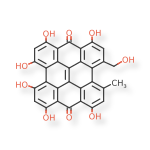
Details
| Stereochemistry | ACHIRAL |
| Molecular Formula | C30H16O9 |
| Molecular Weight | 520.4426 |
| Optical Activity | NONE |
| Defined Stereocenters | 0 / 0 |
| E/Z Centers | 0 |
| Charge | 0 |
SHOW SMILES / InChI
SMILES
CC1=CC(O)=C2C(=O)C3=C(O)C=C(O)C4=C3C5=C6C7=C(C(O)=CC(O)=C47)C(=O)C8=C6C(=C(CO)C=C8O)C1=C25
InChI
InChIKey=YXBUQQDFTYOHQI-UHFFFAOYSA-N
InChI=1S/C30H16O9/c1-7-2-9(32)19-23-15(7)16-8(6-31)3-10(33)20-24(16)28-26-18(12(35)5-14(37)22(26)30(20)39)17-11(34)4-13(36)21(29(19)38)25(17)27(23)28/h2-5,31-37H,6H2,1H3
Pseudohypericin is a predominant naphthodianthrone from St. John’s wort (Hypericum perforatum L.) phytomedicinal drug. It has been shown to specifically inhibit protein kinase C and dopamine-β-hydroxylase. Also, pseudohypericin induces apoptosis and selectively antagonizes corticotropin-releasing factor in murine models. Inhibition of thioredoxin system by pseudohypericin showed appreciable anticancer properties of this natural compound. Pseudohypericin has antiretroviral activity, it has potential therapeutic value in diseases such as AIDS. Pseudohypericin is implicated in the antidepressant efficacy of St. John's wort.
Originator
Approval Year
Targets
| Primary Target | Pharmacology | Condition | Potency |
|---|---|---|---|
Target ID: CHEMBL2094266 |
|||
Target ID: CHEMBL3102 |
3.0 µM [IC50] | ||
Target ID: map04210 |
|||
Target ID: CHEMBL1800 |
|||
Target ID: CHEMBL6035 |
4.4 µM [IC50] | ||
Target ID: CHEMBL5086 |
7.45 µM [IC50] |
Conditions
| Condition | Modality | Targets | Highest Phase | Product |
|---|---|---|---|---|
| Primary | Unknown Approved UseUnknown |
|||
| Primary | Unknown Approved UseUnknown |
|||
| Primary | Unknown Approved UseUnknown |
Cmax
| Value | Dose | Co-administered | Analyte | Population |
|---|---|---|---|---|
2.7 ng/mL EXPERIMENT https://pubmed.ncbi.nlm.nih.gov/7857509 |
526 μg single, oral dose: 526 μg route of administration: Oral experiment type: SINGLE co-administered: |
PSEUDOHYPERICIN plasma | Homo sapiens population: HEALTHY age: ADULT sex: MALE food status: FASTED |
|
30.6 ng/mL EXPERIMENT https://pubmed.ncbi.nlm.nih.gov/7857509 |
3156 μg single, oral dose: 3156 μg route of administration: Oral experiment type: SINGLE co-administered: |
PSEUDOHYPERICIN plasma | Homo sapiens population: HEALTHY age: ADULT sex: MALE food status: FASTED |
|
11.7 ng/mL EXPERIMENT https://pubmed.ncbi.nlm.nih.gov/7857509 |
1578 μg single, oral dose: 1578 μg route of administration: Oral experiment type: SINGLE co-administered: |
PSEUDOHYPERICIN plasma | Homo sapiens population: HEALTHY age: ADULT sex: MALE food status: FASTED |
AUC
| Value | Dose | Co-administered | Analyte | Population |
|---|---|---|---|---|
1900 ng × min/mL EXPERIMENT https://pubmed.ncbi.nlm.nih.gov/7857509 |
526 μg single, oral dose: 526 μg route of administration: Oral experiment type: SINGLE co-administered: |
PSEUDOHYPERICIN plasma | Homo sapiens population: HEALTHY age: ADULT sex: MALE food status: FASTED |
|
19910 ng × min/mL EXPERIMENT https://pubmed.ncbi.nlm.nih.gov/7857509 |
3156 μg single, oral dose: 3156 μg route of administration: Oral experiment type: SINGLE co-administered: |
PSEUDOHYPERICIN plasma | Homo sapiens population: HEALTHY age: ADULT sex: MALE food status: FASTED |
|
7130 ng × min/mL EXPERIMENT https://pubmed.ncbi.nlm.nih.gov/7857509 |
1578 μg single, oral dose: 1578 μg route of administration: Oral experiment type: SINGLE co-administered: |
PSEUDOHYPERICIN plasma | Homo sapiens population: HEALTHY age: ADULT sex: MALE food status: FASTED |
T1/2
| Value | Dose | Co-administered | Analyte | Population |
|---|---|---|---|---|
16.3 h EXPERIMENT https://pubmed.ncbi.nlm.nih.gov/7857509 |
526 μg single, oral dose: 526 μg route of administration: Oral experiment type: SINGLE co-administered: |
PSEUDOHYPERICIN plasma | Homo sapiens population: HEALTHY age: ADULT sex: MALE food status: FASTED |
|
22.8 h EXPERIMENT https://pubmed.ncbi.nlm.nih.gov/7857509 |
3156 μg single, oral dose: 3156 μg route of administration: Oral experiment type: SINGLE co-administered: |
PSEUDOHYPERICIN plasma | Homo sapiens population: HEALTHY age: ADULT sex: MALE food status: FASTED |
|
36 h EXPERIMENT https://pubmed.ncbi.nlm.nih.gov/7857509 |
1578 μg single, oral dose: 1578 μg route of administration: Oral experiment type: SINGLE co-administered: |
PSEUDOHYPERICIN plasma | Homo sapiens population: HEALTHY age: ADULT sex: MALE food status: FASTED |
PubMed
| Title | Date | PubMed |
|---|---|---|
| Synthesis of phenolics and flavonoids in ginger (Zingiber officinale Roscoe) and their effects on photosynthesis rate. | 2010-11-15 |
|
| Secondary metabolites of Hypericum confertum and their possible chemotaxonomic significance. | 2010-06 |
|
| Determination of enantiomerization barriers of hypericin and pseudohypericin by dynamic high-performance liquid chromatography on immobilized polysaccharide-type chiral stationary phases and off-column racemization experiments. | 2010-05-15 |
|
| Effect of St. John's Wort (Hypericum perforatum) treatment on restraint stress-induced behavioral and biochemical alteration in mice. | 2010-05-07 |
|
| Chemical constituents and antidepressant activity of the new species Hypericum enshiense occurring in China. | 2010-05 |
|
| Radical scavenging and antioxidant activities of methanolic extracts from Hypericum species growing in Bulgaria. | 2010-04 |
|
| Antidepressants are a rational complementary therapy for the treatment of Alzheimer's disease. | 2010-03-12 |
|
| Hypericins as potential leads for new therapeutics. | 2010-02-04 |
|
| Matrix-free UV-laser desorption/ionization (LDI) mass spectrometric imaging at the single-cell level: distribution of secondary metabolites of Arabidopsis thaliana and Hypericum species. | 2009-12 |
|
| St. John's wort components and the brain: uptake, concentrations reached and the mechanisms underlying pharmacological effects. | 2009-11 |
|
| LC-MS and LC-PDA analysis of Hypericum empetrifolium and Hypericum sinaicum. | 2009-10-02 |
|
| Identification of light-independent inhibition of human immunodeficiency virus-1 infection through bioguided fractionation of Hypericum perforatum. | 2009-07-13 |
|
| Positive correlations between hypericin and putative precursors detected in the quantitative secondary metabolite spectrum of Hypericum. | 2009-07 |
|
| Rapid and efficient purification of naphthodianthrones from St. John's wort extract by using liquid-liquid extraction and SEC. | 2009-05 |
|
| Study of active naphtodianthrone St John's Wort compounds by electrospray ionization Fourier transform ion cyclotron resonance and multi-stage mass spectrometry in sustained off-resonance irradiation collision-induced dissociation and infrared multiphoton dissociation modes. | 2009-03 |
|
| Chemical constituents of Hypericum adenotrichum Spach, an endemic Turkish species. | 2009 |
|
| Variation of hypericins in Hypericum triquetrifolium Turra growing in different locations of Turkey during plant growth. | 2008-12 |
|
| Influence of the habitat altitude on the (proto)hypericin and (proto)pseudohypericin levels of hypericum plants from Crete. | 2008-10 |
|
| Pseudohypericin is necessary for the light-activated inhibition of prostaglandin E2 pathways by a 4 component system mimicking an Hypericum perforatum fraction. | 2008-09 |
|
| Antiinflammatory and antioxidant activity of Hypericum rumeliacum Boiss. subsp. apollinis (Boiss. & Heldr.) Robson & Strid methanol extract. | 2008-06 |
|
| Pseudohypericin and hyperforin in Hypericum perforatum from Northern Turkey: variation among populations, plant parts and phenological stages. | 2008-05 |
|
| Hypericin inhibits pathological retinal neovascularization in a mouse model of oxygen-induced retinopathy. | 2008-02-04 |
|
| 1H NMR determination of hypericin and pseudohypericin in complex natural mixtures by the use of strongly deshielded OH groups. | 2008-01-28 |
|
| Influence of the developmental stage on the (proto)-hypericin and (proto)pseudohypericin levels of Hypericum plants from Crete. | 2007-10 |
|
| Inhibition of prostaglandin E(2) production by anti-inflammatory hypericum perforatum extracts and constituents in RAW264.7 Mouse Macrophage Cells. | 2007-09-05 |
|
| Simultaneous determination of total hypericin and hyperforin in St. John's wort extracts by HPLC with electrochemical detection. | 2007-05-16 |
|
| Topical anti-inflammatory activity of extracts and compounds from Hypericum perforatum L. | 2007-05 |
|
| The main components of St John's Wort inhibit low-density lipoprotein atherogenic modification: a beneficial "side effect" of an OTC antidepressant drug? | 2007-02 |
|
| Identification of the major constituents of Hypericum perforatum by LC/SPE/NMR and/or LC/MS. | 2007-02 |
|
| The production of hypericins in two selected Hypericum perforatum shoot cultures is related to differences in black gland structure. | 2007-01 |
|
| In silico prediction of pregnane X receptor activators by machine learning approaches. | 2007-01 |
|
| St. John's wort: role of active compounds for its mechanism of action and efficacy. | 2007 |
|
| [The influence of some elicitors on growth and morphogenesis of Hypericum perforatum callus cultures]. | 2006-12-16 |
|
| Plant-environment interactions: Accumulation of hypericin in dark glands of Hypericum perforatum. | 2006-10 |
|
| Single and multiple dose pharmacokinetics of maritime pine bark extract (pycnogenol) after oral administration to healthy volunteers. | 2006-08-03 |
|
| A high-performance liquid chromatography with electrochemical detection for the determination of total hypericin in extracts of St. John's Wort. | 2006-06-06 |
|
| Dietary supplements and sports performance: herbals. | 2006-06-05 |
|
| Development and evaluation of methods for determination of naphthodianthrones and flavonoids in St. John's wort. | 2006-05-19 |
|
| Comparison of methods for the exhaustive extraction of hypericins, flavonoids, and hyperforin from Hypericum perforatum L. | 2006-04-05 |
|
| Induction of hypericins in Hypericum perforatum in response to chromium. | 2006-04 |
|
| Simultaneous determination of protopseudohypericin, pseudohypericin, protohypericin, and hypericin without light exposure. | 2006-03-11 |
|
| Phytochemical analysis and genetic characterization of six Hypericum species from Serbia. | 2006-01 |
|
| Hypericum perforatum: a 'modern' herbal antidepressant: pharmacokinetics of active ingredients. | 2006 |
|
| Investigation of the effect on photosensitivity following multiple oral dosing of two different hypericum extracts in healthy men. | 2006 |
|
| Antidepressant-like components of Hypericum perforatum extracts: an overview of their pharmacokinetics and metabolism. | 2005-12 |
|
| Quantitative analysis of the major constituents of St John's wort with HPLC-ESI-MS. | 2005-12 |
|
| The lipophilic extract of Hypericum perforatum exerts significant cytotoxic activity against T24 and NBT-II urinary bladder tumor cells. | 2005-11 |
|
| Temperature stress can alter the photosynthetic efficiency and secondary metabolite concentrations in St. John's wort. | 2005-04-15 |
|
| Studies of the mechanisms of action of the antiretroviral agents hypericin and pseudohypericin. | 1989-08 |
|
| Therapeutic agents with dramatic antiretroviral activity and little toxicity at effective doses: aromatic polycyclic diones hypericin and pseudohypericin. | 1988-07 |
Patents
Sample Use Guides
Mice: Intravenous - 50 ug solubilized in 100% EtOH and diluted to 1% in PBS.
Intraperitoneal - 40, 80 or 120 ug
Route of Administration:
Other
Incubation of radiation leukemia virus (RadLV)-infected B1O.T(6R) thymoma cells (10 ml of cells at a concentration of 10^5/ml) with 10 ug/ml of pseudohypericin drastically reduced detectable reverse transcriptase (RT) activity from the growth media immediately after incubation of the cells with pseudohypericin. Pseudohypericin does not directly inhibit RT, however, as incubation of it directly with purified RT alone had no effect on the enzyme activity. These results suggest that virus particles are directly affected.
| Name | Type | Language | ||
|---|---|---|---|---|
|
Common Name | English | ||
|
Preferred Name | English | ||
|
Common Name | English | ||
|
Systematic Name | English |
| Code System | Code | Type | Description | ||
|---|---|---|---|---|---|
|
55954-61-5
Created by
admin on Mon Mar 31 20:17:20 GMT 2025 , Edited by admin on Mon Mar 31 20:17:20 GMT 2025
|
PRIMARY | |||
|
8107
Created by
admin on Mon Mar 31 20:17:20 GMT 2025 , Edited by admin on Mon Mar 31 20:17:20 GMT 2025
|
PRIMARY | |||
|
MQ0U4663ZO
Created by
admin on Mon Mar 31 20:17:20 GMT 2025 , Edited by admin on Mon Mar 31 20:17:20 GMT 2025
|
PRIMARY | |||
|
C056602
Created by
admin on Mon Mar 31 20:17:20 GMT 2025 , Edited by admin on Mon Mar 31 20:17:20 GMT 2025
|
PRIMARY | |||
|
DTXSID00204541
Created by
admin on Mon Mar 31 20:17:20 GMT 2025 , Edited by admin on Mon Mar 31 20:17:20 GMT 2025
|
PRIMARY | |||
|
5281751
Created by
admin on Mon Mar 31 20:17:20 GMT 2025 , Edited by admin on Mon Mar 31 20:17:20 GMT 2025
|
PRIMARY | |||
|
Pseudohypericin
Created by
admin on Mon Mar 31 20:17:20 GMT 2025 , Edited by admin on Mon Mar 31 20:17:20 GMT 2025
|
PRIMARY |
SUBSTANCE RECORD