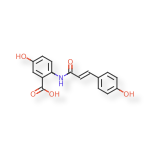
Details
| Stereochemistry | ACHIRAL |
| Molecular Formula | C16H13NO5 |
| Molecular Weight | 299.2781 |
| Optical Activity | NONE |
| Defined Stereocenters | 0 / 0 |
| E/Z Centers | 1 |
| Charge | 0 |
SHOW SMILES / InChI
SMILES
OC(=O)C1=CC(O)=CC=C1NC(=O)\C=C\C2=CC=C(O)C=C2
InChI
InChIKey=QGUMNWHANDITDB-FPYGCLRLSA-N
InChI=1S/C16H13NO5/c18-11-4-1-10(2-5-11)3-8-15(20)17-14-7-6-12(19)9-13(14)16(21)22/h1-9,18-19H,(H,17,20)(H,21,22)/b8-3+
Avenanthramides are a group of phenolic alkaloids found mainly in oats, but also in butterfly eggs (Pieris brassicae and Pieris rapae), and fungal infected carnation (Dianthus caryophyllus). Avenanthramides demonstrate anti-inflammatory, antioxidant, anti-itch, anti-irritant, and antiatherogenic activities. Avenanthramide is considered the active component in a number of skin care products based on colloidal oatmeal; a traditional treatment which was approved by the FDA in 2003. Dietary supplementation with foods enriched in Avenantramides has been studied for the potential to reduce systemic inflammation. Avenanthramides have also been studied in cell models for osteoporosis and cancer.
Approval Year
Targets
| Primary Target | Pharmacology | Condition | Potency |
|---|---|---|---|
Target ID: P19838 Gene ID: 4790.0 Gene Symbol: NFKB1 Target Organism: Homo sapiens (Human) |
Conditions
| Condition | Modality | Targets | Highest Phase | Product |
|---|---|---|---|---|
| Primary | Unknown Approved UseUnknown |
|||
| Primary | colloidal oatmeal Approved Usecolloidal oatmeal is approved for prompt temporary relief of itchy, sore,
sensitive skin due to rashes, eczema/psoriasis, hemorrhoidal and
genital irritations, diaper rash, chicken pox, prickly heat, hives,
poison ivy/oak, and sunburn. Launch Date2013 |
|||
| Primary | Unknown Approved UseUnknown |
Cmax
| Value | Dose | Co-administered | Analyte | Population |
|---|---|---|---|---|
374.6 nM EXPERIMENT https://pubmed.ncbi.nlm.nih.gov/17513394/ |
154 μmol single, oral dose: 154 μmol route of administration: Oral experiment type: SINGLE co-administered: |
AVENANTHRAMIDE A plasma | Homo sapiens population: HEALTHY age: ADULT sex: FEMALE / MALE food status: UNKNOWN |
|
112.9 nM EXPERIMENT https://pubmed.ncbi.nlm.nih.gov/17513394/ |
77 μmol single, oral dose: 77 μmol route of administration: Oral experiment type: SINGLE co-administered: |
AVENANTHRAMIDE A plasma | Homo sapiens population: HEALTHY age: ADULT sex: FEMALE / MALE food status: UNKNOWN |
AUC
| Value | Dose | Co-administered | Analyte | Population |
|---|---|---|---|---|
1501 nM × h EXPERIMENT https://pubmed.ncbi.nlm.nih.gov/17513394/ |
154 μmol single, oral dose: 154 μmol route of administration: Oral experiment type: SINGLE co-administered: |
AVENANTHRAMIDE A plasma | Homo sapiens population: HEALTHY age: ADULT sex: FEMALE / MALE food status: UNKNOWN |
|
394 nM × h EXPERIMENT https://pubmed.ncbi.nlm.nih.gov/17513394/ |
77 μmol single, oral dose: 77 μmol route of administration: Oral experiment type: SINGLE co-administered: |
AVENANTHRAMIDE A plasma | Homo sapiens population: HEALTHY age: ADULT sex: FEMALE / MALE food status: UNKNOWN |
T1/2
| Value | Dose | Co-administered | Analyte | Population |
|---|---|---|---|---|
2 h EXPERIMENT https://pubmed.ncbi.nlm.nih.gov/17513394/ |
154 μmol single, oral dose: 154 μmol route of administration: Oral experiment type: SINGLE co-administered: |
AVENANTHRAMIDE A plasma | Homo sapiens population: HEALTHY age: ADULT sex: FEMALE / MALE food status: UNKNOWN |
|
1.5 h EXPERIMENT https://pubmed.ncbi.nlm.nih.gov/17513394/ |
77 μmol single, oral dose: 77 μmol route of administration: Oral experiment type: SINGLE co-administered: |
AVENANTHRAMIDE A plasma | Homo sapiens population: HEALTHY age: ADULT sex: FEMALE / MALE food status: UNKNOWN |
PubMed
| Title | Date | PubMed |
|---|---|---|
| Rapid quantitation of avenanthramides in oat-containing products by high-performance liquid chromatography coupled with triple quadrupole mass spectrometry (HPLC-TQMS). | 2017-06-01 |
|
| Avenanthramides Prevent Osteoblast and Osteocyte Apoptosis and Induce Osteoclast Apoptosis in Vitro in an Nrf2-Independent Manner. | 2016-07-11 |
|
| In vitro total antioxidant capacity and anti-inflammatory activity of three common oat-derived avenanthramides. | 2014-10-01 |
|
| Mechanism of action and clinical benefits of colloidal oatmeal for dermatologic practice. | 2010-09 |
|
| Potential health benefits of avenanthramides of oats. | 2009-12 |
|
| Avenanthramides and phenolic acids from oats are bioavailable and act synergistically with vitamin C to enhance hamster and human LDL resistance to oxidation. | 2004-06 |
Sample Use Guides
Women aged 50 - 80 years were given two cookies enriched with 9.2 mg avenanthramide (per two cookies) daily for 8 weeks. Before and after consuming the cookies the women walked downhill on a treadmill for 4 bouts of 15 min. Blood samples were collected before and after supplementation at rest and 24 post walking, and 48 hours post walking. Chronis supplementation was observed to decrease inflammation and increased blood-borne antioxidant defense in menopausal women.
Route of Administration:
Oral
Adherent primary osteoblastic C57BL/6 wild-type and Nrf2 knock-out (KO) cells were cultured in a medium of alpha-Minimum Essential Medium Eagle (MEM) with 10% fetal bovine serum (FBS), 1% penicillin/streptomycin, and 50 mg/mL normocin. Adherent OB-6 osteoblastic cells were grown in alpha-MEM with 10% FBS, and 1% penicillin/streptomycin and 50 mg/mL normocin. Non-adherent cells were grown in alpha-MEM with 10% FBS and 1% penicillin/streptomycin, and 80 ng/mL of recombinant murine soluble Receptor Activator for Nuclear Factor κB Ligand (sRANKL) and 20 ng/mL recombinant murine Macrophage Colony Stimulating Factor (M-CSF). Cells were treated for 24 hours with 1 microM Avenathramide 2p. Mature osteoclasts were examined for viability and activity of the osteoclast-specific enzyme TRAPase using a commercial TRAPase staining kit. Avenanthramide 2p (AVA-2p) increased COL1A expression in OB-6 cells. In MLO-Y4 cells, AVA-2p increased the expression of RANKL. Even at low doses, AVA-2p blocks the etoposide-induced apoptosis of osteoblastic cells, and one hour of pre-treatment prevents dexamethasone or H2O2 induced OB-6 and MLO-Y4 cell death.
| Name | Type | Language | ||
|---|---|---|---|---|
|
Preferred Name | English | ||
|
Common Name | English | ||
|
Systematic Name | English | ||
|
Common Name | English |
| Code System | Code | Type | Description | ||
|---|---|---|---|---|---|
|
108605-70-5
Created by
admin on Mon Mar 31 20:37:32 GMT 2025 , Edited by admin on Mon Mar 31 20:37:32 GMT 2025
|
PRIMARY | |||
|
5281157
Created by
admin on Mon Mar 31 20:37:32 GMT 2025 , Edited by admin on Mon Mar 31 20:37:32 GMT 2025
|
PRIMARY | |||
|
G1I8LE060C
Created by
admin on Mon Mar 31 20:37:32 GMT 2025 , Edited by admin on Mon Mar 31 20:37:32 GMT 2025
|
PRIMARY | |||
|
DTXSID801316626
Created by
admin on Mon Mar 31 20:37:32 GMT 2025 , Edited by admin on Mon Mar 31 20:37:32 GMT 2025
|
PRIMARY |
SUBSTANCE RECORD