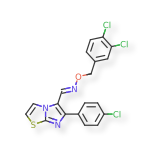
Details
| Stereochemistry | ACHIRAL |
| Molecular Formula | C19H12Cl3N3OS |
| Molecular Weight | 436.742 |
| Optical Activity | NONE |
| Defined Stereocenters | 0 / 0 |
| E/Z Centers | 1 |
| Charge | 0 |
SHOW SMILES / InChI
SMILES
ClC1=CC=C(C=C1)C2=C(\C=N\OCC3=CC(Cl)=C(Cl)C=C3)N4C=CSC4=N2
InChI
InChIKey=ZQWBOKJVVYNKTL-AUEPDCJTSA-N
InChI=1S/C19H12Cl3N3OS/c20-14-4-2-13(3-5-14)18-17(25-7-8-27-19(25)24-18)10-23-26-11-12-1-6-15(21)16(22)9-12/h1-10H,11H2/b23-10+
6-(4-chlorophenyl)imidazo(2,1-b)(1,3)thiazole-5-carbaldehyde O-(3,4-dichlorobenzyl)oxime (CITCO) is a novel potent and selective agonist for the human orphan nuclear receptor CAR (constitutive androstane receptor). CITCO displayed an EC50 of 49 nM in a CAR FRET assay and showed 50-fold selectivity for CAR over PXR. CITCO displayed no activity against a panel of 15 other nuclear receptors at a concentration of 10 µM. In hepatocytes CITCO induced CAR nuclear translocation and induced the CAR target gene CYP2B6. The cell proliferation of several ovarian cell lines expressing CAR significantly increased when CITCO was combined with anticancer agents compared with any anticancer agent alone. The up-regulation of MDR1 and UGT1A1 by anticancer agents was further enhanced in the presence of CITCO. Combination of CITCO with any anticancer agents significantly enhanced CAR-mediated transcription compared with any anticancer agents alone and CAR down-regulation completely inhibited the transcription in the presence of CITCO and/or anticancer agents. Inhibition of CAR pathway could be a novel therapeutic approach for the augmentation of sensitivity to anticancer agents, or to overcome resistance, in the treatment of ovarian cancer. CITCO has being shown to inhibit growth and expansion of brain tumour stem cells. CITCO induced a dose-dependent decrease in growth and expansion of CD133(+) BTSCs as gliospheres in culture. Cell cycle arrest and apoptosis in BTSCs were induced by CITCO, but not in normal astrocytes. Growth of s.c BTSC xenograft in nude mice was also inhibited by CITCO. CITCO inhibits the growth and expansion of BTSCs, suggesting the use of CAR agonists for the treatment of brain tumour.
Originator
Approval Year
PubMed
| Title | Date | PubMed |
|---|---|---|
| Pyrene is a Novel Constitutive Androstane Receptor (CAR) Activator and Causes Hepatotoxicity by CAR. | 2015-10 |
|
| Chrysin, baicalein and galangin are indirect activators of the human constitutive androstane receptor (CAR). | 2015-03-04 |
|
| Allyl isothiocyanate (AITC) inhibits pregnane X receptor (PXR) and constitutive androstane receptor (CAR) activation and protects against acetaminophen- and amiodarone-induced cytotoxicity. | 2015-01 |
|
| Activation of the constitutive androstane receptor inhibits gluconeogenesis without affecting lipogenesis or fatty acid synthesis in human hepatocytes. | 2014-08-15 |
|
| Human receptor activation by aroclor 1260, a polychlorinated biphenyl mixture. | 2014-08-01 |
|
| Phenobarbital and propiconazole toxicogenomic profiles in mice show major similarities consistent with the key role that constitutive androstane receptor (CAR) activation plays in their mode of action. | 2014-07-03 |
|
| Flame retardant BDE-47 effectively activates nuclear receptor CAR in human primary hepatocytes. | 2014-02 |
|
| The human constitutive androstane receptor promotes the differentiation and maturation of hepatic-like cells. | 2013-12-15 |
|
| Evidence for triclosan-induced activation of human and rodent xenobiotic nuclear receptors. | 2013-10 |
|
| Interactions of sesquiterpenes zederone and germacrone with the human cytochrome P450 system. | 2013-09 |
|
| Dual roles of nuclear receptor liver X receptor α (LXRα) in the CYP3A4 expression in human hepatocytes as a positive and negative regulator. | 2013-08-01 |
|
| p38 Mitogen-activated protein kinase regulates nuclear receptor CAR that activates the CYP2B6 gene. | 2013-06 |
|
| Quantitative analysis of the interaction of constitutive androstane receptor with chemicals and steroid receptor coactivator 1 using surface plasmon resonance biosensor systems: a case study of the Baikal seal (Pusa sibirica) and the mouse. | 2013-01 |
|
| TO901317, a potent LXR agonist, is an inverse agonist of CAR. | 2013 |
|
| The orphan nuclear receptor DAX-1 functions as a potent corepressor of the constitutive androstane receptor (NR1I3). | 2012-11 |
|
| Non-coplanar polychlorinated biphenyls (PCBs) are direct agonists for the human pregnane-X receptor and constitutive androstane receptor, and activate target gene expression in a tissue-specific manner. | 2012-08-15 |
|
| Constitutive androstane receptor transactivates the hepatic expression of mouse Dhcr24 and human DHCR24 encoding a cholesterogenic enzyme 24-dehydrocholesterol reductase. | 2012-01-25 |
|
| Transactivation of ABCG2 through a novel cis-element in the distal promoter by constitutive androstane receptor but not pregnane X receptor in human hepatocytes. | 2012-01-15 |
|
| Sudan III dye strongly induces CYP1A1 mRNA expression in HepG2 cells. | 2012-01 |
|
| Triclocarban mediates induction of xenobiotic metabolism through activation of the constitutive androstane receptor and the estrogen receptor alpha. | 2012 |
|
| Use of comprehensive screening methods to detect selective human CAR activators. | 2011-12-15 |
|
| Multi-species analyses of direct activators of the constitutive androstane receptor. | 2011-10 |
|
| Potential role of estradiol and progesterone in insulin resistance through constitutive androstane receptor. | 2011-10 |
|
| Modulation of constitutive androstane receptor (CAR) and pregnane X receptor (PXR) by 6-arylpyrrolo[2,1-d][1,5]benzothiazepine derivatives, ligands of peripheral benzodiazepine receptor (PBR). | 2011-04-25 |
|
| Selective phthalate activation of naturally occurring human constitutive androstane receptor splice variants and the pregnane X receptor. | 2011-04 |
|
| A consecutive three alanine residue insertion mutant of human CAR: a novel CAR ligand screening system in HepG2 cells. | 2010-08 |
|
| Endosulfan induces CYP2B6 and CYP3A4 by activating the pregnane X receptor. | 2010-06-15 |
|
| Regulation of cytochrome P450 2C9 expression in primary cultures of human hepatocytes. | 2009-02-10 |
|
| Preservation of hepatic phenotype in lentiviral-transduced primary human hepatocytes. | 2008-06-17 |
|
| Comparison of immortalized Fa2N-4 cells and human hepatocytes as in vitro models for cytochrome P450 induction. | 2008-06 |
|
| The environmental estrogen, nonylphenol, activates the constitutive androstane receptor. | 2007-08 |
|
| Constitutive androstane receptor (CAR) as a potential sensing biomarker of persistent organic pollutants (POPs) in aquatic mammal: molecular characterization, expression level, and ligand profiling in Baikal seal (Pusa sibirica). | 2006-11 |
|
| Induction of human CYP2A6 is mediated by the pregnane X receptor with peroxisome proliferator-activated receptor-gamma coactivator 1alpha. | 2006-11 |
|
| Human CYP2C8 is transcriptionally regulated by the nuclear receptors constitutive androstane receptor, pregnane X receptor, glucocorticoid receptor, and hepatic nuclear factor 4alpha. | 2005-09 |
|
| Antagonist- and inverse agonist-driven interactions of the vitamin D receptor and the constitutive androstane receptor with corepressor protein. | 2005-09 |
|
| Identification of HMG-CoA reductase inhibitors as activators for human, mouse and rat constitutive androstane receptor. | 2005-07 |
|
| Functional analysis of four naturally occurring variants of human constitutive androstane receptor. | 2005-04-25 |
|
| Meclizine is an agonist ligand for mouse constitutive androstane receptor (CAR) and an inverse agonist for human CAR. | 2004-10 |
Patents
Sample Use Guides
BTSC xenograft in nude mice: The mice were treated intraperitoneally with 25 and 100 mg CITCO in 25 ml DMSO on days 22, 24, 26, 30 and 36 following
xenograft. In vivo treatment with CITCO on days 22, 24, 26, 30 and 36 resulted in a dose-dependent decrease in tumour volume.
Route of Administration:
Intraperitoneal
In Vitro Use Guide
Curator's Comment: Treatment with 2.5 uM CITCO resulted in a significant increase in the transcription of CAR in both T98G–BTSC and U87MG–BTSCs in 48 h. Western blot analyses showed that the T98G and U87MG glioma, and BTSCs
express very low levels of CAR protein that increased significantly
following treatment with 2.5mM CITCO in 48 h. However, higher
concentrations of CITCO (>10 uM) inhibited or abolished CAR
expression in both T98G- and U87MG-derived BTSCs https://www.ncbi.nlm.nih.gov/pubmed/21224854
6-(4-chlorophenyl)imidazo(2,1-b)(1,3)thiazole-5-carbaldehyde O-(3,4-dichlorobenzyl)oxime (CITCO) (50 and 100 nM) induced a concentration-responsive increase in CYP2B6 gene expression in primary human hepatocytes.
| Name | Type | Language | ||
|---|---|---|---|---|
|
Systematic Name | English | ||
|
Preferred Name | English | ||
|
Systematic Name | English | ||
|
Systematic Name | English | ||
|
Systematic Name | English |
| Code System | Code | Type | Description | ||
|---|---|---|---|---|---|
|
338404-52-7
Created by
admin on Mon Mar 31 22:41:24 GMT 2025 , Edited by admin on Mon Mar 31 22:41:24 GMT 2025
|
NON-SPECIFIC STEREOCHEMISTRY | |||
|
DTXSID4040761
Created by
admin on Mon Mar 31 22:41:24 GMT 2025 , Edited by admin on Mon Mar 31 22:41:24 GMT 2025
|
PRIMARY | |||
|
9600409
Created by
admin on Mon Mar 31 22:41:24 GMT 2025 , Edited by admin on Mon Mar 31 22:41:24 GMT 2025
|
PRIMARY | |||
|
D77H8321PB
Created by
admin on Mon Mar 31 22:41:24 GMT 2025 , Edited by admin on Mon Mar 31 22:41:24 GMT 2025
|
PRIMARY |