Details
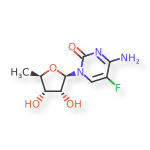
| Stereochemistry | ABSOLUTE |
| Molecular Formula | C9H12FN3O4 |
| Molecular Weight | 245.2077 |
| Optical Activity | UNSPECIFIED |
| Defined Stereocenters | 4 / 4 |
| E/Z Centers | 0 |
| Charge | 0 |
SHOW SMILES / InChI
SMILES
C[C@H]1O[C@H]([C@H](O)[C@@H]1O)N2C=C(F)C(N)=NC2=O
InChI
InChIKey=YSNABXSEHNLERR-ZIYNGMLESA-N
InChI=1S/C9H12FN3O4/c1-3-5(14)6(15)8(17-3)13-2-4(10)7(11)12-9(13)16/h2-3,5-6,8,14-15H,1H3,(H2,11,12,16)/t3-,5-,6-,8-/m1/s1
DescriptionCurator's Comment: description was created based on several sources, including:
http://www.rxlist.com/xeloda-drug.htm
https://www.drugs.com/mtm/capecitabine.html
Curator's Comment: description was created based on several sources, including:
http://www.rxlist.com/xeloda-drug.htm
https://www.drugs.com/mtm/capecitabine.html
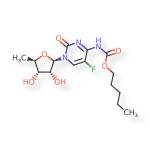
Capecitabine is a fluoropyrimidine carbamate with antineoplastic activity. It is an orally administered systemic prodrug which is converted to 5-fluorouracil (5-FU). Both normal and tumor cells metabolize 5-FU to 5-fluoro-2’-deoxyuridine monophosphate (FdUMP) and 5-fluorouridine triphosphate (FUTP). These metabolites cause cell injury by two different mechanisms. First, FdUMP and the folate cofactor, N5-10-methylenetetrahydrofolate, bind to thymidylate synthase (TS) to form a covalently bound ternary complex. This binding inhibits the formation of thymidylate from 2’-deoxyuridylate. Thymidylate is the necessary precursor of thymidine triphosphate, which is essential for the synthesis of DNA, so that a deficiency of this compound can inhibit cell division. Second, nuclear transcriptional enzymes can mistakenly incorporate FUTP in place of uridine triphosphate (UTP) during the synthesis of RNA. This metabolic error can interfere with RNA processing and protein synthesis. Most common adverse reactions (≥30%) were diarrhea, hand-and-foot syndrome, nausea, vomiting, abdominal pain, fatigue/weakness, and hyperbilirubinemia. The concentration of 5-fluorouracil is increased and its toxicity may be enhanced by leucovorin.
CNS Activity
Curator's Comment: The CNS penetration of 5-FU (Capecitabine is a prodrug that is enzymatically converted to 5-fluorouracil (5-FU) in the body) in human was predicted based on the penetration in preclinical brain tumor, CSF, and human PK and the predicted free CNS concentration was below the antiproliferative potency.
Approval Year
Targets
| Primary Target | Pharmacology | Condition | Potency |
|---|---|---|---|
Target ID: CHEMBL2311222 |
|||
Conditions
| Condition | Modality | Targets | Highest Phase | Product |
|---|---|---|---|---|
| Primary | XELODA Approved UseCapecitabine tablets, USP are a nucleoside metabolic inhibitor with antineoplastic activity indicated for: • Adjuvant Colon Cancer (1.1) oPatients with Dukes’ C colon cancer • Metastatic Colorectal Cancer (1.1) oFirst-line as monotherapy when treatment with fluoropyrimidine therapy alone is preferred • Metastatic Breast Cancer (1.2) oIn combination with docetaxel after failure of prior anthracycline-containing therapy oAs monotherapy in patients resistant to both paclitaxel and an anthracycline-containing regimen 1.1 Colorectal Cancer •Capecitabine tablets, USP are indicated as a single agent for adjuvant treatment in patients with Dukes’ C colon cancer who have undergone complete resection of the primary tumor when treatment with fluoropyrimidine therapy alone is preferred. Capecitabine was non-inferior to 5-fluorouracil and leucovorin (5-FU/LV) for disease-free survival (DFS). Physicians should consider results of combination chemotherapy trials, which have shown improvement in DFS and OS, when prescribing single-agent capecitabine in the adjuvant treatment of Dukes’ C colon cancer. •Capecitabine tablets are indicated as first-line treatment of patients with metastatic colorectal carcinoma when treatment with fluoropyrimidine therapy alone is preferred. Combination chemotherapy has shown a survival benefit compared to 5-FU/LV alone. A survival benefit over 5-FU/LV has not been demonstrated with capecitabine monotherapy. Use of capecitabine instead of 5-FU/LV in combinations has not been adequately studied to assure safety or preservation of the survival advantage. 1.2 Breast Cancer •Capecitabine tablets, USP in combination with docetaxel are indicated for the treatment of patients with metastatic breast cancer after failure of prior anthracycline-containing chemotherapy. •Capecitabine tablets monotherapy is also indicated for the treatment of patients with metastatic breast cancer resistant to both paclitaxel and an anthracycline-containing chemotherapy regimen or resistant to paclitaxel and for whom further anthracycline therapy is not indicated (e.g., patients who have received cumulative doses of 400 mg/m2 of doxorubicin or doxorubicin equivalents). Resistance is defined as progressive disease while on treatment, with or without an initial response, or relapse within 6 months of completing treatment with an anthracycline-containing adjuvant regimen. Launch Date1998 |
|||
| Primary | XELODA Approved UseCapecitabine tablets, USP are a nucleoside metabolic inhibitor with antineoplastic activity indicated for: • Adjuvant Colon Cancer (1.1) oPatients with Dukes’ C colon cancer • Metastatic Colorectal Cancer (1.1) oFirst-line as monotherapy when treatment with fluoropyrimidine therapy alone is preferred • Metastatic Breast Cancer (1.2) oIn combination with docetaxel after failure of prior anthracycline-containing therapy oAs monotherapy in patients resistant to both paclitaxel and an anthracycline-containing regimen 1.1 Colorectal Cancer •Capecitabine tablets, USP are indicated as a single agent for adjuvant treatment in patients with Dukes’ C colon cancer who have undergone complete resection of the primary tumor when treatment with fluoropyrimidine therapy alone is preferred. Capecitabine was non-inferior to 5-fluorouracil and leucovorin (5-FU/LV) for disease-free survival (DFS). Physicians should consider results of combination chemotherapy trials, which have shown improvement in DFS and OS, when prescribing single-agent capecitabine in the adjuvant treatment of Dukes’ C colon cancer. •Capecitabine tablets are indicated as first-line treatment of patients with metastatic colorectal carcinoma when treatment with fluoropyrimidine therapy alone is preferred. Combination chemotherapy has shown a survival benefit compared to 5-FU/LV alone. A survival benefit over 5-FU/LV has not been demonstrated with capecitabine monotherapy. Use of capecitabine instead of 5-FU/LV in combinations has not been adequately studied to assure safety or preservation of the survival advantage. 1.2 Breast Cancer •Capecitabine tablets, USP in combination with docetaxel are indicated for the treatment of patients with metastatic breast cancer after failure of prior anthracycline-containing chemotherapy. •Capecitabine tablets monotherapy is also indicated for the treatment of patients with metastatic breast cancer resistant to both paclitaxel and an anthracycline-containing chemotherapy regimen or resistant to paclitaxel and for whom further anthracycline therapy is not indicated (e.g., patients who have received cumulative doses of 400 mg/m2 of doxorubicin or doxorubicin equivalents). Resistance is defined as progressive disease while on treatment, with or without an initial response, or relapse within 6 months of completing treatment with an anthracycline-containing adjuvant regimen. Launch Date1998 |
Cmax
| Value | Dose | Co-administered | Analyte | Population |
|---|---|---|---|---|
9105 ng/mL EXPERIMENT https://www.ncbi.nlm.nih.gov/pubmed/24022189 |
1000 mg/m² 2 times / day multiple, oral dose: 1000 mg/m² route of administration: Oral experiment type: MULTIPLE co-administered: |
CAPECITABINE plasma | Homo sapiens population: UNHEALTHY age: ADULT sex: FEMALE / MALE food status: FED |
|
3515 ng/mL EXPERIMENT https://www.ncbi.nlm.nih.gov/pubmed/29948022 |
1250 mg/m² 2 times / day multiple, oral dose: 1250 mg/m² route of administration: Oral experiment type: MULTIPLE co-administered: |
.ALPHA.-FLUORO-.BETA.-ALANINE plasma | Homo sapiens population: UNHEALTHY age: ADULT sex: FEMALE food status: UNKNOWN |
|
3035 ng/mL EXPERIMENT https://www.ncbi.nlm.nih.gov/pubmed/24022189 |
1000 mg/m² 2 times / day multiple, oral dose: 1000 mg/m² route of administration: Oral experiment type: MULTIPLE co-administered: |
CAPECITABINE plasma | Homo sapiens population: UNHEALTHY age: ADULT sex: FEMALE / MALE food status: FED |
AUC
| Value | Dose | Co-administered | Analyte | Population |
|---|---|---|---|---|
10238 ng × h/mL EXPERIMENT https://www.ncbi.nlm.nih.gov/pubmed/24022189 |
1000 mg/m² 2 times / day multiple, oral dose: 1000 mg/m² route of administration: Oral experiment type: MULTIPLE co-administered: |
CAPECITABINE plasma | Homo sapiens population: UNHEALTHY age: ADULT sex: FEMALE / MALE food status: FED |
|
45027 ng × h/mL EXPERIMENT https://www.ncbi.nlm.nih.gov/pubmed/29948022 |
1250 mg/m² 2 times / day multiple, oral dose: 1250 mg/m² route of administration: Oral experiment type: MULTIPLE co-administered: |
.ALPHA.-FLUORO-.BETA.-ALANINE plasma | Homo sapiens population: UNHEALTHY age: ADULT sex: FEMALE food status: UNKNOWN |
|
4098 ng × h/mL EXPERIMENT https://www.ncbi.nlm.nih.gov/pubmed/24022189 |
1000 mg/m² 2 times / day multiple, oral dose: 1000 mg/m² route of administration: Oral experiment type: MULTIPLE co-administered: |
CAPECITABINE plasma | Homo sapiens population: UNHEALTHY age: ADULT sex: FEMALE / MALE food status: FED |
T1/2
| Value | Dose | Co-administered | Analyte | Population |
|---|---|---|---|---|
0.75 h |
1250 mg/m² 2 times / day multiple, oral dose: 1250 mg/m² route of administration: Oral experiment type: MULTIPLE co-administered: |
CAPECITABINE plasma | Homo sapiens population: UNKNOWN age: UNKNOWN sex: UNKNOWN food status: UNKNOWN |
|
0.78 h EXPERIMENT https://www.ncbi.nlm.nih.gov/pubmed/24022189 |
1000 mg/m² 2 times / day multiple, oral dose: 1000 mg/m² route of administration: Oral experiment type: MULTIPLE co-administered: |
CAPECITABINE plasma | Homo sapiens population: UNHEALTHY age: ADULT sex: FEMALE / MALE food status: FED |
|
0.74 h EXPERIMENT https://www.ncbi.nlm.nih.gov/pubmed/24022189 |
1000 mg/m² 2 times / day multiple, oral dose: 1000 mg/m² route of administration: Oral experiment type: MULTIPLE co-administered: |
CAPECITABINE plasma | Homo sapiens population: UNHEALTHY age: ADULT sex: FEMALE / MALE food status: FED |
Funbound
| Value | Dose | Co-administered | Analyte | Population |
|---|---|---|---|---|
40% |
1250 mg/m² 2 times / day multiple, oral dose: 1250 mg/m² route of administration: Oral experiment type: MULTIPLE co-administered: |
CAPECITABINE plasma | Homo sapiens population: UNKNOWN age: UNKNOWN sex: UNKNOWN food status: UNKNOWN |
Doses
| Dose | Population | Adverse events |
|---|---|---|
2500 mg 2 times / day multiple, oral Highest studied dose Dose: 2500 mg, 2 times / day Route: oral Route: multiple Dose: 2500 mg, 2 times / day Sources: |
unhealthy, 34-68 |
DLT: Hand-and-foot syndrome, Diarrhea... Dose limiting toxicities: Hand-and-foot syndrome (grade 3, 28.6%) Sources: Diarrhea (grade 3, 14.29%) |
2000 mg 2 times / day multiple, oral MTD Dose: 2000 mg, 2 times / day Route: oral Route: multiple Dose: 2000 mg, 2 times / day Sources: |
unhealthy, 41-53 |
DLT: Hand-and-foot syndrome... Dose limiting toxicities: Hand-and-foot syndrome (grade 3, 14.29%) Sources: |
1250 mg/m2 2 times / day multiple, oral Recommended Dose: 1250 mg/m2, 2 times / day Route: oral Route: multiple Dose: 1250 mg/m2, 2 times / day Sources: |
unhealthy Health Status: unhealthy Sources: |
Disc. AE: Coagulopathy, Diarrhea... AEs leading to discontinuation/dose reduction: Coagulopathy Sources: Diarrhea Cardiotoxicity Dehydration Renal failure Fetal damage Mucocutaneous disorder (severe) Stevens Johnson syndrome Toxic epidermal necrolysis Hyperbilirubinemia |
AEs
| AE | Significance | Dose | Population |
|---|---|---|---|
| Diarrhea | grade 3, 14.29% DLT |
2500 mg 2 times / day multiple, oral Highest studied dose Dose: 2500 mg, 2 times / day Route: oral Route: multiple Dose: 2500 mg, 2 times / day Sources: |
unhealthy, 34-68 |
| Hand-and-foot syndrome | grade 3, 28.6% DLT |
2500 mg 2 times / day multiple, oral Highest studied dose Dose: 2500 mg, 2 times / day Route: oral Route: multiple Dose: 2500 mg, 2 times / day Sources: |
unhealthy, 34-68 |
| Hand-and-foot syndrome | grade 3, 14.29% DLT |
2000 mg 2 times / day multiple, oral MTD Dose: 2000 mg, 2 times / day Route: oral Route: multiple Dose: 2000 mg, 2 times / day Sources: |
unhealthy, 41-53 |
| Cardiotoxicity | Disc. AE | 1250 mg/m2 2 times / day multiple, oral Recommended Dose: 1250 mg/m2, 2 times / day Route: oral Route: multiple Dose: 1250 mg/m2, 2 times / day Sources: |
unhealthy Health Status: unhealthy Sources: |
| Coagulopathy | Disc. AE | 1250 mg/m2 2 times / day multiple, oral Recommended Dose: 1250 mg/m2, 2 times / day Route: oral Route: multiple Dose: 1250 mg/m2, 2 times / day Sources: |
unhealthy Health Status: unhealthy Sources: |
| Dehydration | Disc. AE | 1250 mg/m2 2 times / day multiple, oral Recommended Dose: 1250 mg/m2, 2 times / day Route: oral Route: multiple Dose: 1250 mg/m2, 2 times / day Sources: |
unhealthy Health Status: unhealthy Sources: |
| Diarrhea | Disc. AE | 1250 mg/m2 2 times / day multiple, oral Recommended Dose: 1250 mg/m2, 2 times / day Route: oral Route: multiple Dose: 1250 mg/m2, 2 times / day Sources: |
unhealthy Health Status: unhealthy Sources: |
| Fetal damage | Disc. AE | 1250 mg/m2 2 times / day multiple, oral Recommended Dose: 1250 mg/m2, 2 times / day Route: oral Route: multiple Dose: 1250 mg/m2, 2 times / day Sources: |
unhealthy Health Status: unhealthy Sources: |
| Hyperbilirubinemia | Disc. AE | 1250 mg/m2 2 times / day multiple, oral Recommended Dose: 1250 mg/m2, 2 times / day Route: oral Route: multiple Dose: 1250 mg/m2, 2 times / day Sources: |
unhealthy Health Status: unhealthy Sources: |
| Renal failure | Disc. AE | 1250 mg/m2 2 times / day multiple, oral Recommended Dose: 1250 mg/m2, 2 times / day Route: oral Route: multiple Dose: 1250 mg/m2, 2 times / day Sources: |
unhealthy Health Status: unhealthy Sources: |
| Stevens Johnson syndrome | Disc. AE | 1250 mg/m2 2 times / day multiple, oral Recommended Dose: 1250 mg/m2, 2 times / day Route: oral Route: multiple Dose: 1250 mg/m2, 2 times / day Sources: |
unhealthy Health Status: unhealthy Sources: |
| Toxic epidermal necrolysis | Disc. AE | 1250 mg/m2 2 times / day multiple, oral Recommended Dose: 1250 mg/m2, 2 times / day Route: oral Route: multiple Dose: 1250 mg/m2, 2 times / day Sources: |
unhealthy Health Status: unhealthy Sources: |
| Mucocutaneous disorder | severe Disc. AE |
1250 mg/m2 2 times / day multiple, oral Recommended Dose: 1250 mg/m2, 2 times / day Route: oral Route: multiple Dose: 1250 mg/m2, 2 times / day Sources: |
unhealthy Health Status: unhealthy Sources: |
PubMed
| Title | Date | PubMed |
|---|---|---|
| Gene expression predicts differential capecitabine metabolism, impacting on both pharmacokinetics and antitumour activity. | 2008-01 |
|
| Hydrolysis of capecitabine to 5'-deoxy-5-fluorocytidine by human carboxylesterases and inhibition by loperamide. | 2005-06 |
|
| Gene expression profiling revealed novel mechanism of action of Taxotere and Furtulon in prostate cancer cells. | 2005-01-18 |
|
| Capecitabine (Xeloda). | 2002-03-20 |
|
| Dear doctor: we really are not sure what dose of capecitabine you should prescribe for your patient. | 2002-03-15 |
|
| Drug combination approved for advanced breast cancer. | 2002-03-08 |
|
| Xeloda. Warning: drug interaction increase bleeding risks. | 2002-03 |
|
| The effect of adjuvant 5'-deoxy-5-fluorouridine in early stage breast cancer patients: results from a multicenter randomized controlled trial. | 2002-03 |
|
| An evolving role for oral fluoropyrimidine drugs. | 2002-02-15 |
|
| Treatment of patients with superficial bladder cancer by intravesical instillation of anticancer drugs plus oral chemotherapy following TUR-Bt: a randomized controlled trial. | 2002-02-12 |
|
| Prediction of the response of colorectal cancer to systemic therapy. | 2002-02 |
|
| Recent development of anti-cancer drugs for treatment of GI malignancies in Japan. | 2002-02 |
|
| Future treatment options with capecitabine in solid tumours. | 2002-02 |
|
| Capecitabine as first-line treatment in colorectal cancer. Pooled data from two large, phase III trials. | 2002-02 |
|
| Clinical experience of capecitabine in metastatic breast cancer. | 2002-02 |
|
| Rational development of capecitabine. | 2002-02 |
|
| [The new chemotherapy of colorectal cancers]. | 2002-01-26 |
|
| Dose-escalating study of capecitabine plus gemcitabine combination therapy in patients with advanced cancer. | 2002-01-15 |
|
| Phase II study of oral capecitabine in patients with advanced or metastatic pancreatic cancer. | 2002-01-01 |
|
| Taxanes and capecitabine in combination: rationale and clinical results. | 2002-01 |
|
| Immunohistochemical variation of human equilibrative nucleoside transporter 1 protein in primary breast cancers. | 2002-01 |
|
| Capecitabine in the treatment of metastatic renal cell carcinoma failing immunotherapy. | 2002-01 |
|
| Incidence and severity of hand-foot syndrome in colorectal cancer patients treated with capecitabine: a single-institution experience. | 2002 |
|
| Hand-foot syndrome associated with short infusions of combination chemotherapy with gemcitabine and vinorelbine. | 2001-12 |
|
| Capecitabine and oxaliplatin in advanced colorectal cancer: a dose-finding study. | 2001-12 |
|
| Phase I trial of capecitabine in combination with interferon alpha in patients with metastatic renal cancer: toxicity and pharmacokinetics. | 2001-12 |
|
| Combination chemotherapy of the taxanes and antimetabolites: its use and limitations. | 2001-12 |
|
| Clinical picture: leopard-like vitiligo with capecitabine. | 2001-11-10 |
|
| From the Food and Drug Administration. | 2001-11-07 |
|
| Oral capecitabine compared with intravenous fluorouracil plus leucovorin in patients with metastatic colorectal cancer: results of a large phase III study. | 2001-11-01 |
|
| Oral versus intravenous fluoropyrimidines for advanced colorectal cancer: by either route, it's all the same. | 2001-11-01 |
|
| An EORTC phase I study of epirubicin in combination with fixed doses of cyclophosphamide and infusional 5-fu (CEF-infu) as primary treatment of large operable or locally advanced/inflammatory breast cancer. | 2001-11 |
|
| Acquisition of human concentrative nucleoside transporter 2 (hcnt2) activity by gene transfer confers sensitivity to fluoropyrimidine nucleosides in drug-resistant leukemia cells. | 2001-11 |
|
| Mucositis as a treatment-limiting side effect in the use of capecitabine for the treatment of metastatic breast cancer. | 2001-11 |
|
| [New therapeutic options in chemotherapy of advanced colorectal cancer]. | 2001-10-15 |
|
| [Coronary insufficiency after an oral intake of capecitabine]. | 2001-10-13 |
|
| Multicenter, Phase II study of capecitabine in taxane-pretreated metastatic breast carcinoma patients. | 2001-10-01 |
|
| Nonsurgical treatment of hepatocellular carcinoma. | 2001-10 |
|
| Recent advances in the use of radiosensitizing nucleosides. | 2001-10 |
|
| [Recent aspects of palliative treatment of metastasized colorectal carcinoma]. | 2001-09-15 |
|
| Randomized, open-label, phase II trial of oral capecitabine (Xeloda) vs. a reference arm of intravenous CMF (cyclophosphamide, methotrexate and 5-fluorouracil) as first-line therapy for advanced/metastatic breast cancer. | 2001-09 |
|
| Capecitabine: a novel agent for the treatment of solid tumors. | 2001-09 |
|
| Capecitabine monotherapy in metastatic colorectal cancer. | 2001-07 |
|
| Capecitabine in breast cancer: current status. | 2001-01 |
|
| Investigation of 5-FU disposition after oral administration of capecitabine, a triple-prodrug of 5-FU, using a physiologically based pharmacokinetic model in a human cancer xenograft model: comparison of the simulated 5-FU exposures in the tumour tissue between human and xenograft model. | 2001-01 |
|
| Use of capecitabine as first-line therapy in patients with metastatic breast cancer relapsing after high-dose chemotherapy and autologous stem cell support. | 2001 |
|
| Capecitabine: a review of its use in the treatment of advanced or metastatic colorectal cancer. | 2001 |
|
| Oral fluoropyrimidines: are they the equivalent of parenteral infusional 5-fluorouracil? | 2001 |
|
| Dose scheduling--Herceptin. | 2001 |
|
| Disease management considerations: disease management considerations. | 2001 |
Sample Use Guides
Take XELODA with water within 30 min after a meal. Monotherapy: 1250 mg/m2 twice daily orally for 2 weeks followed by a one week rest period in 3-week cycles.
Route of Administration:
Oral
| Name | Type | Language | ||
|---|---|---|---|---|
|
Systematic Name | English | ||
|
Preferred Name | English | ||
|
Common Name | English | ||
|
Systematic Name | English | ||
|
Common Name | English | ||
|
Common Name | English | ||
|
Common Name | English |
| Code System | Code | Type | Description | ||
|---|---|---|---|---|---|
|
DTXSID00216543
Created by
admin on Mon Mar 31 21:33:37 GMT 2025 , Edited by admin on Mon Mar 31 21:33:37 GMT 2025
|
PRIMARY | |||
|
300000053727
Created by
admin on Mon Mar 31 21:33:37 GMT 2025 , Edited by admin on Mon Mar 31 21:33:37 GMT 2025
|
PRIMARY | |||
|
10037499
Created by
admin on Mon Mar 31 21:33:37 GMT 2025 , Edited by admin on Mon Mar 31 21:33:37 GMT 2025
|
PRIMARY | |||
|
8RWB05I6ON
Created by
admin on Mon Mar 31 21:33:37 GMT 2025 , Edited by admin on Mon Mar 31 21:33:37 GMT 2025
|
PRIMARY | |||
|
66335-38-4
Created by
admin on Mon Mar 31 21:33:37 GMT 2025 , Edited by admin on Mon Mar 31 21:33:37 GMT 2025
|
PRIMARY | |||
|
1090717
Created by
admin on Mon Mar 31 21:33:37 GMT 2025 , Edited by admin on Mon Mar 31 21:33:37 GMT 2025
|
PRIMARY |
PARENT (METABOLITE)
SUBSTANCE RECORD