Details
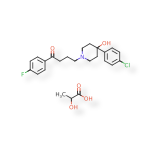
| Stereochemistry | UNKNOWN |
| Molecular Formula | C21H23ClFNO2.C3H6O3 |
| Molecular Weight | 465.942 |
| Optical Activity | ( + / - ) |
| Defined Stereocenters | 0 / 1 |
| E/Z Centers | 0 |
| Charge | 0 |
SHOW SMILES / InChI
SMILES
CC(O)C(O)=O.OC1(CCN(CCCC(=O)C2=CC=C(F)C=C2)CC1)C3=CC=C(Cl)C=C3
InChI
InChIKey=BVUSNQJCSYDJJG-UHFFFAOYSA-N
InChI=1S/C21H23ClFNO2.C3H6O3/c22-18-7-5-17(6-8-18)21(26)11-14-24(15-12-21)13-1-2-20(25)16-3-9-19(23)10-4-16;1-2(4)3(5)6/h3-10,26H,1-2,11-15H2;2,4H,1H3,(H,5,6)
DescriptionSources: http://www.drugbank.ca/drugs/DB00502Curator's Comment: Description was created based on several sources, including http://www.accessdata.fda.gov/drugsatfda_docs/label/2011/015923s079lbl.pdf
Sources: http://www.drugbank.ca/drugs/DB00502
Curator's Comment: Description was created based on several sources, including http://www.accessdata.fda.gov/drugsatfda_docs/label/2011/015923s079lbl.pdf
Haloperidol is a phenyl-piperidinyl-butyrophenone that is used primarily to treat schizophrenia and other psychoses. It is also used in schizoaffective disorder, delusional disorders, ballism, and Tourette syndrome (a drug of choice) and occasionally as adjunctive therapy in mental retardation and the chorea of Huntington disease. It is a potent antiemetic and is used in the treatment of intractable hiccups. Haloperidol also exerts sedative and antiemetic activity. Haloperidol principal pharmacological effects are similar to those of piperazine-derivative phenothiazines. The drug has action at all levels of the central nervous system-primarily at subcortical levels-as well as on multiple organ systems. Haloperidol has strong antiadrenergic and weaker peripheral anticholinergic activity; ganglionic blocking action is relatively slight. It also possesses slight antihistaminic and antiserotonin activity. The precise mechanism whereby the therapeutic effects of haloperidol are produced is not known, but the drug appears to depress the CNS at the subcortical level of the brain, midbrain, and brain stem reticular formation. Haloperidol seems to inhibit the ascending reticular activating system of the brain stem (possibly through the caudate nucleus), thereby interrupting the impulse between the diencephalon and the cortex. The drug may antagonize the actions of glutamic acid within the extrapyramidal system, and inhibitions of catecholamine receptors may also contribute to haloperidol's mechanism of action. Haloperidol may also inhibit the reuptake of various neurotransmitters in the midbrain, and appears to have a strong central antidopaminergic and weak central anticholinergic activity. The drug produces catalepsy and inhibits spontaneous motor activity and conditioned avoidance behaviours in animals. The exact mechanism of antiemetic action of haloperidol has also not been fully determined, but the drug has been shown to directly affect the chemoreceptor trigger zone (CTZ) through the blocking of dopamine receptors in the CTZ. Haloperidol is marketed under the trade name Haldol among others.
CNS Activity
Approval Year
Targets
| Primary Target | Pharmacology | Condition | Potency |
|---|---|---|---|
Target ID: CHEMBL219 |
17.0 nM [EC50] | ||
Target ID: CHEMBL217 Sources: http://www.drugbank.ca/drugs/DB00502 |
|||
Target ID: CHEMBL224 |
53.0 nM [EC50] |
Conditions
| Condition | Modality | Targets | Highest Phase | Product |
|---|---|---|---|---|
| Primary | HALDOL Approved UseHALDOL (haloperidol) is indicated for use in the treatment of schizophrenia. HALDOL is indicated for the control of tics and vocal utterances of Tourette’s Disorder. Launch Date1986 |
|||
| Primary | HALDOL Approved UseHALDOL (haloperidol) is indicated for use in the treatment of schizophrenia. HALDOL is indicated for the control of tics and vocal utterances of Tourette’s Disorder. Launch Date1986 |
Overview
| CYP3A4 | CYP2C9 | CYP2D6 | hERG |
|---|---|---|---|
OverviewOther
| Other Inhibitor | Other Substrate | Other Inducer |
|---|---|---|
Drug as perpetrator
| Target | Modality | Activity | Metabolite | Clinical evidence |
|---|---|---|---|---|
| moderate [Ki 7.2 uM] | ||||
| no [IC50 >10 uM] | ||||
| no [IC50 >10 uM] | ||||
| no [IC50 >133 uM] | ||||
| no [IC50 >133 uM] | ||||
| no [IC50 >133 uM] | ||||
| no [IC50 >30 uM] | ||||
| no [IC50 >50 uM] | ||||
| no | ||||
| yes [Activation 31.6228 uM] | ||||
| yes [IC50 10.7 uM] | ||||
| yes [IC50 141.9 uM] | ||||
| yes [IC50 2.87 uM] | ||||
| yes [IC50 25.3 uM] | ||||
| yes [IC50 25.4 uM] | ||||
| yes [IC50 3.6 uM] | ||||
| yes [IC50 4.69 uM] | ||||
| yes [IC50 8.2 uM] | ||||
| yes | ||||
| yes | ||||
| yes |
Drug as victim
| Target | Modality | Activity | Metabolite | Clinical evidence |
|---|---|---|---|---|
| likely [Km 33 uM] | ||||
| major | ||||
| major | ||||
| major | yes (co-administration study) Comment: Coadministration of CYP2D6 inhibitors (chlorpromazine, promethazine, quinidine, paroxetine, sertraline, venlafaxine) increased Haloperidol plasma concentrations. Page: (Label) 9, 28 |
|||
| major | yes (co-administration study) Comment: Coadministration of Rifampicin (strong CYP3A4 inducer) decreased plasma Haloperidol levels by a mean of 70%. Page: (Label) 9, 28 |
|||
| minor | ||||
| minor | ||||
| minor | ||||
| no | ||||
| no | ||||
| no | ||||
| no | ||||
| yes | ||||
| yes | ||||
| yes | ||||
| yes | ||||
| yes | ||||
| yes | ||||
| yes |
Tox targets
| Target | Modality | Activity | Metabolite | Clinical evidence |
|---|---|---|---|---|
PubMed
| Title | Date | PubMed |
|---|---|---|
| Double activity imaging reveals distinct cellular targets of haloperidol, clozapine and dopamine D(3) receptor selective RGH-1756. | 2001-03 |
|
| Haloperidol-induced impotence improved by switching to olanzapine. | 2001-02-24 |
|
| The role of the D(2) dopamine receptor (D(2)R) in A(2A) adenosine receptor (A(2A)R)-mediated behavioral and cellular responses as revealed by A(2A) and D(2) receptor knockout mice. | 2001-02-13 |
|
| FosB in rat striatum: normal regional distribution and enhanced expression after 6-month haloperidol administration. | 2001-02 |
|
| Increased dopamine d(2) receptor occupancy and elevated prolactin level associated with addition of haloperidol to clozapine. | 2001-02 |
|
| Neurotensin gene expression and behavioral responses following administration of psychostimulants and antipsychotic drugs in dopamine D(3) receptor deficient mice. | 2001-02 |
|
| Haloperidol-induced catalepsy is influenced by calcium channel antagonists. | 2001-01-06 |
|
| Risperidone versus haloperidol in psychotic patients with disturbing neuroleptic-induced extrapyramidal symptoms: a double-blind, multi-center trial. | 2000-12-15 |
|
| Effect of genetic cross on the detection of quantitative trait loci and a novel approach to mapping QTLs. | 2000-12 |
|
| Sildenafil and erectile dysfunction. | 2000-12 |
|
| [Neuropsychiatric symptoms in preventive antimalarial treatment with mefloquine: apropos of 2 cases]. | 2000-11-07 |
|
| Biperiden hydrochlorate ameliorates dystonia of rats produced by microinjection of sigma ligands into the red nucleus. | 2000-11 |
|
| Enhancement of haloperidol-induced catalepsy by nicotine: an investigation of possible mechanisms. | 2000-11 |
|
| Role of prolactin in chloro-S-triazine rat mammary tumorigenesis. | 2000-11 |
|
| The serotonin 5-HT(2A) receptor subtype does not mediate apomorphine-induced aggressive behaviour in male Wistar rats. | 2000-10 |
|
| Contrasting patterns and cellular specificity of transcriptional regulation of the nuclear receptor nerve growth factor-inducible B by haloperidol and clozapine in the rat forebrain. | 2000-10 |
|
| The effects of olanzapine, risperidone, and haloperidol on plasma prolactin levels in patients with schizophrenia. | 2000-09 |
|
| Effects of antipsychotic drugs on cholecystokinin and preprotachykinin (substance P) mRNA expression in the rat hippocampal formation. | 2000-09 |
|
| Estrogen priming modulates autoreceptor-mediated potentiation of dopamine uptake. | 2000-08-11 |
|
| The antidepressive-like effect of oxcarbazepine: possible role of dopaminergic neurotransmission. | 2000-07 |
|
| Further evidence that behavioral tests and neuropeptide mRNA and tissue level alterations can differentiate between typical and atypical antipsychotic drugs. | 2000-07 |
|
| Repeated treatment with 8-OH-DPAT induces tolerance to its ability to produce the 5-HT1A behavioural syndrome, but not to its ability to attenuate haloperidol-induced catalepsy. | 2000-06 |
|
| Effect of magnesium sulfate on the haloperidol-induced QT prolongation assessed in the canine in vivo model under the monitoring of monophasic action potential. | 2000-06 |
|
| Propiverine-induced Parkinsonism: a case report and a pharmacokinetic/pharmacodynamic study in mice. | 2000-05 |
|
| Doses of olanzapine, risperidone, and haloperidol used in clinical practice: results of a prospective pharmacoepidemiologic study. EFESO Study Group. Estudio Farmacoepidemiologico en la Esquizofrenia con Olanzapina. | 2000-05 |
|
| The safety of olanzapine compared with other antipsychotic drugs: results of an observational prospective study in patients with schizophrenia (EFESO Study). Pharmacoepidemiologic Study of Olanzapine in Schizophrenia. | 2000-05 |
|
| Sex differences in catalepsy: evidence for hormone-dependent postural mechanisms in haloperidol-treated rats. | 2000-05 |
|
| Manic episode in an ifosfamide-treated patient. | 2000-04-15 |
|
| Effect of muscarinic receptor agonists on animal models of psychosis. | 2000-04 |
|
| Inhibition by various antipsychotic drugs of the G-protein-activated inwardly rectifying K(+) (GIRK) channels expressed in xenopus oocytes. | 2000-04 |
|
| No changes in dopamine D(1) receptor mRNA expressing neurons in the dorsal striatum of rats with oral movements induced by long-term haloperidol administration. | 2000-03-24 |
|
| Effects of blockade of metabotropic glutamate receptors in the subthalamic nucleus on haloperidol-induced Parkinsonism in rats. | 2000-03-17 |
|
| Haloperidol-induced catalepsy is absent in dopamine D(2), but maintained in dopamine D(3) receptor knock-out mice. | 2000-03-10 |
|
| Double blind study of tiapride versus haloperidol and placebo in agitation and aggressiveness in elderly patients with cognitive impairment. | 2000-03 |
|
| Effect of dopamine agonists and antagonists on the lorazepam withdrawal syndrome in rats. | 2000-03 |
|
| Torsades de pointes secondary to intravenous haloperidol after coronary bypass grafting surgery. | 2000-03 |
|
| Effects of atypical neuroleptics on sustained attention deficits in schizophrenia: a trial of risperidone versus haloperidol. | 2000-03 |
|
| [The neurochemical mechanisms of the formation and consolidation of haloperidol-induced catalepsy]. | 2000-02-29 |
|
| Prevention of cocaine-induced convulsions and lethality in mice: effectiveness of targeting different sites on the NMDA receptor complex. | 2000-01-28 |
|
| Reduced number of striatal neurons expressing preprosomatostatin mRNA in rats with oral dyskinesias after long-term haloperidol administration. | 2000-01-21 |
|
| Sub-chronic inhibition of nitric-oxide synthesis modifies haloperidol-induced catalepsy and the number of NADPH-diaphorase neurons in mice. | 2000-01 |
|
| The role of metabotropic glutamate receptor (mGluR) ligands in parkinsonian muscle rigidity. | 2000 |
|
| Quinpirole, 8-OH-DPAT and ketanserin modulate catalepsy induced by high doses of atypical antipsychotics. | 1999-11 |
|
| Detection and mapping of quantitative trait loci for haloperidol-induced catalepsy in a C57BL/6J x DBA/2J F2 intercross. | 1999-09 |
|
| Haloperidol-induced within-session response decrement patterns and catalepsy in rats: behavioural dissociation. | 1999-02 |
|
| Effect of drugs influencing central serotonergic mechanisms on haloperidol-induced catalepsy. | 1979-03-29 |
|
| A comparative study of haloperidol and chlorpromazine in terms of clinical effects and therapeutic reversal with benztropine in schizophrenia. Theoretical implications for potency differences among neuroleptics. | 1975-08-21 |
|
| Atypical tardive dyskinesia. | 1975-05 |
|
| Drug-induced dystonia. | 1975-05 |
|
| Extrapyramidal reactions and amine metabolites in cerebrospinal fluid during haloperidol and clozapine treatment of schizophrenic patients. | 1975 |
Sample Use Guides
In Vivo Use Guide
Curator's Comment: can also be taken orally https://www.drugs.com/ppa/haloperidol.html
Parenteral medication, administered intramuscularly in doses of 2 to 5 mg, is utilized for prompt control of the acutely agitated schizophrenic patient with moderately severe to very severe symptoms. Depending on the response of the patient, subsequent doses may be given, administered as often as every hour, although 4 to 8 hour intervals may be satisfactory.
Route of Administration:
Intramuscular
| Name | Type | Language | ||
|---|---|---|---|---|
|
Common Name | English | ||
|
Preferred Name | English | ||
|
Common Name | English | ||
|
Common Name | English | ||
|
Common Name | English | ||
|
Common Name | English | ||
|
Common Name | English | ||
|
Common Name | English | ||
|
Common Name | English |
| Classification Tree | Code System | Code | ||
|---|---|---|---|---|
|
NCI_THESAURUS |
C66883
Created by
admin on Mon Mar 31 18:25:58 GMT 2025 , Edited by admin on Mon Mar 31 18:25:58 GMT 2025
|
| Code System | Code | Type | Description | ||
|---|---|---|---|---|---|
|
16051968
Created by
admin on Mon Mar 31 18:25:58 GMT 2025 , Edited by admin on Mon Mar 31 18:25:58 GMT 2025
|
PRIMARY | |||
|
217483
Created by
admin on Mon Mar 31 18:25:58 GMT 2025 , Edited by admin on Mon Mar 31 18:25:58 GMT 2025
|
PRIMARY | RxNorm | ||
|
100000086697
Created by
admin on Mon Mar 31 18:25:58 GMT 2025 , Edited by admin on Mon Mar 31 18:25:58 GMT 2025
|
PRIMARY | |||
|
6387S86PK3
Created by
admin on Mon Mar 31 18:25:58 GMT 2025 , Edited by admin on Mon Mar 31 18:25:58 GMT 2025
|
PRIMARY | |||
|
C78110
Created by
admin on Mon Mar 31 18:25:58 GMT 2025 , Edited by admin on Mon Mar 31 18:25:58 GMT 2025
|
PRIMARY | |||
|
DBSALT001232
Created by
admin on Mon Mar 31 18:25:58 GMT 2025 , Edited by admin on Mon Mar 31 18:25:58 GMT 2025
|
PRIMARY | |||
|
SUB02453MIG
Created by
admin on Mon Mar 31 18:25:58 GMT 2025 , Edited by admin on Mon Mar 31 18:25:58 GMT 2025
|
PRIMARY | |||
|
DTXSID801026594
Created by
admin on Mon Mar 31 18:25:58 GMT 2025 , Edited by admin on Mon Mar 31 18:25:58 GMT 2025
|
PRIMARY | |||
|
CHEMBL54
Created by
admin on Mon Mar 31 18:25:58 GMT 2025 , Edited by admin on Mon Mar 31 18:25:58 GMT 2025
|
PRIMARY | |||
|
53515-91-6
Created by
admin on Mon Mar 31 18:25:58 GMT 2025 , Edited by admin on Mon Mar 31 18:25:58 GMT 2025
|
PRIMARY | |||
|
6387S86PK3
Created by
admin on Mon Mar 31 18:25:58 GMT 2025 , Edited by admin on Mon Mar 31 18:25:58 GMT 2025
|
PRIMARY |
ACTIVE MOIETY
SUBSTANCE RECORD