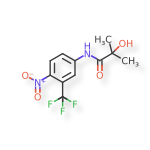
Details
| Stereochemistry | ACHIRAL |
| Molecular Formula | C11H11F3N2O4 |
| Molecular Weight | 292.2112 |
| Optical Activity | NONE |
| Defined Stereocenters | 0 / 0 |
| E/Z Centers | 0 |
| Charge | 0 |
SHOW SMILES / InChI
SMILES
CC(C)(O)C(=O)NC1=CC=C(C(=C1)C(F)(F)F)[N+]([O-])=O
InChI
InChIKey=YPQLFJODEKMJEF-UHFFFAOYSA-N
InChI=1S/C11H11F3N2O4/c1-10(2,18)9(17)15-6-3-4-8(16(19)20)7(5-6)11(12,13)14/h3-5,18H,1-2H3,(H,15,17)
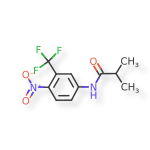
Hydroxyflutamide is the major active metabolite of flutamide. Flutamide undergoes extensive first-pass metabolism by CYP1A2 to its metabolite hydroxyflutamide and its hydrolysis product, 3-trifluoromethyl-4-nitroaniline. Hydroxyflutamide is a more powerful antiandrogen in vivo, with higher affinity for the receptor than that of flutamide. Hydroxyflutamide is in phase II clinical trials for the treatment of prostate cancer. However, a drug resistance problem appears after about one year's treatment. Per-residue free energy decomposition analyses indicate that N705, T877, and M895 androgen receptor mutations are vital residues in the agonist/antagonist mechanism of hydroxyflutamide.
Approval Year
Overview
| CYP3A4 | CYP2C9 | CYP2D6 | hERG |
|---|---|---|---|
OverviewOther
| Other Inhibitor | Other Substrate | Other Inducer |
|---|---|---|
Drug as perpetrator
| Target | Modality | Activity | Metabolite | Clinical evidence |
|---|---|---|---|---|
| inconclusive [IC50 25.1189 uM] | ||||
| no [Activation 25.1189 uM] | ||||
| no [IC50 39.8045 uM] | ||||
| no |
Drug as victim
| Target | Modality | Activity | Metabolite | Clinical evidence |
|---|---|---|---|---|
| no | ||||
| yes |
PubMed
| Title | Date | PubMed |
|---|---|---|
| Low dose evaluation of the antiandrogen flutamide following a Mode of Action approach. | 2015-12-15 |
|
| The brominated flame retardants TBP-AE and TBP-DBPE antagonize the chicken androgen receptor and act as potential endocrine disrupters in chicken LMH cells. | 2015-12 |
|
| Metabolomics-on-a-chip of hepatotoxicity induced by anticancer drug flutamide and Its active metabolite hydroxyflutamide using HepG2/C3a microfluidic biochips. | 2013-03 |
|
| Ligand-independent androgen receptor antagonism caused by the newly developed pesticide pyrifluquinazon (PFQ). | 2013-01 |
|
| Characterization of steroid hormone receptor activities in 100 hydroxylated polychlorinated biphenyls, including congeners identified in humans. | 2011-11-18 |
|
| Unexpected binding orientation of bulky-B-ring anti-androgens and implications for future drug targets. | 2011-06-09 |
|
| Differential effects of a complex organochlorine mixture on the proliferation of breast cancer cell lines. | 2011-04 |
|
| The medial preoptic nucleus integrates the central influences of testosterone on the paraventricular nucleus of the hypothalamus and its extended circuitries. | 2010-09-01 |
|
| Cell viability and PSA secretion assays in LNCaP cells: a tiered in vitro approach to screen chemicals with a prostate-mediated effect on male reproduction within the ReProTect project. | 2010-08 |
|
| Nuclear hormone receptor activity of polybrominated diphenyl ethers and their hydroxylated and methoxylated metabolites in transactivation assays using Chinese hamster ovary cells. | 2009-08 |
|
| Screening of 397 chemicals and development of a quantitative structure--activity relationship model for androgen receptor antagonism. | 2008-04 |
|
| 1,1-dichloro-2,2-bis(p-chlorophenyl)ethylene (p,p'-DDE) disrupts the estrogen-androgen balance regulating the growth of hormone-dependent breast cancer cells. | 2008 |
|
| Ligand-specific dynamics of the androgen receptor at its response element in living cells. | 2007-03 |
|
| Regulation of A Disintegrin And Metalloproteinase with ThromboSpondin repeats-1 expression in human endometrial stromal cells by gonadal steroids involves progestins, androgens, and estrogens. | 2006-12 |
|
| Prediction of estrogen receptor agonists and characterization of associated molecular descriptors by statistical learning methods. | 2006-11 |
|
| Synthesis and biological evaluation of a nonsteroidal bromine-76-labeled androgen receptor ligand 3-[76Br]bromo-hydroxyflutamide. | 2006-08 |
|
| The structural basis of androgen receptor activation: intramolecular and intermolecular amino-carboxy interactions. | 2005-07-12 |
|
| Evidence that inhibited prostatic epithelial bud formation in 2,3,7,8-tetrachlorodibenzo-p-dioxin-exposed C57BL/6J fetal mice is not due to interruption of androgen signaling in the urogenital sinus. | 2004-06 |
|
| Screening of some anti-androgenic endocrine disruptors using a recombinant cell-based in vitro bioassay. | 2004-02 |
|
| Androgen dependent regulation of bacillus Calmette-Guerin induced interleukin-6 expression in human transitional carcinoma cell lines. | 2003-11 |
|
| UV filters with antagonistic action at androgen receptors in the MDA-kb2 cell transcriptional-activation assay. | 2003-07 |
|
| Acquisition of agonistic properties of nonsteroidal antiandrogens after treatment with oncostatin M in prostate cancer cells. | 2002-07 |
|
| Development of two androgen receptor assays using adenoviral transduction of MMTV-luc reporter and/or hAR for endocrine screening. | 2002-03 |
|
| A novel cell line, MDA-kb2, that stably expresses an androgen- and glucocorticoid-responsive reporter for the detection of hormone receptor agonists and antagonists. | 2002-03 |
|
| Role of cadmium in the regulation of AR gene expression and activity. | 2002-01 |
|
| Regulation of GCDFP-15 expression in human mammary cancer cells. | 1999-08 |
|
| Rapid and sensitive reporter gene assays for detection of antiandrogenic and estrogenic effects of environmental chemicals. | 1999-03-01 |
|
| Androgen antagonistic effect of estramustine phosphate (EMP) metabolites on wild-type and mutated androgen receptor. | 1998-05-01 |
Patents
Sample Use Guides
Single injection in one lobe of 2-8 mL ready-made paste (corresponding to 400-1600 mg 2-Hydroxyflutamid)
Route of Administration:
Other
The dihydrotestosterone-mediated induction of Amyloid precursor protein (APP) mRNA expression was potently suppressed by 10 uM of an androgen receptor blocker hydroxyflutamide (0.35-fold and P<0.01, compared to a group treated by DHT alone), whereas hydroxyflutamide alone did not significantly alter APP mRNA level in MCF-7cells (0.79-fold, P=0.69).
| Name | Type | Language | ||
|---|---|---|---|---|
|
Common Name | English | ||
|
Preferred Name | English | ||
|
Systematic Name | English | ||
|
Systematic Name | English | ||
|
Systematic Name | English | ||
|
Common Name | English | ||
|
Common Name | English |
| Classification Tree | Code System | Code | ||
|---|---|---|---|---|
|
NCI_THESAURUS |
C146993
Created by
admin on Mon Mar 31 20:37:19 GMT 2025 , Edited by admin on Mon Mar 31 20:37:19 GMT 2025
|
| Code System | Code | Type | Description | ||
|---|---|---|---|---|---|
|
300000042596
Created by
admin on Mon Mar 31 20:37:19 GMT 2025 , Edited by admin on Mon Mar 31 20:37:19 GMT 2025
|
PRIMARY | |||
|
52806-53-8
Created by
admin on Mon Mar 31 20:37:19 GMT 2025 , Edited by admin on Mon Mar 31 20:37:19 GMT 2025
|
PRIMARY | |||
|
C63948
Created by
admin on Mon Mar 31 20:37:19 GMT 2025 , Edited by admin on Mon Mar 31 20:37:19 GMT 2025
|
PRIMARY | |||
|
31D90UKP5Y
Created by
admin on Mon Mar 31 20:37:19 GMT 2025 , Edited by admin on Mon Mar 31 20:37:19 GMT 2025
|
PRIMARY | |||
|
91649
Created by
admin on Mon Mar 31 20:37:19 GMT 2025 , Edited by admin on Mon Mar 31 20:37:19 GMT 2025
|
PRIMARY | |||
|
C014290
Created by
admin on Mon Mar 31 20:37:19 GMT 2025 , Edited by admin on Mon Mar 31 20:37:19 GMT 2025
|
PRIMARY | |||
|
Hydroxyflutamide
Created by
admin on Mon Mar 31 20:37:19 GMT 2025 , Edited by admin on Mon Mar 31 20:37:19 GMT 2025
|
PRIMARY | |||
|
DTXSID8033562
Created by
admin on Mon Mar 31 20:37:19 GMT 2025 , Edited by admin on Mon Mar 31 20:37:19 GMT 2025
|
PRIMARY |
PARENT (METABOLITE ACTIVE)
SUBSTANCE RECORD