


Details
| Stereochemistry | ACHIRAL |
| Molecular Formula | C19H22N2.ClH.H2O |
| Molecular Weight | 332.868 |
| Optical Activity | NONE |
| Defined Stereocenters | 0 / 0 |
| E/Z Centers | 1 |
| Charge | 0 |
SHOW SMILES / InChI
SMILES
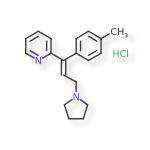
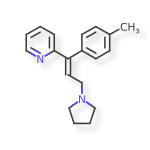
O.Cl.CC1=CC=C(C=C1)C(=C/CN2CCCC2)\C3=CC=CC=N3
InChI
InChIKey=CUZMOIXUFHOLLN-UMVVUDSKSA-N
InChI=1S/C19H22N2.ClH.H2O/c1-16-7-9-17(10-8-16)18(19-6-2-3-12-20-19)11-15-21-13-4-5-14-21;;/h2-3,6-12H,4-5,13-15H2,1H3;1H;1H2/b18-11+;;
| Molecular Formula | ClH |
| Molecular Weight | 36.461 |
| Charge | 0 |
| Count |
|
| Stereochemistry | ACHIRAL |
| Additional Stereochemistry | No |
| Defined Stereocenters | 0 / 0 |
| E/Z Centers | 0 |
| Optical Activity | NONE |
| Molecular Formula | C19H22N2 |
| Molecular Weight | 278.3914 |
| Charge | 0 |
| Count |
|
| Stereochemistry | ACHIRAL |
| Additional Stereochemistry | No |
| Defined Stereocenters | 0 / 0 |
| E/Z Centers | 1 |
| Optical Activity | NONE |
| Molecular Formula | H2O |
| Molecular Weight | 18.0153 |
| Charge | 0 |
| Count |
|
| Stereochemistry | ACHIRAL |
| Additional Stereochemistry | No |
| Defined Stereocenters | 0 / 0 |
| E/Z Centers | 0 |
| Optical Activity | NONE |
Triprolidine is a first generation histamine H1 antagonist, which in combination with codeine phosphate and pseudoephedrine hydrochloride is sold under brand name TRIACIN-C. TRIACIN-C is indicated for temporary relief of coughs and upper respiratory symptoms, including nasal congestion, associated with allergy or the common cold.
Approval Year
Targets
| Primary Target | Pharmacology | Condition | Potency |
|---|---|---|---|
Target ID: CHEMBL231 |
Conditions
| Condition | Modality | Targets | Highest Phase | Product |
|---|---|---|---|---|
| Palliative | TRIACIN-C Approved UseTriacin-C is indicated for temporary relief of coughs and upper respiratory symptoms, including nasal congestion, associated with allergy or the common cold. Launch Date1985 |
|||
| Palliative | TRIACIN-C Approved UseTriacin-C is indicated for temporary relief of coughs and upper respiratory symptoms, including nasal congestion, associated with allergy or the common cold. Launch Date1985 |
Cmax
| Value | Dose | Co-administered | Analyte | Population |
|---|---|---|---|---|
5.6 ng/mL EXPERIMENT https://pubmed.ncbi.nlm.nih.gov/2355108/ |
2.5 mg single, oral dose: 2.5 mg route of administration: Oral experiment type: SINGLE co-administered: |
TRIPROLIDINE plasma | Homo sapiens population: HEALTHY age: ADULT sex: MALE food status: FASTED |
AUC
| Value | Dose | Co-administered | Analyte | Population |
|---|---|---|---|---|
31.22 ng × h/mL EXPERIMENT https://pubmed.ncbi.nlm.nih.gov/2355108/ |
2.5 mg single, oral dose: 2.5 mg route of administration: Oral experiment type: SINGLE co-administered: |
TRIPROLIDINE plasma | Homo sapiens population: HEALTHY age: ADULT sex: MALE food status: FASTED |
T1/2
| Value | Dose | Co-administered | Analyte | Population |
|---|---|---|---|---|
6 h EXPERIMENT https://pubmed.ncbi.nlm.nih.gov/2355108/ |
2.5 mg single, oral dose: 2.5 mg route of administration: Oral experiment type: SINGLE co-administered: |
TRIPROLIDINE plasma | Homo sapiens population: HEALTHY age: ADULT sex: MALE food status: FASTED |
PubMed
| Title | Date | PubMed |
|---|---|---|
| H1-antihistamines induce vacuolation in astrocytes through macroautophagy. | 2012-04-15 |
|
| Involvement of histaminergic receptor mechanisms in the stimulation of NT-3 synthesis in astrocytes. | 2011-06 |
|
| Disruption of the C5a receptor gene increases resistance to acute Gram-negative bacteremia and endotoxic shock: opposing roles of C3a and C5a. | 2008-04 |
|
| H1 histamine receptor antagonists induce genotoxic and caspase-2-dependent apoptosis in human melanoma cells. | 2006-09 |
|
| Histamine excites neonatal rat sympathetic preganglionic neurons in vitro via activation of H1 receptors. | 2006-04 |
|
| Excitatory effect of histamine on neuronal activity of rat globus pallidus by activation of H2 receptors in vitro. | 2005-11 |
|
| Prediction of genotoxicity of chemical compounds by statistical learning methods. | 2005-06 |
|
| Regulation of cytokine production in carcinoembryonic antigen stimulated Kupffer cells by beta-2 adrenergic receptors: implications for hepatic metastasis. | 2004-06-25 |
|
| Activation of histamine H1-receptor enhances neurotrophic factor secretion from cultured astrocytes. | 2004-06 |
|
| Histamine inhibits atrial myocytic ANP release via H2 receptor-cAMP-protein kinase signaling. | 2003-08 |
|
| Molecular characterization of specific H1-receptor agonists histaprodifen and its Nalpha-substituted analogues on bovine aortic H1-receptors. | 2003-05 |
|
| A novel phenylaminotetralin radioligand reveals a subpopulation of histamine H(1) receptors. | 2002-07 |
|
| Regional differences in functional receptor distribution and calcium mobilization in the intact human lens. | 2001-09 |
|
| Increased histidine decarboxylase expression during in vitro monocyte maturation; a possible role of endogenously synthesised histamine in monocyte/macrophage differentiation. | 2001-08 |
|
| Inhibition of effects of endogenously synthesized histamine disturbs in vitro human dendritic cell differentiation. | 2001-04-02 |
|
| A novel phenylaminotetralin (PAT) recognizes histamine H1 receptors and stimulates dopamine synthesis in vivo in rat brain. | 2000-01-03 |
|
| The histamine H1-receptor antagonist binding site. A stereoselective pharmacophoric model based upon (semi-)rigid H1-antagonists and including a known interaction site on the receptor. | 1995-08-18 |
|
| Stable expression of human H1-histamine-receptor cDNA in Chinese hamster ovary cells. Pharmacological characterisation of the protein, tissue distribution of messenger RNA and chromosomal localisation of the gene. | 1994-09-01 |
|
| A role for endogenous histamine in interleukin-8-induced neutrophil infiltration into mouse air-pouch: investigation of the modulatory action of systemic and local dexamethasone. | 1994-07 |
|
| H1-receptor antagonists. Comparative tolerability and safety. | 1994-05 |
|
| Decreased histamine H1 receptors in the frontal cortex of brains from patients with chronic schizophrenia. | 1991-08-15 |
|
| Nonsedating histamine H1-receptor antagonists. | 1989-05 |
|
| Effects of triprolidine and dipipanone in the cold induced pain test, and the central nervous system of healthy volunteers. | 1987-07 |
|
| Regulation of membrane histamine H1-receptor binding sites by guanine nucleotides, mono- and divalent cations. | 1986-04 |
|
| H1-histamine receptors on human astrocytoma cells. | 1986-02 |
|
| Clinical pharmacokinetics of H1-receptor antagonists (the antihistamines). | 1985-11-01 |
|
| Specific binding of [3H]mepyramine to histamine H1-receptors in vascular smooth muscle membranes. | 1983-04 |
|
| [Myoclonia caused by a combination of triprolidine, pseudoephedrine and paracetamol]. | 1982-06-26 |
|
| Clinical and therapeutic aspects of sinusitis in children with bronchial asthma. | 1981-12 |
|
| A Double-blind crossover trial of pseudoephedrine and triprolidine, alone and in combination, for the treatment of allergenic rhinitis. | 1975-01 |
Patents
Sample Use Guides
Adults and children 12 years and older: 2 teaspoonfuls (10 mL) every 4 to 6 hours, not to exceed 8 teaspoonfuls (40 mL) in 24 hours.
Children 6 to under 12 years: 1 teaspoonful (5 mL) every 4 to 6 hours, not to exceed 4 teaspoonfuls (20 mL) in 24 hours.
Children 2 to under 6 years: ½ teaspoonful (2.5 mL) every 4 to 6 hours, not to exceed 2 teaspoonfuls.
Route of Administration:
Oral
In vitro experiments were conducted using Sweetana-Grass (Navicyte) vertical diffusion cells to evaluate the effect of directionality, donor concentration and pH on the permeation of hydroxyzine and triprolidine across excised bovine olfactory mucosa. These studies demonstrated that the Jm-s (mucosal-submucosal flux) and Js-m (submucosal-mucosal flux) of hydroxyzine and triprolidine across the olfactory mucosa were linearly dependent upon the donor concentration without any evidence of saturable transport. Hydroxyzine inhibited the efflux of P-gp substrates like etoposide and chlorpheniramine across the olfactory mucosa. Both hydroxyzine and triprolidine reduced the net flux (Js-m-Jm-s) of etoposide with IC50 values of 39.2 and 130.6 microM, respectively. The lipophilicty of these compounds, coupled with their ability to inhibit P-gp, enable them to freely permeate across the olfactory mucosa. Despite the presence of a number of protective barriers such as efflux transporters and metabolizing enzymes in the olfactory system, lipophilic compounds such as hydroxyzine and triprolidine can access the CNS primarily by passive diffusion when administered via the nasal cavity.
| Substance Class |
Chemical
Created
by
admin
on
Edited
Mon Mar 31 17:50:31 GMT 2025
by
admin
on
Mon Mar 31 17:50:31 GMT 2025
|
| Record UNII |
YAN7R5L890
|
| Record Status |
Validated (UNII)
|
| Record Version |
|
-
Download
| Name | Type | Language | ||
|---|---|---|---|---|
|
Preferred Name | English | ||
|
Common Name | English | ||
|
Common Name | English | ||
|
Common Name | English | ||
|
Common Name | English | ||
|
Common Name | English | ||
|
Common Name | English | ||
|
Common Name | English | ||
|
Common Name | English | ||
|
Common Name | English | ||
|
Common Name | English | ||
|
Common Name | English | ||
|
Common Name | English | ||
|
Common Name | English | ||
|
Common Name | English | ||
|
Common Name | English | ||
|
Common Name | English | ||
|
Common Name | English | ||
|
Brand Name | English | ||
|
Code | English | ||
|
Common Name | English | ||
|
Common Name | English | ||
|
Common Name | English | ||
|
Common Name | English | ||
|
Common Name | English | ||
|
Brand Name | English | ||
|
Common Name | English | ||
|
Common Name | English |
| Classification Tree | Code System | Code | ||
|---|---|---|---|---|
|
NCI_THESAURUS |
C29578
Created by
admin on Mon Mar 31 17:50:31 GMT 2025 , Edited by admin on Mon Mar 31 17:50:31 GMT 2025
|
||
|
CFR |
21 CFR 341.12
Created by
admin on Mon Mar 31 17:50:31 GMT 2025 , Edited by admin on Mon Mar 31 17:50:31 GMT 2025
|
| Code System | Code | Type | Description | ||
|---|---|---|---|---|---|
|
SUB04984MIG
Created by
admin on Mon Mar 31 17:50:31 GMT 2025 , Edited by admin on Mon Mar 31 17:50:31 GMT 2025
|
PRIMARY | |||
|
DTXSID0021410
Created by
admin on Mon Mar 31 17:50:31 GMT 2025 , Edited by admin on Mon Mar 31 17:50:31 GMT 2025
|
PRIMARY | |||
|
YAN7R5L890
Created by
admin on Mon Mar 31 17:50:31 GMT 2025 , Edited by admin on Mon Mar 31 17:50:31 GMT 2025
|
PRIMARY | |||
|
CHEMBL855
Created by
admin on Mon Mar 31 17:50:31 GMT 2025 , Edited by admin on Mon Mar 31 17:50:31 GMT 2025
|
PRIMARY | |||
|
DBSALT000623
Created by
admin on Mon Mar 31 17:50:31 GMT 2025 , Edited by admin on Mon Mar 31 17:50:31 GMT 2025
|
PRIMARY | |||
|
m11192
Created by
admin on Mon Mar 31 17:50:31 GMT 2025 , Edited by admin on Mon Mar 31 17:50:31 GMT 2025
|
PRIMARY | Merck Index | ||
|
6138-79-0
Created by
admin on Mon Mar 31 17:50:31 GMT 2025 , Edited by admin on Mon Mar 31 17:50:31 GMT 2025
|
PRIMARY | |||
|
5282442
Created by
admin on Mon Mar 31 17:50:31 GMT 2025 , Edited by admin on Mon Mar 31 17:50:31 GMT 2025
|
PRIMARY | |||
|
757361
Created by
admin on Mon Mar 31 17:50:31 GMT 2025 , Edited by admin on Mon Mar 31 17:50:31 GMT 2025
|
PRIMARY | |||
|
1696007
Created by
admin on Mon Mar 31 17:50:31 GMT 2025 , Edited by admin on Mon Mar 31 17:50:31 GMT 2025
|
PRIMARY | |||
|
300000050182
Created by
admin on Mon Mar 31 17:50:31 GMT 2025 , Edited by admin on Mon Mar 31 17:50:31 GMT 2025
|
PRIMARY | |||
|
32265
Created by
admin on Mon Mar 31 17:50:31 GMT 2025 , Edited by admin on Mon Mar 31 17:50:31 GMT 2025
|
PRIMARY | |||
|
71534
Created by
admin on Mon Mar 31 17:50:31 GMT 2025 , Edited by admin on Mon Mar 31 17:50:31 GMT 2025
|
PRIMARY | RxNorm | ||
|
YAN7R5L890
Created by
admin on Mon Mar 31 17:50:31 GMT 2025 , Edited by admin on Mon Mar 31 17:50:31 GMT 2025
|
PRIMARY | |||
|
C61993
Created by
admin on Mon Mar 31 17:50:31 GMT 2025 , Edited by admin on Mon Mar 31 17:50:31 GMT 2025
|
PRIMARY |
| Related Record | Type | Details | ||
|---|---|---|---|---|
|
ANHYDROUS->SOLVATE | |||
|
|
PARENT -> SALT/SOLVATE |
| Related Record | Type | Details | ||
|---|---|---|---|---|
|
IMPURITY -> PARENT |
CHROMATOGRAPHIC PURITY (HPLC/UV)
USP
|
![Structure of Pyridine, 2-[(1Z)-1-(4-methylphenyl)-3-(1-pyrrolidinyl)-1-propenyl]-, monohydrochloride](/img/364195a4-2b23-4406-99ad-5e3843f19988.svg "Structure of Pyridine, 2-[(1Z)-1-(4-methylphenyl)-3-(1-pyrrolidinyl)-1-propenyl]-, monohydrochloride")
| Related Record | Type | Details | ||
|---|---|---|---|---|
|
|
ACTIVE MOIETY |