Details
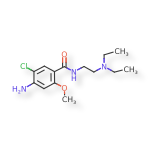
| Stereochemistry | ACHIRAL |
| Molecular Formula | C14H22ClN3O2.2ClH.H2O |
| Molecular Weight | 390.734 |
| Optical Activity | NONE |
| Defined Stereocenters | 0 / 0 |
| E/Z Centers | 0 |
| Charge | 0 |
SHOW SMILES / InChI
SMILES
O.Cl.Cl.CCN(CC)CCNC(=O)C1=C(OC)C=C(N)C(Cl)=C1
InChI
InChIKey=IRQVJPHZDYMXNW-UHFFFAOYSA-N
InChI=1S/C14H22ClN3O2.2ClH.H2O/c1-4-18(5-2)7-6-17-14(19)10-8-11(15)12(16)9-13(10)20-3;;;/h8-9H,4-7,16H2,1-3H3,(H,17,19);2*1H;1H2
| Molecular Formula | H2O |
| Molecular Weight | 18.0153 |
| Charge | 0 |
| Count |
|
| Stereochemistry | ACHIRAL |
| Additional Stereochemistry | No |
| Defined Stereocenters | 0 / 0 |
| E/Z Centers | 0 |
| Optical Activity | NONE |
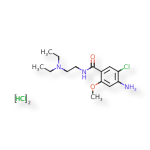
| Molecular Formula | C14H22ClN3O2 |
| Molecular Weight | 299.796 |
| Charge | 0 |
| Count |
|
| Stereochemistry | ACHIRAL |
| Additional Stereochemistry | No |
| Defined Stereocenters | 0 / 0 |
| E/Z Centers | 0 |
| Optical Activity | NONE |
| Molecular Formula | ClH |
| Molecular Weight | 36.461 |
| Charge | 0 |
| Count |
|
| Stereochemistry | ACHIRAL |
| Additional Stereochemistry | No |
| Defined Stereocenters | 0 / 0 |
| E/Z Centers | 0 |
| Optical Activity | NONE |
DescriptionSources: http://www.drugbank.ca/drugs/DB01233Curator's Comment: Description was created based on several sources, including
http://www.accessdata.fda.gov/drugsatfda_docs/label/2011/017854s058lbl.pdf
Sources: http://www.drugbank.ca/drugs/DB01233
Curator's Comment: Description was created based on several sources, including
http://www.accessdata.fda.gov/drugsatfda_docs/label/2011/017854s058lbl.pdf
Metoclopramide is a dopamine D2 antagonist that is used as an antiemetic. Metoclopramide inhibits gastric smooth muscle relaxation produced by dopamine, therefore increasing cholinergic response of the gastrointestinal smooth muscle. It accelerates intestinal transit and gastric emptying by preventing relaxation of gastric body and increasing the phasic activity of antrum. Simultaneously, this action is accompanied by relaxation of the upper small intestine, resulting in an improved coordination between the body and antrum of the stomach and the upper small intestine. Metoclopramide also decreases reflux into the esophagus by increasing the resting pressure of the lower esophageal sphincter and improves acid clearance from the esophagus by increasing amplitude of esophageal peristaltic contractions. Metoclopramide's dopamine antagonist action raises the threshold of activity in the chemoreceptor trigger zone and decreases the input from afferent visceral nerves. Studies have also shown that high doses of metoclopramide can antagonize 5-hydroxytryptamine (5-HT) receptors in the peripheral nervous system in animals. Metoclopramide is used for the treatment of gastroesophageal reflux disease (GERD). It is also used in treating nausea and vomiting, and to increase gastric emptying.
Approval Year
Targets
| Primary Target | Pharmacology | Condition | Potency |
|---|---|---|---|
Target ID: CHEMBL216 Sources: http://www.drugbank.ca/drugs/DB01233 |
|||
Target ID: CHEMBL320 |
24.0 µM [IC50] | ||
Target ID: CHEMBL217 Sources: http://www.drugbank.ca/drugs/DB01233 |
100.0 nM [IC50] | ||
Target ID: CHEMBL1899 |
0.064 µM [IC50] |
Conditions
| Condition | Modality | Targets | Highest Phase | Product |
|---|---|---|---|---|
| Primary | REGLAN Approved UseSymptomatic Gastroesophageal Reflux
Reglan® tablets are indicated as short-term (4 to 12 weeks) therapy for adults with symptomatic, documented gastroesophageal reflux who fail to respond to conventional therapy
Diabetic Gastroparesis (Diabetic Gastric Stasis)
Reglan® tablets (metoclopramide tablets, USP) is indicated for the relief of symptoms associated with acute and recurrent diabetic gastric stasis. Launch Date1980 |
|||
| Palliative | REGLAN Approved UseSymptomatic Gastroesophageal Reflux
Reglan® tablets are indicated as short-term (4 to 12 weeks) therapy for adults with symptomatic, documented gastroesophageal reflux who fail to respond to conventional therapy
Diabetic Gastroparesis (Diabetic Gastric Stasis)
Reglan® tablets (metoclopramide tablets, USP) is indicated for the relief of symptoms associated with acute and recurrent diabetic gastric stasis. Launch Date1980 |
Cmax
| Value | Dose | Co-administered | Analyte | Population |
|---|---|---|---|---|
41 ng/mL |
15 mg single, nasal dose: 15 mg route of administration: Nasal experiment type: SINGLE co-administered: |
METOCLOPRAMIDE plasma | Homo sapiens population: HEALTHY age: ADULT sex: UNKNOWN food status: UNKNOWN |
AUC
| Value | Dose | Co-administered | Analyte | Population |
|---|---|---|---|---|
367 ng × h/mL |
15 mg single, nasal dose: 15 mg route of administration: Nasal experiment type: SINGLE co-administered: |
METOCLOPRAMIDE plasma | Homo sapiens population: HEALTHY age: ADULT sex: UNKNOWN food status: UNKNOWN |
T1/2
| Value | Dose | Co-administered | Analyte | Population |
|---|---|---|---|---|
8.1 h |
15 mg single, nasal dose: 15 mg route of administration: Nasal experiment type: SINGLE co-administered: |
METOCLOPRAMIDE plasma | Homo sapiens population: HEALTHY age: ADULT sex: UNKNOWN food status: UNKNOWN |
Funbound
| Value | Dose | Co-administered | Analyte | Population |
|---|---|---|---|---|
70% |
15 mg single, nasal dose: 15 mg route of administration: Nasal experiment type: SINGLE co-administered: |
METOCLOPRAMIDE plasma | Homo sapiens population: HEALTHY age: ADULT sex: UNKNOWN food status: UNKNOWN |
Overview
| CYP3A4 | CYP2C9 | CYP2D6 | hERG |
|---|---|---|---|
OverviewOther
| Other Inhibitor | Other Substrate | Other Inducer |
|---|---|---|
Drug as perpetrator
| Target | Modality | Activity | Metabolite | Clinical evidence |
|---|---|---|---|---|
| likely | unlikely (co-administration study) Comment: metoclopramide is unlikely to interact with CYP2D6 substrates in vivo at therapeutically relevant concentrations Page: 15.0 |
Drug as victim
| Target | Modality | Activity | Metabolite | Clinical evidence |
|---|---|---|---|---|
| major | yes (co-administration study) Comment: patients who received concomitant metoclopramide and fluoxetine had a 40% and 90% increase in metoclopramide Cmax and AUC0-∞, respectively Page: 13.0 |
|||
| minor | ||||
| minor |
Tox targets
| Target | Modality | Activity | Metabolite | Clinical evidence |
|---|---|---|---|---|
PubMed
| Title | Date | PubMed |
|---|---|---|
| Acute dystonia due to metoclopramide: increased risk in AIDS. | 2002-02-11 |
|
| [Syncope - a systematic overview of classification, pathogenesis, diagnosis and management]. | 2002-02 |
|
| Endoscopic balloon dilation of benign esophageal strictures in dogs and cats. | 2002-01-31 |
|
| A simple method to investigate the inhibitory effects of drugs on gastric emptying in the mouse in vivo. | 2002-01-05 |
|
| Serotonin syndrome caused by selective serotonin reuptake-inhibitors-metoclopramide interaction. | 2002-01 |
|
| Why not to use erythromycin in GI motility. | 2002-01 |
|
| Effect of prolactin and dopaminergic drugs on uterine response to chronic estrogen exposure. | 2002-01 |
|
| Physical compatibility and in vivo evaluation of drug mixtures for subcutaneous infusion to cancer patients in palliative care. | 2002-01 |
|
| Comparison of ondansetron with metoclopramide in the symptomatic relief of uremia-induced nausea and vomiting. | 2002 |
|
| Gastroesophageal reflux in infants and children. | 2001-12-01 |
|
| Gastroparesis: prevalence, clinical significance and treatment. | 2001-12 |
|
| RP-HPLC method with electrochemical detection for the determination of metoclopramide in serum and its use in pharmacokinetic studies. | 2001-12 |
|
| [Evaluation and treatment of hyperemesis gravidarum]. | 2001-12 |
|
| Randomized clinical trial of intravenous magnesium sulfate as an adjunctive medication for emergency department treatment of migraine headache. | 2001-12 |
|
| Laryngospasm: an atypical manifestation of severe gastroesophageal reflux disease (GERD). | 2001-11 |
|
| Comparison of cisapride and metoclopramide for facilitating gastric emptying and improving tolerance to intragastric enteral nutrition in critically III, mechanically ventilated adults. | 2001-11 |
|
| AS-924, a novel, orally active, bifunctional prodrug of ceftizoxime: physicochemical properties, oral absorption in animals, and antibacterial activity. | 2001-11 |
|
| Aberrant membrane hormone receptors in incidentally discovered bilateral macronodular adrenal hyperplasia with subclinical Cushing's syndrome. | 2001-11 |
|
| Low-dose dexamethasone effectively prevents postoperative nausea and vomiting after ambulatory laparoscopic surgery. | 2001-11 |
|
| One thousand small-bowel biopsies in children. A single-port versus a double-port capsule. | 2001-11 |
|
| [Acute treatment of infantile headache]. | 2001-10-06 |
|
| Initial experience with the stretta procedure for the treatment of gastroesophageal reflux disease. | 2001-10 |
|
| In vitro release of metoclopramide from hydrophobic matrix tablets. influence of hydrodynamic conditions on kinetic release parameters. | 2001-10 |
|
| Efficacy of metoclopramide in postoperative ileus after exploratory laparotomy. | 2001-10 |
|
| Preoperative diagnosis and localization of aldosterone-producing adenoma by adrenal venous sampling after administration of metoclopramide. | 2001-09 |
|
| [ Ambulatory laparoscopic gynecological surgery in Africa: feasibility]. | 2001-09 |
|
| Comparing the efficacy of prophylactic metoclopramide, ondansetron, and placebo in cesarean section patients given epidural anesthesia. | 2001-09 |
|
| Growth hormone and prolactin secretion after metoclopramide administration (DA2 receptor blockade) in fertile women. | 2001-09 |
|
| Prevention of postoperative nausea and vomiting after laparoscopic gynaecological surgery. Combined antiemetic treatment with tropisetron and metoclopramide vs. metoclopramide alone. | 2001-09 |
|
| [Pheochromocytoma with severe paralytic ileus occurred from acute pulmonary edema caused by metoclopramide]. | 2001-08-10 |
|
| [Acute dystonia caused by metoclopramide (Afipran) therapy]. | 2001-08-10 |
|
| Variation in practice patterns of anesthesiologists in California for prophylaxis of postoperative nausea and vomiting. | 2001-08 |
|
| Pharmacological comparison of human homomeric 5-HT3A receptors versus heteromeric 5-HT3A/3B receptors. | 2001-08 |
|
| Persistent hiccup associated with thoracic epidural injection. | 2001-08 |
|
| Nonulcer Dyspepsia. | 2001-08 |
|
| [Sinus arrest after the administration of intravenous metoclopramide]. | 2001-07-14 |
|
| Comparison of ondansetron-dexamethasone-lorazepam versus metoclopramide-dexamethasone-lorazepam in the control of cisplatin induced emesis. | 2001-07 |
|
| Pharmacoeconomic issues of the treatment of gastroesophageal reflux disease. | 2001-07 |
|
| Gastroparesis following bone marrow transplantation. | 2001-07 |
|
| [Prophylaxis of nausea and vomiting after thyroid surgery: comparison of oral and intravenous dolasetron with intravenous droperidol and placebo]. | 2001-07 |
|
| Supraglottic dystonic reaction to metoclopramide in a child. | 2001-06-04 |
|
| The cardiovascular effects of metoclopramide in multiple system atrophy and pure autonomic failure. | 2001-06 |
|
| Gastric residual volume in children: a study comparing efficiency of erythromycin and metoclopramide as prokinetic agents. | 2001-06 |
|
| Pre-emptive metoclopramide and ondansetron for nausea and vomiting associated with iloprost infusions. | 2001-06 |
|
| Effect of ATP sensitive potassium channel modifiers on antinociceptive effect of metoclopramide. | 2001-05 |
|
| Erythromycin as a gastrointestinal prokinetic agent. | 2001-04 |
|
| Mongolian spots with involvement of the temporal area. | 2001-04 |
|
| Prevention of vomiting after general anesthesia for pediatric ophthalmic surgery. | 2001-02 |
|
| Pharmacological options for the treatment of Tourette's disorder. | 2001 |
|
| Metoclopramide-related pisa syndrome in clozapine treatment. | 2001 |
Sample Use Guides
For the relief of Symptomatic Gastroesophageal Reflux
Administer from 10 mg to 15 mg reglan® (metoclopramide hydrochloride, USP) orally up to q.i.d. 30 minutes before each meal and at bedtime, depending upon symptoms being treated and clinical response
Route of Administration:
Oral
| Substance Class |
Chemical
Created
by
admin
on
Edited
Mon Mar 31 21:55:55 GMT 2025
by
admin
on
Mon Mar 31 21:55:55 GMT 2025
|
| Record UNII |
W1KXE205VU
|
| Record Status |
Validated (UNII)
|
| Record Version |
|
-
Download
| Name | Type | Language | ||
|---|---|---|---|---|
|
Preferred Name | English | ||
|
Common Name | English | ||
|
Common Name | English | ||
|
Common Name | English |
| Code System | Code | Type | Description | ||
|---|---|---|---|---|---|
|
5581-45-3
Created by
admin on Mon Mar 31 21:55:55 GMT 2025 , Edited by admin on Mon Mar 31 21:55:55 GMT 2025
|
PRIMARY | |||
|
DTXSID50204394
Created by
admin on Mon Mar 31 21:55:55 GMT 2025 , Edited by admin on Mon Mar 31 21:55:55 GMT 2025
|
PRIMARY | |||
|
100000141889
Created by
admin on Mon Mar 31 21:55:55 GMT 2025 , Edited by admin on Mon Mar 31 21:55:55 GMT 2025
|
PRIMARY | |||
|
SUB100003
Created by
admin on Mon Mar 31 21:55:55 GMT 2025 , Edited by admin on Mon Mar 31 21:55:55 GMT 2025
|
PRIMARY | |||
|
656838
Created by
admin on Mon Mar 31 21:55:55 GMT 2025 , Edited by admin on Mon Mar 31 21:55:55 GMT 2025
|
PRIMARY | |||
|
W1KXE205VU
Created by
admin on Mon Mar 31 21:55:55 GMT 2025 , Edited by admin on Mon Mar 31 21:55:55 GMT 2025
|
PRIMARY |
| Related Record | Type | Details | ||
|---|---|---|---|---|
|
ANHYDROUS->SOLVATE |
| Related Record | Type | Details | ||
|---|---|---|---|---|
|
|
ACTIVE MOIETY |