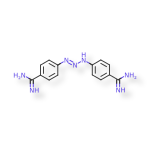
Details
| Stereochemistry | ACHIRAL |
| Molecular Formula | C14H15N7.2ClH |
| Molecular Weight | 354.238 |
| Optical Activity | NONE |
| Defined Stereocenters | 0 / 0 |
| E/Z Centers | 1 |
| Charge | 0 |
SHOW SMILES / InChI
SMILES
Cl.Cl.NC(=N)C1=CC=C(N\N=N\C2=CC=C(C=C2)C(N)=N)C=C1
InChI
InChIKey=QTFXIVUZEWTIAR-UHFFFAOYSA-N
InChI=1S/C14H15N7.2ClH/c15-13(16)9-1-5-11(6-2-9)19-21-20-12-7-3-10(4-8-12)14(17)18;;/h1-8H,(H3,15,16)(H3,17,18)(H,19,20);2*1H
| Molecular Formula | ClH |
| Molecular Weight | 36.461 |
| Charge | 0 |
| Count |
|
| Stereochemistry | ACHIRAL |
| Additional Stereochemistry | No |
| Defined Stereocenters | 0 / 0 |
| E/Z Centers | 0 |
| Optical Activity | NONE |
| Molecular Formula | C14H15N7 |
| Molecular Weight | 281.3158 |
| Charge | 0 |
| Count |
|
| Stereochemistry | ACHIRAL |
| Additional Stereochemistry | No |
| Defined Stereocenters | 0 / 0 |
| E/Z Centers | 1 |
| Optical Activity | NONE |
Diminazene is an aromatic diamidine derived from Surfen C. Diminazene is used as aceturate salt. Diminazene is highly active against both Trypanosoma and Babesia spp. It is also of value in the treatment of theileriosis due to Theileria annulata. Diminazene has become the most commonly used therapeutic agent for trypanosomiasis in animals. It is said to be effective in canine, ovine and bovine babesiosis and, unlike some drugs, is less susceptible to relapse. It may also possess antibacterial properties. Diminazene binds to trypanosomal kDNA. This binding does not occur by intercalation but via specific interaction with sites rich in adenine-thymine (A-T) base pairs. Diminazene specifically inhibits mitochondrial type II topoisomerase in viable trypanosomes. Thus, inhibition of DNA replication may also occur via this interaction. Diminazene is extensively distributed in the body of treated animals. Residues of the compound may persist for several weeks, principally in the liver and kidneys, and also, to a lesser extent, in the gastrointestinal tract, lungs, muscle, brain and fat.
Approval Year
PubMed
| Title | Date | PubMed |
|---|---|---|
| The pathogenesis of anaemia in goats experimentally infected with Trypanosoma congolense or Trypanosoma brucei: use of the myeloid:erythroid ratio. | 2007-02-28 |
|
| Trypanosomiasis by Trypanosoma vivax in cattle in the Brazilian semiarid: Description of an outbreak and lesions in the nervous system. | 2007-01-31 |
|
| Fumagillin, a new P-glycoprotein-interfering agent able to modulate moxidectin efflux in rat hepatocytes. | 2006-12 |
|
| Androgens differentially potentiate mouse intestinal smooth muscle by nongenomic activation of polyamine synthesis and Rho kinase activation. | 2006-12 |
|
| Combined contribution of TbAT1 and TbMRPA to drug resistance in Trypanosoma brucei. | 2006-12 |
|
| Confirmation of diminazene diaceturate in bovine plasma using electrospray liquid chromatography-mass spectrometry. | 2006-11-21 |
|
| SSCP analysis of the P2 purine transporter TcoAT1 gene of Trypanosoma congolense leads to a simple PCR-RFLP test allowing the rapid identification of diminazene resistant stocks. | 2006-11 |
|
| Response of four indigenous cattle breeds to natural tsetse and trypanosomosis challenge in the Ghibe valley of Ethiopia. | 2006-10-10 |
|
| Porcine eperythrozoonosis in China. | 2006-10 |
|
| Equine trypanosomosis in the Central River Division of The Gambia: a study of veterinary gate-clinic consultation records. | 2006-08-17 |
|
| In vitro growth inhibition of bloodstream forms of Trypanosoma brucei and Trypanosoma congolense by iron chelators. | 2006-08-16 |
|
| The effectivity analysis of accumulation of liposomal, micellar, and water-soluble forms of diminazene in cells and in organs. | 2006-08-01 |
|
| Stability analysis for double-stranded DNA oligomers and their noncovalent complexes with drugs by laser spray. | 2006-08 |
|
| Excitability scores of goats administered ascorbic acid and transported during hot-dry conditions. | 2006-06 |
|
| Chemotherapy against babesiosis. | 2006-05-31 |
|
| Epidemiology of Trypanosoma vivax infection in cattle in the tse-tse free area of Lake Chad. | 2006-05-17 |
|
| Study on the susceptibility of Sahel goats to experimental Trypanosoma vivax infection. | 2006-04-30 |
|
| Quantitative analysis of DNA-porphyrin interactions. | 2006-04-05 |
|
| Complexes of poly(ethylene oxide)-block-poly(L-glutamate) and diminazene. | 2006-02-28 |
|
| Drug-resistance of Trypanosoma b. rhodesiense isolates from Tanzania. | 2006-02 |
|
| A diminazene-resistant strain of Trypanosoma brucei brucei isolated from a dog is cross-resistant to pentamidine in experimentally infected albino rats. | 2006-01 |
|
| Leishmania donovani: differential activities of classical topoisomerase inhibitors and antileishmanials against parasite and host cells at the level of DNA topoisomerase I and in cytotoxicity assays. | 2006-01 |
|
| RNA aptamers as potential pharmaceuticals against infections with African trypanosomes. | 2006 |
|
| The susceptibility of Trypanosoma congolense isolated in Zambézia Province, Mozambique, to isometamidium chloride, diminazene aceturate and homidium chloride. | 2005-12 |
|
| Comparative application of wavelet approaches to absorption and ratio spectra for the simultaneous determination of diminazene aceturate and phenazone in veterinary granules for injection. | 2005-12 |
|
| Diminazene aceturate resistance on the virulence of Trypanosoma brucei for rats. | 2005-11 |
|
| Thermodynamic evaluation and modeling of proton and water exchange associated with benzamidine and berenil binding to beta-trypsin. | 2005-11 |
|
| Acquired resistance to berenil in a cloned isolate of Trypanosoma evansi is associated with upregulation of a novel gene, TeDR40. | 2005-11 |
|
| The pharmacokinetics of diminazene aceturate after intramuscular administration in healthy dogs. | 2005-09 |
|
| Synthesis of a novel PEG-block-poly(aspartic acid-stat-phenylalanine) copolymer shows potential for formation of a micellar drug carrier. | 2005-06-13 |
|
| Identification of anti-babesial activity for four ethnoveterinary plants in vitro. | 2005-06-10 |
|
| Susceptibility of West African Dwarf goats and WAD x Saanen crosses to experimental infection with Trypanosoma congolense. | 2005-06-10 |
|
| Anti-babesial compounds from Curcuma zedoaria. | 2005-05 |
|
| Semicarbazide-functionalized Si(111) surfaces for the site-specific immobilization of peptides. | 2005-02-15 |
|
| Knowledge and attitudes of cattle owners regarding trypanosomosis control in tsetse-infested areas of Uganda. | 2004-12 |
|
| Transition models to assess risk factors for new and persistent trypanosome infections in cattle-analysis of longitudinal data from the Ghibe Valley, southwest Ethiopia. | 2004-12 |
|
| Analysis of GAA/TTC DNA triplexes using nuclear magnetic resonance and electrospray ionization mass spectrometry. | 2004-11-15 |
|
| Degradation of berenil (diminazene aceturate) in acidic aqueous solution. | 2004-10 |
|
| Protective efficacy of isometamidium chloride and diminazene aceturate against natural Trypanosoma brucei, Trypanosoma congolense and Trypanosoma vivax infections in cattle under a suppressed tsetse population in Uganda. | 2004-09 |
|
| Trypanocidal failure suggested by PCR results in cattle field samples. | 2004-09 |
|
| Efficacy of combined atovaquone and azithromycin for therapy of chronic Babesia gibsoni (Asian genotype) infections in dogs. | 2004-08-24 |
|
| Gametocytogenesis: the puberty of Plasmodium falciparum. | 2004-07-14 |
|
| Micronuclei induced by aneugens and clastogens in mononucleate and binucleate cells using the cytokinesis block assay. | 2004-07 |
|
| DNA minor groove binders as potential antitumor and antimicrobial agents. | 2004-07 |
|
| Efficacy of Trypan: a diminazene based drug as antileishmanial agent. | 2004-06-01 |
|
| Effect of diminazene block treatment on live redwater vaccine reactions. | 2004-06 |
|
| Lipid-drug conjugate nanoparticles of the hydrophilic drug diminazene-cytotoxicity testing and mouse serum adsorption. | 2004-05-18 |
|
| Application of field methods to assess isometamidium resistance of trypanosomes in cattle in western Ethiopia. | 2004-04 |
|
| RNA-interference silencing of the adenosine transporter-1 gene in Trypanosoma evansi confers resistance to diminazene aceturate. | 2003-10-22 |
|
| Developments in the treatment of leishmaniasis and trypanosomiasis. | 2002-05 |
| Substance Class |
Chemical
Created
by
admin
on
Edited
Tue Apr 01 19:48:36 GMT 2025
by
admin
on
Tue Apr 01 19:48:36 GMT 2025
|
| Record UNII |
V40X8767D1
|
| Record Status |
Validated (UNII)
|
| Record Version |
|
-
Download
| Name | Type | Language | ||
|---|---|---|---|---|
|
Common Name | English | ||
|
Preferred Name | English | ||
|
Common Name | English | ||
|
Systematic Name | English |
| Code System | Code | Type | Description | ||
|---|---|---|---|---|---|
|
147381
Created by
admin on Tue Apr 01 19:48:36 GMT 2025 , Edited by admin on Tue Apr 01 19:48:36 GMT 2025
|
PRIMARY | |||
|
31384-83-5
Created by
admin on Tue Apr 01 19:48:36 GMT 2025 , Edited by admin on Tue Apr 01 19:48:36 GMT 2025
|
PRIMARY | |||
|
357775
Created by
admin on Tue Apr 01 19:48:36 GMT 2025 , Edited by admin on Tue Apr 01 19:48:36 GMT 2025
|
PRIMARY | |||
|
DTXSID20953423
Created by
admin on Tue Apr 01 19:48:36 GMT 2025 , Edited by admin on Tue Apr 01 19:48:36 GMT 2025
|
PRIMARY | |||
|
V40X8767D1
Created by
admin on Tue Apr 01 19:48:36 GMT 2025 , Edited by admin on Tue Apr 01 19:48:36 GMT 2025
|
PRIMARY |
| Related Record | Type | Details | ||
|---|---|---|---|---|
|
|
PARENT -> SALT/SOLVATE |