


Details
| Stereochemistry | RACEMIC |
| Molecular Formula | C11H11Cl2NO2 |
| Molecular Weight | 260.117 |
| Optical Activity | ( + / - ) |
| Defined Stereocenters | 0 / 1 |
| E/Z Centers | 0 |
| Charge | 0 |
SHOW SMILES / InChI
SMILES
CC(O)(C=C)C(=O)NC1=CC(Cl)=CC(Cl)=C1
InChI
InChIKey=FBYYIBNYONAZCU-UHFFFAOYSA-N
InChI=1S/C11H11Cl2NO2/c1-3-11(2,16)10(15)14-9-5-7(12)4-8(13)6-9/h3-6,16H,1H2,2H3,(H,14,15)
| Molecular Formula | C11H11Cl2NO2 |
| Molecular Weight | 260.117 |
| Charge | 0 |
| Count |
|
| Stereochemistry | RACEMIC |
| Additional Stereochemistry | No |
| Defined Stereocenters | 0 / 1 |
| E/Z Centers | 0 |
| Optical Activity | ( + / - ) |
3',5'-DICHLORO-2-HYDROXY-2-METHYLBUT-3-ENANILIDE is a metabolite of vinclozolin, a dicarboximide fungicide widely used in the United States and Europe for control of diseases caused by B. cineera, S. sclerotiorum, and Monilinia species in fruits, grapes, ornamental plants, turfgrass and vegetables. This fungicide possesses antiandrogenic activity. 3',5'-DICHLORO-2-HYDROXY-2-METHYLBUT-3-ENANILIDE has an antiandrogenic activity too. Moreover, it is an antagonist of progesterone, glucocorticoid, mineralocorticoid receptors and agonist for both estrogen receptors. This ability to act via more than one mechanism must be taken into consideration in the risk assessment process.
CNS Activity
Originator
Approval Year
Targets
| Primary Target | Pharmacology | Condition | Potency |
|---|---|---|---|
Target ID: CHEMBL1871 |
9.7 µM [Kd] | ||
Target ID: CHEMBL206 |
1.1 µM [EC50] | ||
Target ID: CHEMBL242 |
18.6 µM [EC50] | ||
Target ID: CHEMBL1994 |
1.4 µM [IC50] | ||
Target ID: CHEMBL2034 |
41.0 µM [IC50] | ||
Target ID: CHEMBL208 |
3.3 µM [IC50] |
Conditions
| Condition | Modality | Targets | Highest Phase | Product |
|---|---|---|---|---|
PubMed
| Title | Date | PubMed |
|---|---|---|
| Pharmacokinetics and dosimetry of the antiandrogen vinclozolin after oral administration in the rat. | 2008-11 |
|
| Steroid receptor profiling of vinclozolin and its primary metabolites. | 2006-10-01 |
|
| Mode of action: inhibition of androgen receptor function--vinclozolin-induced malformations in reproductive development. | 2006-01-19 |
|
| Liquid chromatography determination of the anti-androgen vinclozolin and its metabolites in rat serum. | 2004-09-25 |
|
| Response-surface modeling of the effect of 5alpha-dihydrotestosterone and androgen receptor levels on the response to the androgen antagonist vinclozolin. | 2002-10 |
|
| A novel cell line, MDA-kb2, that stably expresses an androgen- and glucocorticoid-responsive reporter for the detection of hormone receptor agonists and antagonists. | 2002-03 |
|
| Environmental xenoestrogens, antiandrogens and disorders of male sexual differentiation. | 2001-06-10 |
|
| Peripubertal exposure to the antiandrogenic fungicide, vinclozolin, delays puberty, inhibits the development of androgen-dependent tissues, and alters androgen receptor function in the male rat. | 1999-04-03 |
Sample Use Guides
3',5'-DICHLORO-2-HYDROXY-2-METHYLBUT-3-ENANILIDE was able to inhibit rat epididymal 5alpha-reductase activity by 5% at 100uM and 28% at the highest dose examined - 1.0 mM. Since serum level of this drug following in vivo administration is far less than 1 mM, it is unlikely that it acts by inhibiting the enzymatic activity of 5alpha-reductase in the male reproductive target organs.
| Substance Class |
Chemical
Created
by
admin
on
Edited
Mon Mar 31 23:21:09 GMT 2025
by
admin
on
Mon Mar 31 23:21:09 GMT 2025
|
| Record UNII |
U6Y06GAX2T
|
| Record Status |
Validated (UNII)
|
| Record Version |
|
-
Download
| Name | Type | Language | ||
|---|---|---|---|---|
|
Preferred Name | English | ||
|
Systematic Name | English | ||
|
Systematic Name | English | ||
|
Systematic Name | English |
| Code System | Code | Type | Description | ||
|---|---|---|---|---|---|
|
U6Y06GAX2T
Created by
admin on Mon Mar 31 23:21:09 GMT 2025 , Edited by admin on Mon Mar 31 23:21:09 GMT 2025
|
PRIMARY | |||
|
DTXSID9039789
Created by
admin on Mon Mar 31 23:21:09 GMT 2025 , Edited by admin on Mon Mar 31 23:21:09 GMT 2025
|
PRIMARY | |||
|
83792-61-4
Created by
admin on Mon Mar 31 23:21:09 GMT 2025 , Edited by admin on Mon Mar 31 23:21:09 GMT 2025
|
PRIMARY | |||
|
115209
Created by
admin on Mon Mar 31 23:21:09 GMT 2025 , Edited by admin on Mon Mar 31 23:21:09 GMT 2025
|
PRIMARY |
| Related Record | Type | Details | ||
|---|---|---|---|---|
|
PARENT -> DEGRADENT |
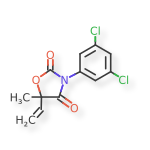
Vinclozolin (20.2 mg) was suspended in tap water (500 mL, pH 8.0), stirred for three days, and then, allowed to stand for further two weeks (20-21 centigrade degree). The suspension was filtered, extracted with diethyl ether (150 mL x 3), dried over sodium sulfate (4 hrs), and analyzed by TLC after evaporation.
CHROMATOGRAPHIC PURITY (TLC)
Scientific Literature
|
| Related Record | Type | Details | ||
|---|---|---|---|---|
|
PARENT -> METABOLITE INACTIVE |
By rat liver microsomes
IN-VITRO
Scientific Literature
|
||
|
PARENT -> METABOLITE INACTIVE |
Inactive against Botrytis cinerea
IN-VITRO
Scientific Literature
|