


Details
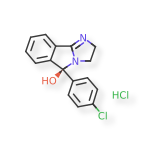
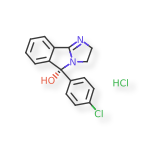
| Stereochemistry | RACEMIC |
| Molecular Formula | C16H13ClN2O.ClH |
| Molecular Weight | 321.201 |
| Optical Activity | ( + / - ) |
| Defined Stereocenters | 0 / 1 |
| E/Z Centers | 0 |
| Charge | 0 |
SHOW SMILES / InChI
SMILES
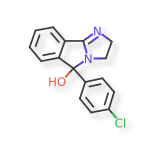
Cl.OC1(N2CCN=C2C3=C1C=CC=C3)C4=CC=C(Cl)C=C4
InChI
InChIKey=NIUFFPYONFMTAH-UHFFFAOYSA-N
InChI=1S/C16H13ClN2O.ClH/c17-12-7-5-11(6-8-12)16(20)14-4-2-1-3-13(14)15-18-9-10-19(15)16;/h1-8,20H,9-10H2;1H
| Molecular Formula | ClH |
| Molecular Weight | 36.461 |
| Charge | 0 |
| Count |
|
| Stereochemistry | ACHIRAL |
| Additional Stereochemistry | No |
| Defined Stereocenters | 0 / 0 |
| E/Z Centers | 0 |
| Optical Activity | NONE |
| Molecular Formula | C16H13ClN2O |
| Molecular Weight | 284.74 |
| Charge | 0 |
| Count |
|
| Stereochemistry | RACEMIC |
| Additional Stereochemistry | No |
| Defined Stereocenters | 0 / 1 |
| E/Z Centers | 0 |
| Optical Activity | ( + / - ) |
Mazindol is an amphetamine-like medicine which was developed by Sandoz in 1967 and approved by FDA for the treatment of obesity and Duchenne muscular dystrophy under the names Sanorex and Mazanor. The exact mechanism of action is unknown, but possibly involves the stimulation of beta-adrenergic receptors and inhibition of monoamine reuptake. Both Sanorex and Mazanor were withdrawn from the market by reason other than safety. NLS Pharma now is developing mazindol for Attention Hyperactivity Disorder in adults (phase II).
Approval Year
Cmax
| Value | Dose | Co-administered | Analyte | Population |
|---|---|---|---|---|
4.09 ng/mL EXPERIMENT https://pubmed.ncbi.nlm.nih.gov/27066959/ |
2 mg single, oral dose: 2 mg route of administration: Oral experiment type: SINGLE co-administered: |
MAZINDOL plasma | Homo sapiens population: HEALTHY age: ADULT sex: MALE food status: FASTED |
AUC
| Value | Dose | Co-administered | Analyte | Population |
|---|---|---|---|---|
35.63 ng × h/mL EXPERIMENT https://pubmed.ncbi.nlm.nih.gov/27066959/ |
2 mg single, oral dose: 2 mg route of administration: Oral experiment type: SINGLE co-administered: |
MAZINDOL plasma | Homo sapiens population: HEALTHY age: ADULT sex: MALE food status: FASTED |
T1/2
| Value | Dose | Co-administered | Analyte | Population |
|---|---|---|---|---|
7.66 h EXPERIMENT https://pubmed.ncbi.nlm.nih.gov/27066959/ |
2 mg single, oral dose: 2 mg route of administration: Oral experiment type: SINGLE co-administered: |
MAZINDOL plasma | Homo sapiens population: HEALTHY age: ADULT sex: MALE food status: FASTED |
PubMed
| Title | Date | PubMed |
|---|---|---|
| Tyr-95 and Ile-172 in transmembrane segments 1 and 3 of human serotonin transporters interact to establish high affinity recognition of antidepressants. | 2006-01-27 |
|
| A reliable model of intravenous MDMA self-administration in naïve mice. | 2006-01 |
|
| Dysfunction of the cortico-basal ganglia-cortical loop in a rat model of early parkinsonism is reversed by metabotropic glutamate receptor 5 antagonism. | 2005-12 |
|
| Differential effects of dopamine and psychoactive drugs on dopamine transporter phosphorylation and regulation. | 2005-11 |
|
| Neurochemical effects of chronic dietary and repeated high-level acute exposure to chlorpyrifos in rats. | 2005-11 |
|
| Enhanced dopamine uptake in the striatum following repeated restraint stress. | 2005-09-01 |
|
| Endothelin-1 inhibits the neuronal norepinephrine transporter in hearts of male rats. | 2005-08-01 |
|
| The interaction of methylphenidate and benztropine with the dopamine transporter is different than other substrates and ligands. | 2005-08-01 |
|
| Perinatal heptachlor exposure increases expression of presynaptic dopaminergic markers in mouse striatum. | 2005-08 |
|
| Recognition of benztropine by the dopamine transporter (DAT) differs from that of the classical dopamine uptake inhibitors cocaine, methylphenidate, and mazindol as a function of a DAT transmembrane 1 aspartic acid residue. | 2005-08 |
|
| Pharmacological characterization of ecstasy synthesis byproducts with recombinant human monoamine transporters. | 2005-07 |
|
| Dopaminergic innervation of the human striatum in Parkinson's disease. | 2005-07 |
|
| Obesity. | 2005-06 |
|
| Mechanism of 1-methyl-4-phenylpyridinium-induced dopamine release from PC12 cells. | 2005-05 |
|
| Effects of monoamine reuptake inhibitors on wet-dog shakes mediated by 5-HT2A receptors in ACTH-treated rats. | 2005-05 |
|
| Inhibiting BDNF expression by antisense oligonucleotide infusion causes loss of nigral dopaminergic neurons. | 2005-03 |
|
| Pharmacotherapy for weight loss in adults with type 2 diabetes mellitus. | 2005-01-25 |
|
| Hypersomnia. | 2005 |
|
| Pharmacotherapy for obesity. | 2005 |
|
| Diabesity: are weight loss medications effective? | 2005 |
|
| Differential effects of prolonged high frequency stimulation and of excitotoxic lesion of the subthalamic nucleus on dopamine denervation-induced cellular defects in the rat striatum and globus pallidus. | 2004-12 |
|
| Sensitivity to oxidative stress in DJ-1-deficient dopamine neurons: an ES- derived cell model of primary Parkinsonism. | 2004-11 |
|
| Low dose pramipexole is neuroprotective in the MPTP mouse model of Parkinson's disease, and downregulates the dopamine transporter via the D3 receptor. | 2004-10-11 |
|
| Binding of [3H]mazindol to cardiac norepinephrine transporters: kinetic and equilibrium studies. | 2004-07 |
|
| Obesity. | 2004-06 |
|
| A model of L-DOPA-induced dyskinesia in 6-hydroxydopamine lesioned mice: relation to motor and cellular parameters of nigrostriatal function. | 2004-06 |
|
| [Determination of fenfluramine, diethylpropion and mazindol in slimming foods by gas chromatography-mass spectrometry]. | 2004-05 |
|
| The inhibitory role of methylation on the binding characteristics of dopamine receptors and transporter. | 2004-03 |
|
| Uptake inhibitors but not substrates induce protease resistance in extracellular loop two of the dopamine transporter. | 2004-03 |
|
| Dopamine agonist 3-PPP fails to protect against MPTP-induced toxicity. | 2004-02 |
|
| Synergistic interaction between mazindol, an anorectic drug, and swim-stress on analgesic responses in the formalin test in mice. | 2004-01-23 |
|
| Chronic intoxication with 3-nitropropionic acid in rats induces the loss of striatal dopamine terminals without affecting nigral cell viability. | 2004-01-16 |
|
| Dopamine transmission in DYT1 dystonia. | 2004 |
|
| Obesity. | 2003-12 |
|
| Dependence and chronic psychosis with D-nor-pseudoephedrine. | 2003-12 |
|
| The human dopamine transporter forms a tetramer in the plasma membrane: cross-linking of a cysteine in the fourth transmembrane segment is sensitive to cocaine analogs. | 2003-11-14 |
|
| Apparent opposite effects of tetrabenazine and reserpine on the toxic effects of 1-methyl-4-phenylpyridinium or 6-hydroxydopamine on nigro-striatal dopaminergic neurons. | 2003-11-07 |
|
| Dopamine transporter as target for drug development of cocaine dependence medications. | 2003-10-31 |
|
| Inhibition of the norepinephrine transporter by the venom peptide chi-MrIA. Site of action, Na+ dependence, and structure-activity relationship. | 2003-10-10 |
|
| GM1 enhances dopaminergic markers in the brain of aged rats. | 2003-10 |
|
| Destruction of midbrain dopaminergic neurons by using immunotoxin to dopamine transporter. | 2003-10 |
|
| Dual effects of intermittent or continuous L-DOPA administration on gene expression in the globus pallidus and subthalamic nucleus of adult rats with a unilateral 6-OHDA lesion. | 2003-09-15 |
|
| Strain differences in the distribution of dopamine transporter sites in rat brain. | 2003-09 |
|
| Acquired narcolepsy in an acromegalic patient who underwent pituitary irradiation. | 2003-08-26 |
|
| Serotonin transporter and MAO-B levels in monoamine nuclei of the human brainstem are normal in major depression. | 2003-07-10 |
|
| Changes in function and ultrastructure of striatal dopaminergic terminals that regenerate following partial lesions of the SNpc. | 2003-07 |
|
| Rapid reduction of ATP synthesis and lack of free radical formation by MPP+ in rat brain synaptosomes and mitochondria. | 2003-06-13 |
|
| Risk of valvular heart disease associated with use of fenfluramine. | 2003-06-11 |
|
| Discriminative stimulus effects of (-)-ephedrine in rats: analysis with catecholamine transporter and receptor ligands. | 2003-06-05 |
|
| Changes in GABA(B) receptor mRNA expression in the rodent basal ganglia and thalamus following lesion of the nigrostriatal pathway. | 2003 |
Patents
Sample Use Guides
In Vivo Use Guide
Sources: DOI: 10.1604/9780440235378, Catalano J., 'The Women's Pharmacy: An Essential Guide to What Women Should Know About Prescription Drugs' (2008), p.218, Retrieved from https://books.google.es/books?id=WueSNTyQq6sC&dq
The usual dose is 1 mg three times a day an hour before meals or 2 mg once a day an our before lunch.
Route of Administration:
Oral
| Substance Class |
Chemical
Created
by
admin
on
Edited
Mon Mar 31 23:07:54 GMT 2025
by
admin
on
Mon Mar 31 23:07:54 GMT 2025
|
| Record UNII |
TYC95TXB8Q
|
| Record Status |
Validated (UNII)
|
| Record Version |
|
-
Download
| Name | Type | Language | ||
|---|---|---|---|---|
|
Preferred Name | English | ||
|
Common Name | English | ||
|
Systematic Name | English |
| Code System | Code | Type | Description | ||
|---|---|---|---|---|---|
|
TYC95TXB8Q
Created by
admin on Mon Mar 31 23:07:54 GMT 2025 , Edited by admin on Mon Mar 31 23:07:54 GMT 2025
|
PRIMARY | |||
|
DTXSID60974091
Created by
admin on Mon Mar 31 23:07:54 GMT 2025 , Edited by admin on Mon Mar 31 23:07:54 GMT 2025
|
PRIMARY | |||
|
26859-70-1
Created by
admin on Mon Mar 31 23:07:54 GMT 2025 , Edited by admin on Mon Mar 31 23:07:54 GMT 2025
|
NON-SPECIFIC STOICHIOMETRY | |||
|
3041799
Created by
admin on Mon Mar 31 23:07:54 GMT 2025 , Edited by admin on Mon Mar 31 23:07:54 GMT 2025
|
PRIMARY | |||
|
DBSALT002359
Created by
admin on Mon Mar 31 23:07:54 GMT 2025 , Edited by admin on Mon Mar 31 23:07:54 GMT 2025
|
PRIMARY | |||
|
58535-70-9
Created by
admin on Mon Mar 31 23:07:54 GMT 2025 , Edited by admin on Mon Mar 31 23:07:54 GMT 2025
|
PRIMARY |
| Related Record | Type | Details | ||
|---|---|---|---|---|
|
|
ENANTIOMER -> RACEMATE | |||
|
|
PARENT -> SALT/SOLVATE | |||
|
|
ENANTIOMER -> RACEMATE |
| Related Record | Type | Details | ||
|---|---|---|---|---|
|
|
ACTIVE MOIETY |