


Details
| Stereochemistry | ABSOLUTE |
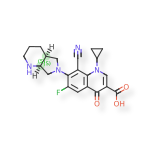
| Molecular Formula | C21H21FN4O3.3H2O |
| Molecular Weight | 450.4607 |
| Optical Activity | UNSPECIFIED |
| Defined Stereocenters | 2 / 2 |
| E/Z Centers | 0 |
| Charge | 0 |
SHOW SMILES / InChI
SMILES
O.O.O.OC(=O)C1=CN(C2CC2)C3=C(C=C(F)C(N4C[C@@H]5CCCN[C@@H]5C4)=C3C#N)C1=O
InChI
InChIKey=OTPLAFVGCAMVAC-DEWAGMQLSA-N
InChI=1S/C21H21FN4O3.3H2O/c22-16-6-13-18(26(12-3-4-12)9-15(20(13)27)21(28)29)14(7-23)19(16)25-8-11-2-1-5-24-17(11)10-25;;;/h6,9,11-12,17,24H,1-5,8,10H2,(H,28,29);3*1H2/t11-,17+;;;/m0.../s1
| Molecular Formula | C21H21FN4O3 |
| Molecular Weight | 396.4148 |
| Charge | 0 |
| Count |
|
| Stereochemistry | ABSOLUTE |
| Additional Stereochemistry | No |
| Defined Stereocenters | 2 / 2 |
| E/Z Centers | 0 |
| Optical Activity | UNSPECIFIED |
| Molecular Formula | H2O |
| Molecular Weight | 18.0153 |
| Charge | 0 |
| Count |
|
| Stereochemistry | ACHIRAL |
| Additional Stereochemistry | No |
| Defined Stereocenters | 0 / 0 |
| E/Z Centers | 0 |
| Optical Activity | NONE |
Pradofloxacin (trade name Veraflox) is a 3rd generation enhanced spectrum veterinary antibiotic of the fluoroquinolone class. It was developed by Bayer HealthCare AG, Animal Health GmbH, and received approval from the European Commission in April 2011 for prescription-only use in veterinary medicine for the treatment of bacterial infections in dogs and cats. The primary mode of action of fluoroquinolones involves interaction with enzymes essential for major DNA functions such as replication, transcription, and recombination. The primary targets for Pradofloxacin are the bacterial DNA gyrase and topoisomerase IV enzymes. Reversible association between Pradofloxacin and DNA gyrase or DNA topoisomerase IV in the target bacteria results in inhibition of these enzymes and rapid death of the bacterial cell. The rapidity and extent of bacterial killing are directly proportional to the drug concentration.
Approval Year
PubMed
| Title | Date | PubMed |
|---|---|---|
| Fluoroquinolone resistance mechanisms in multidrug-resistant Escherichia coli isolated from extraintestinal infections in dogs. | 2010-11-20 |
|
| Evaluation of the clinical efficacy of pradofloxacin tablets for the treatment of canine pyoderma. | 2010-09-03 |
|
| Identification of Qnr and AAC(6')-1b-cr plasmid-mediated fluoroquinolone resistance determinants in multidrug-resistant Enterobacter spp. isolated from extraintestinal infections in companion animals. | 2010-07-14 |
|
| Haemotropic mycoplasmas: what's their real significance in cats? | 2010-05 |
|
| Molecular mechanisms of Bartonella henselae resistance to azithromycin, pradofloxacin and enrofloxacin. | 2010-03 |
|
| Use of pradofloxacin to treat experimentally induced Mycoplasma hemofelis infection in cats. | 2009-01 |
|
| Evaluation of pradofloxacin for the treatment of feline rhinitis. | 2008-10 |
|
| Retinal safety of a new fluoroquinolone, pradofloxacin, in cats: assessment with electroretinography. | 2008-05 |
|
| Pharmacokinetics of pradofloxacin and doxycycline in serum, saliva, and tear fluid of cats after oral administration. | 2008-04 |
|
| Efficacy of pradofloxacin in cats with feline upper respiratory tract disease due to Chlamydophila felis or Mycoplasma infections. | 2008-02-22 |
|
| Comparative activity of pradofloxacin against anaerobic bacteria isolated from dogs and cats. | 2007-11 |
|
| Clinical efficacy and palatability of pradofloxacin 2.5% oral suspension for the treatment of bacterial lower urinary tract infections in cats. | 2007-10-18 |
|
| Pradofloxacin in the treatment of canine deep pyoderma: a multicentred, blinded, randomized parallel trial. | 2007-06 |
|
| Mutant prevention concentration of pradofloxacin against Porphyromonas gingivalis. | 2007-03-31 |
|
| In vivo tolerance and kinetics of a novel ocular drug delivery device. | 2006-11-28 |
|
| Antimicrobial drug susceptibility of Staphylococcus intermedius clinical isolates from canine pyoderma. | 2005-02 |
|
| Studies on a new device for drug delivery to the eye. | 2005-02 |
Patents
Sample Use Guides
Administer 3.0 mg/kg bodyweight of pradofloxacin once daily.
Route of Administration:
Oral
The MIC of pradofloxacinc was determined by broth microdilution according to Clinical and Laboratory Standards Institute (CLSI) standards,6 within the concentration range 0.008–16 μg/mL. The MICs of enrofloxacin and ciprofloxacin were determined using commercial stripsd on Mueller–Hinton 2 agar inoculated with a bacterial suspension (density of 0.5 McFarland) and incubated for 24 h at 35°C. The reference strain S. aureus ATCC 25923 was used as a quality control for MIC determination with the commercial strips, according to the manufacturer’s instructions.
| Substance Class |
Chemical
Created
by
admin
on
Edited
Wed Apr 02 17:24:25 GMT 2025
by
admin
on
Wed Apr 02 17:24:25 GMT 2025
|
| Record UNII |
T9J58ERF3L
|
| Record Status |
Validated (UNII)
|
| Record Version |
|
-
Download
| Name | Type | Language | ||
|---|---|---|---|---|
|
Preferred Name | English | ||
|
Common Name | English | ||
|
Systematic Name | English |
| Code System | Code | Type | Description | ||
|---|---|---|---|---|---|
|
67315146
Created by
admin on Wed Apr 02 17:24:25 GMT 2025 , Edited by admin on Wed Apr 02 17:24:25 GMT 2025
|
PRIMARY | |||
|
T9J58ERF3L
Created by
admin on Wed Apr 02 17:24:25 GMT 2025 , Edited by admin on Wed Apr 02 17:24:25 GMT 2025
|
PRIMARY | |||
|
866760-50-1
Created by
admin on Wed Apr 02 17:24:25 GMT 2025 , Edited by admin on Wed Apr 02 17:24:25 GMT 2025
|
PRIMARY |
| Related Record | Type | Details | ||
|---|---|---|---|---|
|
ANHYDROUS->SOLVATE |
|
||
|
PARENT -> SALT/SOLVATE |
|
| Related Record | Type | Details | ||
|---|---|---|---|---|
|
ACTIVE MOIETY |
|