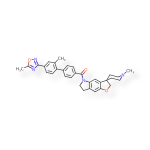
Details
| Stereochemistry | ACHIRAL |
| Molecular Formula | C32H32N4O3.ClH |
| Molecular Weight | 557.082 |
| Optical Activity | NONE |
| Defined Stereocenters | 0 / 0 |
| E/Z Centers | 0 |
| Charge | 0 |
SHOW SMILES / InChI
SMILES
Cl.CN1CCC2(COC3=C2C=C4N(CCC4=C3)C(=O)C5=CC=C(C=C5)C6=C(C)C=C(C=C6)C7=NOC(C)=N7)CC1
InChI
InChIKey=GKGKBZYMDILCOF-UHFFFAOYSA-N
InChI=1S/C32H32N4O3.ClH/c1-20-16-25(30-33-21(2)39-34-30)8-9-26(20)22-4-6-23(7-5-22)31(37)36-13-10-24-17-29-27(18-28(24)36)32(19-38-29)11-14-35(3)15-12-32;/h4-9,16-18H,10-15,19H2,1-3H3;1H
| Molecular Formula | C32H32N4O3 |
| Molecular Weight | 520.6215 |
| Charge | 0 |
| Count |
|
| Stereochemistry | ACHIRAL |
| Additional Stereochemistry | No |
| Defined Stereocenters | 0 / 0 |
| E/Z Centers | 0 |
| Optical Activity | NONE |
| Molecular Formula | ClH |
| Molecular Weight | 36.461 |
| Charge | 0 |
| Count |
|
| Stereochemistry | ACHIRAL |
| Additional Stereochemistry | No |
| Defined Stereocenters | 0 / 0 |
| E/Z Centers | 0 |
| Optical Activity | NONE |
SB-224289 was originally developed by SmithKline, now known as GlaxoSmithKline. It was identified as an antagonist of the 5-hydroxytryptamine receptor 1B (5-HT1B) and subsequently investigated for potential antidepressant activity, although no human trials have been reported. Interestingly, SB-224289 was also found to exhibit antagonistic activity for the antifungal mechanism of Marine Depsipeptide Papuamide A in Candida albicans; although the specific mechanism of action remains unknown.
Approval Year
PubMed
| Title | Date | PubMed |
|---|---|---|
| Effects of 5-HT in globus pallidus on haloperidol-induced catalepsy in rats. | 2009-04-17 |
|
| Effects of 5-HT drugs in prefrontal cortex during memory formation and the ketamine amnesia-model. | 2008 |
|
| Dopamine released from 5-HT terminals is the cause of L-DOPA-induced dyskinesia in parkinsonian rats. | 2007-07 |
|
| Donitriptan, but not sumatriptan, inhibits capsaicin-induced canine external carotid vasodilatation via 5-HT1B rather than 5-HT1D receptors. | 2006-09 |
|
| Pharmacological characterisation of the agonist radioligand binding site of 5-HT(2A), 5-HT(2B) and 5-HT(2C) receptors. | 2004-08 |
|
| The role of the 5-HT1D receptor as a presynaptic autoreceptor in the guinea pig. | 2004-06-16 |
|
| Specific labelling of serotonin 5-HT(1B) receptors in rat frontal cortex with the novel, phenylpiperazine derivative, [3H]GR125,743. A pharmacological characterization. | 2002-04 |
|
| Agonist properties of pindolol at h5-HT1A receptors coupled to mitogen-activated protein kinase. | 2001-07-13 |
|
| Inverse agonism and constitutive activity as functional correlates of serotonin h5-HT(1B) receptor/G-protein stoichiometry. | 2000-11 |
|
| SB-224289--a novel selective (human) 5-HT1B receptor antagonist with negative intrinsic activity. | 1998-09 |
|
| The selective 5-HT1B receptor inverse agonist 1'-methyl-5-[[2'-methyl-4'-(5-methyl-1,2, 4-oxadiazol-3-yl)biphenyl-4-yl]carbonyl]-2,3,6,7-tetrahydro- spiro[furo[2,3-f]indole-3,4'-piperidine] (SB-224289) potently blocks terminal 5-HT autoreceptor function both in vitro and in vivo. | 1998-04-09 |
Patents
Sample Use Guides
The regulation of extracellular 5-HT1B receptors by SB-224289 was investigated in Guinea pigs which were dosed via intraperitoneal injection at a concentration of 4 mg/kg. SB-224289 had no effect on 5-HT levels in frontal cortex or striatum. In the dentate gyrus SB-224289 significantly increased extracellular 5-HT, reaching maxima of 151+/-19% of basal levels.
Route of Administration:
Intraperitoneal
Human 5-HT1B and 5-HT1D receptors were stably transfected into the Chinese Hamster Ovary (ACC098) cell line. Competition studies were performed to determine the affinity of SB-224289 at both h5-HT1B and h5-HT1D receptor subtypes. SB-224289 was also equal to or greater than 75 fold selective for the h5-HT1B receptor over the other human 5-HT receptor subtypes exhibiting a pKi of 8 for human 5HT1B.
| Substance Class |
Chemical
Created
by
admin
on
Edited
Mon Mar 31 21:54:43 GMT 2025
by
admin
on
Mon Mar 31 21:54:43 GMT 2025
|
| Record UNII |
RTX59ZSB74
|
| Record Status |
Validated (UNII)
|
| Record Version |
|
-
Download
| Name | Type | Language | ||
|---|---|---|---|---|
|
Common Name | English | ||
|
Preferred Name | English | ||
|
Systematic Name | English | ||
|
Systematic Name | English | ||
|
Code | English |
| Code System | Code | Type | Description | ||
|---|---|---|---|---|---|
|
RTX59ZSB74
Created by
admin on Mon Mar 31 21:54:43 GMT 2025 , Edited by admin on Mon Mar 31 21:54:43 GMT 2025
|
PRIMARY | |||
|
DTXSID9042627
Created by
admin on Mon Mar 31 21:54:43 GMT 2025 , Edited by admin on Mon Mar 31 21:54:43 GMT 2025
|
PRIMARY | |||
|
180084-26-8
Created by
admin on Mon Mar 31 21:54:43 GMT 2025 , Edited by admin on Mon Mar 31 21:54:43 GMT 2025
|
PRIMARY | |||
|
11226716
Created by
admin on Mon Mar 31 21:54:43 GMT 2025 , Edited by admin on Mon Mar 31 21:54:43 GMT 2025
|
PRIMARY |
| Related Record | Type | Details | ||
|---|---|---|---|---|
|
|
PARENT -> SALT/SOLVATE |