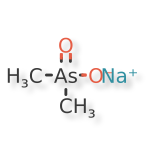
Details
| Stereochemistry | ACHIRAL |
| Molecular Formula | C2H6AsO2.Na.3H2O |
| Molecular Weight | 214.025 |
| Optical Activity | NONE |
| Defined Stereocenters | 0 / 0 |
| E/Z Centers | 0 |
| Charge | 0 |
SHOW SMILES / InChI
SMILES
O.O.O.[Na+].C[As](C)([O-])=O
InChI
InChIKey=RLGWPHBPRCROJO-UHFFFAOYSA-M
InChI=1S/C2H7AsO2.Na.3H2O/c1-3(2,4)5;;;;/h1-2H3,(H,4,5);;3*1H2/q;+1;;;/p-1
| Molecular Formula | H2O |
| Molecular Weight | 18.0153 |
| Charge | 0 |
| Count |
|
| Stereochemistry | ACHIRAL |
| Additional Stereochemistry | No |
| Defined Stereocenters | 0 / 0 |
| E/Z Centers | 0 |
| Optical Activity | NONE |
| Molecular Formula | C2H6AsO2 |
| Molecular Weight | 136.9894 |
| Charge | -1 |
| Count |
|
| Stereochemistry | ACHIRAL |
| Additional Stereochemistry | No |
| Defined Stereocenters | 0 / 0 |
| E/Z Centers | 0 |
| Optical Activity | NONE |
| Molecular Formula | Na |
| Molecular Weight | 22.98976928 |
| Charge | 1 |
| Count |
|
| Stereochemistry | ACHIRAL |
| Additional Stereochemistry | No |
| Defined Stereocenters | 0 / 0 |
| E/Z Centers | 0 |
| Optical Activity | NONE |
Cacodylic acid also known as dimethylarsinic acid (DMA) has been used as a herbicide. As a part of agent blue it used to destroy broadleaf plants and trees, especially rice paddies during the Vietnam War. DMA is the major metabolite formed after exposure to tri- (arsenite) or pentavalent (arsenate) inorganic arsenic (iAs) via ingestion or inhalation in both humans and rodents. DMA induces an organ-specific lesion--single strand breaks in DNA. Mechanistic studies have suggested that this damage is due mainly to the peroxyl radical of DMA and production of active oxygen species by pulmonary tissues. Multi-organ initiation-promotion studies have demonstrated that DMA acts as a promotor of urinary bladder, kidney, liver and thyroid gland cancers in rats and as a promotor of lung tumors in mice. Thus it was shown, that DMA played a role in the carcinogenesis of inorganic arsenic.
Originator
Approval Year
PubMed
| Title | Date | PubMed |
|---|---|---|
| Characterization of arsenic hepatobiliary transport using sandwich-cultured human hepatocytes. | 2015-06 |
|
| Role of autophagy in arsenite-induced neurotoxicity: the involvement of α-synuclein. | 2015-03-18 |
|
| Differential influences of various arsenic compounds on antioxidant defense system in liver and kidney of rats. | 2013-11 |
|
| SLCO1B1 variants and urine arsenic metabolites in the Strong Heart Family Study. | 2013-11 |
|
| Evaluation of gene expression changes in human primary uroepithelial cells following 24-hr exposures to inorganic arsenic and its methylated metabolites. | 2013-03 |
|
| Association between arsenic suppression of adipogenesis and induction of CHOP10 via the endoplasmic reticulum stress response. | 2013-02 |
|
| Methylation of arsenic by recombinant human wild-type arsenic (+3 oxidation state) methyltransferase and its methionine 287 threonine (M287T) polymorph: Role of glutathione. | 2012-10-01 |
|
| Effect of topical dimethylarsinic acid on the expression of apoptosis-related proteins in mouse skin. | 2012-05 |
|
| Arsenic affects expression and processing of amyloid precursor protein (APP) in primary neuronal cells overexpressing the Swedish mutation of human APP. | 2011-06 |
|
| Differential cytotoxic effects of arsenic compounds in human acute promyelocytic leukemia cells. | 2009-08-15 |
|
| [Inhibition of (-)epigallocatechin gallate on dimethylarsinic acid promoting lung tumorigenesis through the induction of oxidative stress in mice]. | 2008-11 |
|
| Effects of endogenous hydrogen peroxide and glutathione on the stability of arsenic metabolites in rat bile. | 2008-10-01 |
|
| Identification of interspecies concordance of mechanisms of arsenic-induced bladder cancer. | 2007-12 |
|
| Elevation of 8-hydroxydeoxyguanosine and cell proliferation via generation of oxidative stress by organic arsenicals contributes to their carcinogenicity in the rat liver and bladder. | 2007-06-15 |
|
| Carcinogenicity of dimethylarsinic acid in Ogg1-deficient mice. | 2007-06 |
|
| Possible application of human c-Ha-ras proto-oncogene transgenic rats in a medium-term bioassay model for carcinogens. | 2007-04 |
|
| Arsenic methylation, GSTT1, GSTM1, GSTP1 polymorphisms, and skin lesions. | 2007-03 |
|
| Chronic exposure to methylated arsenicals stimulates arsenic excretion pathways and induces arsenic tolerance in rat liver cells. | 2006-05 |
|
| A comparative study of the sub-chronic toxic effects of three organic arsenical compounds on the urothelium in F344 rats; gender-based differences in response. | 2006-02-01 |
|
| Gene expression profiling of responses to dimethylarsinic acid in female F344 rat urothelium. | 2005-11-15 |
|
| The role of trivalent dimethylated arsenic in dimethylarsinic acid-promoted skin and lung tumorigenesis in mice: tumor-promoting action through the induction of oxidative stress. | 2005-08-14 |
|
| Effects of co-administration of antioxidants and arsenicals on the rat urinary bladder epithelium. | 2005-02 |
|
| Role of glutathione in dimethylarsinic acid-induced apoptosis. | 2004-08-01 |
|
| Biokinetics and subchronic toxic effects of oral arsenite, arsenate, monomethylarsonic acid, and dimethylarsinic acid in v-Ha-ras transgenic (Tg.AC) mice. | 2004-08 |
|
| Induction of structural and numerical changes of chromosome, centrosome abnormality, multipolar spindles and multipolar division in cultured Chinese hamster V79 cells by exposure to a trivalent dimethylarsenic compound. | 2003-09-29 |
|
| Carcinogenicity of dimethylarsinic acid in male F344 rats and genetic alterations in induced urinary bladder tumors. | 2002-08 |
|
| Promoting effects of monomethylarsonic acid, dimethylarsinic acid and trimethylarsine oxide on induction of rat liver preneoplastic glutathione S-transferase placental form positive foci: a possible reactive oxygen species mechanism. | 2002-07-10 |
|
| Inorganic and methylated arsenic compounds induce cell death in murine macrophages via different mechanisms. | 1998-04 |
Patents
Sample Use Guides
mutagenicity in rats: The purpose of present study is to evaluate the in vivo mutagenicities of dimethylarsinic acid (DMAV), (Cacodylic acid) and sodium arsenite (iAs) in rat urinary bladder epithelium and liver using gpt delta F344 rats. Ten-week old male gpt delta F344 rats were randomized into 3 groups and administered 0, 92 mg/L dimethylarsinic acid (DMAV), or 87mg/L sodium arsenite (iAs) (each 50mg/L As) for 13 weeks in the drinking water.
Route of Administration:
Oral
Gene damage in cultured human alveolar (L-132) cells induced by exposure to dimethylarsinic acid (DMAA) was stidued. DNA single-strand breaks and DNA-protein cross-links were induced by the treatment of L-132 cells with 10 mM DMAA. These kinds of damage appeared at 8 hr after start of exposure to DMAA. As regards DNA-protein cross-links, the DNA was found to bind not only to core histone proteins but also linker histone (H1) and nonhistone proteins. Furthermore, the cross-links were formed by the binding to serine or threonine residues of H1 or nonhistone proteins through phosphate moieties of the DNA. The induction of the alkali-labile sites in DNA in DMAA-treated L-132 cells was observed prior to that of DNA single-strand breaks and DNA-protein cross-links. As one of the alkali-labile sites in DNA, we estimated apurinic/apyrimidinic (AP) sites in DNA.
| Substance Class |
Chemical
Created
by
admin
on
Edited
Mon Mar 31 21:44:12 GMT 2025
by
admin
on
Mon Mar 31 21:44:12 GMT 2025
|
| Record UNII |
R7A6NC7YGY
|
| Record Status |
Validated (UNII)
|
| Record Version |
|
-
Download
| Name | Type | Language | ||
|---|---|---|---|---|
|
Systematic Name | English | ||
|
Preferred Name | English | ||
|
Common Name | English | ||
|
Systematic Name | English |
| Code System | Code | Type | Description | ||
|---|---|---|---|---|---|
|
R7A6NC7YGY
Created by
admin on Mon Mar 31 21:44:12 GMT 2025 , Edited by admin on Mon Mar 31 21:44:12 GMT 2025
|
PRIMARY | |||
|
DTXSID701319372
Created by
admin on Mon Mar 31 21:44:12 GMT 2025 , Edited by admin on Mon Mar 31 21:44:12 GMT 2025
|
PRIMARY | |||
|
m10000
Created by
admin on Mon Mar 31 21:44:12 GMT 2025 , Edited by admin on Mon Mar 31 21:44:12 GMT 2025
|
PRIMARY | Merck Index | ||
|
23679059
Created by
admin on Mon Mar 31 21:44:12 GMT 2025 , Edited by admin on Mon Mar 31 21:44:12 GMT 2025
|
PRIMARY | |||
|
6131-99-3
Created by
admin on Mon Mar 31 21:44:12 GMT 2025 , Edited by admin on Mon Mar 31 21:44:12 GMT 2025
|
PRIMARY |
| Related Record | Type | Details | ||
|---|---|---|---|---|
|
ANHYDROUS->SOLVATE |