


Details
| Stereochemistry | RACEMIC |
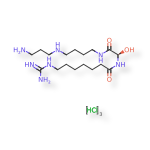
| Molecular Formula | C17H37N7O3.3ClH |
| Molecular Weight | 496.904 |
| Optical Activity | ( + / - ) |
| Defined Stereocenters | 0 / 1 |
| E/Z Centers | 0 |
| Charge | 0 |
SHOW SMILES / InChI
SMILES
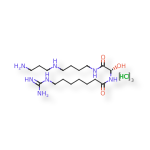
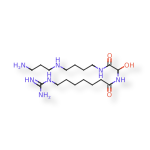
Cl.Cl.Cl.NCCCNCCCCNC(=O)C(O)NC(=O)CCCCCCNC(N)=N
InChI
InChIKey=AXSPHUWXYSZPBG-UHFFFAOYSA-N
InChI=1S/C17H37N7O3.3ClH/c18-9-7-11-21-10-5-6-12-22-15(26)16(27)24-14(25)8-3-1-2-4-13-23-17(19)20;;;/h16,21,27H,1-13,18H2,(H,22,26)(H,24,25)(H4,19,20,23);3*1H
| Molecular Formula | ClH |
| Molecular Weight | 36.461 |
| Charge | 0 |
| Count |
|
| Stereochemistry | ACHIRAL |
| Additional Stereochemistry | No |
| Defined Stereocenters | 0 / 0 |
| E/Z Centers | 0 |
| Optical Activity | NONE |
| Molecular Formula | C17H37N7O3 |
| Molecular Weight | 387.5208 |
| Charge | 0 |
| Count |
|
| Stereochemistry | RACEMIC |
| Additional Stereochemistry | No |
| Defined Stereocenters | 0 / 1 |
| E/Z Centers | 0 |
| Optical Activity | ( + / - ) |
DescriptionCurator's Comment: description was created based on several sources, including, www.ncbi.nlm.nih.gov/pubmed/24501242
Curator's Comment: description was created based on several sources, including, www.ncbi.nlm.nih.gov/pubmed/24501242
Gusperimus is an antibiotic, isolated from cultures of the soil commensal Bacillus laterosporus. It possess immunosuppressive properties and exerts its effect through binding to heat shock proteins Hsp90 and Hsc70. Although initially, the drug was being investigated for the treatment of cancer, it recieved orphan designation for the treatment of refractory Wegener’s granulomatosis.
Approval Year
Targets
| Primary Target | Pharmacology | Condition | Potency |
|---|---|---|---|
Target ID: CHEMBL2095165 |
|||
Target ID: P0DMV8 Gene ID: 3303|||3304 Gene Symbol: HSPA1A Target Organism: Homo sapiens (Human) |
|||
Target ID: P0DMV9 Gene ID: 3303|||3304 Gene Symbol: HSPA1B Target Organism: Homo sapiens (Human) |
Conditions
| Condition | Modality | Targets | Highest Phase | Product |
|---|---|---|---|---|
| Primary | SPANIDIN Approved UseSpanidin (0.5 mg/kg body weight (BW)) is indicated as therapy for induction of remission in adult patients suffering from refractory Wegener’s granulomatosis, unresolved by standard treatment with cyclophosphamide and glucocorticoids according to EULAR recommendations. Launch Date2001 |
PubMed
| Title | Date | PubMed |
|---|---|---|
| Clinicopathological analysis of acute vascular rejection cases after renal transplantation. | 2010-07 |
|
| Reduction of MPO-ANCA epitopes in SCG/Kj mice by 15-deoxyspergualin treatment restricted by IgG2b associated with crescentic glomerulonephritis. | 2010-07 |
|
| Long-term treatment of relapsing Wegener's granulomatosis with 15-deoxyspergualin. | 2010-03 |
|
| Plasmodial heat shock proteins: targets for chemotherapy. | 2010-02 |
|
| Deoxyspergualin in relapsing and refractory Wegener's granulomatosis. | 2009-07 |
|
| Cooperation of salivary protein histatin 3 with heat shock cognate protein 70 relative to the G1/S transition in human gingival fibroblasts. | 2009-05-22 |
|
| Polyamine compound deoxyspergualin inhibits heat shock protein-induced activation of immature dendritic cells. | 2009-03 |
|
| Induction of T regulatory cells attenuates idiopathic nephrotic syndrome. | 2009-01 |
|
| Differential promotion of hematopoietic chimerism and inhibition of alloreactive T cell proliferation by combinations of anti-CD40Ligand, anti-LFA-1, everolimus, and deoxyspergualin. | 2008-11 |
|
| Maintaining remission in a patient with vasculitis. | 2008-09 |
|
| Evaluation of the ameliorative effects of immunosuppressants on crescentic glomerulonephritis in SCG/Kj mice. | 2008-09 |
|
| Chemical conjugation of DeltaF508-CFTR corrector deoxyspergualin to transporter human serum albumin enhances its ability to rescue Cl- channel functions. | 2008-08 |
|
| IL-10 and IL-4 in skin allograft survival induced by T-cell depletion plus deoxyspergualin. | 2008 |
|
| Control of cyclosporine A-induced tumor progression using 15-deoxyspergualin for rat cardiac transplantation. | 2007-08-15 |
|
| 15-deoxyspergualin prevents mucosal injury by inhibiting production of TNF-alpha and down-regulating expression of MD-1 in a murine model of TNBS-induced colitis. | 2007-08 |
|
| Association of treatment with 15-deoxyspergualin and BK virus nephropathy in kidney allograft recipients. | 2007-07-25 |
|
| 15-deoxyspergualin primarily targets the trafficking of apicoplast proteins in Plasmodium falciparum. | 2007-03-02 |
|
| Steroid-resistant late acute rejection after a living donor liver transplantation: case report and review of the literature. | 2007-02 |
|
| 15-deoxyspergualin inhibits eukaryotic protein synthesis through eIF2alpha phosphorylation. | 2007-01-15 |
|
| In vivo effects of cyclic administration of 15-deoxyspergualin on leucocyte function in patients with Wegener's granulomatosis. | 2006-12 |
|
| 15-Deoxyspergualin modulates Plasmodium falciparum heat shock protein function. | 2006-09-22 |
|
| Beneficial effects of simultaneous treatment with 15-deoxyspergualin and monoclonal antibodies to CD45RB and CD154 on murine islet transplantation recipients. | 2006-07-27 |
|
| Vasculitis treatment - new therapeutic approaches. | 2006-06 |
|
| Deoxyspergualin, an immunosuppressant, in patients suffering from nephropathies with crescent formation: an open-label trial to evaluate safety and efficacy. | 2006-03 |
|
| Usage of deoxyspergualin on steroid-resistant acute rejection in living donor liver transplantation. | 2006-03 |
|
| 15-Deoxyspergualin and cyclophosphamide, but not mycophenolate mofetil, prolong survival and attenuate renal disease in a murine model of ANCA-associated crescentic nephritis. | 2006-01 |
|
| Induction of tolerance to composite tissue allograft in a rat model. | 2006 |
|
| The molecular chaperone hsp70 interacts with the cytosolic II-III loop of the Cav2.3 E-type voltage-gated Ca2+ channel. | 2006 |
|
| Elevated T regulatory cells in long-term stable transplant tolerance in rhesus macaques induced by anti-CD3 immunotoxin and deoxyspergualin. | 2005-12-15 |
|
| Results from a human renal allograft tolerance trial evaluating T-cell depletion with alemtuzumab combined with deoxyspergualin. | 2005-10-27 |
|
| Safety of 15-deoxyspergualin in the treatment of glomerulonephritis associated with active systemic lupus erythematosus. | 2005-10 |
|
| Prolonged treatment of refractory Wegener's granulomatosis with 15-deoxyspergualin: an open study in seven patients. | 2005-06 |
|
| Combined therapy of deoxyspergualin and plasmapheresis: a useful treatment for antibody-mediated acute rejection after kidney transplantation. | 2005-03 |
|
| Deoxyspergualin prophylaxis with tacrolimus further improves long-term graft survival in living-related renal-transplant recipients transfused with donor-specific blood. | 2005-03 |
|
| A case of acute humoral rejection with various depositions of C4d, IgG, IgM, and C3c in peritubular capillaries and/or glomerular capillaries. | 2005 |
|
| Small molecule modulators of endogenous and co-chaperone-stimulated Hsp70 ATPase activity. | 2004-12-03 |
|
| Novel immunosuppressants. | 2004-12 |
|
| [Long-term survival of a heterologously transplanted heart following daily administration of cyclosporin and short-term treatment with 15-deoxyspergualin]. | 2004-11 |
|
| Adenovirus-mediated CTLA4 immunoglobulin G gene therapy in cardiac xenotransplantation. | 2004-10 |
|
| Syenergistic effect of 15-deoxyspergualin with costimulation blockade on alloimmune response. | 2004-10 |
|
| Results of kidney transplantation in patients receiving MMF- or MMF and basiliximab-containing immunosuppression. | 2004-09 |
|
| Successful treatment of accelerated vascular rejection in a highly immunised renal transplant recipient with immunoadsorption and 15-deoxyspergualin. | 2004-08 |
|
| Both T and non-T cells with proliferating potentials are effective in inducing suppression of allograft responses by alloantigen-specific intravenous presensitization combined with suboptimal doses of 15-deoxyspergualin. | 2003-09-10 |
|
| Inhibition of CTP: phosphocholine cytidylyltransferase activity by 15-deoxyspergualin. | 2003-08 |
|
| Tolerance induced by anti-CD3 immunotoxin plus 15-deoxyspergualin associates with donor-specific indirect pathway unresponsiveness. | 2003-06 |
|
| Heterologous immunity provides a potent barrier to transplantation tolerance. | 2003-06 |
|
| Effect of plasma exchange in combination with deoxyspergualin on the survival of guinea-pig hearts in macrophage-depleted C6-deficient rats. | 2003-05 |
|
| Pretransplant xenogeneic blood transfusions reduce the humoral response in a mouse-to-rat heart transplantation model. | 2003-03 |
|
| Stable alpha- and beta-islet cell function after tolerance induction to pancreatic islet allografts in diabetic primates. | 2003-02 |
|
| Prophylactic deoxyspergualin treatment in living-related renal-transplant recipients transfused with donor-specific blood. | 2003-01-15 |
Sample Use Guides
To test whether Gusperimus influences the proloferative response of human B-cells, the cells were cultured on CDw32L with 1 ug/ml anti-CD40 mAb with or without IL-10 (100 ng/ml), IL-2 (500 U/ml) or IL-4 (500 U/ml) for 7 days. The drug was added at concentration of 0.2-200 ug/ml. The drug inhibited the prolifirative response of anti-CD40 stimulated B lymphocytes. The inhibition varied among cultures from 48% to 85% at 200 ug/ml.
| Substance Class |
Chemical
Created
by
admin
on
Edited
Mon Mar 31 18:36:06 GMT 2025
by
admin
on
Mon Mar 31 18:36:06 GMT 2025
|
| Record UNII |
QZS4144IO0
|
| Record Status |
Validated (UNII)
|
| Record Version |
|
-
Download
| Name | Type | Language | ||
|---|---|---|---|---|
|
Official Name | English | ||
|
Preferred Name | English | ||
|
Code | English | ||
|
Code | English | ||
|
Brand Name | English | ||
|
Common Name | English | ||
|
Code | English | ||
|
Common Name | English | ||
|
Common Name | English | ||
|
Common Name | English | ||
|
Common Name | English | ||
|
Code | English | ||
|
Systematic Name | English | ||
|
Common Name | English | ||
|
Systematic Name | English |
| Classification Tree | Code System | Code | ||
|---|---|---|---|---|
|
FDA ORPHAN DRUG |
342711
Created by
admin on Mon Mar 31 18:36:06 GMT 2025 , Edited by admin on Mon Mar 31 18:36:06 GMT 2025
|
||
|
NCI_THESAURUS |
C574
Created by
admin on Mon Mar 31 18:36:06 GMT 2025 , Edited by admin on Mon Mar 31 18:36:06 GMT 2025
|
||
|
EU-Orphan Drug |
EU/3/01/034
Created by
admin on Mon Mar 31 18:36:06 GMT 2025 , Edited by admin on Mon Mar 31 18:36:06 GMT 2025
|
| Code System | Code | Type | Description | ||
|---|---|---|---|---|---|
|
85468-01-5
Created by
admin on Mon Mar 31 18:36:06 GMT 2025 , Edited by admin on Mon Mar 31 18:36:06 GMT 2025
|
PRIMARY | |||
|
356894
Created by
admin on Mon Mar 31 18:36:06 GMT 2025 , Edited by admin on Mon Mar 31 18:36:06 GMT 2025
|
PRIMARY | |||
|
100000091725
Created by
admin on Mon Mar 31 18:36:06 GMT 2025 , Edited by admin on Mon Mar 31 18:36:06 GMT 2025
|
PRIMARY | |||
|
55361
Created by
admin on Mon Mar 31 18:36:06 GMT 2025 , Edited by admin on Mon Mar 31 18:36:06 GMT 2025
|
PRIMARY | |||
|
m5887
Created by
admin on Mon Mar 31 18:36:06 GMT 2025 , Edited by admin on Mon Mar 31 18:36:06 GMT 2025
|
PRIMARY | Merck Index | ||
|
QZS4144IO0
Created by
admin on Mon Mar 31 18:36:06 GMT 2025 , Edited by admin on Mon Mar 31 18:36:06 GMT 2025
|
PRIMARY | |||
|
CHEMBL406117
Created by
admin on Mon Mar 31 18:36:06 GMT 2025 , Edited by admin on Mon Mar 31 18:36:06 GMT 2025
|
PRIMARY | |||
|
SUB21750
Created by
admin on Mon Mar 31 18:36:06 GMT 2025 , Edited by admin on Mon Mar 31 18:36:06 GMT 2025
|
PRIMARY | |||
|
C1598
Created by
admin on Mon Mar 31 18:36:06 GMT 2025 , Edited by admin on Mon Mar 31 18:36:06 GMT 2025
|
PRIMARY | |||
|
DTXSID0048761
Created by
admin on Mon Mar 31 18:36:06 GMT 2025 , Edited by admin on Mon Mar 31 18:36:06 GMT 2025
|
PRIMARY |
| Related Record | Type | Details | ||
|---|---|---|---|---|
|
|
ENANTIOMER -> RACEMATE | |||
|
|
ENANTIOMER -> RACEMATE | |||
|
|
PARENT -> SALT/SOLVATE |
| Related Record | Type | Details | ||
|---|---|---|---|---|
|
|
ACTIVE MOIETY |