


Details
| Stereochemistry | ACHIRAL |
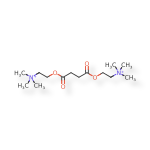
| Molecular Formula | C14H30N2O4.2I |
| Molecular Weight | 544.2079 |
| Optical Activity | NONE |
| Defined Stereocenters | 0 / 2 |
| E/Z Centers | 0 |
| Charge | 0 |
SHOW SMILES / InChI
SMILES
[I-].[I-].C[N+](C)(C)CCOC(=O)CCC(=O)OCC[N+](C)(C)C
InChI
InChIKey=QMJHHGXCWYZSBV-UHFFFAOYSA-L
InChI=1S/C14H30N2O4.2HI/c1-15(2,3)9-11-19-13(17)7-8-14(18)20-12-10-16(4,5)6;;/h7-12H2,1-6H3;2*1H/q+2;;/p-2
| Molecular Formula | C14H30N2O4 |
| Molecular Weight | 290.399 |
| Charge | 2 |
| Count |
|
| Stereochemistry | MIXED |
| Additional Stereochemistry | No |
| Defined Stereocenters | 0 / 2 |
| E/Z Centers | 0 |
| Optical Activity | NONE |
| Molecular Formula | HI |
| Molecular Weight | 127.91241 |
| Charge | 0 |
| Count |
|
| Stereochemistry | ACHIRAL |
| Additional Stereochemistry | No |
| Defined Stereocenters | 0 / 0 |
| E/Z Centers | 0 |
| Optical Activity | NONE |
Succinylcholine also known as suxamethonium is a quaternary skeletal muscle relaxant usually used in the form of its halogen salt. It is is indicated under brand name anectine as an adjunct to general anesthesia, to facilitate tracheal intubation, and to provide skeletal muscle relaxation during surgery or mechanical ventilation. Succinylcholine activates the muscle-type nicotinic acetylcholine receptor followed by desensitization. Succinylcholine does not inhibit the presynaptic alpha3beta2 autoreceptor at clinically relevant concentrations, that provides a possible mechanistic explanation for the typical lack of tetanic fade in succinylcholine-induced neuromuscular blockade. Finally, was explored, that cardiovascular side effects (e.g., tachyarrhythmias) of succinylcholine were not mediated via direct activation of the autonomic ganglionic alpha3beta4 subtype because succinylcholine didn’t not activate the neuronal nicotinic acetylcholine receptor (nAChR) subtypes.
Originator
Approval Year
Targets
| Primary Target | Pharmacology | Condition | Potency |
|---|---|---|---|
Target ID: CHEMBL2362997 |
Conditions
| Condition | Modality | Targets | Highest Phase | Product |
|---|---|---|---|---|
| Palliative | ANECTINE Approved UseSuccinylcholine chloride is indicated as an adjunct to general anesthesia, to facilitate tracheal intubation, and to provide skeletal muscle relaxation during surgery or mechanical ventilation. Launch Date1952 |
AUC
| Value | Dose | Co-administered | Analyte | Population |
|---|---|---|---|---|
18.5 μg × min/mL EXPERIMENT https://pubmed.ncbi.nlm.nih.gov/14564614/ |
1 mg/kg bw single, intravenous dose: 1 mg/kg bw route of administration: Intravenous experiment type: SINGLE co-administered: |
SUCCINYLCHOLINE plasma | Homo sapiens population: UNHEALTHY age: ADULT sex: FEMALE / MALE food status: UNKNOWN |
|
58.6 μg × min/mL EXPERIMENT https://pubmed.ncbi.nlm.nih.gov/14564614/ |
2 mg/kg bw single, intravenous dose: 2 mg/kg bw route of administration: Intravenous experiment type: SINGLE co-administered: |
SUCCINYLCHOLINE plasma | Homo sapiens population: UNHEALTHY age: ADULT sex: FEMALE / MALE food status: UNKNOWN |
T1/2
| Value | Dose | Co-administered | Analyte | Population |
|---|---|---|---|---|
25.4 s EXPERIMENT https://pubmed.ncbi.nlm.nih.gov/14564614/ |
1 mg/kg bw single, intravenous dose: 1 mg/kg bw route of administration: Intravenous experiment type: SINGLE co-administered: |
SUCCINYLCHOLINE plasma | Homo sapiens population: UNHEALTHY age: ADULT sex: FEMALE / MALE food status: UNKNOWN |
|
26.3 s EXPERIMENT https://pubmed.ncbi.nlm.nih.gov/14564614/ |
2 mg/kg bw single, intravenous dose: 2 mg/kg bw route of administration: Intravenous experiment type: SINGLE co-administered: |
SUCCINYLCHOLINE plasma | Homo sapiens population: UNHEALTHY age: ADULT sex: FEMALE / MALE food status: UNKNOWN |
Doses
| Dose | Population | Adverse events |
|---|---|---|
1.5 mg/kg single, intravenous Higher than recommended Dose: 1.5 mg/kg Route: intravenous Route: single Dose: 1.5 mg/kg Sources: |
healthy, 31 |
|
1.1 mg/kg single, intravenous Recommended Dose: 1.1 mg/kg Route: intravenous Route: single Dose: 1.1 mg/kg Sources: |
unhealthy Health Status: unhealthy Sources: |
Disc. AE: Rhabdomyolysis, Ventricular arrhythmia... AEs leading to discontinuation/dose reduction: Rhabdomyolysis (acute, rare) Sources: Ventricular arrhythmia (rare) Cardiac arrest (grade 5, rare) |
AEs
| AE | Significance | Dose | Population |
|---|---|---|---|
| Rhabdomyolysis | acute, rare Disc. AE |
1.1 mg/kg single, intravenous Recommended Dose: 1.1 mg/kg Route: intravenous Route: single Dose: 1.1 mg/kg Sources: |
unhealthy Health Status: unhealthy Sources: |
| Cardiac arrest | grade 5, rare Disc. AE |
1.1 mg/kg single, intravenous Recommended Dose: 1.1 mg/kg Route: intravenous Route: single Dose: 1.1 mg/kg Sources: |
unhealthy Health Status: unhealthy Sources: |
| Ventricular arrhythmia | rare Disc. AE |
1.1 mg/kg single, intravenous Recommended Dose: 1.1 mg/kg Route: intravenous Route: single Dose: 1.1 mg/kg Sources: |
unhealthy Health Status: unhealthy Sources: |
PubMed
| Title | Date | PubMed |
|---|---|---|
| Succinylcholine in the intensive care unit. | 2002-01 |
|
| B-lymphocytes from malignant hyperthermia-susceptible patients have an increased sensitivity to skeletal muscle ryanodine receptor activators. | 2001-12-21 |
|
| Neuromuscular blockers in surgery and intensive care, Part 2. | 2001-12-15 |
|
| Why do we still use suxamethonium for caesarean section? | 2001-12 |
|
| Analysis of mutations in the plasma cholinesterase gene of patients with a history of prolonged neuromuscular block during anesthesia. | 2001-12 |
|
| The laryngeal mask airway is effective (and probably safe) in selected healthy parturients for elective Cesarean section: a prospective study of 1067 cases. | 2001-12 |
|
| Intubating trauma patients before reaching hospital -- revisited. | 2001-12 |
|
| The effect of rocuronium on intraocular pressure: a comparison with succinylcholine. | 2001-12 |
|
| Intralingual succinylcholine injection provides a rapid onset of muscle relaxation in an emergency. | 2001-12 |
|
| A randomized multicenter study of remifentanil compared with halothane in neonates and infants undergoing pyloromyotomy. I. Emergence and recovery profiles. | 2001-12 |
|
| [Pseudocholinesterase (ChE)]. | 2001-11 |
|
| Retrospective analysis of drug-induced urticaria and angioedema: a survey of 2287 patients. | 2001-11 |
|
| Rapid sequence induction: a national survey of practice. | 2001-11 |
|
| Is succinylcholine appropriate or obsolete in the intensive care unit? | 2001-10 |
|
| Goal oriented general anesthesia for Cesarean section in a parturient with a large intracranial epidermoid cyst. | 2001-10 |
|
| The substitute for the intravenous route. | 2001-10 |
|
| Intramuscular succinylcholine and laryngospasm. | 2001-10 |
|
| Basotest and suxamethonium allergy. | 2001-10 |
|
| [Anesthesia for electroconvulsive therapy during pregnancy--a case report]. | 2001-09 |
|
| Hyperkalaemic cardiac arrest in a manifesting carrier of Duchenne muscular dystrophy following general anaesthesia. | 2001-09 |
|
| Autosomal dominant canine malignant hyperthermia is caused by a mutation in the gene encoding the skeletal muscle calcium release channel (RYR1). | 2001-09 |
|
| Different patterns of mast cell activation by muscle relaxants in human skin. | 2001-09 |
|
| In patients with head injuries who undergo rapid sequence intubation using succinylcholine, does pretreatment with a competitive neuromuscular blocking agent improve outcome? A literature review. | 2001-09 |
|
| Are fade and sustained post-tetanic facilitation characteristics of typical succinylcholine-induced block? | 2001-09 |
|
| Giant multimodal heart motoneurons of Achatina fulica: a new cardioregulatory input in pulmonates. | 2001-08 |
|
| [Anesthetic management of a patient with a history of acute intermittent porphyria and an elevation of urinary porphobilinogen]. | 2001-08 |
|
| Tracheal intubation without muscle relaxant--a technique using sevoflurane vital capacity induction and alfentanil. | 2001-08 |
|
| Increased sensitivity to depolarization and nondepolarizing neuromuscular blocking agents in young rat hemidiaphragms. | 2001-08 |
|
| Safety and efficacy of rocuronium for controlled intubation with paralytics in the pediatric emergency department. | 2001-08 |
|
| The influence of fentanyl vs. s-ketamine on intubating conditions during induction of anaesthesia with etomidate and rocuronium. | 2001-08 |
|
| Effects of combined methohexitone-remifentanil anaesthesia in electroconvulsive therapy. | 2001-08 |
|
| [Short-term anesthesia to stop persistent hiccups]. | 2001-06-22 |
|
| Intramuscular ketamine in a parturient in whom pre-operative intravenous access was not possible. | 2001-06 |
|
| Facilitation of fiberoptic nasotracheal intubation by simultaneous direct laryngoscopy in anesthetized patients. | 2001-06 |
|
| Asystole during electroconvulsive therapy: a case report. | 2001-06 |
|
| Malignant hyperthermia in a patient with Graves' disease during subtotal thyroidectomy. | 2001-04 |
|
| Military and civilian penetrating eye trauma: anesthetic implications. | 2001-02 |
|
| Interactions of neuromuscular blocking drugs. | 2001 |
|
| Rapacuronium: first experience in clinical practice. | 2001 |
|
| Rapacuronium: clinical pharmacology. | 2001 |
|
| Choice of the muscle relaxant for rapid-sequence induction. | 2001 |
|
| Choice of the hypnotic and the opioid for rapid-sequence induction. | 2001 |
|
| Muscle relaxants in paediatric day case surgery. | 2001 |
|
| Muscle relaxants suitable for day case surgery. | 2001 |
|
| [Clinical administration of muscle relaxants for intubation]. | 2001 |
|
| Difficult airway management of a child impaled through the neck. | 2001 |
|
| Cardiac arrest related to anesthesia. Contributing factors in infants and children. | 1975-07-21 |
|
| Response of the newborn to succinlycholine injection in homozygotic atypical mothers. | 1975-07 |
|
| Comparison of gallamine with d-tubocurarine effects on fasciculations after succinylcholine. | 1975-01-01 |
|
| "Precurarization" using pancuronium. | 1975-01-01 |
Patents
Sample Use Guides
Adults: For Short Surgical Procedures: the average dose required to produce neuromuscular blockade and to facilitate tracheal intubation is 0.6 mg/kg ANECTINE (Succinylcholine Chloride Injection) given intravenously. The optimum dose will vary among individuals and may be from 0.3 to 1.1 mg/kg for adults. Following administration of doses in this range, neuromuscular blockade develops in about 1 minute; maximum blockade may persist for about 2 minutes, after which recovery takes place within 4 to 6 minutes. However, very large doses may result in more prolonged blockade. A 5- to 10-mg test dose may be used to determine the sensitivity of the patient and the individual recovery time (see PRECAUTIONS). For Long Surgical Procedures The dose of succinylcholine administered by infusion depends upon the duration of the surgical procedure and the need for muscle relaxation. The average rate for an adult ranges between 2.5 and 4.3 mg per minute. Solutions containing from 1 to 2 mg per mL succinylcholine have commonly been used for continuous infusion. The more dilute solution (1 mg per mL) is probably preferable from the standpoint of ease of control of the rate of administration of the drug and, hence, of relaxation. This IV solution containing 1 mg per mL may be administered at a rate of 0.5 mg (0.5 mL) to 10 mg (10 mL) per minute to obtain the required amount of relaxation. Intermittent IV injections of succinylcholine may also be used to provide muscle relaxation for long procedures. An IV injection of 0.3 to 1.1 mg/kg may be given initially, followed, at appropriate intervals, by further injections of 0.04 to 0.07 mg/kg to maintain the degree of relaxation required.
Pediatrics: for emergency tracheal intubation or in instances where immediate securing of the airway is necessary, the IV dose of succinylcholine is 2 mg/kg for infants and small children; for older children and adolescents the dose is 1 mg/kg. Rarely, IV bolus administration of succinylcholine in infants and children may result in malignant ventricular arrhythmias and cardiac arrest secondary to acute rhabdomyolysis with hyperkalemia. In such situations, an underlying myopathy should be suspected. Intravenous bolus administration of succinylcholine in infants or children may result in profound bradycardia or, rarely, asystole. As in adults, the incidence of bradycardia in children is higher
Intramuscular Use: If necessary, succinylcholine may be given intramuscularly to infants, older children, or adults when a suitable vein is inaccessible. A dose of up to 3 to 4 mg/kg may be given, but not more than 150 mg total dose should be administered by this route. The onset of effect of succinylcholine given intramuscularly is usually observed in about 2 to 3 minutes.
Route of Administration:
Other
The rat diaphragm was used as an in vitro model for studies of contractures synergistically-induced by halothane and suxamethonium (succinylcholine). The effects of three agents reported to inhibit phospholipase A2 activity (quinacrine, spermine and indomethacin), tubocurarine and dantrolene were examined on these contractures. Contractures induced by 1% halothane (0.26 +/- 0.02 g) (mean +/- SEM) were increased (0.60 +/- 0.04 g) if suxamethonium 50 mmol litre-1 was also in the bathing medium. Suxamethonium-induced contractures (0.22 +/- 0.03 g) were also enhanced when halothane was present (0.51 +/- 0.03 g). Spermine, indomethacin and dantrolene antagonized both halothane- and suxamethonium-induced contractures. Quinacrine potentiated contractures induced by either halothane or suxamethonium. Contractures induced by suxamethonium were antagonized by tubocurarine; however, contractures induced by halothane were not antagonized by tubocurarine. These results suggest that free fatty acids may be involved in contractures induced synergistically by halothane and suxamethonium. Different mechanisms are involved in the induction of contractures by suxamethonium than by halothane.
| Substance Class |
Chemical
Created
by
admin
on
Edited
Mon Mar 31 18:45:46 GMT 2025
by
admin
on
Mon Mar 31 18:45:46 GMT 2025
|
| Record UNII |
PG6H2852BK
|
| Record Status |
Validated (UNII)
|
| Record Version |
|
-
Download
| Name | Type | Language | ||
|---|---|---|---|---|
|
Common Name | English | ||
|
Preferred Name | English | ||
|
Code | English | ||
|
Common Name | English | ||
|
Systematic Name | English | ||
|
Common Name | English |
| Code System | Code | Type | Description | ||
|---|---|---|---|---|---|
|
SUB04655MIG
Created by
admin on Mon Mar 31 18:45:46 GMT 2025 , Edited by admin on Mon Mar 31 18:45:46 GMT 2025
|
PRIMARY | |||
|
208-770-1
Created by
admin on Mon Mar 31 18:45:46 GMT 2025 , Edited by admin on Mon Mar 31 18:45:46 GMT 2025
|
PRIMARY | |||
|
m10277
Created by
admin on Mon Mar 31 18:45:46 GMT 2025 , Edited by admin on Mon Mar 31 18:45:46 GMT 2025
|
PRIMARY | Merck Index | ||
|
DTXSID90877662
Created by
admin on Mon Mar 31 18:45:46 GMT 2025 , Edited by admin on Mon Mar 31 18:45:46 GMT 2025
|
PRIMARY | |||
|
541-19-5
Created by
admin on Mon Mar 31 18:45:46 GMT 2025 , Edited by admin on Mon Mar 31 18:45:46 GMT 2025
|
PRIMARY | |||
|
100000091109
Created by
admin on Mon Mar 31 18:45:46 GMT 2025 , Edited by admin on Mon Mar 31 18:45:46 GMT 2025
|
PRIMARY | |||
|
PG6H2852BK
Created by
admin on Mon Mar 31 18:45:46 GMT 2025 , Edited by admin on Mon Mar 31 18:45:46 GMT 2025
|
PRIMARY | |||
|
221197
Created by
admin on Mon Mar 31 18:45:46 GMT 2025 , Edited by admin on Mon Mar 31 18:45:46 GMT 2025
|
PRIMARY | |||
|
68325
Created by
admin on Mon Mar 31 18:45:46 GMT 2025 , Edited by admin on Mon Mar 31 18:45:46 GMT 2025
|
PRIMARY | |||
|
262295
Created by
admin on Mon Mar 31 18:45:46 GMT 2025 , Edited by admin on Mon Mar 31 18:45:46 GMT 2025
|
PRIMARY | RxNorm |
| Related Record | Type | Details | ||
|---|---|---|---|---|
|
|
PARENT -> SALT/SOLVATE |
| Related Record | Type | Details | ||
|---|---|---|---|---|
|
|
ACTIVE MOIETY |